](https://deep-paper.org/en/paper/2503.18803/images/cover.png)
Change detection is one of the most fundamental tasks in computer vision for remote sensing. Whether we are assessing damage after a natural disaster, monitoring urban expansion, or tracking deforestation, the core goal remains the same: compare two images taken at different times and identify what is different.
For years, the standard approach has been to treat this as a “Spot the Difference” game using static images. We take an image from Time A, an image from Time B, and ask a neural network to compare them.
But what if we’ve been looking at this wrong? What if, instead of comparing two static photos, we treated the pair as a video?
In this post, we will dive deep into Change3D, a novel framework presented by researchers from Wuhan University, the University of Hong Kong, and Bytedance. This paper proposes a paradigm shift: by viewing bi-temporal images as a “tiny video” and processing them with 3D video encoders, we can achieve state-of-the-art results with a fraction of the computational cost.
The Problem with the Current Paradigm
To understand why Change3D is such a breakthrough, we first need to look at how change detection is currently performed.
The “Siamese” Struggle
Most modern approaches use a Siamese Network architecture. Imagine you have two photos of the same city block, one from 2020 and one from 2024.
- Image Encoding: You pass the 2020 photo through a heavy neural network (like ResNet or a Transformer) to extract features. You do the exact same thing for the 2024 photo.
- Change Extraction: You take these two sets of features and feed them into a complex “Change Extractor” or “Fusion Module.” This module attempts to compare the features and figure out what changed.
- Decoding: Finally, a decoder creates a map highlighting the changes.
While this works, it has a major flaw: Inefficiency.
The image encoder is “task-agnostic.” It spends a massive amount of computational power describing everything in both images—the houses, the roads, the trees—without knowing that its only job is to find changes. It is only after this heavy lifting that the network starts looking for differences.
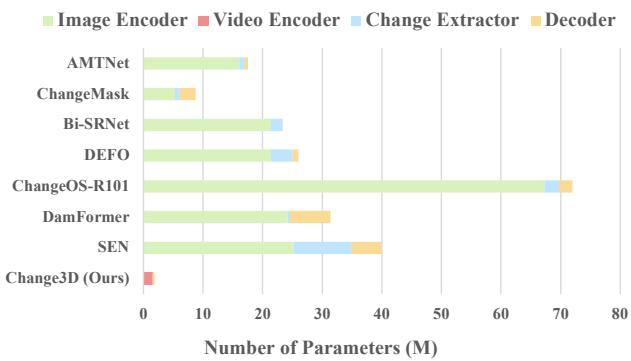
As shown in the figure above, existing methods (like ChangeOS or DamFormer) allocate the vast majority of their parameters (the green bars) to image encoding. Very little capacity (the blue bars) is actually dedicated to the core task of change extraction. This is a massive imbalance.
The Complexity Trap
Because the encoders process images independently, they don’t communicate during the feature extraction phase. To compensate for this, researchers have to design increasingly complex and heavy “Change Extractors” to stitch the information together later. This results in bloated models that are slow to run and difficult to adapt to different tasks (like captioning vs. detection).
The Change3D Solution: It’s Just a Video
The researchers behind Change3D asked a simple question: Why simulate a comparison between two static images when we have video models designed to understand motion and temporal changes?
They propose treating the bi-temporal image pair not as two independent inputs, but as a video sequence.
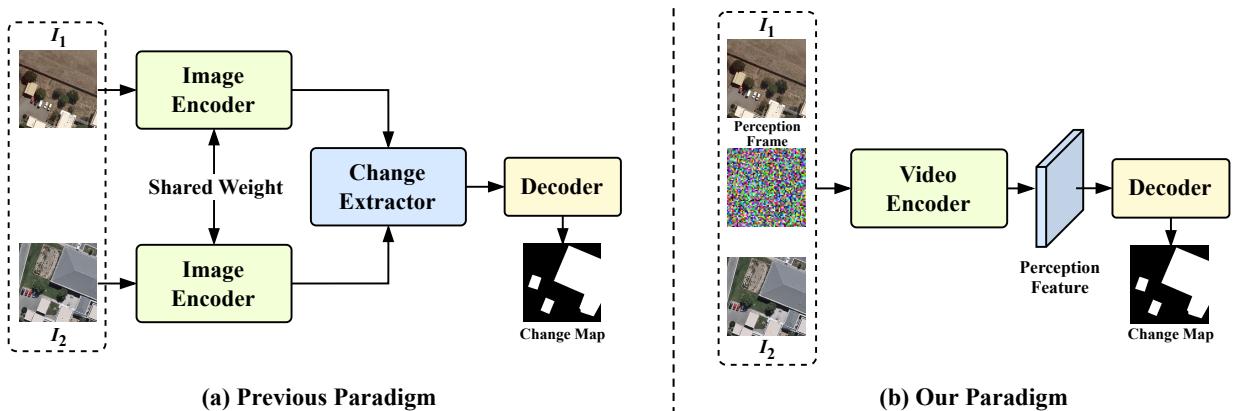
As visualized in Figure 2:
- (a) Previous Paradigm: Parallel processing of images, followed by a complex interaction step.
- (b) Our Paradigm (Change3D): The images are stacked together into a sequence. A video encoder processes them simultaneously, allowing the network to “see” the change as it happens across the temporal dimension.
The Secret Ingredient: The Perception Frame
You might be wondering: “A video of two frames is very short. How does the model effectively capture the transition?”
This is where the authors introduce a brilliant concept called the Perception Frame.
Instead of just feeding the model \(\{Image_1, Image_2\}\), they insert a learnable frame, denoted as \(I_P\), in the middle. The input becomes a sequence of three frames:
\[ \text{Input} = [I_1, I_P, I_2] \]Think of the Perception Frame as a blank canvas or a “query” token in a Transformer. As the 3D video encoder processes the sequence, it allows information to flow from the first image, through the perception frame, to the second image. The perception frame essentially “absorbs” the differential information.

In this equation, \(\mathcal{F}_{\mathrm{enc}}\) is a standard video encoder (like X3D or SlowFast). The symbol \(\bigodot\) represents concatenation along the time dimension. The model processes this volume and outputs features that inherently contain information about the changes.
A Unified Framework for All Tasks
One of the most impressive aspects of Change3D is its versatility. In the past, you might need a specific architecture for Binary Change Detection (Did something change? Yes/No) and a completely different one for Change Captioning (Describe what changed in text).
Because Change3D relies on a generalized video encoder, it can handle four distinct tasks using the same core backbone.
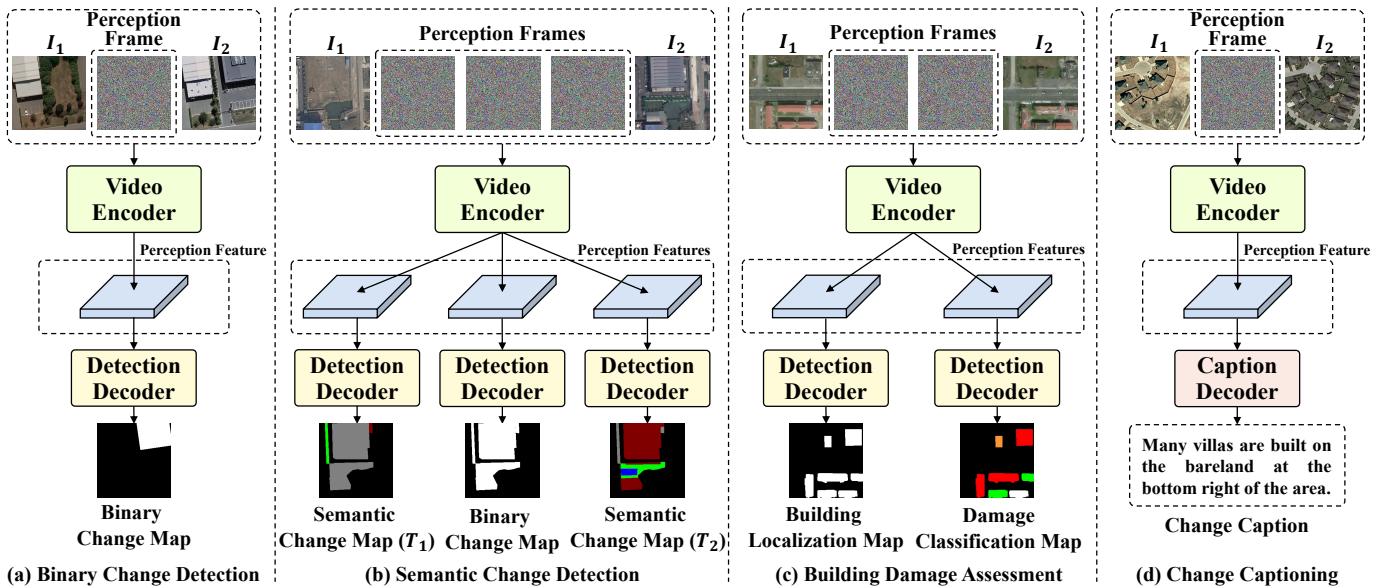
Let’s break down how it handles these different objectives, as shown in Figure 3:
- Binary Change Detection (BCD): We insert one perception frame. The video encoder extracts features, and a simple decoder predicts a mask showing where changes occurred.
- Semantic Change Detection (SCD): Here, we need to know what changed (e.g., “Forest” became “Urban”). We use three perception frames to capture the semantic state at Time 1, the semantic state at Time 2, and the binary difference.
- Building Damage Assessment (BDA): We need to find buildings and classify their damage level. Two perception frames are used: one for localization and one for damage classification.
- Change Captioning (CC): The perception frame absorbs visual changes, and a Transformer decoder translates those visual features into a natural language sentence (e.g., “New buildings appeared in the north”).
Detailed Architecture
The beauty of this approach lies in its simplicity. By offloading the “thinking” to a pre-trained video encoder (which is already good at understanding temporal dynamics), the rest of the architecture can remain lightweight.
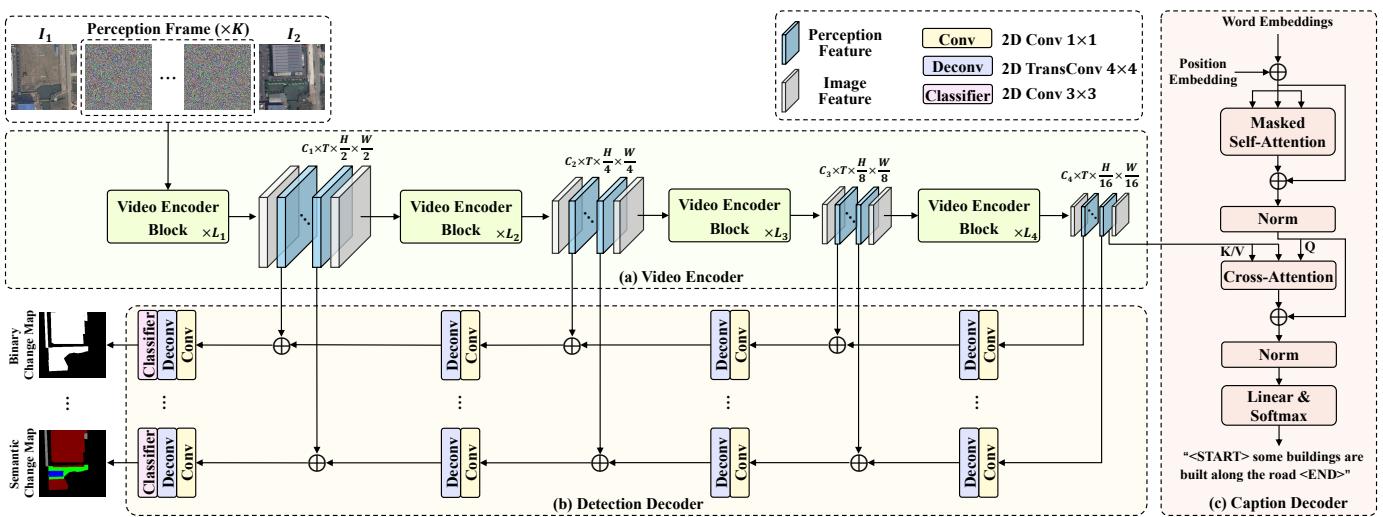
As detailed in Figure 6, the system consists of:
- The Video Encoder: This uses 3D convolutions. Unlike 2D convolutions that only slide over height and width, 3D convolutions slide over time as well. This means the model naturally mixes features from the “Before” image and the “After” image at every single layer of the network.
- The Decoders: Because the video encoder does such a good job extracting “perception features,” the decoders don’t need to be complex. For detection tasks, a simple lightweight convolutional decoder is used.

As shown above, the decoder essentially just upsamples the features and adds them together—no complex attention mechanisms or feature fusion modules required.
Why It Works: A Theoretical Perspective
The paper provides a compelling theoretical argument for why video modeling is superior to the Siamese approach.
In the standard approach (Previous Paradigm), the model tries to estimate the probability of a change output (\(O\)) based on independently extracted features (\(F_1\) and \(F_2\)). The mutual information—the measure of how much one variable tells you about another—is limited because \(F_1\) and \(F_2\) are created in isolation.
In the Change3D paradigm, the probability is conditioned on the entire sequence simultaneously:

By including the perception frame \(I_P\) and processing everything as a single block, the entropy (uncertainty) of the system is reduced.

Put simply: The video model is less “confused” because it sees the context of both images at the exact same time, rather than trying to remember one image while looking at the other.
Experiments and Results
Theory is great, but does it work in practice? The authors tested Change3D on eight standard benchmarks covering all four tasks. The results were remarkable, particularly regarding efficiency.
1. Binary Change Detection
On datasets like LEVIR-CD (building changes) and WHU-CD, Change3D outperformed massive, complex models.

Look at the #Params(M) column in the table above.
- The previous state-of-the-art, AMTNet, uses 16.44 Million parameters.
- ChangeFormer uses 41.03 Million.
- Change3D uses just 1.54 Million parameters.
Despite being 10x to 20x smaller, Change3D achieves higher F1 scores (91.82% on LEVIR-CD) and faster inference speeds. This is a game-changer for deploying these models on satellites or drones where hardware is limited.
2. Building Damage Assessment
This is a harder task requiring the model to distinguish between “Minor Damage,” “Major Damage,” and “Destroyed.”

Again, Change3D dominates efficiently. It uses only 6% of the parameters of PCDASNet and roughly 12% of the FLOPs (computational operations), yet it achieves the highest F1 scores across almost all damage categories.
3. Change Captioning
Can the model describe what it sees?
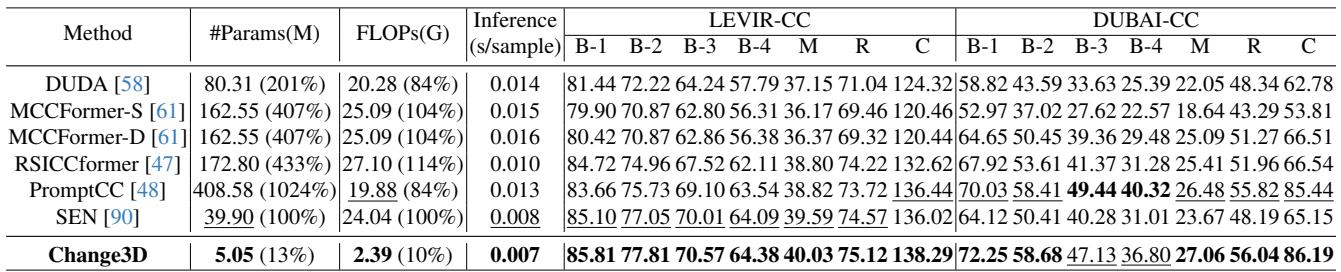
Using metrics like BLEU-4 and CIDEr (which measure how close the generated text is to human descriptions), Change3D sets a new standard. It is particularly good at understanding the context of changes, not just pixel differences.
Visualizing the “Brain” of the Model
To prove that the video encoder is actually learning to “see” changes, the authors visualized the attention maps—essentially, where the model is looking.

In Figure 4, look at the column \(F_C\) (the perception features).
- GASNet and AMTNet (rows 1 and 2) show somewhat messy activations.
- Change3D (bottom row) shows incredibly sharp, focused attention on exactly the areas that changed (the building footprints). This confirms that the 3D convolutions are effectively filtering out the background noise (unchanged roads, trees, grass) and focusing solely on the temporal differences.
Qualitative Results
Let’s look at the final outputs.
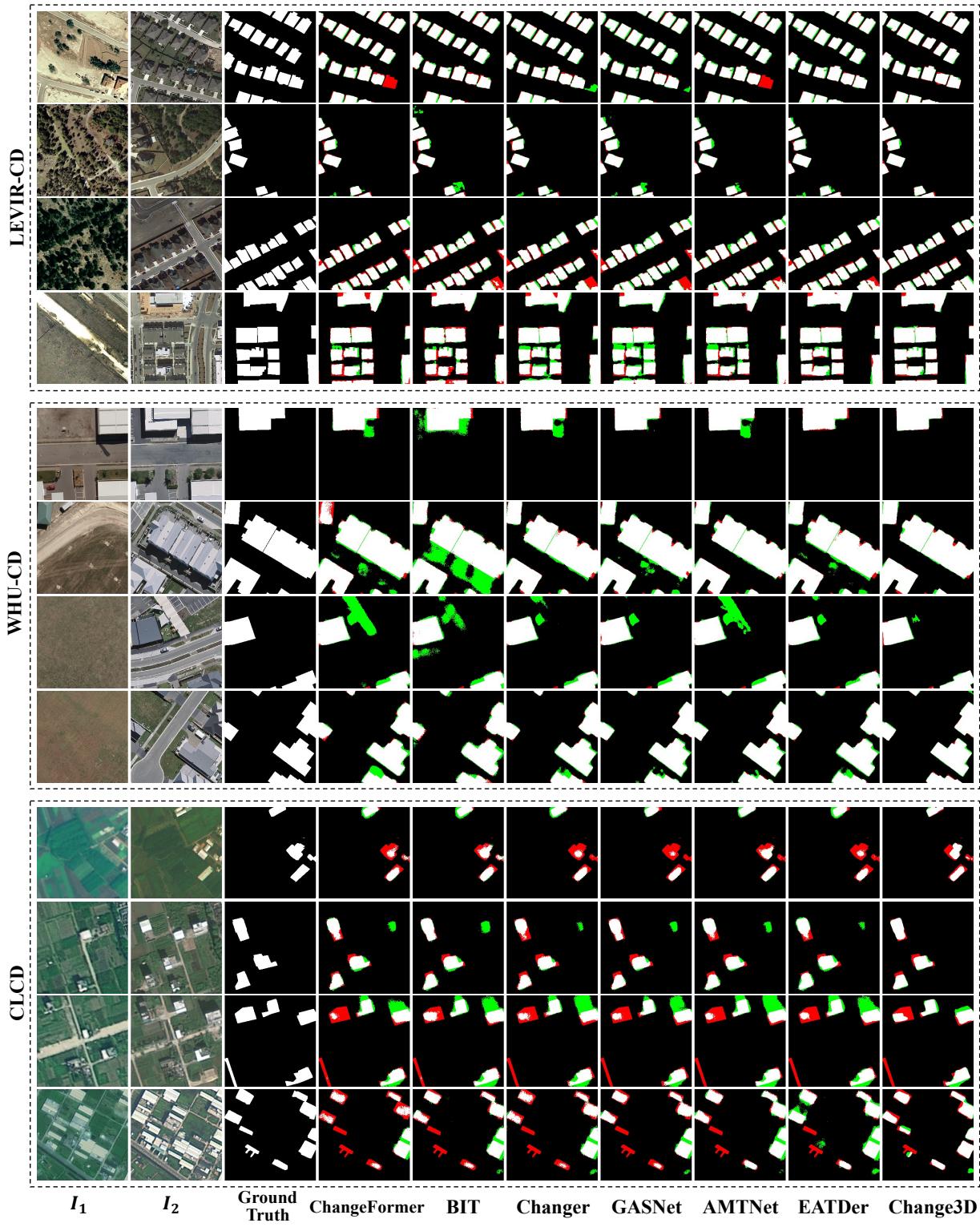
Binary Detection: In the image below, white pixels represent correctly detected changes. Red pixels are missed changes. You can see Change3D produces crisp, clean masks with very few errors compared to competitors like EATDer.
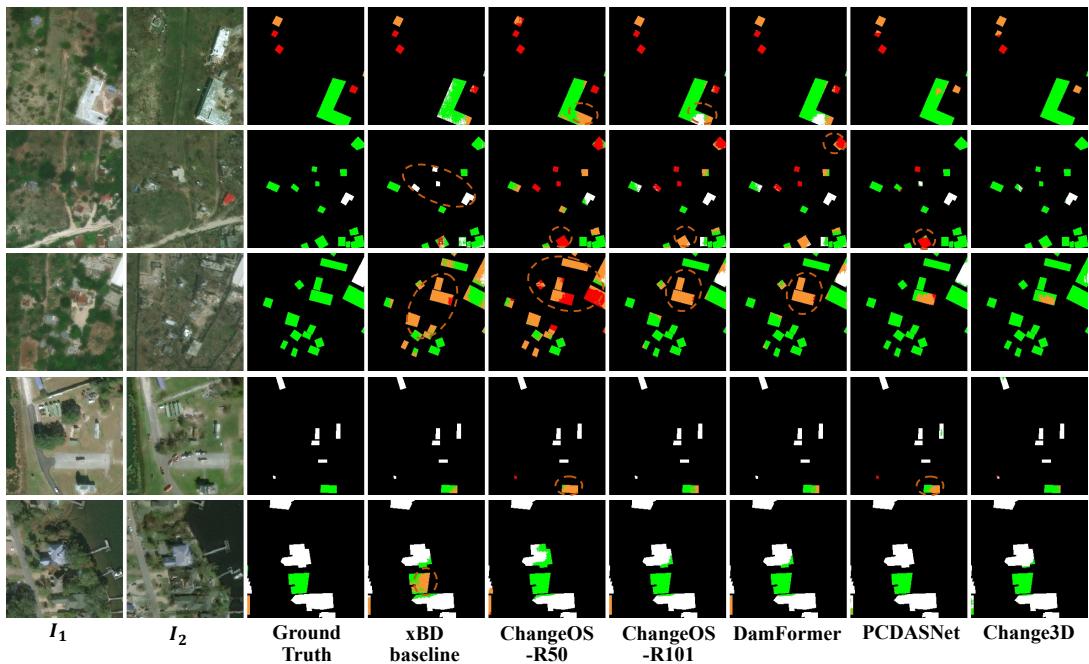
Damage Assessment: Here, the model must classify damage severity (Green=Minor, Orange=Major, Red=Destroyed). Change3D aligns very closely with the Ground Truth, accurately identifying destroyed structures that other models miss.
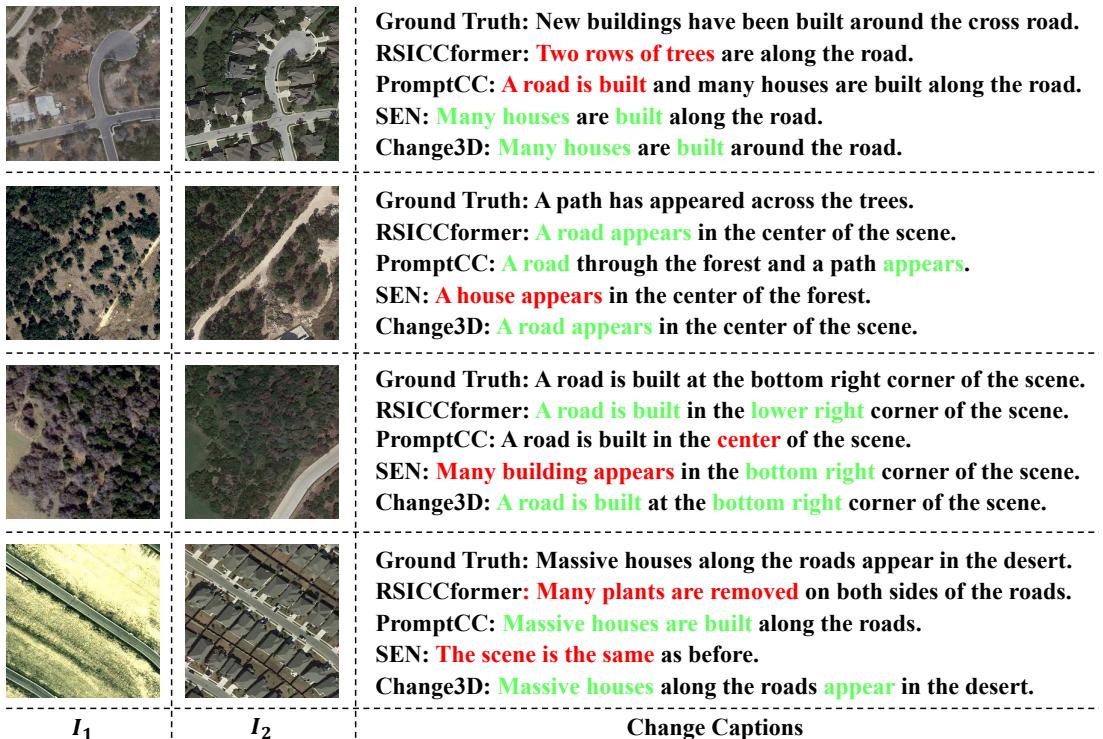
Change Captioning: The captions generated by Change3D are contextually accurate. While other models might hallucinate objects, Change3D correctly identifies “Massive houses along the roads appear in the desert.”
Why Efficiency Matters
The massive reduction in parameters (up to 94% reduction) isn’t just a vanity metric.
- Satellite Edge Computing: We often want to process data in orbit to save bandwidth. Sending huge models to space is hard; sending Change3D is feasible.
- Disaster Response: When analyzing damage after an earthquake, time is critical. A model that runs faster and requires less GPU memory can process entire cities in minutes rather than hours.
Conclusion
Change3D represents a “back to basics” moment for remote sensing. Instead of building increasingly complex networks to force-feed interactions between static images, the authors realized that change is inherently a temporal process.
By treating bi-temporal images as a tiny video and using a learnable perception frame, they unlocked the power of 3D video encoders. The result is a unified framework that is faster, lighter, and more accurate than the complex 2D architectures that came before it.
This paper serves as a reminder to researchers: sometimes the best way to solve a problem isn’t to build a bigger hammer, but to change your perspective on what the nail looks like. In this case, looking at “images” as “video” changed everything.
Data Source: The analysis and images in this post are based on the paper Change3D: Revisiting Change Detection and Captioning from a Video Modeling Perspective by Zhu et al. (2023).