](https://deep-paper.org/en/paper/2503.19145/images/cover.png)
Introduction: The Complexity of “Simple” Description
In computer vision, identifying an object—say, a “car”—is a problem that has largely been solved. We have robust models that can spot a car in a crowded street with high accuracy. But what if we want to go deeper? What if we need to know if the car is rusty, wet, metallic, or vintage?
This is the challenge of Attribute Detection. Unlike object classification, which deals with concrete nouns, attribute detection deals with adjectives. These properties shape how we perceive the world, but they are notoriously difficult for AI models to grasp.
Why? Because attributes are inherently ambiguous and compositional.
Consider the image below. If asked to describe the goat on the left, one annotator might say it is “brown,” while another might insist it is a specific shade of “reddish-brown.” One might focus on the “twisted horns,” while another focuses on the “spotted pattern.”
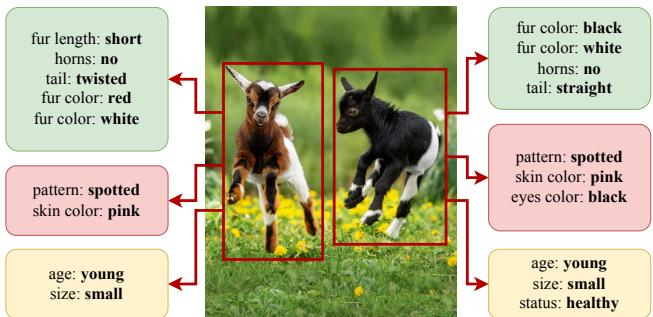
As shown in Figure 1, manual annotations are often sparse, incomplete, and subjective. Training a model on such data often leads to biases. For example, if a model is only trained on “red apples,” it might struggle to recognize a “red car.”
Furthermore, the standard approach—training a massive model on a fixed list of attributes—limits scalability. If you want your robot to recognize a “dusty” surface, but “dusty” wasn’t in the training set, you are out of luck.
This brings us to COMCA (Compositional Caching), a novel method introduced by researchers from the University of Trento and Cisco Research. COMCA is a training-free approach for open-vocabulary attribute detection. It doesn’t require labor-intensive labeling or expensive re-training. Instead, it leverages the power of Vision-Language Models (VLMs) and a clever “caching” mechanism to understand the complex, compositional nature of objects and their attributes.
In this post, we will deconstruct how COMCA works, why it outperforms existing baselines, and how it solves the problem of detecting attributes in the wild.
Background: Vision-Language Models and Caching
Before diving into the mechanics of COMCA, we need to establish two foundational concepts: Vision-Language Models (VLMs) and Cache-based Adaptation.
Vision-Language Models (VLMs)
Models like CLIP (Contrastive Language-Image Pre-training) have revolutionized computer vision. CLIP consists of two encoders: one for text (\(f_t\)) and one for images (\(f_v\)). It is trained to map images and their corresponding captions to the same point in a high-dimensional vector space.
Mathematically, the similarity between an image \(x\) and a class name \(c\) is calculated using cosine similarity:

If the vectors point in the same direction, the score is high. This allows CLIP to perform zero-shot detection: it can recognize categories it hasn’t explicitly seen during training, provided you can describe them in text.
Cache-based Adaptation
While CLIP is powerful, it is a generalist. To adapt it to specific tasks without retraining the whole model, researchers use caching.
Imagine a cache as a “cheat sheet.” If you want to classify dog breeds, you might retrieve a few hundred reference images of distinct breeds and store their feature vectors in a key-value cache (where the key is the image feature, and the value is the label).
When a new test image arrives, the model compares it not just to the text description “Golden Retriever,” but also to the visual features of the stored reference images in the cache. This refinement process is mathematically expressed as:

Here, the model calculates the similarity between the input image \(x\) and the cached images \(x_c\). This helps the model align the input with known visual examples.
The Problem with Standard Caching for Attributes
Standard caching works great for objects (nouns). It fails, however, for attributes (adjectives).
If you build a cache for the attribute “round,” you might populate it with oranges, basketballs, and coins. If you then feed the model an image of a “round table,” the visual features might not align well with an orange or a coin, even though they share the attribute “round.”
Attributes are compositional. They do not exist in a vacuum; they modify objects. Furthermore, a single image contains many attributes. A “red car” is also “shiny,” “metallic,” “opaque,” and “fast.” Standard caching assigns a single “hard” label to an image (e.g., this image = “red”), ignoring all other co-occurring attributes.
COMCA solves this by introducing Compositional Caching.
The Core Method: COMCA
COMCA’s philosophy is built on two principles:
- Context Matters: Not all attributes apply to all objects (you can have a “ripe kiwi” but not a “ripe car”).
- Multiplicity: Every object possesses multiple attributes simultaneously.
The architecture of COMCA is elegant but multi-staged. It creates a specialized cache on the fly, solely based on the list of attributes and objects you are interested in.
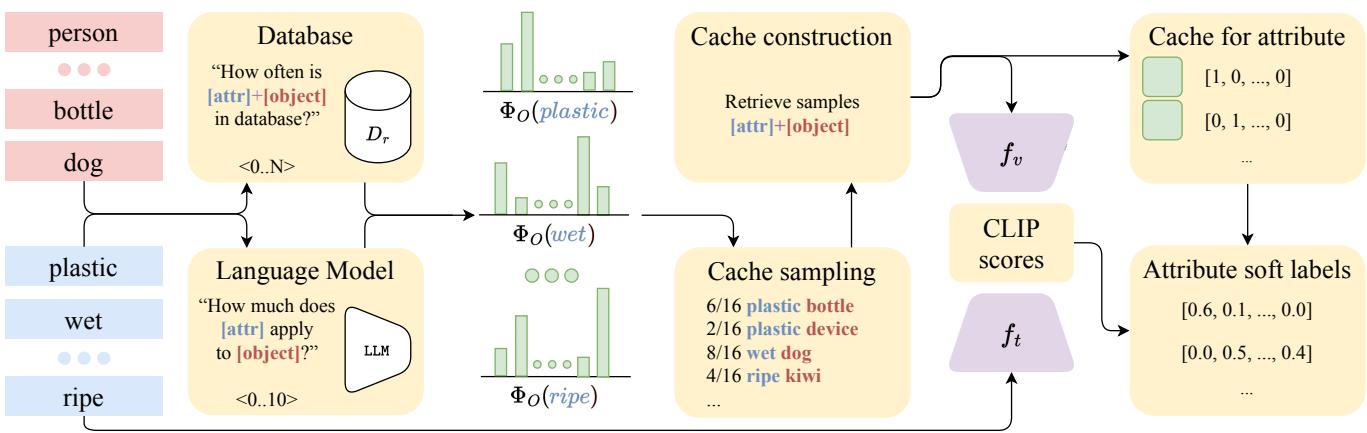
As illustrated in Figure 2, the pipeline involves estimating compatibility, constructing the cache, and refining labels. Let’s break this down step-by-step.
Step 1: Attribute-Object Compatibility
To build a useful cache, we first need to know which attribute-object pairs actually exist in the real world. Blindly pairing every attribute with every object creates noise (e.g., “transparent dog”).
COMCA estimates this compatibility using two sources of knowledge: Web-scale Databases and Large Language Models (LLMs).
Database Prior
The system queries a large image-text database (like CC12M). It counts how often an attribute \(a\) and an object \(o\) appear together in captions.

This gives a raw frequency count based on real-world data.
LLM Prior
Databases can be biased. Captions often mention “wet dog” but rarely “dry dog” (because the default state is dry). To counter this, COMCA queries an LLM (like GPT-3.5) to estimate the semantic likelihood of an attribute modifying an object.

Combining the Scores
These two scores are combined to create a robust probability distribution \(\Phi_O(a)\). This tells the system: “If I am looking for the attribute ripe, I should prioritize images of fruits rather than cars.”

Step 2: Scalable Cache Construction
Once the system knows which objects best represent a specific attribute, it populates the cache. It doesn’t just search for “round”; it searches for “round table,” “round orange,” and “round clock” based on the compatibility scores derived in Step 1.
The system samples \(K\) objects for each attribute based on the distribution \(\tilde{\Phi}_O(a)\). It then uses a retrieval function (T2I) to pull relevant images from the database.

The resulting cache is a collection of images that visually represent the attribute in varied, semantically relevant contexts.

Step 3: Soft Labeling (The “Secret Sauce”)
This is the most critical innovation in COMCA.
In traditional approaches, if an image of a “red car” is retrieved for the “red” category, it is assigned a label of [1, 0, 0…], meaning “this is red and nothing else.” But that image is also metallic, shiny, and opaque.
COMCA applies Soft Labeling. It acknowledges that every image in the cache likely exhibits multiple target attributes.
First, the system computes the similarity between the cached image \(x_c\) and the text embedding of every target attribute \(a\).

This generates a raw similarity score. However, raw VLM scores can be noisy or clustered in a small range. To make these scores useful, COMCA normalizes them using the statistics (mean \(\mu_C\) and standard deviation \(\sigma_C\)) of the entire cache.

This creates a probability distribution over all attributes for every image in the cache. Now, the “red car” in the cache contributes strongly to the “red” score, but it also contributes (appropriately) to the “metallic” and “shiny” scores during inference.
Step 4: Inference
At inference time, when a new image arrives, COMCA calculates two things:
- Standard Zero-Shot Score: The standard CLIP similarity.
- Refined Cache Score: The similarity between the input image and the cache images, weighted by the soft labels we just calculated.
The cache-based score is defined as:

Finally, these two components are blended using a hyperparameter \(\lambda\) to produce the final prediction:

This result is a training-free prediction that benefits from the specific visual evidence stored in the cache, properly weighted by the soft labels.
Experiments and Results
The researchers evaluated COMCA on two major benchmarks: OVAD (Open-Vocabulary Attribute Detection) and VAW (Visual Attributes in the Wild).
Quantitative Performance
The results show that COMCA significantly outperforms existing training-free methods and even competes with methods that require massive amounts of training data.
Let’s look at the comparison against state-of-the-art methods.
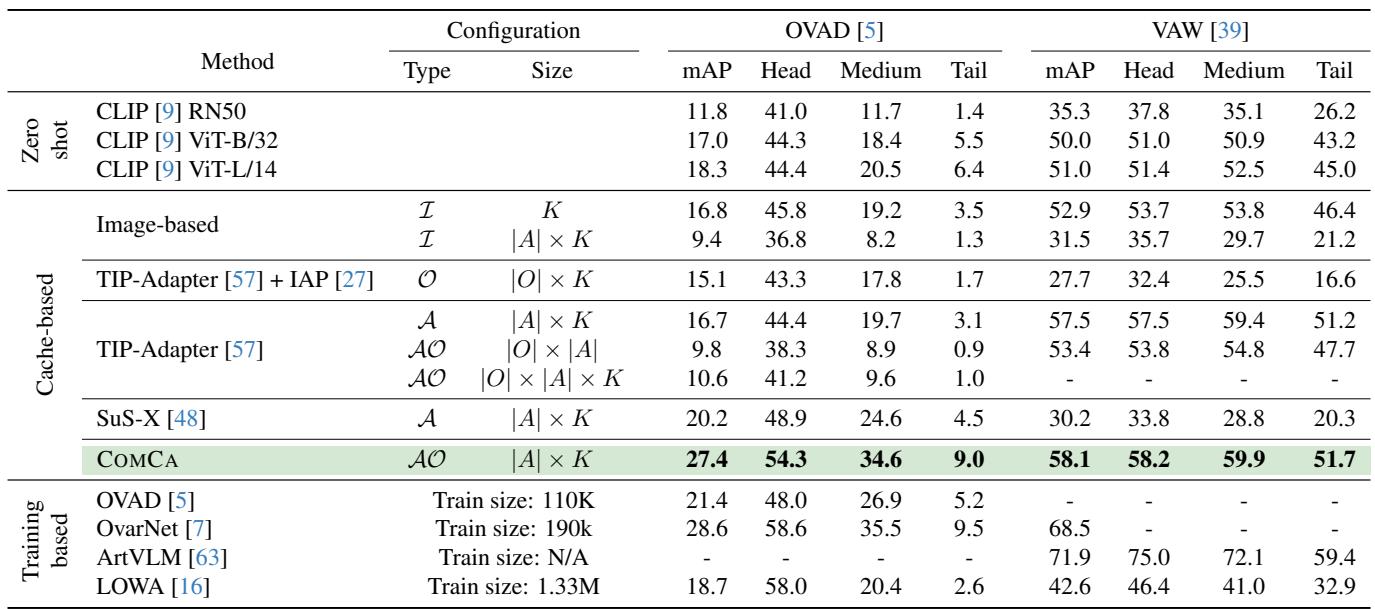
In Table 6 (an extended version of the main results), we see COMCA (highlighted in green) achieving 27.4 mAP on OVAD and 58.1 mAP on VAW.
- It beats the Image-based baseline (simple retrieval without the compositional logic).
- It beats TIP-Adapter and SuS-X, which are popular cache-based methods designed for object classification.
- Remarkably, it outperforms LOWA, a training-based method trained on 1.33 million samples, on the OVAD benchmark.
We also see COMCA’s versatility across different backbones. Whether using CLIP (RN50, ViT-B/32, ViT-L/14) or other models like CoCa or BLIP, COMCA consistently boosts performance over the baseline.

As shown above, applying COMCA on top of a CLIP ViT-L/14 backbone improves performance by +6.5 mAP on OVAD and +10.0 mAP on VAW. This proves the method is model-agnostic; it improves whatever VLM you plug into it.
The “Training-Free” Advantage
One of the strongest arguments for COMCA is its robustness to domain shifts. Training-based models often overfit to the biases of their training data. If you train on COCO attributes, the model learns “COCO-style” attributes.
Figure 4 illustrates this cross-dataset generalization perfectly.
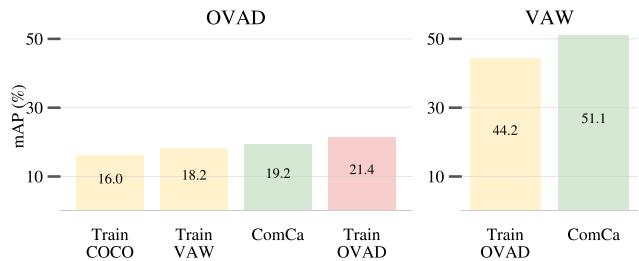
- Left Chart (OVAD): The yellow bars represent models trained on other datasets (like VAW or COCO) trying to predict on OVAD. Their performance drops significantly. The green bar (COMCA) holds its ground.
- Right Chart (VAW): Similarly, a model trained on OVAD performs poorly on VAW (red bar), while COMCA (green bar) excels.
Because COMCA builds its cache dynamically from the web/databases based on the target attributes, it doesn’t suffer from the “seen vs. unseen” bias inherent in fixed training sets.
Qualitative Analysis
Numbers are great, but does it actually work on images?
Figure 9 provides a qualitative comparison between OVAD (a training-based supervised model), standard CLIP, and COMCA.
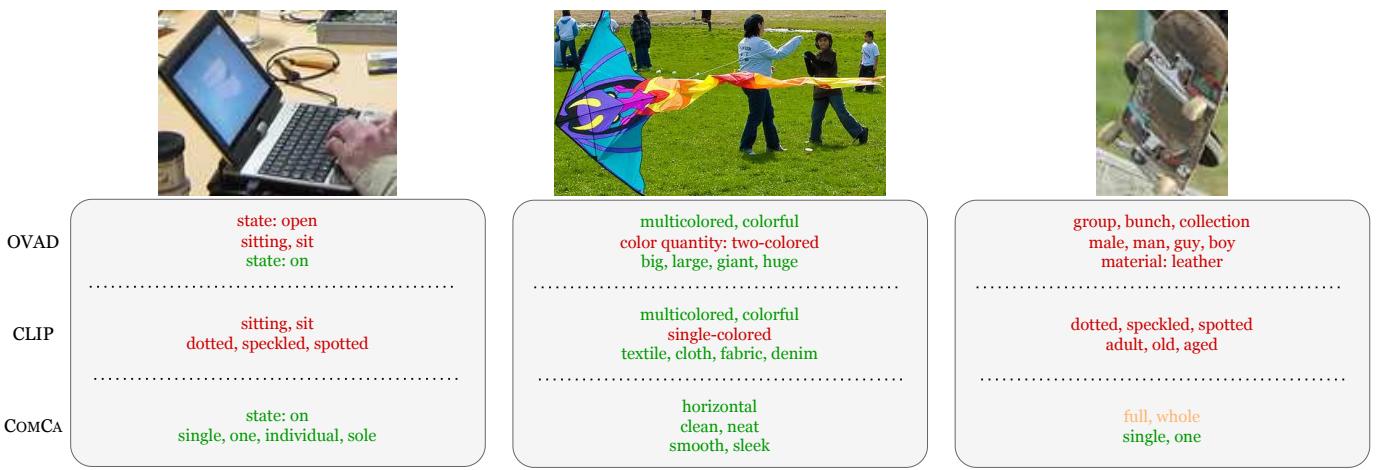
- Laptop (Left): OVAD suggests the material is “paper/cardboard” (incorrect). CLIP suggests “smooth.” COMCA correctly identifies “vertical/upright” and “two-colored.”
- Skateboard (Right): Notice the skateboard. Standard CLIP struggles with specific textures. COMCA identifies relevant attributes more accurately because its cache contains visually similar objects (skateboards) that share those specific attributes.
Ablation Studies: Proving the Components
To confirm that every part of COMCA is necessary, the authors performed ablation studies.
1. Does Soft Labeling Matter? Yes. Figure 6 shows the impact of soft labels (red/green bars) versus one-hot labels (yellow bars). Across all prior types (LLM vs Database), soft labeling provides a massive boost.

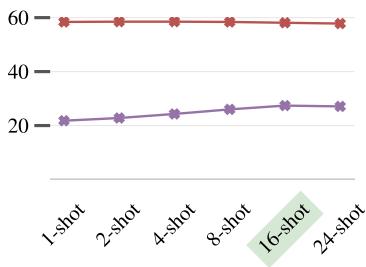
2. How many shots (samples) do we need? Figure 5 shows the performance as we increase \(K\) (samples per attribute). On OVAD (purple line), performance increases steadily up to 16 shots. On VAW (red line), performance is stable even with fewer shots because VAW has so many attributes that the cache naturally becomes dense and diverse very quickly.
Conclusion and Implications
COMCA represents a significant step forward in making computer vision systems more granular and descriptive without incurring the high costs of training.
By recognizing that attributes are compositional—they depend on the objects they modify and rarely appear in isolation—COMCA constructs a smarter “memory” for Vision-Language Models.
- It uses Compatibility to ensure the cache contains semantically sensible images.
- It uses Soft Labeling to ensure the rich, multi-attribute nature of those images is utilized.
The implications are broad. For robotics, image retrieval, and automated captioning, COMCA offers a way to detect nuanced properties (like “ripe,” “broken,” or “vintage”) in open-world settings, free from the constraints of fixed training datasets.
For students and researchers, COMCA serves as a masterclass in how to leverage the “frozen” knowledge of large foundation models. Rather than fine-tuning parameters, sometimes the best approach is to simply give the model better, more contextual reference materials.