](https://deep-paper.org/en/paper/2503.19207/images/cover.png)
Introduction
Imagine taking a few quick photos of yourself with your smartphone—front, back, maybe a side profile—and within seconds, having a fully 3D, digital double. Not just a static statue, but a fully rigged, animatable avatar wearing your exact clothes, ready to be dropped into a VR chatroom or a video game.
For years, this has been the “holy grail” of 3D computer vision. The reality, however, has been a trade-off between quality and speed. You could either have high-quality avatars generated in a studio with expensive camera rigs (photogrammetry), or you could use neural networks that require hours of optimization per person to learn how a specific t-shirt folds. Neither is scalable for everyday users.
A recent paper titled FRESA (Feedforward Reconstruction of Personalized Skinned Avatars) changes the game. It proposes a method to reconstruct personalized avatars in a “feed-forward” manner—meaning it runs instantly without needing to retrain the network for every new person.
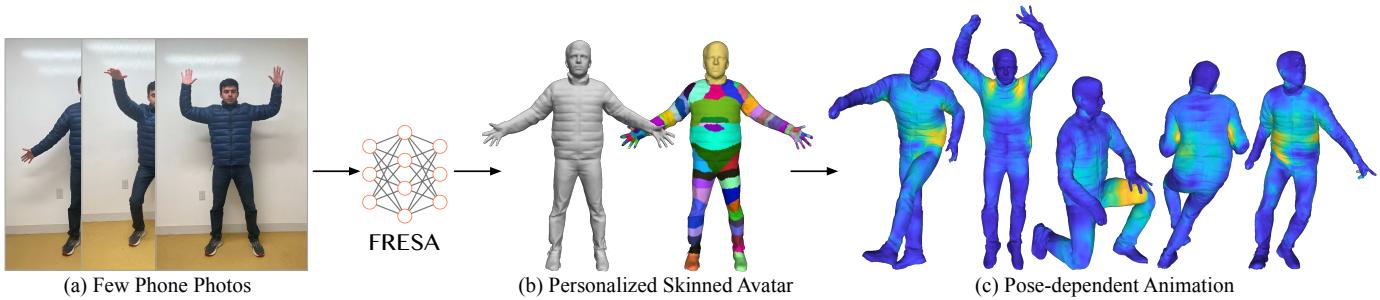
As shown above, FRESA takes casual phone photos and outputs a mesh that not only captures the geometry but is also ready to move. In this post, we are going to deconstruct how FRESA solves the hardest problems in digital human reconstruction: dealing with loose clothing, predicting how that clothing moves, and doing it all in under 20 seconds.
The Core Problem: Why is this hard?
To understand why FRESA is significant, we need to understand the limitations of current technology.
Most animatable avatars rely on Linear Blend Skinning (LBS). This is the standard animation technique where a 3D mesh is controlled by an underlying skeleton. Each vertex on the skin follows one or more bones based on “skinning weights.”
The problem arises when we move from naked bodies (which are easy to model) to clothed humans.
- Topology: A person in a dress has a radically different shape than a person in jeans. Standard body templates (like SMPL) don’t account for this.
- Skinning: If you attach a skirt vertex to the “Left Thigh” bone using standard template weights, the skirt will stretch and rip like candy wrappers when the avatar walks. The skinning weights need to be personalized for the clothing.
- Speed: Existing methods that solve the problems above usually require “optimization-based” approaches, where an AI spends hours studying a specific video of a person to figure out their geometry.
FRESA addresses all three by learning a Universal Prior. Instead of learning from scratch for every new user, the model has been trained on thousands of humans to understand generally how clothes look and move.
Method Overview: The FRESA Pipeline
The FRESA pipeline is a masterclass in breaking a complex problem into manageable stages. The authors move away from the idea of simply predicting a 3D shape from a 2D image. Instead, they use a process of Canonicalization followed by Reconstruction.
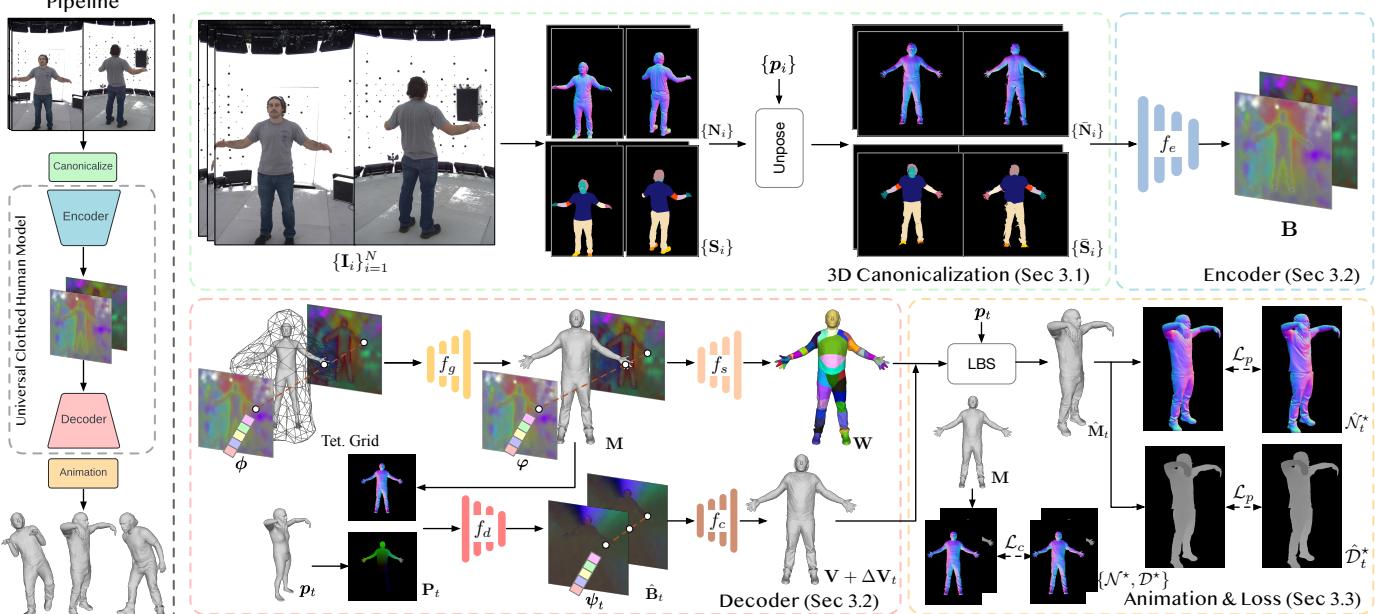
As illustrated in Figure 2, the workflow consists of three major phases:
- 3D Canonicalization: Taking posed images and “unposing” them into a standard T-pose.
- Universal Model Encoding: Aggregating features from multiple frames to remove noise.
- Joint Decoding: Simultaneously predicting the shape, the skinning weights, and the deformation.
Let’s break these down step-by-step.
1. 3D Canonicalization: The Art of “Unposing”
To learn a universal model, you need to compare apples to apples. You cannot easily compare a person sitting down to a person jumping. You need them both in a neutral “Canonical” space (usually a T-pose).
FRESA starts by taking the input images (RGB) and estimating their Normal maps (surface detail) and Segmentation maps (body part labels).
Then comes the clever part: Unposing. The system estimates the person’s pose in the photo and mathematically reverses the skeletal transformation to warp the pixels into a T-pose.
The mathematical basis for this is the Inverse Linear Blend Skinning (LBS) operation:

Here, \(u\) is the unposed vertex and \(\hat{u}\) is the posed vertex. By applying the inverse of the bone transformations (\(T\)), they can warp the geometry back to the center.
The Challenge: To unpose someone perfectly, you need perfect skinning weights. But we haven’t reconstructed the avatar yet, so we don’t have skinning weights!
The Solution: The authors use “naive” skinning weights from a standard body template. This results in a messy, noisy unposed image—sometimes body parts are stretched or distorted. However, because the model is pixel-aligned (the left hand is always in the left hand region), a neural network can learn to fix these artifacts later.
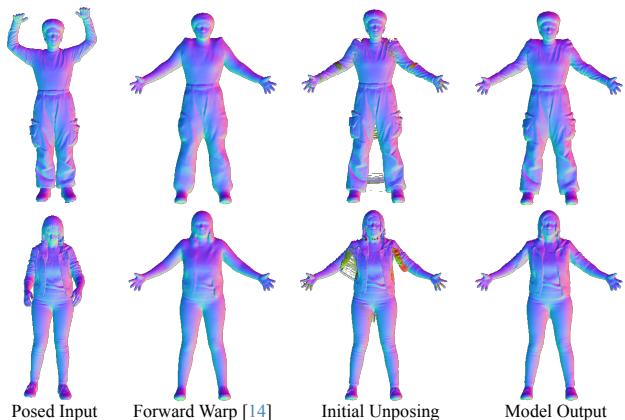
As seen in Figure 6 above, “Initial Unposing” (third column) looks a bit rough. But compared to “Forward Warp” (second column), which tries to blindly guess features, the unposing provides a structural foundation that the model can polish into a clean output (fourth column).
2. The Universal Clothed Human Model
Once the system has these “unposed” feature maps (Normals and Segmentation), it feeds them into a Multi-Frame Encoder.
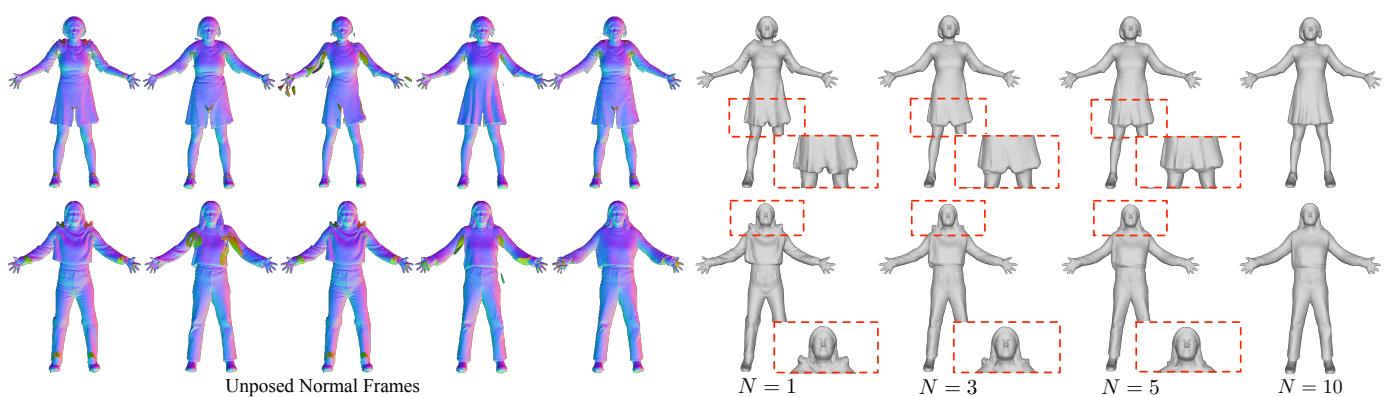
Why multi-frame? If you only have one photo, you might not see the person’s left side, or a fold in the shirt might look like a permanent shape change. By using a few frames (\(N=5\) is a sweet spot), the model can aggregate information.
The encoder extracts high-resolution features (for details like wrinkles) and low-resolution features (for global shape) and fuses them.

These features are then averaged across all input frames to create a single Bi-plane Feature Representation (\(B\)). Think of this as a compressed, rich “identity card” for the avatar that contains all geometric and semantic data.

Figure 5 below demonstrates the power of this aggregation. With \(N=1\) (one frame), the mesh is noisy. As you add frames (\(N=5\) or \(10\)), the system “hallucinates” less and reconstructs more accurately, smoothing out the artifacts from the naive unposing.
3. Joint Decoding: Shape, Weights, and Motion
This is the heart of FRESA. Most methods just output a mesh. FRESA uses the Bi-plane features to decode three distinct but coupled components.
A. Canonical Geometry (\(f_g\))
First, it reconstructs the static T-pose mesh using a representation called DMTet (Deep Marching Tetrahedra). This allows for high-resolution surfaces with arbitrary topology (it can handle open jackets, skirts, etc.).

Here, the decoder predicts the Signed Distance Function (\(s\)) and vertex displacement (\(\Delta g\)) to carve the avatar out of a grid.

B. Personalized Skinning Weights (\(f_s\))
This is the game-changer. Instead of assuming the avatar moves like a naked human, FRESA predicts specific skinning weights (\(w\)) for every vertex on the clothing.


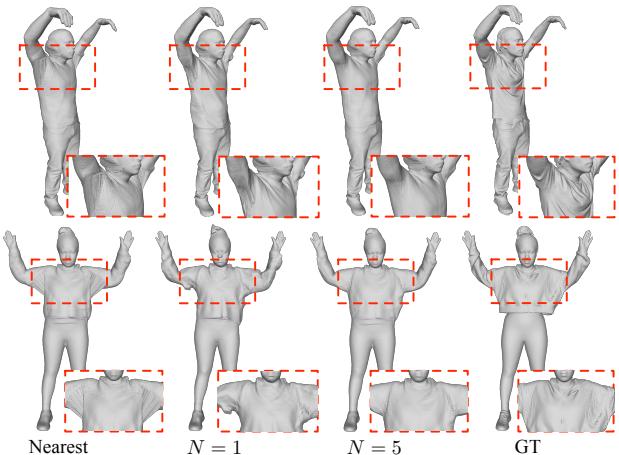
Why does this matter? Look at Figure 7 below. If you use standard “Nearest” weights (left), the area under the armpit stretches unnaturally. With FRESA’s personalized weights (middle columns), the movement is natural, closely matching the Ground Truth (GT).
C. Pose-Dependent Deformation (\(f_c\))
Even with good skinning, LBS is a linear operation—it’s rigid. Real clothes fold, wrinkle, and slide when you move. To capture this, FRESA adds a deformation module. It looks at the target pose the avatar needs to perform and predicts how the vertices should shift (\(\Delta v_t\)) to create wrinkles or correct volume.



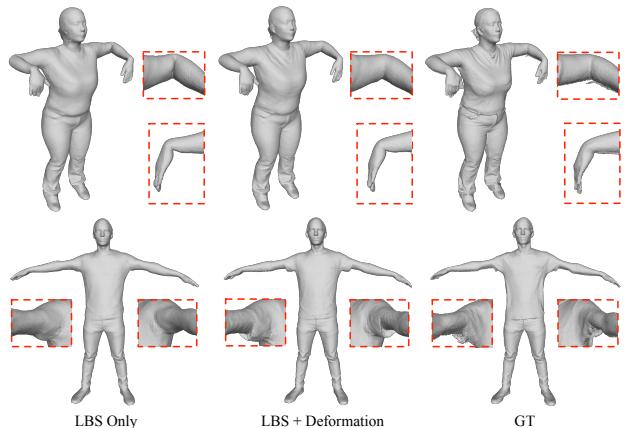
The result is visualized in Figure 8. Note how the deformation module corrects the “rubber tube” look of the elbows and adds realistic draping to the sleeves.
Putting It All Together
The final animated vertex position is calculated by combining these three predictions: the base mesh, the pose-dependent deformation, and the personalized skinning weights, all processed through the LBS equation:

Training the Beast
Training this system is tricky because we usually only have “Posed” ground truth scans (3D scans of people moving), but the model works in “Canonical” (T-pose) space. There is no ground truth for the perfect T-pose of a person wearing a specific outfit.
The researchers used a Multi-Stage Training Process:
Canonical-Space Stage: They created “Pseudo Ground Truths” by carefully unposing 3D scans using slow, expensive optimization. This gave the model a rough target to learn the T-pose geometry.

Posed-Space Stage: Once the model understood basic shapes, they trained it end-to-end. They took the predicted avatar, re-posed it to match a specific video frame, and compared it against the actual 3D scan of that frame.

They also regularized the skinning weights to ensure they didn’t deviate too wildly from the body template:

And finally, an edge loss to prevent spiky artifacts:

Experiments and Results
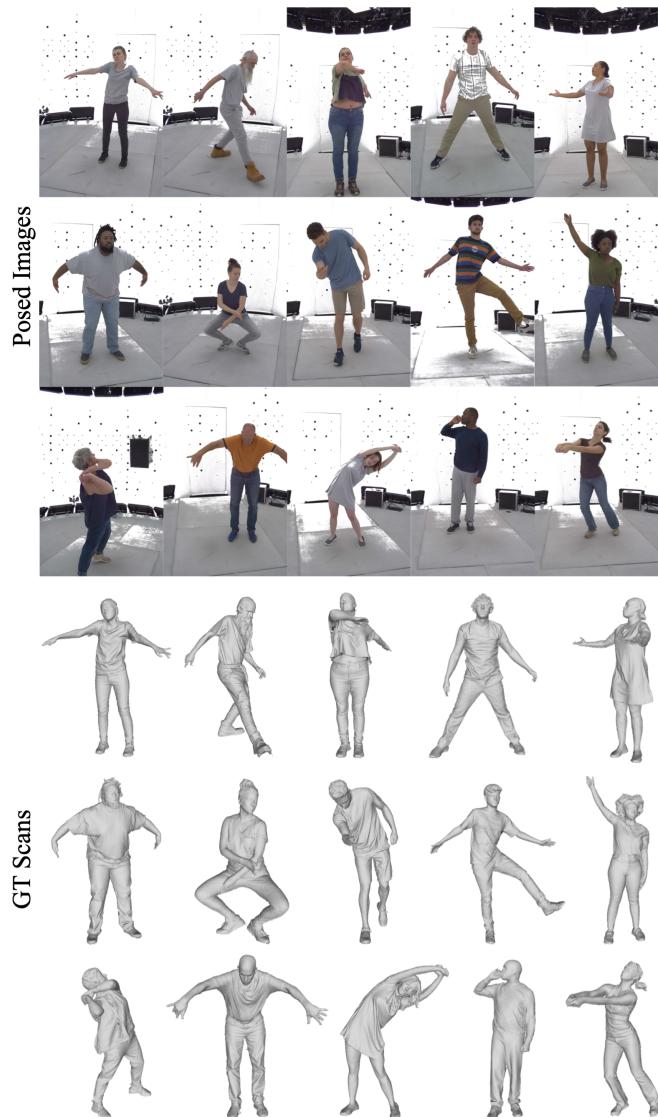
To train this universal prior, the team built a massive dataset called “Dome Data,” containing 1100 subjects captured with high-end photogrammetry rigs.
Quantitative Results
The results are impressive, particularly regarding speed. While optimization-based methods like Vid2Avatar or PuzzleAvatar take hours (3h to 8h) to generate an avatar, FRESA does it in 18 seconds.
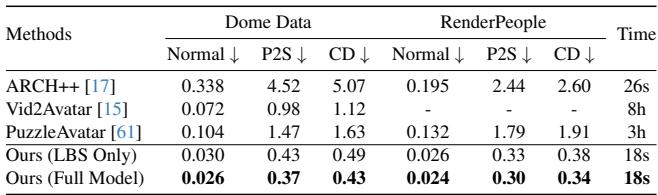
In terms of geometry quality (measured by Normal error and Point-to-Surface distance), FRESA outperforms existing feed-forward methods (like ARCH++) significantly and competes with the slow, optimization-based methods.
Qualitative Results
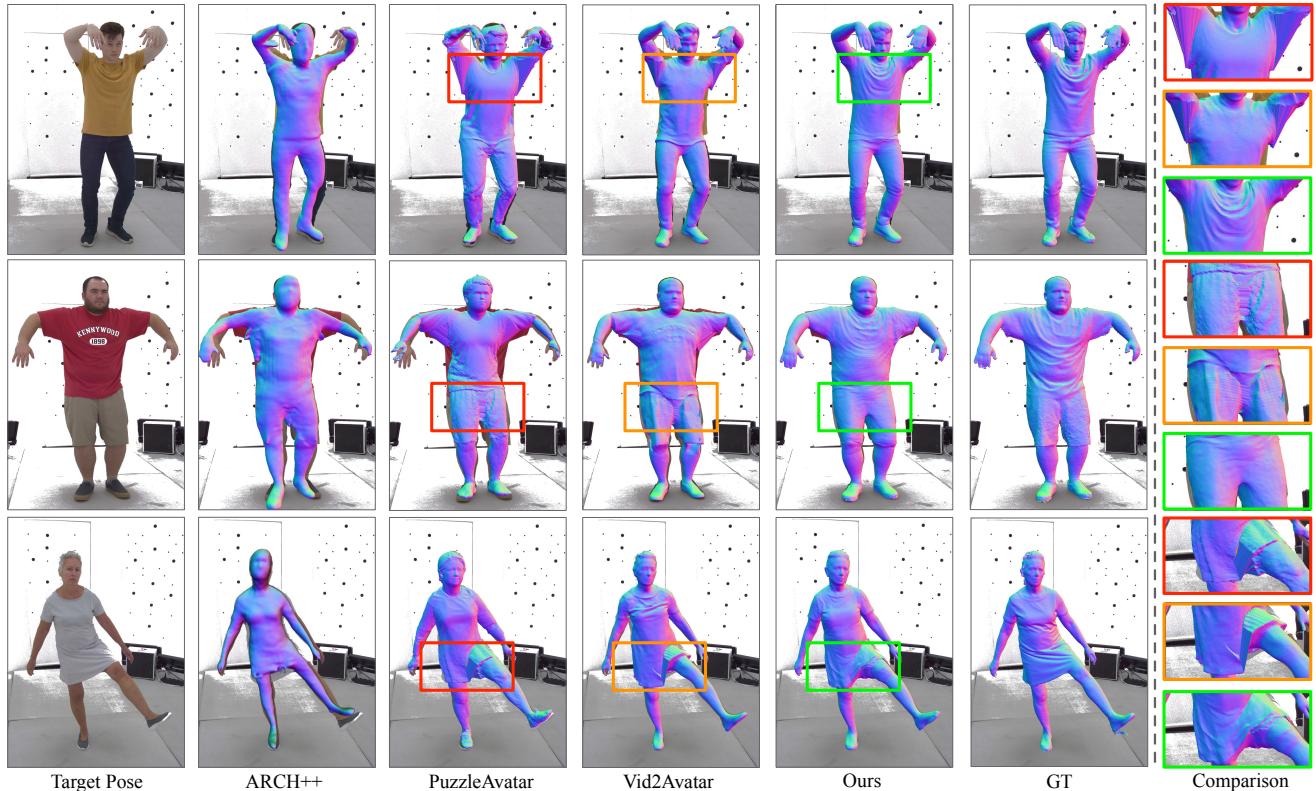
The visual comparisons highlight the difference in animation quality. In the figure below, look at the “Ours” column compared to the baselines. The deformation is smoother, and the clothing retains its volume better during complex poses.
Generalization to Phone Photos
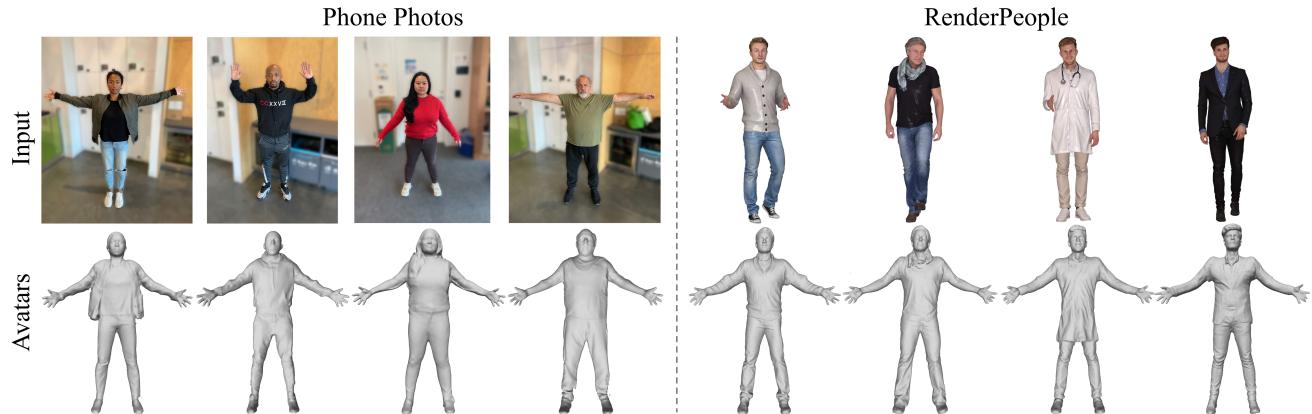
Perhaps the most exciting result is zero-shot generalization. The model was trained on high-quality dome data, but it works surprisingly well on casual phone photos. It doesn’t even require the front and back photos to be perfectly aligned or taken at the same time.
Conclusion
FRESA represents a significant leap toward democratizing 3D avatar creation. By moving away from per-subject optimization and utilizing a powerful, learned universal prior, it allows for the reconstruction of personalized, animatable avatars in near real-time.
Key Takeaways:
- Speed: Feed-forward architecture allows for inference in seconds, not hours.
- Personalization: Jointly learning skinning weights allows for avatars that move realistically, even with loose clothing.
- Robustness: The canonicalization and multi-frame aggregation strategy makes the system resilient to noisy inputs.
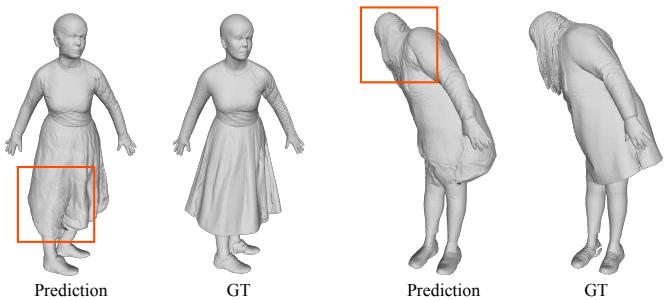
While limitations exist—it struggles with extremely loose clothing (like long dresses) or complex hair dynamics that require physics simulation rather than just pose dependence—FRESA paves the way for a future where bringing your digital self into the metaverse is as easy as snapping a selfie.