](https://deep-paper.org/en/paper/2503.19458/images/cover.png)
Introduction
In the world of 3D computer vision, reconstructing digital objects from 2D images is a fundamental quest. We want to take a few photos of an object—a T-shirt, a flower, a complex statue—and turn it into a perfect 3D model. For years, this field has been dominated by methods that assume objects are “watertight,” meaning they are closed volumes with a clearly defined inside and outside. Think of a sphere or a cube; you are either inside it or outside it.
But the real world isn’t always watertight. Consider a piece of clothing, the leaves of a plant, or an open umbrella. These are “open surfaces.” They are thin, have boundaries, and don’t necessarily enclose a volume. Traditional methods that rely on Signed Distance Functions (SDFs)—which categorize space as positive (outside) or negative (inside)—fail spectacularly here.
Enter the Unsigned Distance Function (UDF). Unlike SDFs, UDFs simply tell you how far you are from the nearest surface, regardless of “inside” or “outside.” This makes them perfect for open surfaces. However, learning high-quality, continuous UDFs from images has historically been slow and computationally expensive, often relying on volumetric rendering techniques like NeRF (Neural Radiance Fields).
Recent research titled “GaussianUDF: Inferring Unsigned Distance Functions through 3D Gaussian Splatting” proposes a breakthrough solution. By leveraging the blistering speed and explicit representation of 3D Gaussian Splatting (3DGS), the researchers have found a way to reconstruct accurate, sharp open surfaces efficiently.
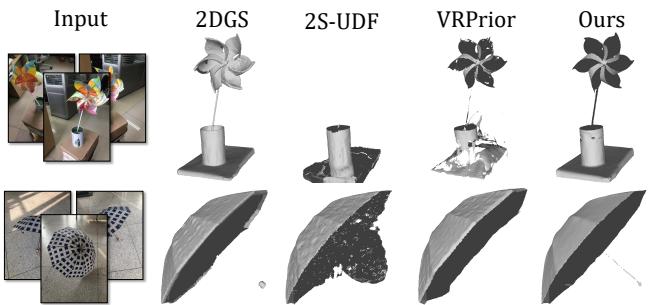
As shown above, where other methods result in broken geometries or smoothed-out details, GaussianUDF captures the intricate structures of open surfaces like pinwheels and umbrellas. In this post, we will decode how this method bridges the gap between discrete 3D Gaussians and continuous implicit functions.
Background: The Explicit vs. The Implicit
To understand why GaussianUDF is significant, we need to understand the two main players in 3D representation:
- Implicit Representations (UDFs): These represent a shape as a continuous mathematical function. For any point in 3D space, the function returns the distance to the surface. The surface itself is the “zero level set” (where the distance is 0). They are great for topology and smoothness but can be hard to optimize directly from images.
- Explicit Representations (3D Gaussians): Recently popularized by 3D Gaussian Splatting, this method represents a scene as a cloud of 3D ellipses (Gaussians). It is incredibly fast to render because it uses rasterization (splatting onto the screen) rather than expensive ray-marching.
The Problem
While 3D Gaussian Splatting is fast and produces pretty pictures, the resulting “mesh” is essentially a loose cloud of disjointed blobs. It lacks the continuous surface definition needed for high-quality geometry extraction. Conversely, UDFs provide excellent surface definitions but are slow to train.
The researchers’ goal was to combine them: Use the speed of 3D Gaussians to supervise and learn a continuous UDF.
However, there is a catch. UDFs have complex gradient fields, especially near the surface (where the distance is zero). The gradient isn’t defined at the surface, and it flips direction immediately upon crossing it. This makes it incredibly unstable to train a neural network to learn a UDF using standard gradient descent methods found in SDF literature.
The Core Method: GaussianUDF
The proposed method, GaussianUDF, treats the 3D Gaussians not just as rendering primitives, but as “anchor points” that guide the learning of the underlying UDF.
The architecture involves a cooperative loop:
- Optimize 2D Gaussians to match the input images (standard 3DGS).
- Use the Gaussians to supervise a UDF network, teaching it where the surface is.
- Use the UDF gradients to refine the positions of the Gaussians, snapping them tightly to the surface.
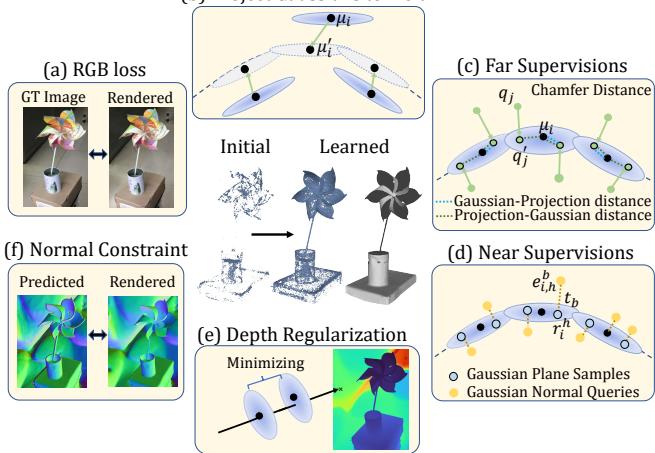
Let’s break down the specific innovations that make this work.
1. 2D Gaussians: The “Pancake” Approach
Standard 3D Gaussians are ellipsoids. However, to represent a thin surface (like cloth), a flat, pancake-like shape is geometrically superior. The authors adopt 2D Gaussian Splatting, where the Gaussians are flattened into planes defined by two scaling factors (width and height) and a normal vector (orientation).
The rendering process follows the standard splatting equation, where colors \(c_i\) and opacities \(\alpha_i\) are blended to form the image \(C'(u,v)\):

The model is trained by minimizing the difference between this rendered image and the ground truth image:

While this handles the visual appearance, it doesn’t guarantee the geometry is a clean, continuous surface. That’s where the UDF comes in.
2. Bridging the Gap: Far and Near Supervision
The core contribution of this paper is how the researchers utilize the 3D Gaussians to train the UDF. They divide the space into two regions: Far (areas away from the surface) and Near (areas immediately surrounding the surface).
Far Supervision: Coarse Alignment
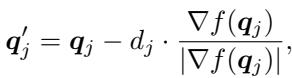
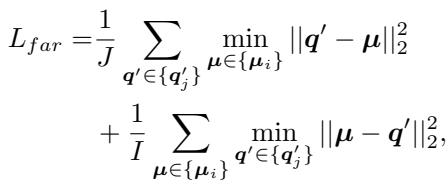
For points far from the surface, the centers of the Gaussians act as a rough approximation of the geometry. The researchers sample random query points in space and use the gradient of the UDF to “pull” these points toward the zero level set.
The projection equation moves a point \(q_j\) along the gradient direction by its predicted distance \(d_j\):
They then force this projected point to align with the nearest Gaussian center. This coarse supervision ensures that the UDF field generally agrees with the location of the visual point cloud.
Near Supervision: The Novel Self-Supervision
This is the most critical innovation. Relying only on Gaussian centers is insufficient because the Gaussians are sparse; there are gaps between them.
To fill in the gaps and handle the unstable gradients near the surface, the authors introduce a self-supervision strategy using the flat planes of the 2D Gaussians.
Since the 2D Gaussian is effectively a small patch of the surface, we know that:
- Any point on this patch has a distance of 0.
- Any point moved along the normal vector by a distance \(t\) should have a UDF value of \(t\).
The researchers sample “root points” (\(r_i\)) randomly across the surface of the flat Gaussian. They then create training pairs by moving these root points along the normal vector by a random amount \(t\).
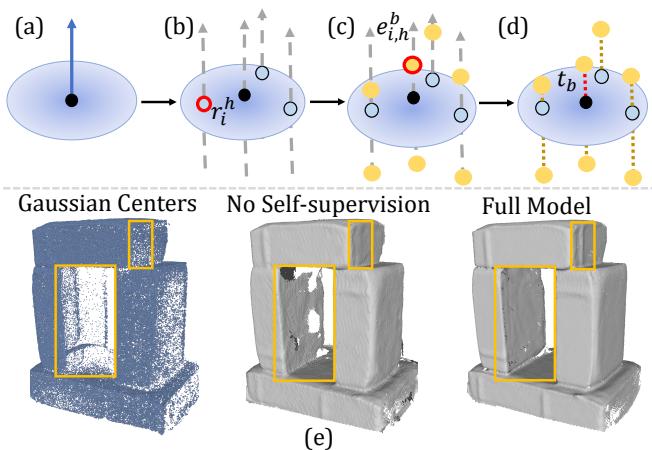
This creates a dense set of training data \(\{e_{i,h}^b, t_b\}\) where \(e\) is the spatial coordinate and \(t\) is the ground-truth distance. The loss function simply ensures the UDF network predicts this distance correctly:

This strategy allows the network to learn the distance field continuously and smoothly across the entire surface area covered by the Gaussians, not just at their centers.
3. Overfitting Gaussians to the Surface
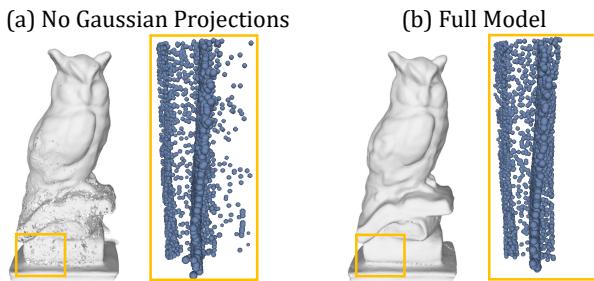
For the supervision to be accurate, the Gaussians themselves must lie exactly on the surface. The authors introduce a projection constraint.
They take the center of a Gaussian \(\mu_i\), calculate where the UDF thinks the surface is, and then explicitly minimize the distance between the Gaussian’s center and that projected location.

This creates a feedback loop: the UDF learns from the Gaussians, and the Gaussians snap to the UDF’s zero level set. This significantly reduces noise in the point cloud, as illustrated below:
4. Regularization
To ensure the geometry is physically plausible, two additional constraints are applied:
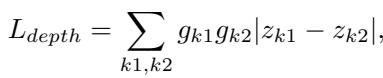
Depth Regularization: Encourages Gaussians to cluster closely along the viewing ray, preventing “floaters” or semi-transparent clouds that look correct from one angle but are geometrically messy.
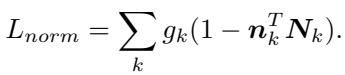
Normal Constraint: Aligns the explicit normal of the 2D Gaussian with the normal derived from the rendered depth map. This ensures the orientation of the “pancakes” is consistent with the overall surface shape.
The Total Loss Function
The final optimization combines all these elements: RGB reconstruction, structural similarity (SSIM), far/near UDF supervision, projection constraints, and regularizations.

Experiments and Results
The researchers validated GaussianUDF on several datasets, including DeepFashion3D (clothing with open surfaces) and DTU (general objects).
Reconstructing Open Surfaces
The primary goal was to handle open surfaces better than existing methods. In the comparison below on the DeepFashion3D dataset, note the heatmaps indicating error (red/yellow is high error, blue is low).
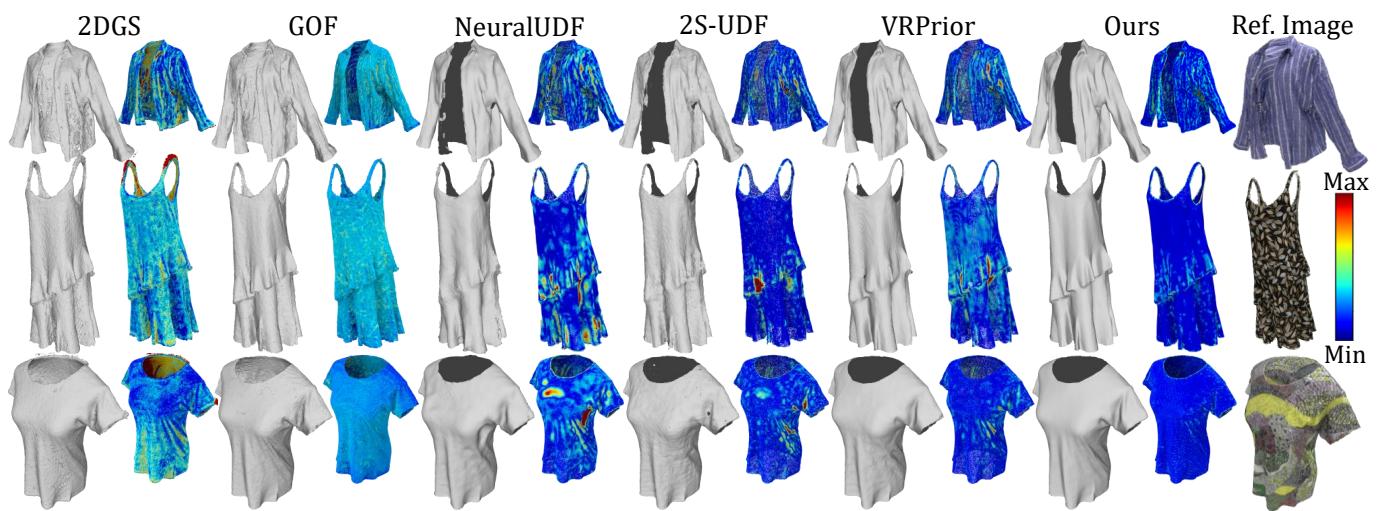
SDF-based methods (like 2DGS and GOF) struggle because they try to close the surface, resulting in double layers or smoothed-out details. UDF baselines (like NeuralUDF) capture the open topology but often miss fine details like clothing folds. GaussianUDF achieves the most accurate reconstruction.
Visual Quality on General Objects
Even on standard datasets like DTU, which contain watertight objects, GaussianUDF performs exceptionally well.
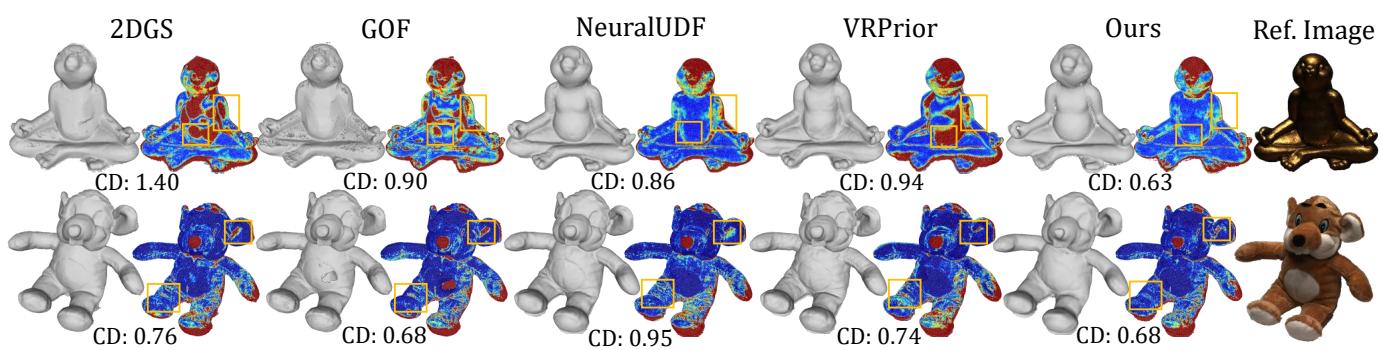
The method reconstructs fine details and handles complex lighting conditions effectively. The numerical analysis (Chamfer Distance) confirms this, showing that GaussianUDF beats or matches state-of-the-art methods.

Real-World Scans
Synthetic data is one thing, but real-world data is noisy. The authors tested on the NeUDF dataset and their own captured scenes.
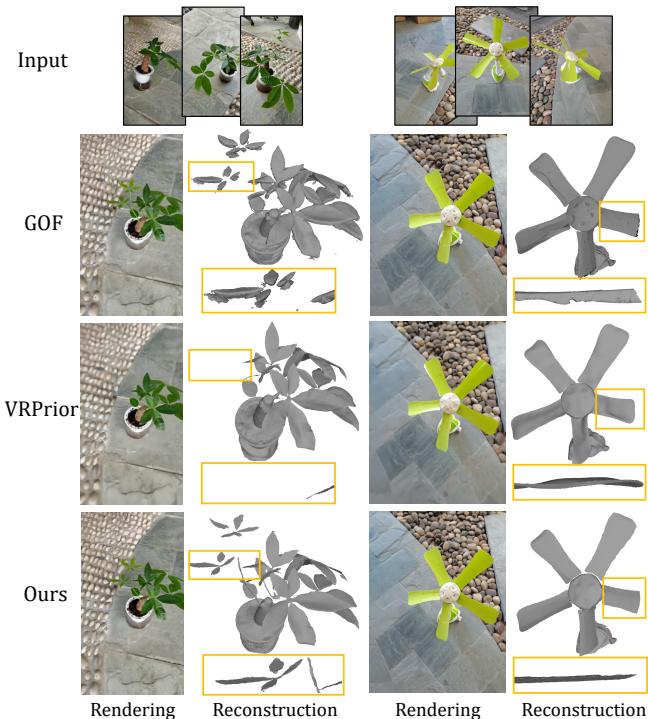
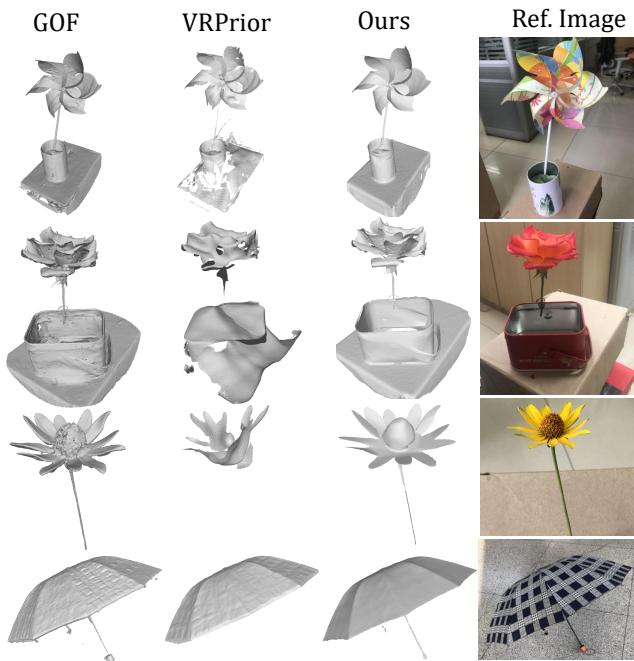
The results demonstrate that the method is robust enough to handle the noise and varying density of real-world photogrammetry.
Why does it work? (Ablation Studies)
The authors performed ablation studies to prove that every part of their complex loss function is necessary.
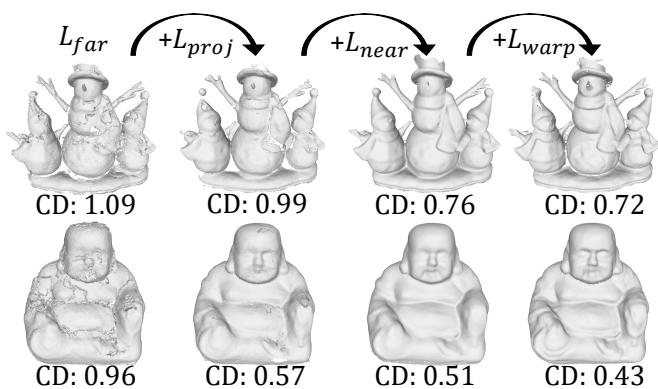
- L_far only: Results in a blobby, noisy mess.
- + L_proj: The surface thins out but creates holes.
- + L_near: The holes fill in, and the surface becomes continuous.
This visually confirms that the Near Supervision (the sampling on the Gaussian planes) is the “secret sauce” that allows for complete surface reconstruction.
Analysis of the Learned Field
One of the most interesting visualizations in the paper is the slice of the UDF field itself.
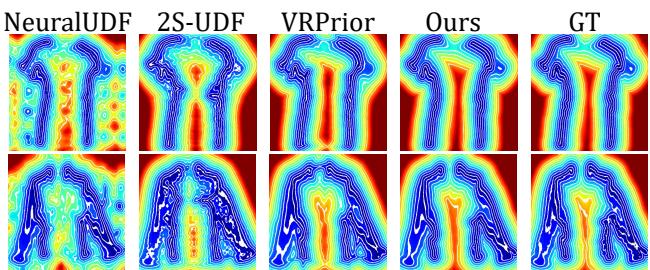
In the image above, you can see the “energy” of the distance field.
- NeuralUDF has a weak field far from the surface.
- 2S-UDF is noisy and overfitted to texture.
- GaussianUDF produces a smooth, clean gradient that clearly defines the object boundary.
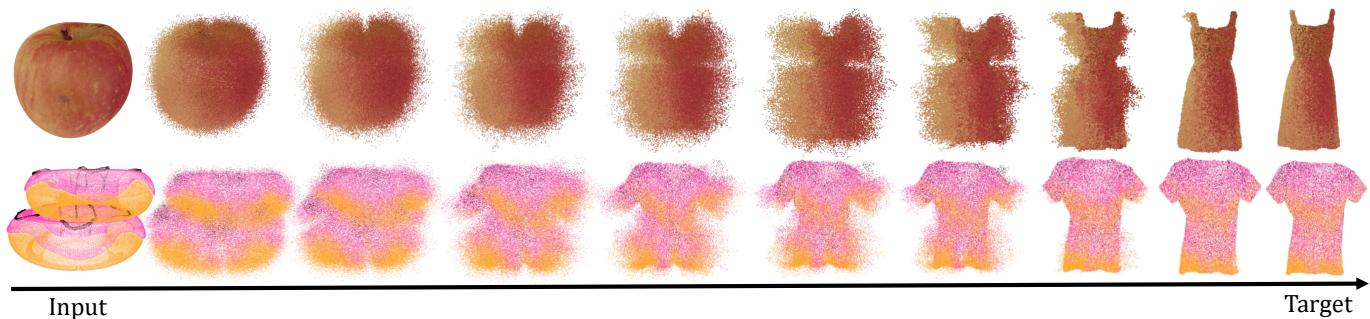
Because this field is so clean, it can even be used to deform arbitrary point clouds. In the example below, a point cloud shaped like an apple is progressively “pulled” by the GaussianUDF field until it takes the shape of a dress.
Conclusion
GaussianUDF represents a significant step forward in 3D reconstruction. By successfully marrying the explicit, fast nature of 3D Gaussian Splatting with the continuous, topology-agnostic nature of Unsigned Distance Functions, the researchers have solved a major bottleneck.
The key takeaways are:
- Open Surfaces are Solvable: We no longer need to rely on watertight assumptions that fail on clothing or plants.
- Hybrid Approaches Win: Pure implicit methods (NeRF-based UDFs) are slow; pure explicit methods (Gaussians) lack connectivity. The hybrid approach offers the best of both worlds.
- Geometry-Aware Supervision: The clever use of the flat Gaussian plane to generate “near” supervision data stabilizes the notoriously difficult UDF optimization.
As digital twins and 3D content creation become more central to industries ranging from fashion to gaming, methods like GaussianUDF that can quickly and accurately digitize the messy, open-surfaced real world will be invaluable.