](https://deep-paper.org/en/paper/2503.19718/images/cover.png)
If you have been following the development of Quantum Computing, you likely know that we are in the “NISQ” era (Noisy Intermediate-Scale Quantum). While universal, fault-tolerant quantum computers are still on the horizon, we currently have access to Quantum Annealers (like those from D-Wave). These machines are specialized hardware designed to find the lowest energy state of a system, making them potentially powerful tools for combinatorial optimization.
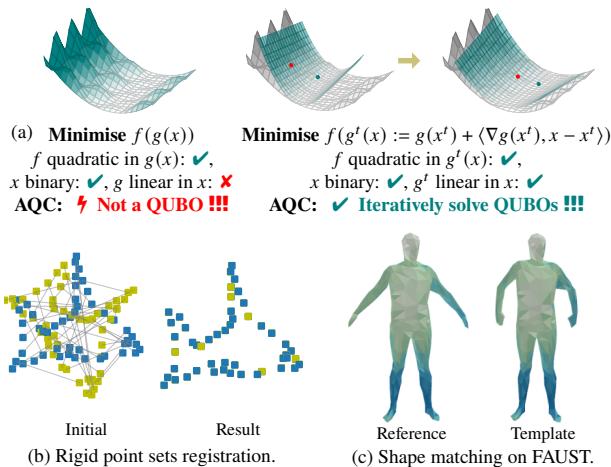
However, there is a catch. Modern quantum annealers effectively speak only one language: QUBO (Quadratic Unconstrained Binary Optimization).
If your problem fits neatly into a QUBO formulation, great! But many real-world problems, particularly in Computer Vision—like aligning 3D shapes or matching graph structures—are complicated. They often involve non-quadratic objective functions or complex constraints (like requiring a matrix to be a valid rotation matrix). Traditionally, this meant these problems were off-limits for quantum annealers.
In this post, we are diving deep into QuCOOP, a framework introduced by researchers from the University of Siegen and MPI for Informatics. QuCOOP (Quantum Framework for COmposite and Binary-Parametrised OPtimisation Problems) proposes a clever iterative method to bridge the gap between complex, non-quadratic computer vision problems and the QUBO-restricted hardware of today.
The Problem: The QUBO Bottleneck
To understand the innovation of QuCOOP, we first need to understand the limitation it addresses. Adiabatic Quantum Computing (AQC) leverages quantum mechanics (specifically tunneling and superposition) to explore optimization landscapes and escape local minima better than classical methods.
However, the hardware usually accepts problems in this specific form:
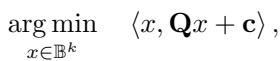
Here, \(x\) is a binary vector (0s and 1s), \(Q\) is a matrix defining the relationships between variables, and the goal is to minimize the function.
The issue arises when we look at computer vision problems. Let’s say you want to align two 3D point clouds. You need to find a rotation matrix and a permutation matrix. These matrices have strict constraints (orthogonality, rows summing to 1) and often interact in non-quadratic ways. You cannot simply plug these directly into a D-Wave machine.
The Solution: Composite Optimization
The authors of QuCOOP tackle this by framing the general problem as a composite optimization problem. Instead of trying to force the entire complex problem into a single QUBO, they view the objective function \(f\) as a function of another inner function \(g(x)\).
Mathematically, they aim to solve:
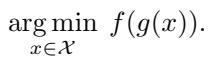
Here:
- \(x\) is our binary parameter vector (compatible with the quantum machine).
- \(g(x)\) maps these binary parameters to the complex feasible set (like a set of rotation matrices).
- \(f\) is the objective function we want to minimize.
The QuCOOP Algorithm
The core insight of QuCOOP is Iterative Linearization. Instead of solving the difficult composite function all at once, the framework creates a sequence of local approximations that are QUBOs.
Here is the step-by-step logic:
- Current State: Imagine we are at a current guess for the solution, \(x^t\).
- Linearize: We approximate the inner function \(g(x)\) using a first-order Taylor expansion around \(x^t\).
- Quadratic Model: Because the outer function \(f\) is quadratic (a common trait in energy minimization problems), feeding a linear approximation of \(g(x)\) into it results in a quadratic function of \(x\).
- QUBO Generation: This local quadratic model is a QUBO! The quantum annealer can now solve it to find the next best step, \(x^{t+1}\).
The local model \(f^t\) constructed at each step looks like this:

The algorithm iteratively solves these local QUBOs. It acts like a gradient descent for discrete variables, using the quantum computer to find the best “step” within the local landscape.
The complete iterative update rule is summarized by this equation:
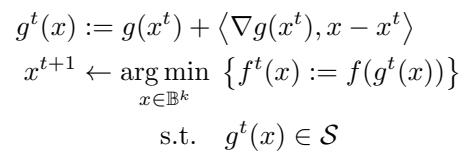
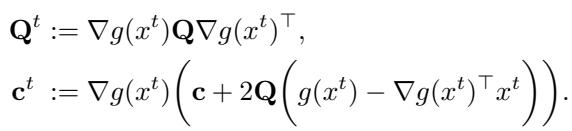
To make this concrete, the framework derives the specific matrix \(Q^t\) and vector \(c^t\) that the quantum annealer needs to program for each iteration:
Application 1: Graph Matching and QAP
One of the hardest combinatorial problems is the Quadratic Assignment Problem (QAP). It is essentially the problem of matching nodes between two graphs to minimize the structural difference.
The objective usually looks like minimizing the difference between two adjacency matrices \(A\) and \(B\) permuted by a matrix \(P\):
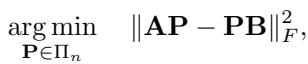
The constraint here is that \(P\) must be a permutation matrix (a matrix of 0s and 1s where every row and column sums to exactly 1).
Binary Parametrization of Permutations
A quantum annealer uses bits, not matrices. How do we represent a permutation matrix using binary variables?
QuCOOP uses a clever decomposition. Any permutation can be built by a sequence of “swaps” (transpositions). The researchers parameterize the permutation matrix \(P\) as a product of 2-cycles (swaps), where each swap is toggled on or off by a binary variable \(x_i\).
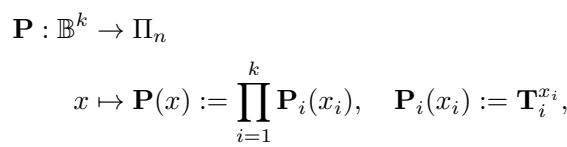
By optimizing these binary variables \(x\), the algorithm constructs the optimal permutation matrix. To ensure the result remains a valid permutation, they add a penalty term to the QUBO that punishes deviations from validity.
The resulting local sub-problem for the quantum annealer becomes:

Application 2: Point Set Registration
Perhaps the most impressive application of QuCOOP is Point Set Registration without correspondences. This is a classic vision problem: you have two clouds of points, and you want to rotate and shuffle one so it aligns with the other.
Most previous quantum approaches assumed you already knew which point matched which (known correspondences). QuCOOP solves for the rotation (\(R\)) and the permutation (\(P\)) simultaneously.
The objective function combines finding the best rotation and the best matching:

This is a composite problem where the variables are partitioned into rotation parameters and permutation parameters. The researchers linearize both. The rotation matrix is parameterized using the exponential map of skew-symmetric matrices (standard in Lie algebra), which is then discretized into bits.
The resulting QUBO matrix for the quantum annealer is a block matrix, handling the interaction between the rotation variables and the permutation variables:
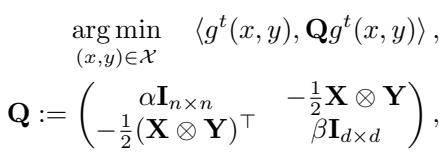
The top-left block handles the permutation constraints (\(\alpha I\)), the bottom-right handles rotation constraints (\(\beta I\)), and the off-diagonal blocks (\(\mathbf{X} \otimes \mathbf{Y}\)) handle the coupling—how rotating the points affects the matching cost.
Experimental Results
The researchers tested QuCOOP on both classical simulators (Simulated Annealing - SA) and real quantum hardware (D-Wave).
1. Quadratic Assignment Problem (QAP)
They compared QuCOOP against classical heuristics (FAQ, 2-OPT) and a specialized quantum approach called Q-Match. They used the QAPLIB benchmark, a standard library for these types of problems.
The results were statistically significant. As shown below, QuCOOP (blue diamonds) consistently achieved the lowest energy error (y-axis, logarithmic scale) across different problem sizes (\(n\)).
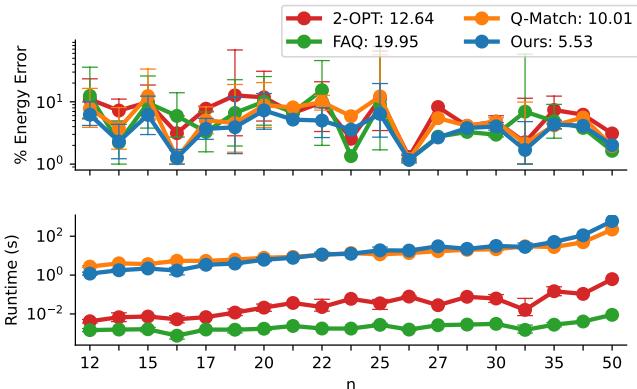
While the runtime (bottom chart) is slightly higher than the fastest heuristics, the accuracy payoff is substantial.
2. Shape Matching
They applied the method to the FAUST dataset, which involves mapping high-resolution meshes of human bodies in different poses. This is a massive QAP instance.
The qualitative results show that QuCOOP successfully handles complex deformations, matching points from a reference shape to a target shape accurately.
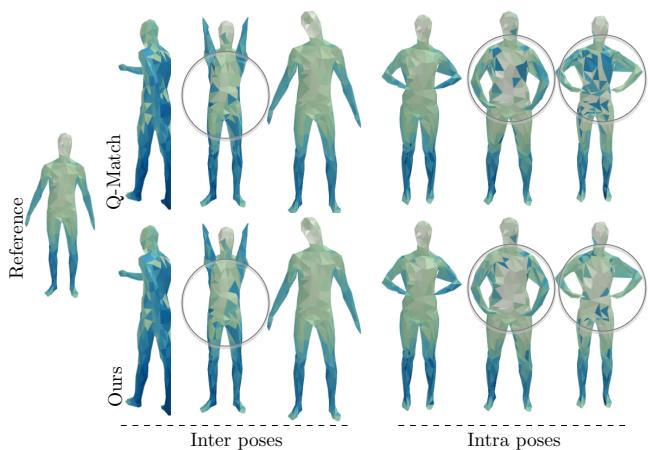
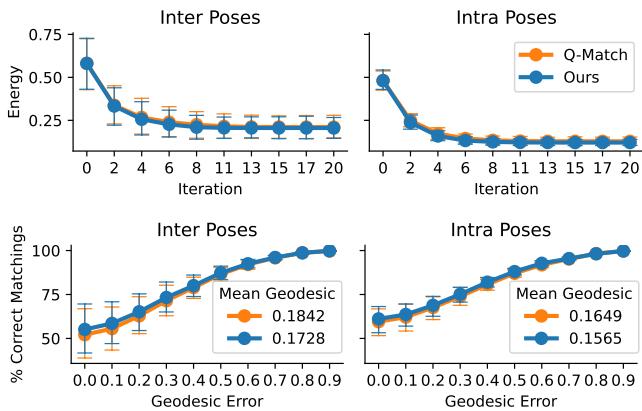
In terms of quantitative accuracy (Geodesic Error), QuCOOP performed slightly better than the previous state-of-the-art quantum method, Q-Match, demonstrating that the general framework is just as capable as specialized solvers.
3. Point Set Registration (The “Impossible” Task)
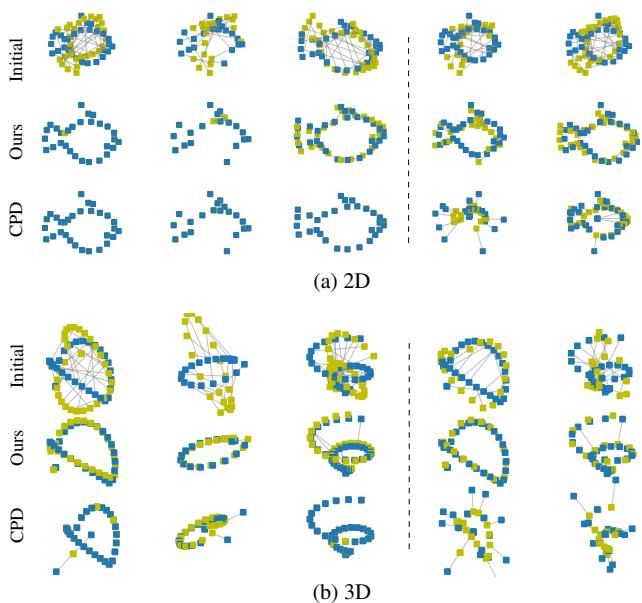
This experiment highlights the versatility of QuCOOP. The task was to register 2D and 3D point sets without knowing which points correspond to each other—a task previous quantum methods could not handle.
The visual results below show the alignment process. From the “Initial” messy state, QuCOOP aligns the blue crosses (template) to the olive squares (reference).
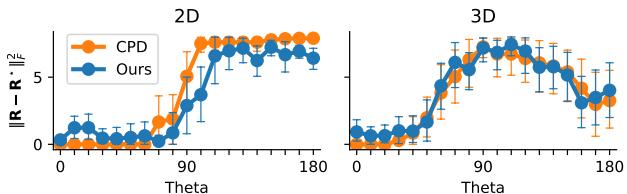
It is worth noting the robustness of the method regarding rotation angles. As the rotation required to align the shapes increases (towards 180 degrees), the problem becomes harder. The graph below compares QuCOOP against CPD (Coherent Point Drift, a standard classical algorithm). QuCOOP remains competitive, though both struggle with extreme rotations (a known difficulty in local optimization).
Real Quantum Hardware Performance
The ultimate test is running this on a physical D-Wave Quantum Annealer. The researchers used the D-Wave Advantage system.
For QAP, the D-Wave machine successfully found valid permutation matrices for problem sizes up to \(n=12\).
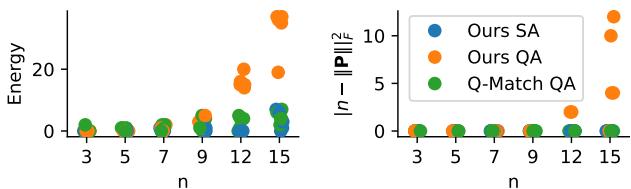
For Point Set Registration, the hardware successfully registered point sets up to \(n=5\) without correspondences.
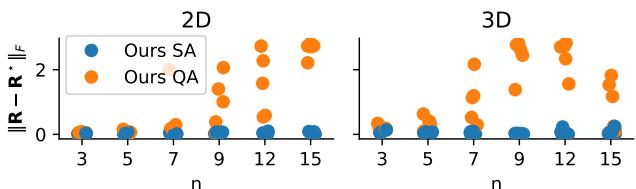
Why such small sizes? Current quantum annealers have limited connectivity. A fully connected graph of logical variables (which these problems require) must be “embedded” onto the sparse physical grid of qubits. This embedding explodes the number of physical qubits required. As hardware connectivity improves, these sizes will naturally scale up.
Conclusion
QuCOOP represents a significant step forward in Quantum Computer Vision. It breaks the “QUBO barrier,” allowing researchers to solve composite, constrained, and non-quadratic problems using quantum annealers.
By using an iterative approach—linearizing the complex geometry of rotations and permutations and feeding local QUBO models to the quantum solver—QuCOOP achieves state-of-the-art results on graph matching and enables point set registration tasks that were previously out of reach for quantum algorithms.
While current hardware limits the scale of problems that can be solved physically, frameworks like QuCOOP are laying the algorithmic foundation. As quantum hardware matures, we now have the software tools ready to tackle complex vision problems in a fundamentally new way.