](https://deep-paper.org/en/paper/2503.19902/images/cover.png)
Introduction
In the rapidly evolving world of Generative AI, we have become accustomed to a specific direction of flow: Text-to-Image (T2I). You type “a futuristic city made of crystal,” and a diffusion model like Stable Diffusion paints it for you. These models are incredibly powerful, having ingested massive datasets that effectively encode a vast amount of “world knowledge.” They know what a city looks like, they know what crystal looks like, and they know how to combine them.
But what happens if we reverse the flow?
Imagine showing an AI a single photograph of a complex scene—say, a ceramic figurine sitting in a dark bowl. Can the AI look at that image and not just copy it, but actually understand it? Can it identify that there is a “figurine” and a “bowl”? Can it go further and recognize that the figurine is made of “bronze” and the bowl is “ceramic”? Can it separate the concept of the object’s shape from its color or material?
This is the challenge of Intrinsic Concept Extraction, and it is a notoriously difficult problem. While models can generate images, inverting that process to learn structured concepts from a single image is fraught with ambiguity. Most existing methods struggle to separate an object from its background or disentangle an object’s shape from its texture.
Enter ICE, a novel framework proposed by researchers that stands for Intrinsic Concept Extraction.
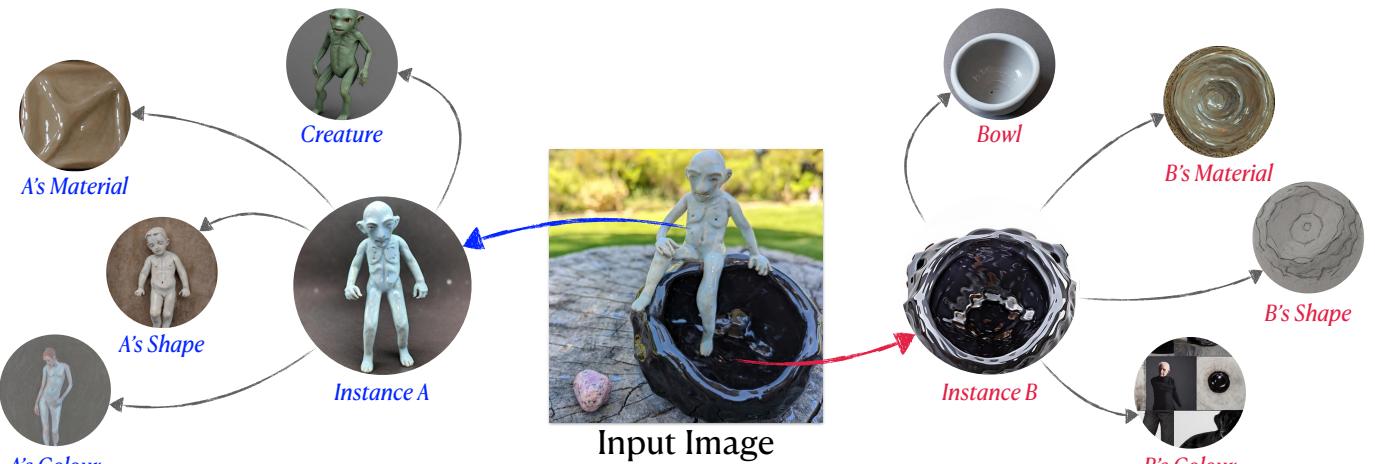
As illustrated above, ICE does something remarkable: it uses a pre-trained T2I model to systematically discover, localize, and decompose concepts within a single image without requiring human supervision. It doesn’t just see pixels; it sees a hierarchy of Instance, Shape, Material, and Colour.
In this post, we will take a deep dive into the ICE framework. We will explore how it automates the discovery of objects and how it uses a clever “divide and conquer” strategy to teach itself the difference between what an object is and what it is made of.
The Background: The Ambiguity of Visual Concepts
To understand why ICE is such a significant contribution, we first need to understand the limitations of previous approaches.
Diffusion models generate images by iteratively removing noise. Mathematically, they are trained to predict noise \(\epsilon\) added to an image \(x\). The standard training objective looks like this:

Here, the model \(\epsilon_\theta\) tries to denoise the image \(x_t\) guided by a text prompt \(p\).
Researchers quickly realized that this process could be inverted. Techniques like Textual Inversion and DreamBooth allow users to “teach” a model a new concept (like a specific dog or a unique toy) by optimizing a new word embedding based on a few images.
However, these methods have significant limitations:
- Data Requirements: They often require multiple images of the same object to learn effectively.
- Human Input: They usually rely on user-provided masks or captions to know what to focus on.
- Entanglement: They learn the concept as a whole “blob.” If you teach a model a “red car,” it often struggles to separate “red” from “car.” It creates a monolithic concept where shape, color, and texture are fused together.
This fusion creates ambiguity. If a model sees a green alien toy, does the new token it learns represent “alien,” “green,” “plastic,” or “toy”? Without a structured approach, the model acts like a student who memorizes the answers without understanding the underlying logic.
The ICE Framework: A Structured Approach
The researchers behind ICE propose a shift from unstructured memorization to Structured Concept Learning. Their goal is to take a single image and decompose it into a hierarchy.
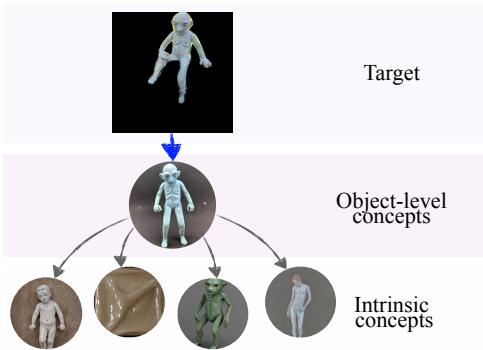
Figure 2 visualizes this hierarchy. An input (Target) isn’t just one thing. It is an Object-level concept (the alien shape) which is composed of Intrinsic concepts (the baby doll shape, the leathery texture, the green skin, the translucent material).
To achieve this automatically, ICE operates in two distinct stages:
- Stage One: Automatic Concept Localization. The model looks at the image and figures out where the distinct objects are and what they might be called, generating masks automatically.
- Stage Two: Structured Concept Learning. The model takes those masked regions and learns specific tokens for them, rigorously separating the “object” from its “properties” (materials/colors).
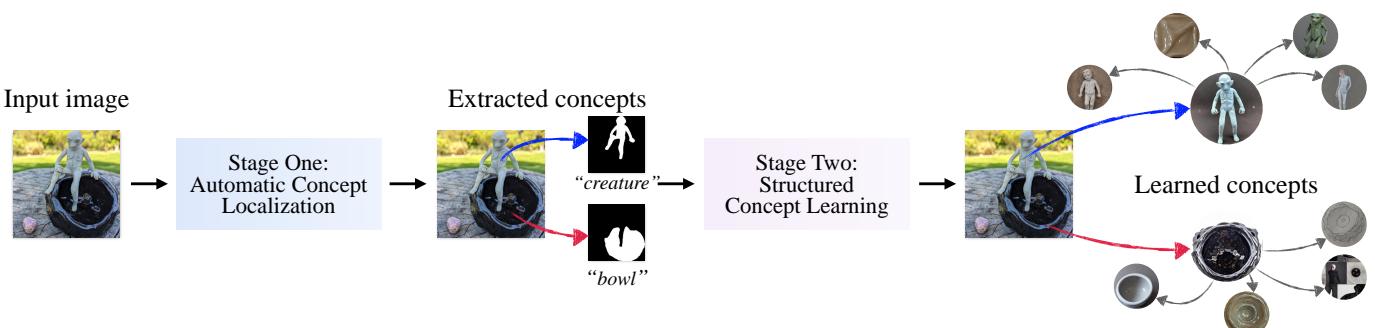
Let’s break these stages down.
Stage One: Automatic Concept Localization
The first hurdle in unsupervised learning is figuring out where the objects are. If we don’t have a human drawing a box around the “bowl” or the “creature,” the AI has to find them itself.
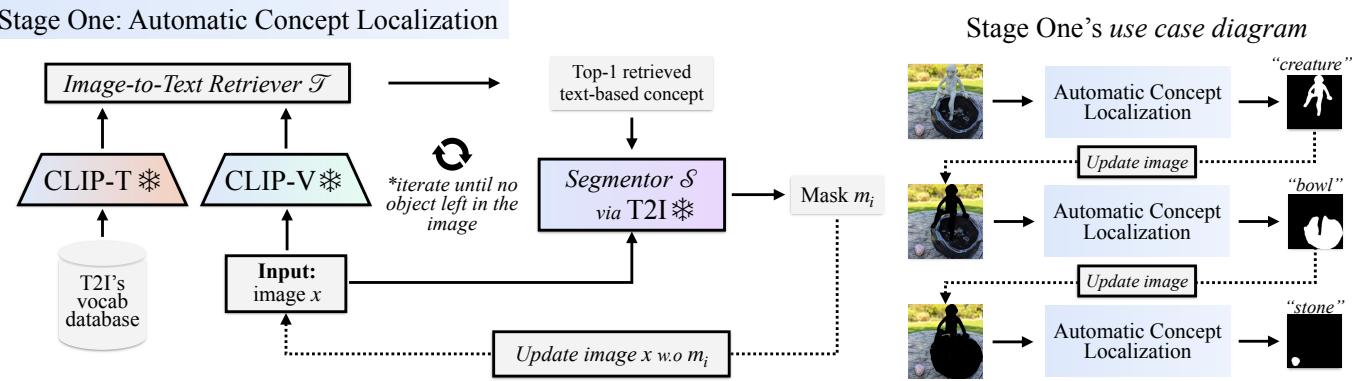
ICE solves this by leveraging the “world knowledge” already hidden inside the Text-to-Image model. It uses a combination of CLIP (a model that connects text and images) and the attention mechanisms of the diffusion model itself.
Step 1: Text-Based Concept Retrieval
Given an unlabeled image \(\mathbf{x}\), the system first asks: “What is in this picture?” It uses an Image-to-Text Retriever (\(\mathcal{T}\)), powered by CLIP, to find the most relevant words from the model’s vocabulary.
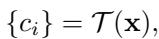
For example, if the image contains a strange creature, CLIP might return the word “creature” or “toy” as the top concept \(c_i\).
Step 2: Mask Generation
Once the model has the word “creature,” it asks the diffusion model: “Where is the creature?” It uses a Zero-Shot Segmentor (\(\mathcal{S}\)). This component looks at the cross-attention maps inside the diffusion model—basically, looking at which pixels the model “pays attention to” when it thinks of the word “creature.” This generates a segmentation mask \(\mathbf{m}_i\) without any extra training.
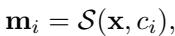
Step 3: The Iterative Loop
This is the clever part. Once the “creature” is identified and masked, ICE effectively “erases” it from the image (mathematically masking it out). It then repeats the process on the remaining pixels.
- Iteration 1: Finds “Creature”. Masks it.
- Iteration 2: Looks at the background. Finds “Bowl”. Masks it.
- Iteration 3: Looks at what’s left. Finds “Table”. Masks it.
This loop continues until the image is empty. The result is a set of masks and text labels for every object in the scene, obtained completely automatically.
Stage Two: Structured Concept Learning
Now that ICE knows where the objects are (the masks) and roughly what they are (the text labels), it needs to learn them deeply. It’s not enough to know it’s a “creature”; ICE wants to learn the specific visual signature of this creature and break it down into its atomic parts.
This stage is divided into two phases.
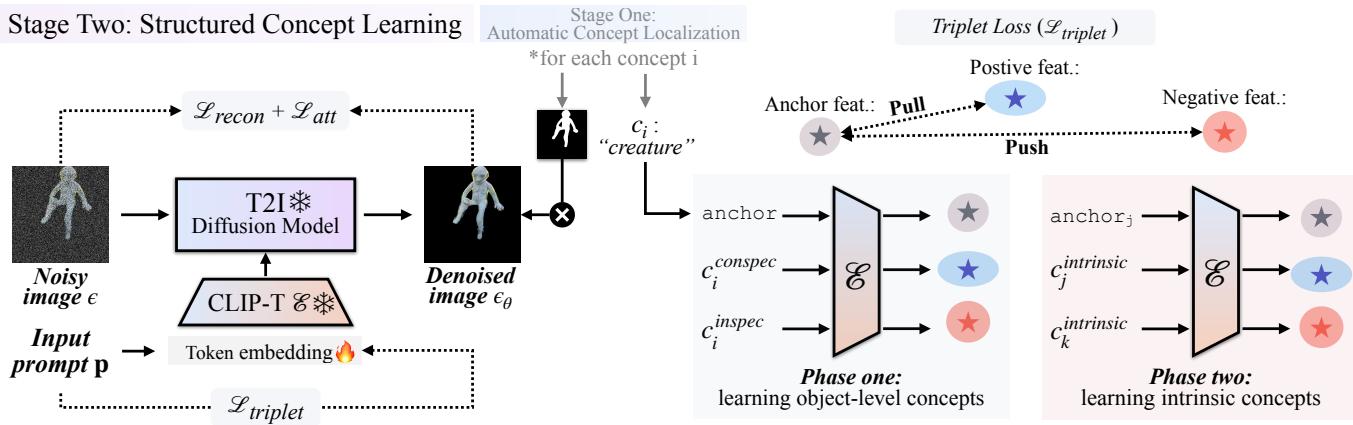
Phase One: Learning Object-Level Concepts
In this phase, the goal is to distinguish between the general category and the specific instance. For every object found in Stage One, ICE creates two new learnable tokens (embeddings):
- Concept-specific token (\(c_i^{\text{conspec}}\)): Represents the general category (e.g., “statue”).
- Instance-specific token (\(c_i^{\text{inspec}}\)): Represents this unique object (e.g., “this specific weird alien statue”).
To learn these, the authors use a Triplet Loss.
The Intuition Behind Triplet Loss
Imagine you are trying to describe a “Green Apple.”
- Anchor: The word “Apple.”
- Positive: The general concept of “Fruit” or “Apple-ness.”
- Negative: The specific “Green-ness” or unique dent in this specific apple.
We want the Concept-specific token to be very close to the general word anchor (e.g., “statue”), and we want the Instance-specific token to capture everything else (the details that make it unique).
The mathematical formulation forces the text encoder \(\mathcal{E}\) to pull the concept-specific token closer to the anchor word while pushing the instance-specific token further away.
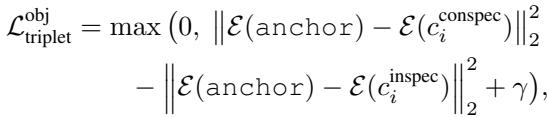
This ensures that \(c_i^{\text{conspec}}\) stays true to the general category, effectively forcing the other token, \(c_i^{\text{inspec}}\), to absorb the unique visual details.
Phase Two: Learning Intrinsic Concepts
Now comes the granular decomposition. We have the object, but what about its Material and Colour?
ICE introduces Intrinsic Tokens (\(c_j^{\text{intrinsic}}\)). The model uses specific prompt templates (anchors) like “a [material] concept” or “a [colour] concept”.
It uses another Triplet Loss, but this time the goal is to separate different intrinsic attributes from each other.

Here, the loss ensures that the token for “Color” is close to the concept of color, and far away from the token for “Material.” This prevents the model from confusing the object’s gold texture (material) with its yellow hue (color), or its metallic nature with the object’s shape.
The Total Training Objective
The final training involves balancing three things:
- Reconstruction Loss (\(\mathcal{L}_{\text{recon}}\)): Can the model still generate the image correctly?
- Attention Loss (\(\mathcal{L}_{\text{att}}\)): Is the model looking at the correct masked region for this concept?
- Triplet Loss (\(\mathcal{L}_{\text{triplet}}\)): Are the concepts and attributes correctly separated in the embedding space?

The attention loss specifically uses the Wasserstein distance to align the model’s internal attention maps (\(\mathbf{A}_i\)) with the masks generated in Stage One (\(\mathbf{m}_i\)).

Experiments and Results
The theory is sound, but how does it perform in practice? The authors compared ICE against state-of-the-art methods like ConceptExpress and Break-A-Scene using the Unsupervised Concept Extraction (UCE) benchmark.
Qualitative Results: What does ICE see?
The visual results are perhaps the most compelling argument for this framework.
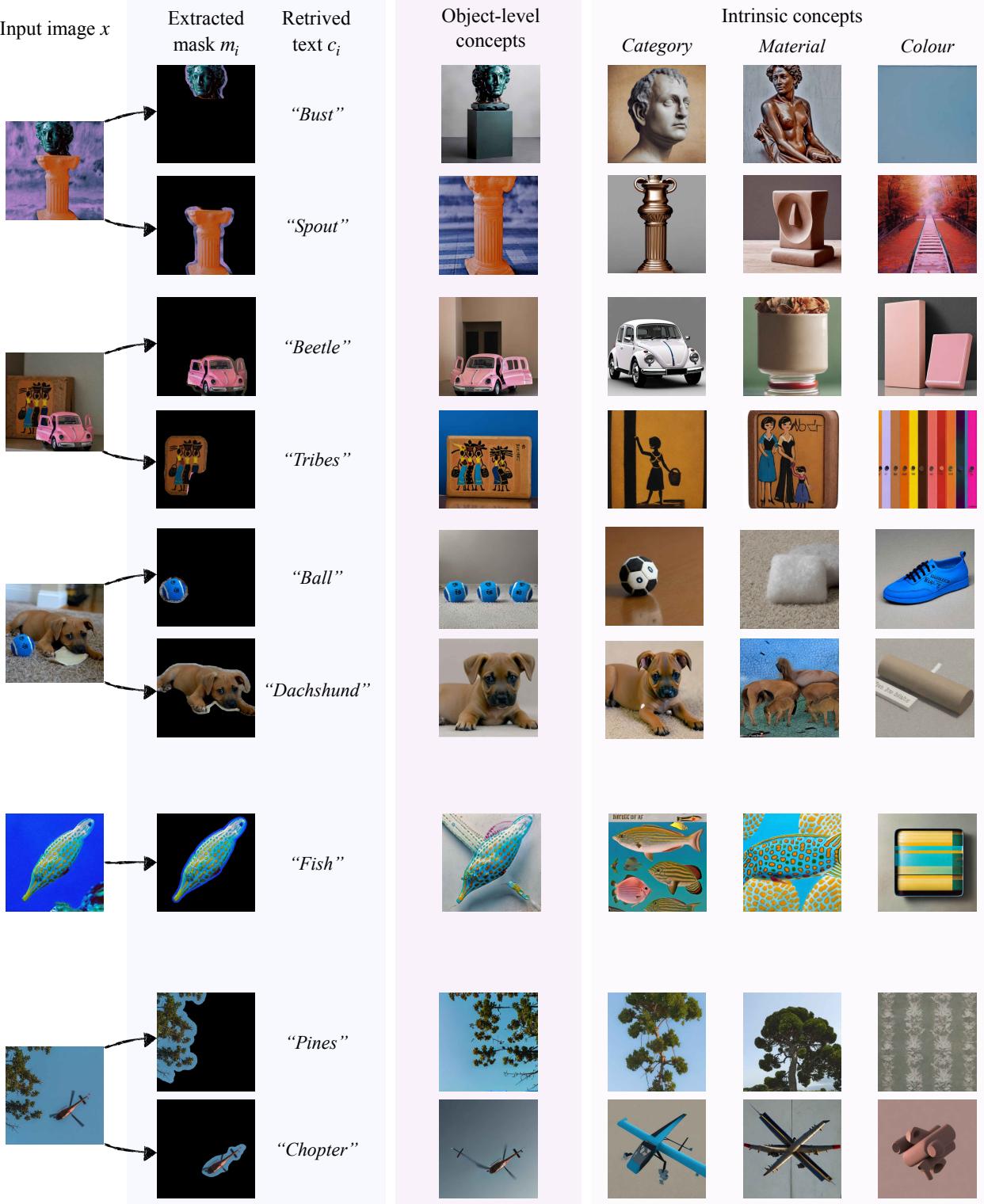
Look at the rows in Figure 6 above.
- Row 1 (Bust): ICE identifies the “Bust” (sculpture). It then breaks it down. It sees the Category (Sculpture), the Material (Bronze/Metal), and the Colour (Blue/Patina).
- Row 3 (Beetle): It sees a pink car. It extracts “Beetle” (Instance), “Car” (Category), “Plastic/Toy” (Material), and “Pink” (Colour).
Crucially, look at the masks in the second column. These were generated automatically. ICE successfully isolated the car from its box and the bust from the background.
Quantitative Comparison
The researchers measured performance using metrics like SIM (Similarity)—how well the learned concept matches the original image—and ACC (Accuracy)—how well the extracted concepts can be classified.
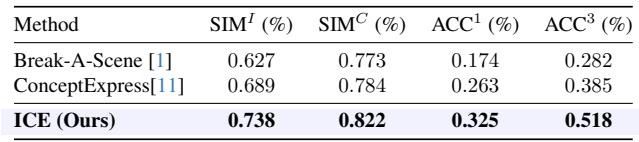
As shown in Table 2, ICE outperforms previous methods across the board.
- SIM\(^I\) (Identity Similarity): 0.738 vs 0.689 for ConceptExpress. This means ICE is much better at capturing the true identity of the object.
- SIM\(^C\) (Compositional Similarity): 0.822 vs 0.784. This means ICE is better at composing the scene correctly.
Better Segmentation
One of the standout features of ICE is that its Stage One (Automatic Concept Localization) is actually a better segmenter than the methods used by competitors.

In Figure 7, look at the “Concept Express” column. It frequently produces empty black boxes (“n.a.”) because it failed to localize the object. ICE (labeled “Ours”) consistently finds the woman, the dog, the Buddha, and the figurines.
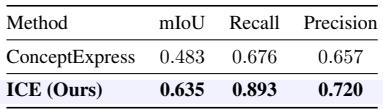
The quantitative data backs this up. In Table 5 (below), ICE achieves a mean Intersection over Union (mIoU) of 0.635 compared to ConceptExpress’s 0.483. That is a massive jump in segmentation accuracy.
Applications: Compositional Generation
Why does this matter? Beyond just “understanding,” ICE allows for powerful editing capabilities. Because ICE separates Shape from Material and Colour, users can mix and match these attributes.
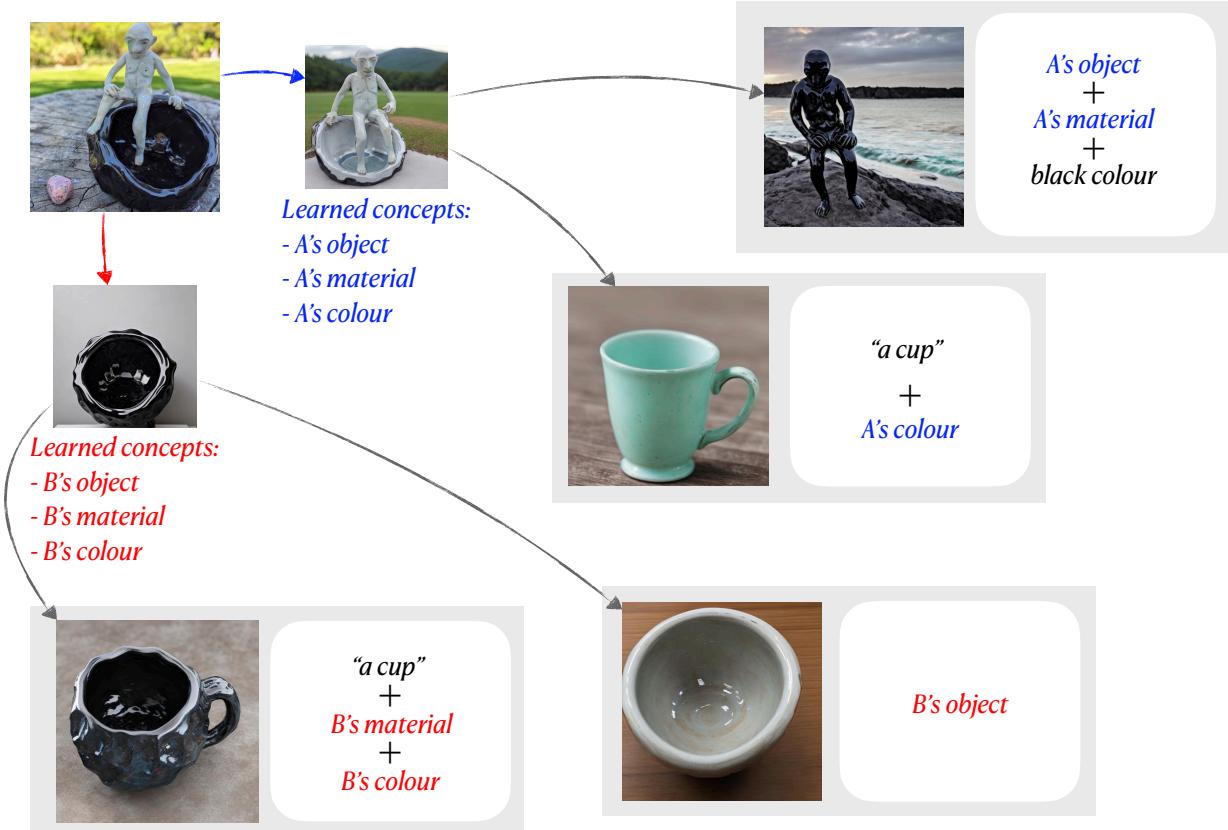
In Figure C, notice the top row. ICE extracts the concept of the figurine (Object A).
- It can generate “A’s object + A’s material + black colour” (changing only the color).
- It can generate “a cup + A’s colour” (transferring the color to a new object).
- In the bottom row, it takes a dark mug (Object B) and generates “a cup + B’s material + B’s colour,” effectively transferring the texture and style of the original mug to a generic cup shape.
This level of disentanglement—being able to pull the “texture” off an object and paint it onto something else—is the holy grail of concept learning.
Conclusion
The ICE framework represents a significant step forward in unsupervised computer vision. By leveraging the “world knowledge” inherent in diffusion models, it moves beyond simple image generation and toward true image comprehension.
Its two-stage approach offers a robust solution to the ambiguity problem:
- Stage One automates the tedious task of finding and masking objects.
- Stage Two forces the model to structure its understanding, rigorously separating distinct attributes like material and color via Triplet Loss.
For students and researchers, ICE demonstrates that Diffusion Models are not just “art generators.” They are dense repositories of visual concepts. With the right framework, we can unlock that repository, turning these models into powerful tools for extracting and organizing visual information from the chaotic world around us.
As we move forward, techniques like ICE will likely become foundational for advanced photo editing, 3D asset creation, and semantic scene understanding, bridging the gap between how pixels are arranged and what they actually mean.