](https://deep-paper.org/en/paper/2503.20308/images/cover.png)
If you have ever played a modern RPG or watched a dubbed movie using AI-generated lip-sync, you have likely experienced the “Uncanny Valley.” The character’s lips are moving, and technically they are hitting the right shapes for the sounds, but something feels off. The mouth might open perfectly for an ‘a’ vowel, but it lacks the energy of the shout, or the timing is just a few milliseconds too robotic.
For years, the field of speech-driven 3D talking head generation has chased a specific mathematical goal: minimizing the physical distance between the generated 3D lip vertices and the “ground truth” recording. This is measured by Lip Vertex Error (LVE). The logic is simple: if the geometry matches the recording, the animation is perfect.
However, a recent paper titled “Perceptually Accurate 3D Talking Head Generation” challenges this assumption. The authors argue that a low geometric error does not guarantee a realistic animation. Human perception is far more complex than a Mean Squared Error (MSE) calculation.
In this post, we will deconstruct this research. We will explore why current models feel robotic, introduce a new “Speech-Mesh” representation that captures the feel of speech, and look at how this can be plugged into existing models to drastically improve realism.
The Problem: Geometry vs. Perception
The core issue with existing methods (like FaceFormer or CodeTalker) is that they rely heavily on minimizing MSE loss. While this reduces the LVE metric, it fails to capture the perceptual alignment between speech and motion.
The authors identify a critical gap: existing datasets are often small and lack intensity range (people usually speak at a normal volume in datasets). Consequently, models fail to learn that a shout requires a wider mouth opening than a whisper, even if the phoneme is the same.
Defining Perceptually Accurate Lip Movement
So, what actually makes a talking head look “real” to a human? The researchers propose three essential criteria:
- Temporal Synchronization: The lips must move at the exact same time as the audio. Humans are incredibly sensitive to audio-visual delays.
- Lip Readability: The visual shape (viseme) must accurately reflect the sound (phoneme). If you hear a “b” but see an “o” shape, the illusion breaks.
- Expressiveness: This is the often-overlooked factor. As speech intensity (loudness/emotion) increases, jaw and lip movements should proportionally increase.
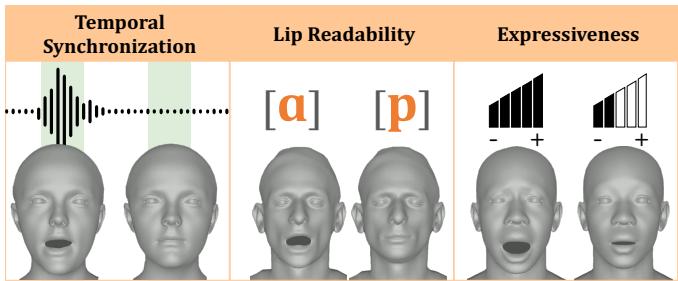
As shown in Figure 1(a) above, these three pillars support perceptual accuracy. Interestingly, the researchers conducted a human study to see which of these factors matters most.
Look at the table above. In a side-by-side comparison, participants actually preferred Sample B—which had high expressiveness but was out of sync by 100ms—over Sample A, which was perfectly timed but lacked expressiveness. This suggests that humans might prioritize the intensity and energy of the motion (Expressiveness) over strict temporal precision, a finding that completely upends the traditional focus on vertex accuracy.
The Core Method: Speech-Mesh Synchronized Representation
To solve this, the authors didn’t just build a new generator; they built a new representation space. They hypothesized the existence of a shared latent space where speech and 3D facial movements are perfectly aligned according to the three criteria mentioned above.
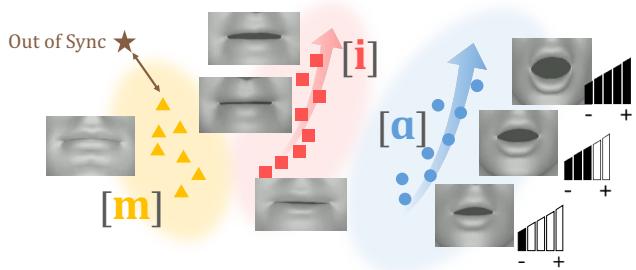
The diagram above illustrates this “Desired Representation Space.” In this space, representations of the same phoneme (like [a] or [i]) should cluster together (Lip Readability), trajectories should align temporally (Synchronization), and the magnitude of the vectors should grow as speech gets louder (Expressiveness).
Building this space is difficult because 3D scan data is expensive and scarce. However, 2D video data is abundant. The authors propose a clever two-stage training pipeline to overcome this data scarcity.
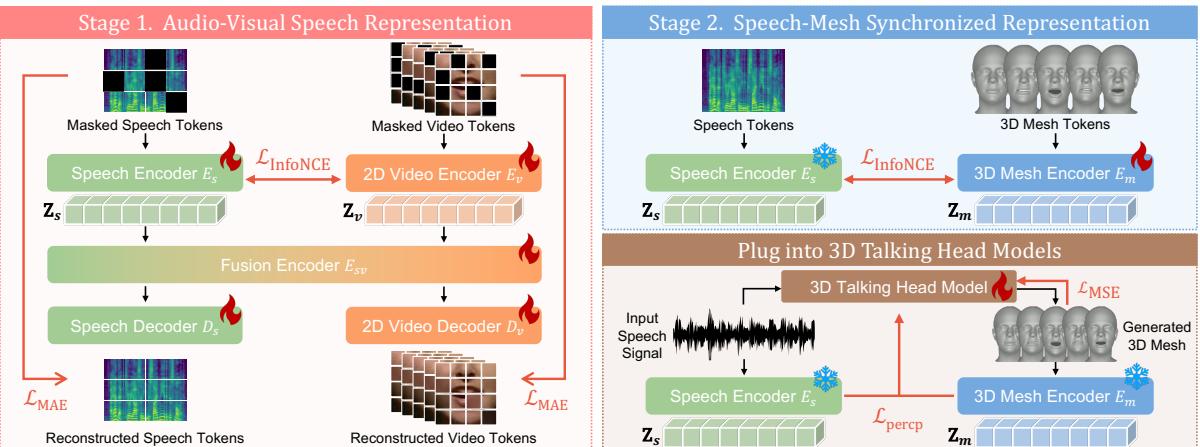
Stage 1: Learning Audio-Visual Speech Representation (2D)
Before touching 3D meshes, the model learns from standard 2D video datasets (like LRS3). The goal here is to learn the relationship between audio and lip motion generally.
The architecture uses a Transformer-based approach with two key learning objectives:
- Masked Autoencoder (MAE): The model randomly masks parts of the audio and video and tries to reconstruct them. This forces the model to understand the context and structure of the data.
- Contrastive Learning (InfoNCE): This aligns the audio and video in a shared space.
The InfoNCE loss function pulls the embeddings of synchronized audio and video together while pushing unsynchronized pairs apart. The equation for the speech-to-video loss is:

Here, \(\mathbf{c}_{s,i}\) and \(\mathbf{c}_{v,i}\) are the speech and video embeddings. The total InfoNCE loss is the sum of speech-to-video and video-to-speech losses:

The reconstruction (MAE) loss ensures that the model retains the detailed information of the original signals:

The total objective for Stage 1 combines these, creating a rich “Audio-Visual Speech Representation.”

Stage 2: Learning Speech-Mesh Representation (3D)
Now comes the “transfer” magic. The authors take the robust speech encoder trained in Stage 1 and freeze it. They then introduce a 3D Mesh Encoder.
Using a dataset of speech-3D mesh pairs, they train the Mesh Encoder to map 3D vertices into that same frozen speech space defined in Stage 1. Because the speech space was learned from massive 2D datasets, it already possesses “emergent properties”—it knows about intensity and phoneme clustering. By forcing the 3D meshes to align with this space, the 3D representation inherits those rich properties.
The loss function here aligns the mesh embeddings \(\mathbf{c}_{m}\) with the fixed speech embeddings \(\mathbf{c}_{s}\):

The “Plug-and-Play” Perceptual Loss
The ultimate contribution of this paper isn’t just the representation itself, but how it’s used. This learned representation acts as a Perceptual Loss.
You can take any existing 3D talking head model (like FaceFormer or CodeTalker) and add this loss function during training. Instead of just minimizing the physical distance of vertices (MSE), the model now tries to minimize the distance between the generated mesh’s embedding and the input audio’s embedding in this perceptually aligned space.
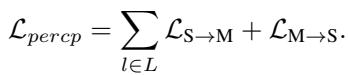
This loss (\(\mathcal{L}_{percp}\)) acts as a guide, correcting the model when it generates movements that are geometrically “okay” but perceptually “dead.”
New Definitions: Evaluating What Matters
Since the authors argue that LVE (Lip Vertex Error) is insufficient, they introduce three new metrics corresponding to their three criteria.
1. Mean Temporal Misalignment (MTM)
To measure timing errors without needing manual labels, the researchers use Derivative Dynamic Time Warping (DDTW). They calculate the velocity of lip movements for both the ground truth and the generated mesh and find the temporal offset between them.
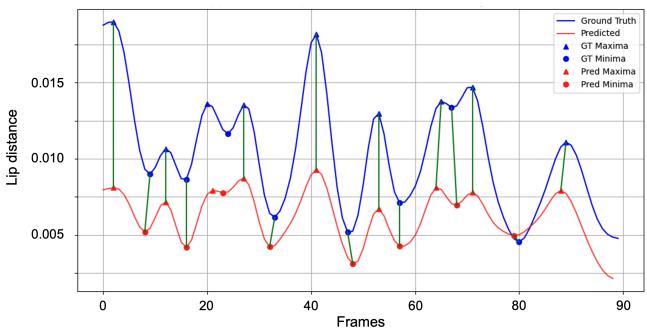
As seen in the figure above, DDTW identifies local peaks (mouth opening/closing) and measures the time difference (\(\Delta t\)) between them.
2. Perceptual Lip Readability Score (PLRS)
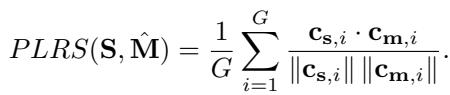
This metric re-uses the pre-trained Speech-Mesh representation. It calculates the cosine similarity between the input speech and the generated mesh in that learned latent space. If the model generates the correct viseme for the phoneme, the embeddings should be close, resulting in a high score.
3. Speech-Lip Intensity Correlation Coefficient (SLCC)
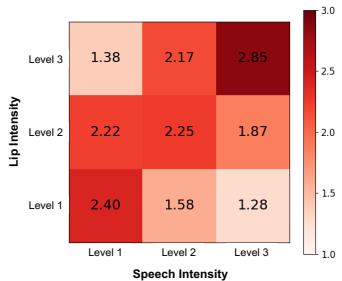
This metric assesses expressiveness. It measures the correlation between the loudness of the speech (Speech Intensity or SI) and the magnitude of the lip movement (Lip Intensity or LI).

A high correlation (\(r_{SL}\)) means the avatar opens its mouth wider when the audio is louder, imitating natural human behavior.
Experiments and Results
The researchers tested their method by plugging their perceptual loss into state-of-the-art models (FaceFormer, CodeTalker, SelfTalk) and evaluating them on standard datasets (VOCASET) and new, more expressive datasets (MEAD-3D).
Does the Representation Work?
First, they analyzed the learned representation space itself.
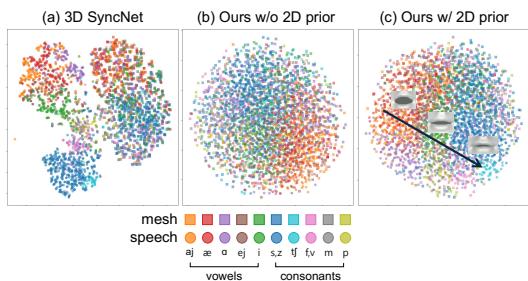
The t-SNE plots above show the feature space.
- (a) 3D SyncNet: A baseline method shows scattered clusters.
- (b) Ours w/o 2D prior: Without Stage 1 (2D video training), the features are messy.
- (c) Ours w/ 2D prior: With the full two-stage pipeline, we see distinct, clean clusters where speech (circles) and mesh (squares) of the same phoneme group together tightly. This confirms that the 2D initialization is crucial.
They also verified the representation’s sensitivity to timing and intensity.
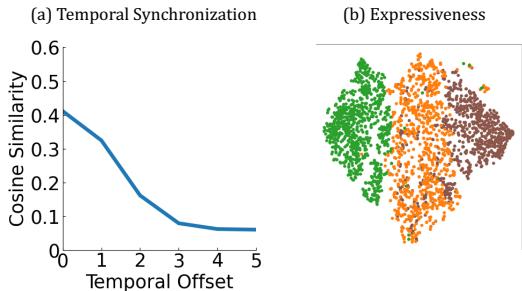
In Figure 5(a), the cosine similarity drops sharply as the audio and mesh become desynchronized, proving the metric is sensitive to timing. In Figure 5(b), distinct clusters form for low, medium, and high intensity, proving the space understands expressiveness.
Improving Existing Models
When the perceptual loss was added to existing models, the results were significant.

In the qualitative comparison above, look at the columns marked +Ours. The lip shapes are more distinct and accurate compared to the base models. For example, in the pronunciation of “some” (top row), the +Ours versions show better lip closure (bilabial sounds) than the baselines.
Unlocking Expressiveness
Perhaps the most dramatic improvement is in expressiveness. The authors found that training on standard datasets (VOCASET) limits expressiveness because the data is “flat.” However, by combining a more expressive dataset (MEAD-3D) with their perceptual loss, they achieved high-fidelity emotional speech.
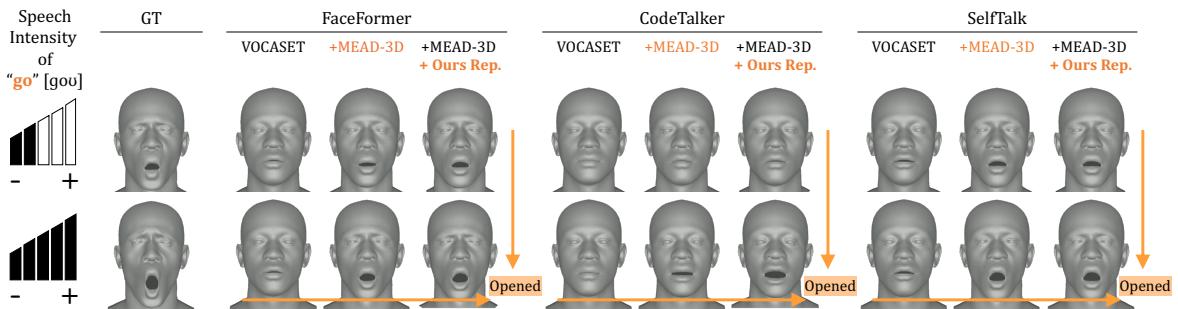
Figure 6 shows the difference between low (-) and high (+) intensity speech. The models trained with the perceptual loss (labeled +Ours rep.) show a much wider range of motion for high-intensity speech (orange arrows), opening the mouth significantly wider than the standard models.
Finally, an ablation study confirmed that every part of the architecture matters.
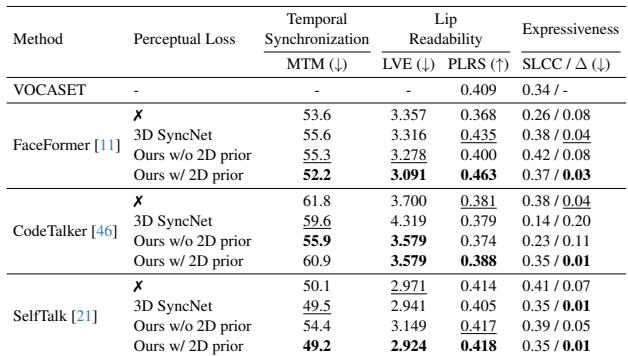
Table 3 shows that removing the 2D prior (Stage 1) creates a model that performs significantly worse on PLRS (Readability) and MTM (Timing). The transformer architecture also outperforms CNN-based approaches (SyncNet).
Conclusion and Implications
This research marks a pivot point for 3D facial animation. It moves the goalposts from geometric accuracy (matching vertices) to perceptual accuracy (matching human expectations).
By defining the “Holy Trinity” of lip-sync—Synchronization, Readability, and Expressiveness—and building a representation space that naturally understands them, the authors have provided a tool that can upgrade almost any existing talking head model.
For students and researchers, the key takeaway is the power of cross-modal transfer learning. By learning rich features from abundant 2D video data and projecting sparse 3D data into that space, we can solve problems that seemed impossible with 3D data alone. The result is digital avatars that don’t just move their lips, but actually speak.