](https://deep-paper.org/en/paper/2503.20519/images/cover.png)
The transition from 2D image generation to 3D content creation is one of the most exciting, yet technically challenging, frontiers in modern AI. While models like Midjourney or Stable Diffusion can dream up photorealistic images in seconds, generating a high-quality, watertight 3D mesh that looks good from every angle is a significantly harder problem.
The challenges are structural. Unlike images, which are neat grids of pixels, 3D data is unordered and sparse. Traditional methods often struggle to balance high geometric resolution with computational efficiency. Today, we are diving deep into MAR-3D, a novel framework presented by researchers from the National University of Singapore and collaborators. This paper introduces a “Progressive Masked Auto-regressor” that fundamentally changes how we approach high-resolution 3D generation.
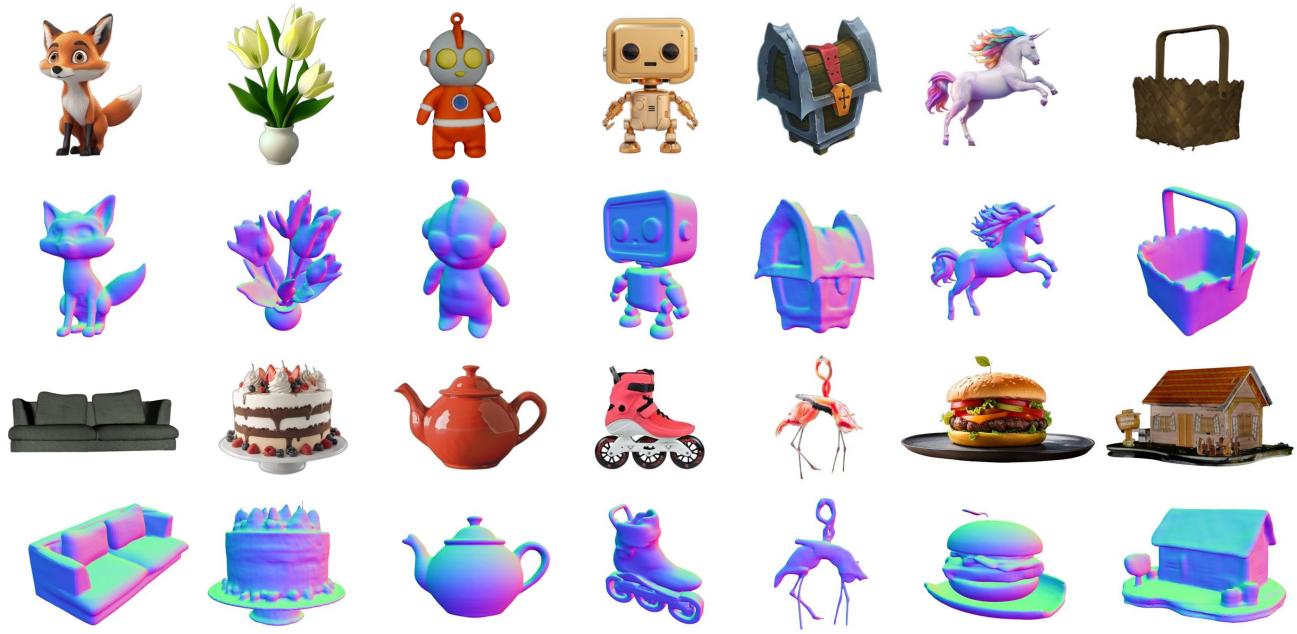
As seen in the figure above, MAR-3D is capable of generating varied, high-fidelity objects ranging from organic shapes (like the fox) to complex rigid structures (like the treasure chest). In this article, we will unpack the architecture that makes this possible, moving from the foundational Pyramid VAE to the sophisticated Cascaded Masked Auto-Regressive system.
The Core Problem: Why is 3D Generation So Hard?
To appreciate the solution MAR-3D offers, we first need to understand the bottlenecks in current 3D generative modeling.
- The Unordered Nature of 3D: In Natural Language Processing (NLP), data is sequential. Word A leads to Word B. In 3D space, a chair’s leg doesn’t necessarily come “before” or “after” its backrest. They exist simultaneously. Forcing 3D data into a strict sequence—common in standard auto-regressive models—can be unnatural and inefficient.
- Compression Loss: To make 3D data manageable for neural networks, we typically compress it into latent tokens using Vector Quantization (VQ). However, standard VQ is “lossy.” It approximates the continuous shape with a discrete codebook, often losing fine geometric details like sharp edges or thin structures.
- The Scaling Problem: The computational complexity of Transformer-based generators grows quadratically with the sequence length. If you want to double the resolution of your 3D model, the computational cost doesn’t just double; it explodes. This makes generating high-resolution meshes directly from a single model incredibly expensive.
MAR-3D addresses these by abandoning the “next-token” prediction paradigm in favor of a Masked Auto-Regressive (MAR) approach operating in continuous space, combined with a progressive upscaling strategy.
The Architecture of MAR-3D
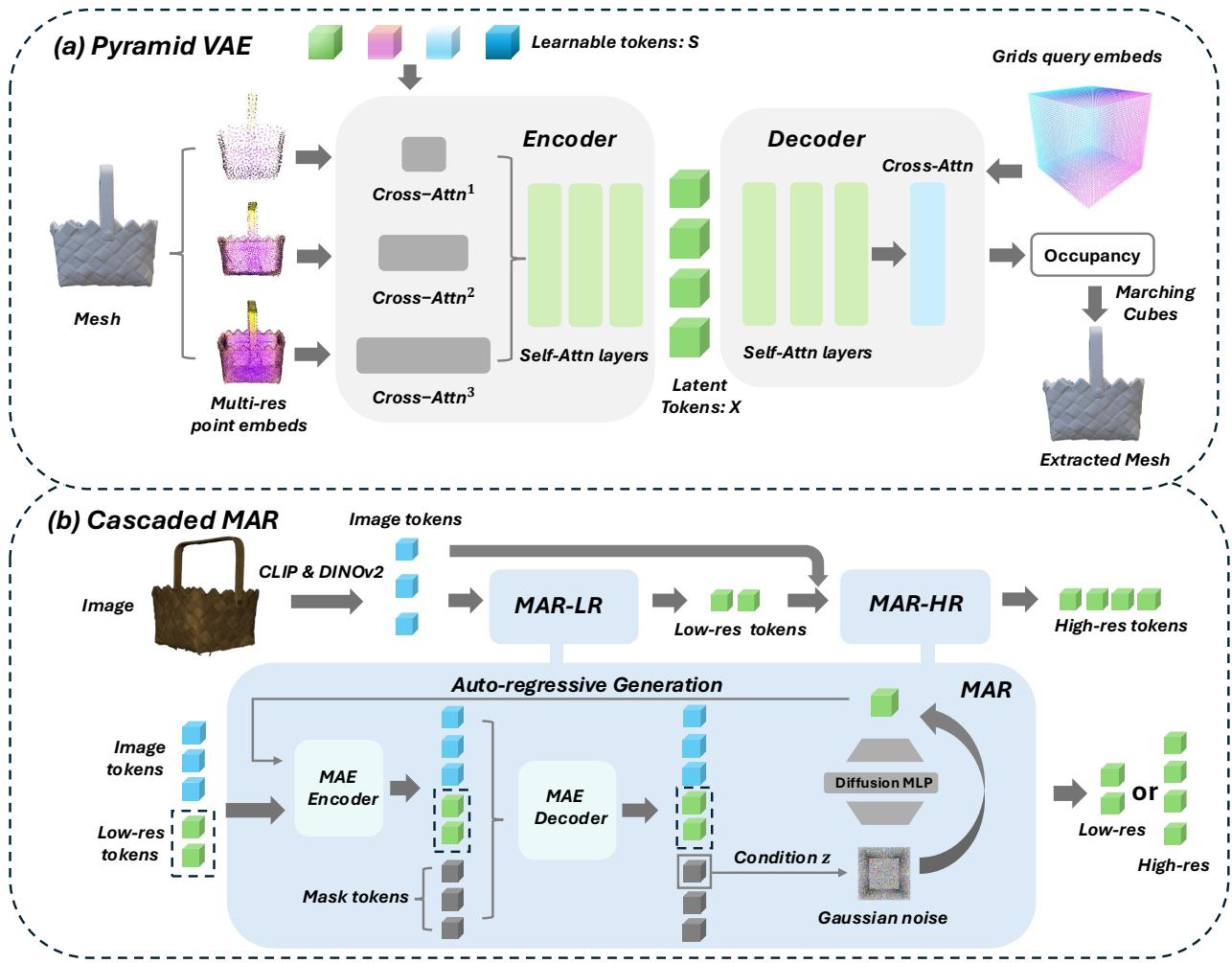
The MAR-3D framework is built upon two distinct but interconnected pillars:
- A Pyramid Variational Auto-Encoder (Pyramid VAE): To compress 3D meshes into efficient latent representations without losing detail.
- A Cascaded Masked Auto-Regressive (MAR) Model: To generate these latent representations from images, starting with a coarse shape and progressively refining it.
Let’s visualize the entire pipeline:
1. The Pyramid VAE
Standard VAEs often fail to capture the multi-scale nature of 3D objects. Some details are global (the shape of a car), while others are local (the side-mirror). The authors introduce a Pyramid VAE designed to capture this hierarchy.
The Encoder
Instead of encoding a single point cloud, the Pyramid VAE processes inputs at \(K\) different resolution levels. For a specific level \(k\), the input consists of \(N^k\) points. The system creates embeddings by concatenating the position coordinates (\(\mathbf{P}\)) with surface normals (\(\mathbf{P}_n\)).
The embedding equation for level \(k\) is defined as:
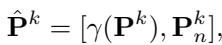
Here, \(\gamma\) represents a positional embedding function.
These multi-scale embeddings are then processed via cross-attention. The model uses learnable query tokens (\(\mathbf{S}\)) to extract features from each resolution level of the point cloud. Coarse levels provide structural info, while fine levels provide geometric nuance.
The final latent tokens \(\mathbf{X}\) are derived by summing the outputs of these cross-attention layers and passing them through self-attention layers:
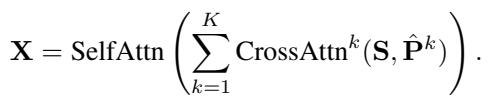
This hierarchical summation allows the model to compress the 3D data efficiently while retaining significantly more detail than a single-resolution approach.
The Decoder and Training
To reconstruct the mesh, the decoder takes these latent tokens and queries them to predict an “occupancy field”—essentially determining which points in space are inside or outside the object. The training minimizes a combination of Binary Cross-Entropy (for accurate shape) and KL-divergence (to regularize the latent space):

2. Cascaded Masked Auto-Regressive Generation
Once the Pyramid VAE is trained, we have a way to turn 3D meshes into compact tokens and back again. The next step is generation: teaching a model to predict these tokens based on an input image.
This is where MAR-3D diverges from traditional methods. Instead of predicting tokens one by one in a fixed order (autoregressive), it uses a Masked Auto-Regressive approach.
Random Masking and Continuous Space
In this setup, the model is trained to reconstruct random subsets of tokens. During training, a large portion of the latent tokens are masked out. The model must predict the missing tokens based on the visible ones and the condition image (processed via CLIP and DINOv2).
Critically, the authors model the latent tokens in continuous space using a diffusion process, rather than a discrete codebook. This avoids the “quantization error” that makes other methods look blocky or low-fidelity.
The loss function for this diffusion-based token generation is:

Here, \(\mathbf{z}\) is the condition vector output by the encoder, and the model tries to denoise the latent token \(\mathbf{x}\).
The Cascade: Coarse-to-Fine
Directly predicting a massive number of high-resolution tokens is computationally prohibitive. MAR-3D solves this with a cascade of two models:
- MAR-LR (Low Resolution): This model takes the input image and generates a small set of “global” tokens. These capture the rough shape and posture of the object.
- MAR-HR (High Resolution): This model takes the input image and the tokens generated by MAR-LR. It effectively “upscales” the representation, adding fine geometric details.
The probability distribution for the sequence of tokens is modeled progressively:
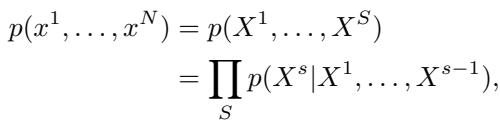
This cascaded approach decouples the structural generation from the detailing, allowing the system to scale to higher resolutions without requiring hundreds of GPUs.
Handling Error Propagation: Condition Augmentation
A classic problem in cascaded systems is error propagation. If MAR-LR makes a slight mistake, MAR-HR treats it as ground truth and might hallucinate weird details to compensate.
To fix this, the researchers use Condition Augmentation. During training, they intentionally corrupt the low-resolution tokens fed into MAR-HR with noise. This teaches MAR-HR to be robust and to fix minor errors from the low-res stage rather than amplifying them.
The augmentation is applied as follows:

Where \(t\) is a mixing factor. This simple interpolation between the token and noise makes the super-resolution model significantly more stable.
3. Inference Schedule
During inference (generating a new object), the model doesn’t just guess everything at once. It uses a parallel decoding strategy.
It starts with the image tokens. Then, it generates the latent tokens iteratively. Interestingly, the number of tokens generated at each step isn’t constant. It follows a cosine schedule, meaning it generates fewer tokens in early steps (when uncertainty is high) and more tokens in later steps (when the structure is established).

Furthermore, the diffusion process uses Classifier-Free Guidance (CFG) to strictly adhere to the input image. The guidance scale \(\omega_s\) is also dynamic, increasing linearly over time to tighten the visual consistency as the generation progresses.

Experiments and Results
Does this complex architecture actually yield better 3D meshes? The experiments conducted on the Google Scanned Objects (GSO) and OmniObject3D datasets suggest a resounding yes.
Quantitative Comparison
The authors compared MAR-3D against several state-of-the-art methods, including InstantMesh (a multi-view diffusion model), LGM (Large Gaussian Model), and CraftsMan (a similar VAE-diffusion pipeline).
The metrics used were:
- Chamfer Distance (CD): Measures the geometric distance between the generated mesh and the ground truth. (Lower is better).
- F-Score: A measure of reconstruction accuracy. (Higher is better).
- Normal Consistency (NC): Measures how well surface orientations match. (Higher is better).
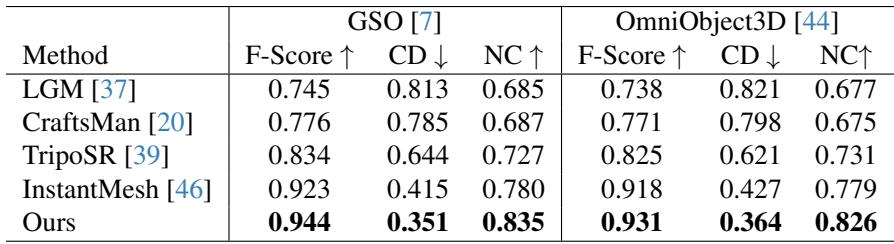
As shown in Table 1, MAR-3D achieves the best scores across the board. Notably, the Chamfer Distance (CD) on the GSO dataset is 0.351, significantly lower than InstantMesh’s 0.415. This indicates that MAR-3D’s geometry is much tighter and truer to the real objects.
Qualitative Comparison
Numbers are useful, but in computer graphics, visual inspection is paramount. Figure 3 displays a comparison of normal maps (which highlight surface details) across different methods.
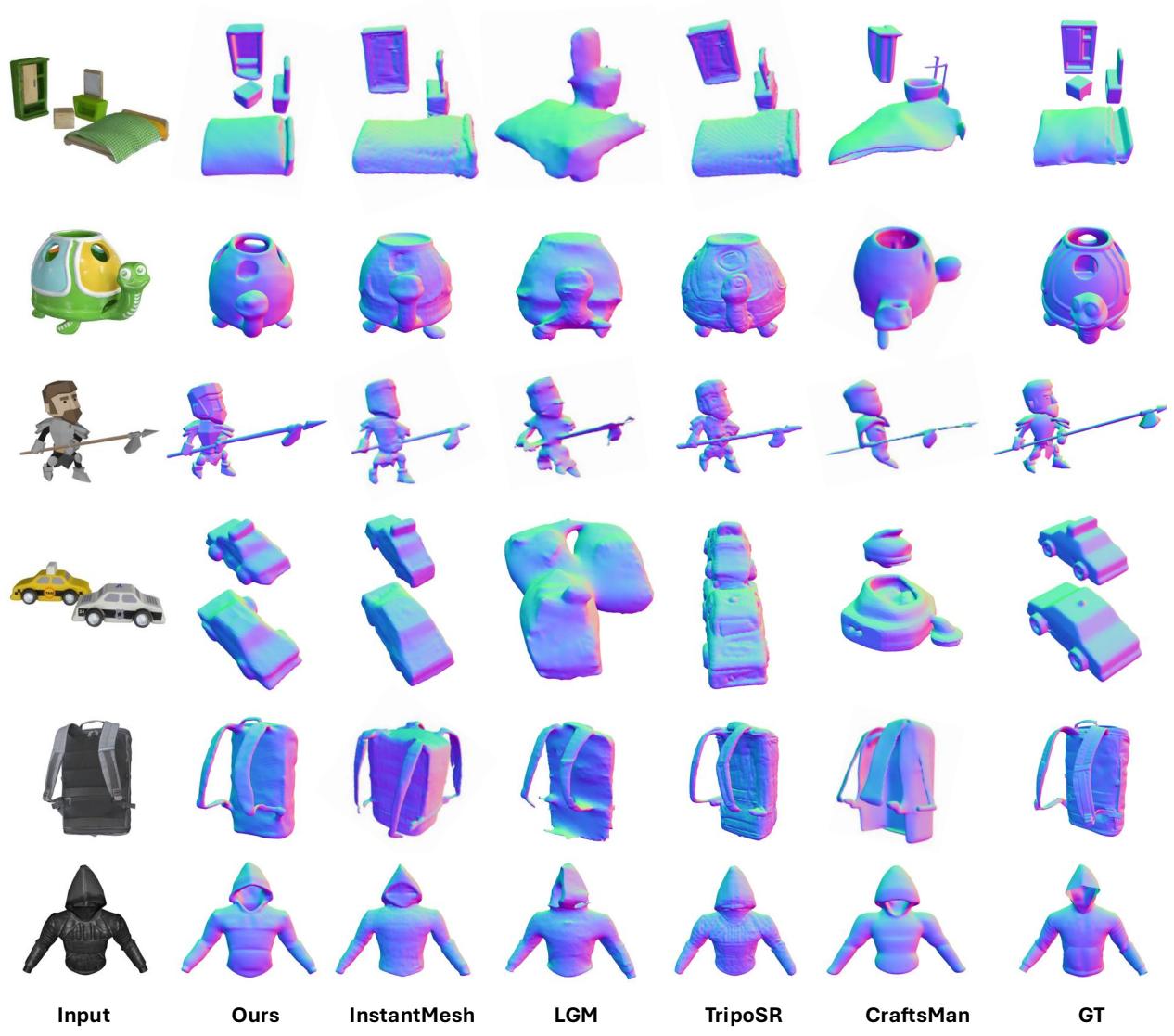
Looking at the Backpack (row 5) or the Turtle (row 2), the difference is stark:
- LGM often produces noisy or blurry surfaces.
- CraftsMan struggles with complex topology, sometimes missing parts entirely.
- InstantMesh is good but tends to smooth out fine details.
- MAR-3D (Ours) retains sharp creases, intricate textures (like the backpack straps), and correct topology.
Why the Pyramid VAE Matters
One of the key claims of the paper is that the Pyramid architecture is essential for handling high token counts efficiently. The ablation study in Figure 4 and Figure 6 proves this.
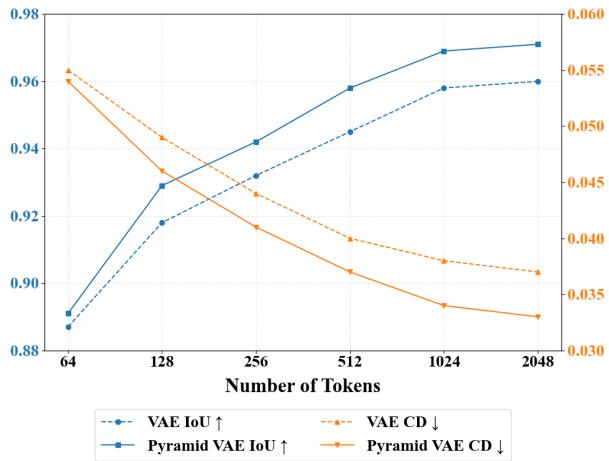
The graph shows that the Pyramid VAE (orange and red lines) consistently outperforms the standard VAE (blue and green lines) at equivalent token counts.
Visually, the difference is even more obvious:
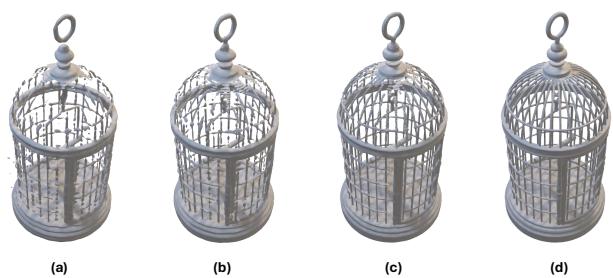
In Figure 6, compare the birdcage in (b) (Standard VAE, 1024 tokens) with (d) (Pyramid VAE, 1024 tokens). The standard VAE fails to capture the thin vertical bars, turning the cage into a mushy blob. The Pyramid VAE, utilizing the same number of tokens, preserves the thin bars perfectly.
Why Cascaded Generation Matters
Finally, the researchers tested why the “Cascade” (LR \(\rightarrow\) HR) is better than just training a massive model to do everything at once (Joint Distribution Modeling, like standard Diffusion Transformers or DiT).
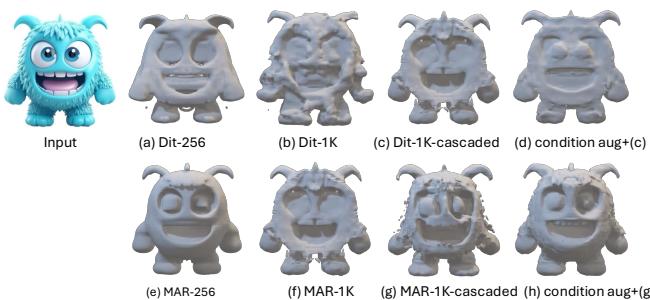
In Figure 5, column (b) shows a standard DiT attempting to generate 1024 tokens directly. The result is distorted and poorly converged. Column (h) shows the full MAR-3D pipeline (Cascaded MAR + Condition Augmentation). The result is a clean, highly detailed monster. This confirms that breaking the problem into “Shape First, Detail Second” is a far more stable training strategy than brute force.
Conclusion and Implications
MAR-3D represents a significant step forward in generative 3D. By combining the strengths of Masked Auto-Regressive modeling (which handles the “what should go where” puzzle efficiently) with Diffusion processes in a continuous latent space (preserving detail), it solves several legacy problems in the field.
Key takeaways for students and researchers:
- Don’t fear the hierarchy: The Pyramid VAE shows that processing data at multiple scales simultaneously is crucial for 3D, where fine details and global shape are equally important.
- Continuous is often better than discrete: Avoiding vector quantization allows for smoother, higher-fidelity outputs.
- Divide and Conquer: The cascaded strategy (LR then HR) proves that you don’t need infinite compute to generate high-resolution results; you just need to structure the generation process intelligently.
As we look toward the future of 3D asset generation for gaming, VR, and film, architectures like MAR-3D pave the way for automated creation pipelines that require less manual cleanup and offer higher fidelity out of the box.