](https://deep-paper.org/en/paper/2503.20779/images/cover.png)
Digital clothing has always been a thorn in the side of computer graphics. If you play modern video games or watch visual effects breakdowns, you might notice that while faces are becoming indistinguishable from reality, clothing often lags behind. It either looks like a stiff plastic shell, or it moves weirdly, or it lacks that fuzzy, tactile “softness” that real fabric has.
Traditionally, we’ve had to choose between two imperfect options: mesh-based simulations that move well but lack detailed texture, or volumetric captures that look photorealistic but break apart when they move.
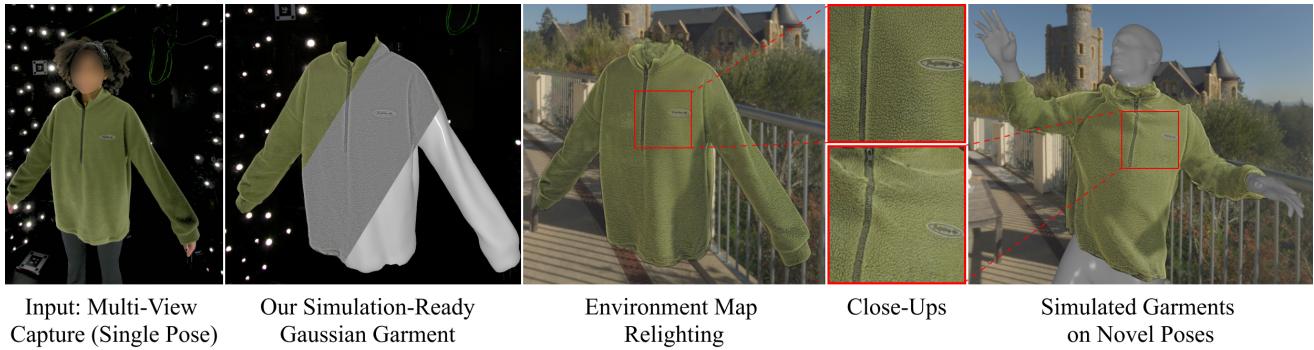
But what if you didn’t have to choose? In a fascinating new paper titled “PGC: Physics-Based Gaussian Cloth from a Single Pose,” researchers from Stanford University and Meta Reality Labs propose a hybrid method. They have figured out a way to take a single multi-view snapshot of a person and generate a digital garment that is simulation-ready, highly detailed, and fully relightable.
In this deep dive, we will unpack how they managed to merge the structural reliability of physics simulations with the visual fidelity of 3D Gaussian Splatting.
The Problem: Geometry vs. Appearance
To understand why this paper is significant, we first need to understand the limitations of current techniques.
The Mesh Limitation
Standard digital clothing is built on meshes—networks of triangles that define the shape of a shirt or dress. Meshes are excellent for physics. We have decades of algorithms (like XPBD or FEM) that can calculate how a mesh should fold, wrinkle, and drape when a character moves.
However, meshes are just surfaces. They don’t account for “fuzz.” Real fabrics, like fleece or wool, have loose fibers, flyaways, and micro-geometry that a flat triangle cannot represent. To make a mesh look like cloth, we usually paste 2D textures onto it. This works for smooth silk, but for a knit cardigan, it often looks like a wallpapered polygon.
The Gaussian Limitation
Enter 3D Gaussian Splatting (3DGS). Instead of triangles, 3DGS represents a scene as millions of 3D blobs (Gaussians), each with its own color, opacity, and scale. This technique is incredible at capturing “fuzzy” details and volumetric effects.
The problem? Gaussians are unstructured. They don’t naturally stick together like a fabric. If you try to animate a cloud of Gaussians, they don’t know they are supposed to be a shirt; they might separate or distort in ugly ways. Furthermore, standard Gaussian splatting “bakes in” the lighting. If you scan a shirt in a bright room, the digital version will forever look like it’s in a bright room, even if you put the character in a dark cave.
The Solution: A Hybrid Approach
The researchers propose a method that treats the garment as a hybrid signal. They realized that clothing appearance can be split into two categories:
- Low-Frequency Information: The overall shape, large folds, and shadows caused by lighting. This is handled best by Meshes and Physically Based Rendering (PBR).
- High-Frequency Information: The fine texture, seams, stray fibers, and fabric fuzz. This is handled best by Gaussian Splats.
By combining these two, PGC (Physics-Based Gaussian Cloth) achieves the best of both worlds.
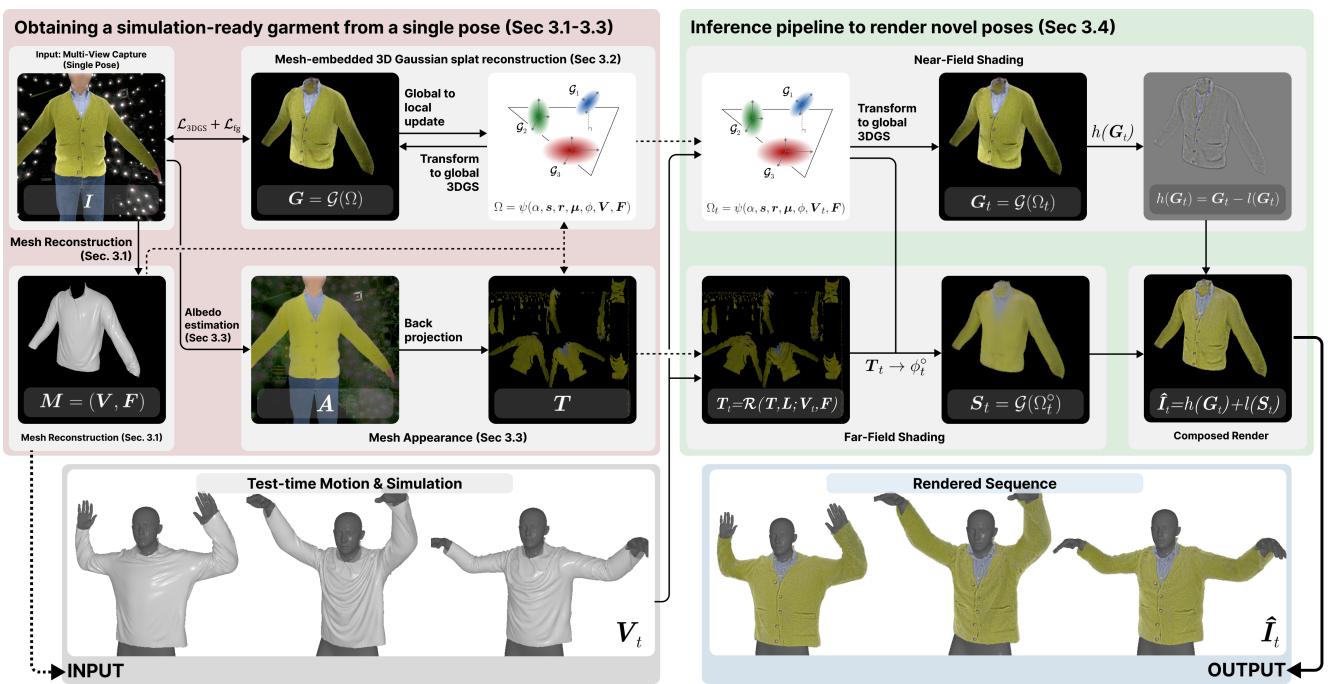
As shown in the overview above, the process starts with a single static pose. From this capture, the system builds a mesh-embedded Gaussian representation. This allows the system to simulate the underlying mesh using physics, while the Gaussians ride along on the surface to provide the realistic details.
Core Method: Deconstructing the Pipeline
Let’s break down the technical architecture of PGC step-by-step.
1. Mesh-Embedded Gaussian Splats
Standard 3D Gaussians float freely in space. In PGC, every Gaussian is anchored to a specific triangle on the garment mesh.
Imagine the mesh as the “skin” of the cloth. The researchers sample millions of points across this mesh. At each point, they define a Gaussian splat. Crucially, the position and rotation of these splats are defined within the local coordinate system of their parent triangle.
This is the key to animation. When the physics simulator moves the mesh triangle (because the character waved their arm), the Gaussian splat automatically moves and rotates with it.
The transformation from local triangle coordinates to world space is handled by the following set of equations:
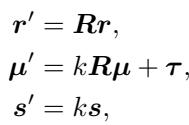
Here, \(r'\) and \(\mu'\) represent the global rotation and position. By tying these to the mesh’s rotation matrix \(R\) and position \(\tau\), the visual details (the Gaussians) are perfectly synchronized with the physics simulation (the mesh).
2. Physically-Based Rendering (PBR) and Albedo
If we simply trained Gaussians on the input images, we would have the “baked-in lighting” problem. The shadows under the armpit would be painted onto the texture. If the character raised their arm, the shadow would still be there, which looks wrong.
To fix this, the researchers implement a Physically-Based Rendering (PBR) pipeline alongside the Gaussians.
They use an intrinsic image decomposition network to estimate the albedo (the raw color without lighting) of the garment. They then use differentiable rendering to estimate the material properties, such as roughness and sheen.
The Importance of Sheen: Fabrics interact with light differently than plastic or metal. Specifically, cloth exhibits “sheen”—strong scattering of light at grazing angles (think of how velvet looks bright on the edges). Standard PBR models (like Lambertian) fail to capture this.
The researchers adopted a specific cloth-shading model (based on Disney BRDF but improved) to capture this effect.
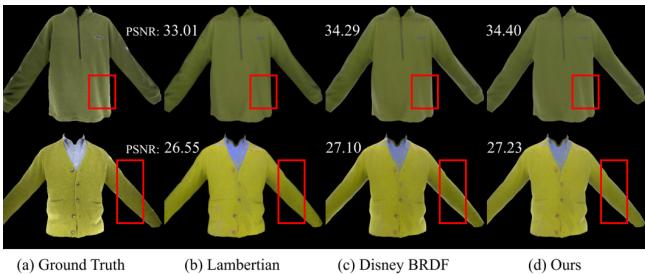
In the comparison above, look closely at the red box on the sleeve. The Lambertian model looks flat. The PGC model (d) accurately recreates the way light catches the fuzzy fibers on the edge of the arm.
3. The Hybrid Rendering Equation
This is the heart of the paper. How do you combine a PBR mesh render with a Gaussian render?
The researchers rely on frequency decomposition. They assume that:
- Far-field shading (Low frequency): Shadows, global lighting, and shape are best handled by the PBR mesh.
- Near-field shading (High frequency): Texture, flyaways, and woven patterns are best handled by Gaussians.
They decompose the final image \(I\) into low-pass \(l(I)\) and high-pass \(h(I)\) components:

During inference (when generating a new frame), the system renders the scene twice.
First, it renders the PBR Mesh to get the new lighting and shadows (stored as \(S_t\)). Second, it renders the Gaussians to get the fine details (stored as \(G_t\)).
The final image is stitched together using this logic:

Here, \(h(G_t)\) extracts the high-frequency details from the Gaussian render (the texture), and \(l(S_t)\) extracts the lighting and color from the PBR render.
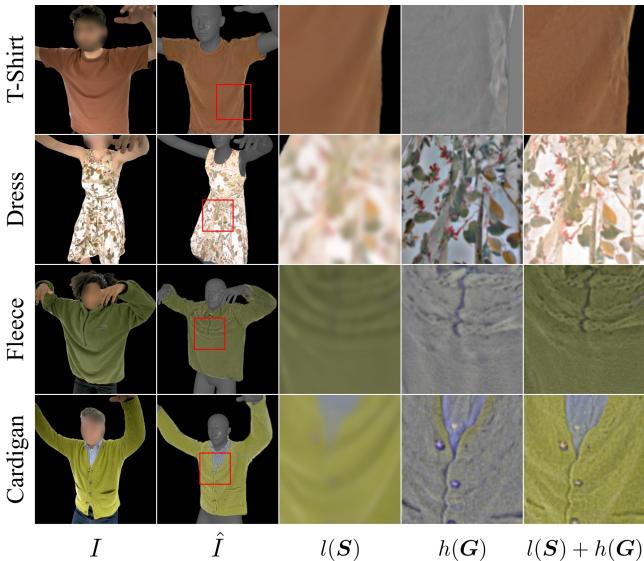
Figure 6 perfectly illustrates this. Look at the column \(l(S)\); it looks like a smooth, shaded video game model. Now look at \(h(G)\); it looks like a ghost image containing only the zippers, seams, and fabric grain. When you add them together (\(l(S) + h(G)\)), you get a photorealistic result that responds to new lighting.
Experiments & Results
The researchers validated their method using four different garments: a loose t-shirt, a dress, a fleece quarter-zip, and a knit cardigan. The setup involved a multi-view capture system with 170 cameras, though notably, they only used one single frame for training.
Ablation Studies: Why Hybrid?
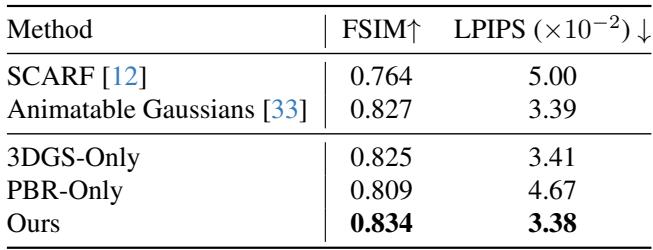
Is the hybrid approach actually necessary? The researchers compared their full method against “3DGS-Only” (pure Gaussians) and “PBR-Only” (pure Mesh).
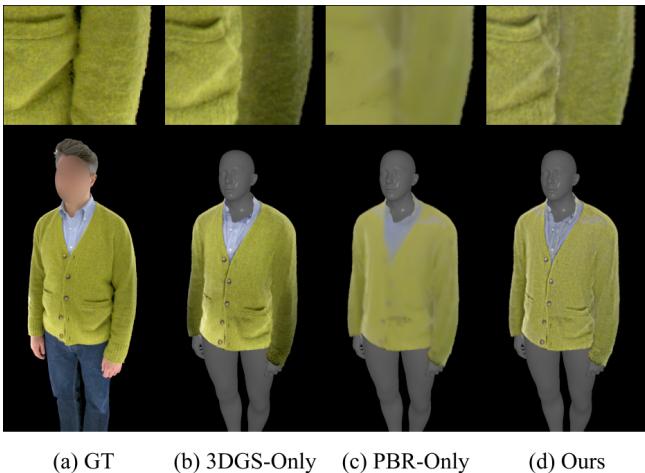
- 3DGS-Only (b): Look at the armpit area. It has dark shadows “baked” into the texture. When the arm moves, those dark spots move with it, looking like stains rather than shadows.
- PBR-Only (c): This looks clean but artificial. It lacks the depth and fuzziness of real cloth.
- Ours (d): It retains the texture of the Gaussians but the shadows are dynamic and correct.
Comparison with State-of-the-Art
The team compared PGC against leading methods like SCARF and Animatable Gaussians (AG).
The results highlight a major advantage of PGC: handling loose clothing. Methods like AG often rely on the body’s skin movement to drive the cloth, which fails when the cloth (like a dress) hangs loosely off the body. PGC uses a physics simulator (XPBD), so the skirt swishes and folds naturally.
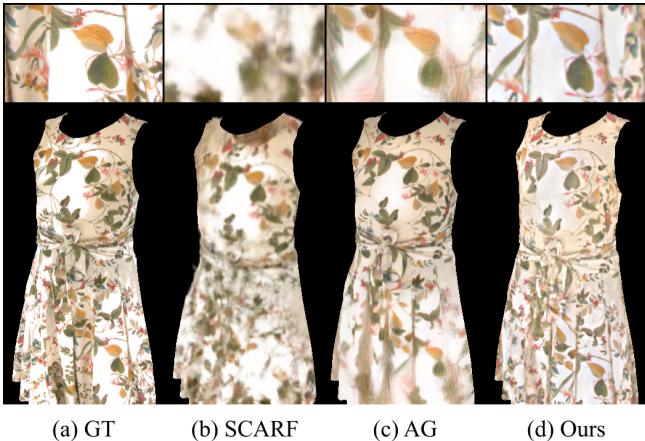
In the figure above, note the floral pattern. In SCARF (b), it is blurry. In AG (c), it is sharper but the geometry is rigid. In PGC (d), the pattern is crisp, and the dress deforms naturally.
Relighting Capabilities
Because the low-frequency component comes from a PBR model, the garment can be placed in any environment. The system essentially “scrubs” the original studio lighting from the capture and allows you to apply new HDR environment maps.
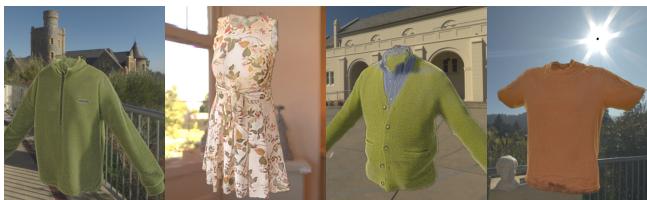
This is a massive leap forward for creating digital assets. Usually, if you scan a costume in a studio, it is difficult to use it in a night scene in a movie. PGC solves this by decoupling the texture from the lighting.
Quantitative Success
The paper includes metrics like LPIPS (perceptual similarity) and FSIM (feature similarity). In almost every metric, PGC outperformed existing methods, particularly in maintaining visual quality during novel poses.
Conclusion and Implications
PGC: Physics-Based Gaussian Cloth from a Single Pose represents a significant step toward the “holy grail” of digital avatars: assets that are easy to create (single photo capture), easy to animate (physics-based), and look indistinguishable from reality (Gaussian detail).
By successfully marrying the old guard (meshes) with the new contender (Gaussians), the authors have created a robust pipeline for digital fashion.
Key Takeaways:
- Single Frame Input: You don’t need complex video tracking to create these assets.
- Hybrid Power: Mesh handles the physics/lighting; Gaussians handle the fuzz/texture.
- Frequency Decomposition: Splitting the image into high and low frequencies allows for relighting without losing detail.
While there are still limitations—such as reconstructing areas that were completely hidden in the input photo (like the inside of a pocket)—this method opens the door for much more accessible and realistic virtual try-ons, video game characters, and VR experiences. The days of “plastic” looking digital shirts may finally be numbered.