](https://deep-paper.org/en/paper/2503.21099/images/cover.png)
Introduction
In the rapidly evolving world of computer vision, 3D object detection stands as a pillar for technologies like autonomous driving and embodied robotics. To navigate the world, machines must perceive it in three dimensions. However, the deep learning models powering these perceptions have a massive hunger for data—specifically, precise 3D bounding box annotations.
Annotating 3D point clouds is notoriously labor-intensive and expensive. While 2D images are relatively easy to label, rotating a 3D scene to draw exact boxes around every chair, car, or pedestrian requires significant human effort. This bottleneck has led researchers to explore sparse supervision—a training setting where only a small fraction of objects in a scene are annotated.
While sparse supervision has shown promise in outdoor scenarios (like self-driving cars), it has hit a wall in indoor environments (like home robotics). Why? Because current methods rely on “pasting” objects from other scenes to augment data—a trick that works for cars on a road but fails when you try to paste a bathtub into a living room.
In this post, we will dive deep into a new unified approach: CPDet3D. This method, proposed in the paper Learning Class Prototypes for Unified Sparse Supervised 3D Object Detection, introduces a clever way to learn “class prototypes.” By understanding what a generic “chair” or “table” looks like across the entire dataset, the model can identify unlabeled objects in a scene without needing physically impossible data augmentation.
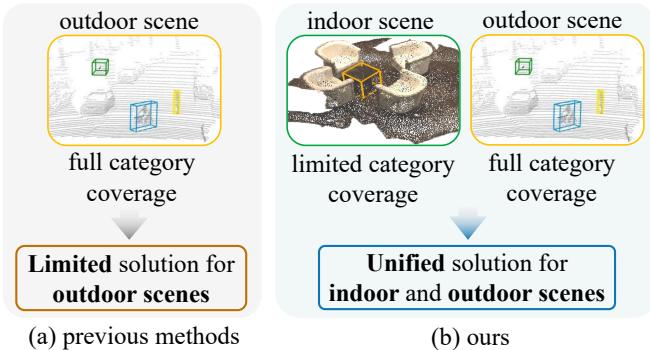
As shown above, this method moves away from the assumption that a single scene contains all necessary category information, offering a unified solution for both indoor and outdoor domains.
The Background: Why Indoor Sparse Detection is Hard
To understand the innovation here, we first need to understand the limitation of previous works. Most existing sparse supervised 3D detection methods are tailored for outdoor scenes, such as the KITTI dataset used for autonomous driving.
These outdoor methods often use a strategy called GT (Ground Truth) Sampling. This involves taking labeled objects (like cars or pedestrians) from one scene and pasting them into another to ensure the model sees plenty of examples. In an outdoor street scene, this is generally fine; a car can essentially be placed anywhere on a road.
However, indoor scenes have strict semantic contexts.
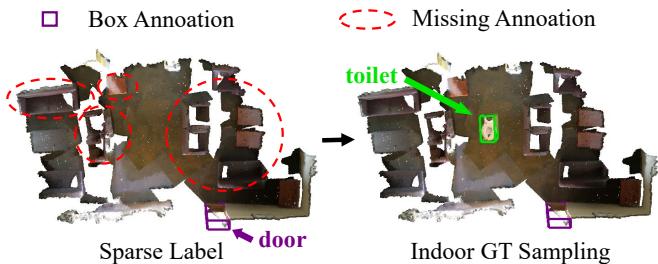
As illustrated in the figure above, blindly pasting objects breaks the logic of indoor environments. You cannot simply paste a toilet into a living room or a bed into a kitchen without confusing the model. Because we cannot rely on this “copy-paste” augmentation, and because we only have a few labels per scene (sparse supervision), the model struggles to learn representations for objects that aren’t labeled in that specific scene.
If you have a scene with a table and a chair, but only the table is labeled, a standard sparse model ignores the chair. The challenge is: How can we teach the model to recognize that unlabeled chair without explicitly telling it “this is a chair”?
The Solution: CPDet3D
The researchers propose a method that leverages Class Prototypes. Instead of looking at objects in isolation within a single scene, the model aggregates features from labeled objects across the entire dataset to create a “prototype”—a representative feature vector—for each class.
The architecture consists of two main innovative modules:
- Prototype-based Object Mining: This module converts the problem of finding unlabeled objects into a matching problem. It matches unlabeled features in a scene to the learned class prototypes.
- Multi-label Cooperative Refinement: This module refines the detections by using a combination of sparse ground truth labels, pseudo labels (high-confidence predictions), and the newly mined prototype labels.
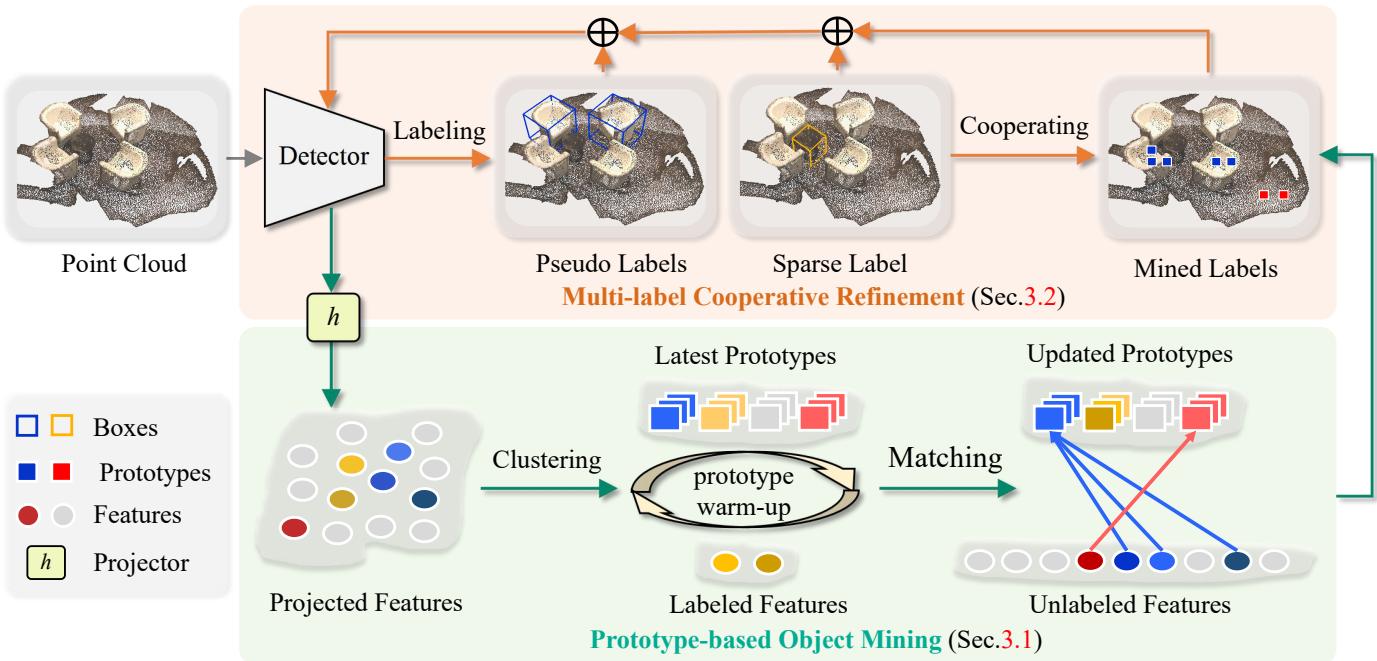
Let’s break down these distinct components to understand the mechanics of this unified detector.
1. Prototype-based Object Mining
The core philosophy here is that even if a “chair” isn’t labeled in Scene A, the model knows what a “chair” looks like from Scene B, Scene C, and Scene D.
Class-aware Prototype Clustering
First, the model needs to build these prototypes. It takes the point cloud features generated by the detector and projects them into a new feature space. Using the limited sparse annotations available, it clusters features belonging to the same category.
Mathematically, let’s say we have proposal features \(X\). A projector transforms these into projected features \(F\). For a specific category \(k\), we extract the relevant features using a mask \(M_k\) (which identifies labeled objects of class \(k\)).

Here, \(F_k\) represents the semantic features for category \(k\).
The goal is to update the prototypes \(P_k\) to represent these features. The researchers model this as an Optimal Transport problem. They calculate a matching matrix \(L_k\) between the current prototypes and the incoming features using the Sinkhorn-Knopp iteration. This algorithm is excellent for finding an optimal alignment between two distributions.

Once the best matches are found, the prototypes aren’t just replaced; they are updated using a momentum strategy. This ensures stable learning. The \(i\)-th prototype for class \(k\) is updated by moving slightly towards the mean of the new features matched to it.
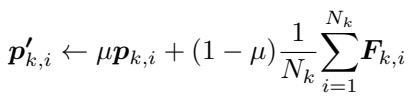
In this equation, \(\mu\) is a momentum coefficient (usually close to 1, e.g., 0.99), ensuring the prototypes evolve smoothly rather than jumping around erratically with every batch.
The Warm-up Phase
When training starts, the prototypes are initialized randomly. If we tried to use them immediately to label objects, the model would be confused. Therefore, the system undergoes a “warm-up” phase.
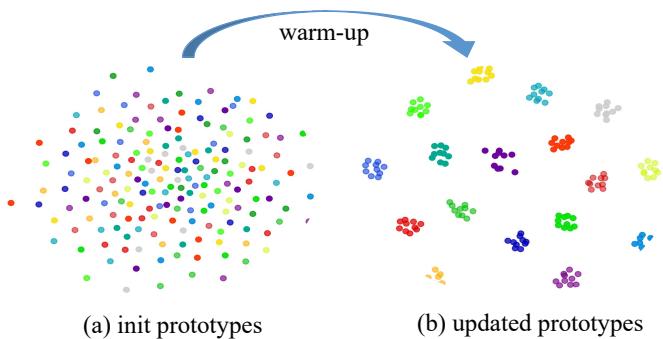
The t-SNE visualization above demonstrates this beautifully. On the left (a), the initial prototypes are scattered and mixed. After the warm-up (b), clear, distinct clusters emerge for different classes. This separation is crucial for accurate matching.
Matching Prototypes to Unlabeled Objects
Once the prototypes are stable (post warm-up), the model looks at the unlabeled features in a scene. It calculates a similarity score (affinity) between every unlabeled feature and the class prototypes.
It combines the classification score from the detector (\(S\)) with this affinity matrix (\(A'\)) to compute a propagation probability \(W\).
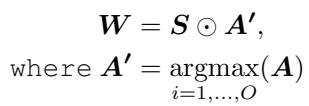
Using this probability, the model assigns a “Prototype Label” (\(C_f\)) to the unlabeled features.
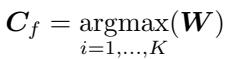
Essentially, if an unlabeled blob of points looks mathematically similar to the “chair” prototype, it gets tagged as a chair.
Filtering the Labels
Not every match is perfect. To ensure high quality, the system filters these new prototype labels. It removes background regions, regions that already have sparse ground truth labels (to avoid redundancy), and regions outside the valid point cloud range.

The result? The model successfully “mines” objects that humans didn’t label.
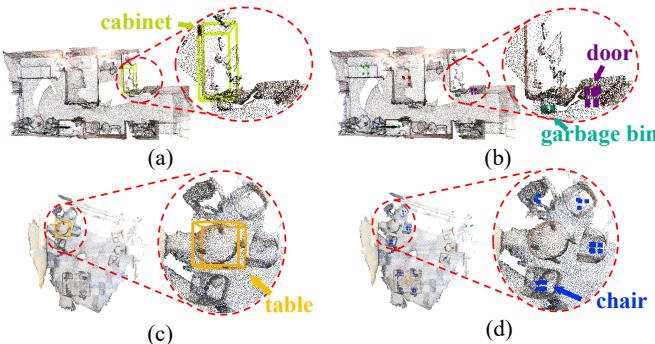
In the visualization above, columns (a) and (c) show the sparse input (one label per scene). Columns (b) and (d) show what the model found on its own. Notice how it successfully identified the garbage bin and multiple chairs.
2. Multi-label Cooperative Refinement
Now that the model has mined these prototype labels, it combines them with the original sparse labels and standard pseudo labels for training. This is the Multi-label Cooperative Refinement module.
Iterative training often faces a dilemma:
- High Thresholds: If you only trust predictions with 90% confidence, you miss many objects (low recall).
- Low Thresholds: If you accept predictions with 40% confidence, you get a lot of noise (low precision).
This module balances this by cooperating between different label types.
Pseudo Labeling: It takes the model’s predictions (\(y_j\)) and filters them based on a classification score threshold (\(\alpha_{cls}\)).

IoU Filtering: It removes duplicate boxes using Intersection over Union (IoU) to ensure distinct object detection.

Collision Filtering: It ensures that pseudo labels don’t overlap (collide) with the ground truth sparse labels. If the model predicts a box where we know a ground truth box exists, we keep the ground truth.

Finally, it integrates the Prototype Labels derived in the previous section. These usually cover the “hard” examples that the standard pseudo-labeling (based on confidence scores) might miss. By combining sparse, pseudo, and prototype labels, the model fills in the gaps of missing annotations.
3. Training Strategy
The training happens in two stages.
Stage 1: Train an initial detector using only the sparse annotations and the prototype mining module.
 Here, the loss includes detection loss (\(\mathcal{L}_{det}\)), prototype contrastive loss (\(\mathcal{L}_{pcon}\)), and prototype classification loss (\(\mathcal{L}_{pcls}\)).
Stage 2: Use the model from Stage 1 to generate pseudo labels, then retrain using the refinement module.
 This adds a refinement loss (\(\mathcal{L}_{ref}\)) calculated using the high-quality pseudo labels.
Experiments and Results
Does this unified approach actually work? The researchers tested CPDet3D on three major datasets: ScanNet V2 and SUN RGB-D (indoor) and KITTI (outdoor).
Indoor Performance
The results on indoor datasets are particularly impressive because this is where previous methods failed.
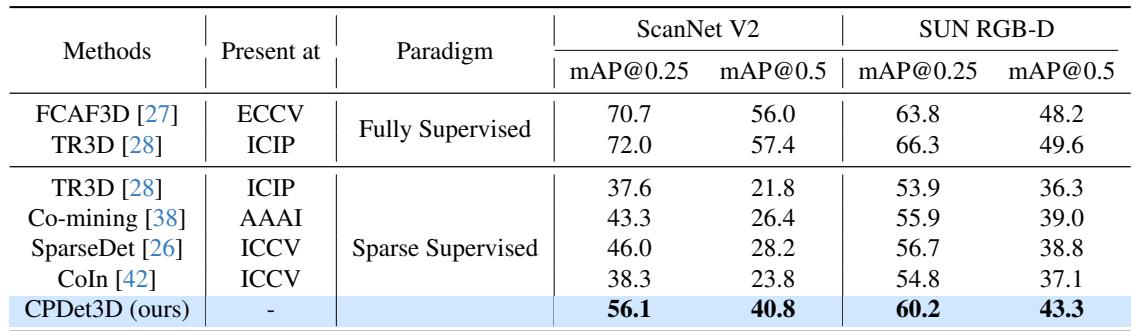
As shown in Table 1, CPDet3D achieves significantly higher mean Average Precision (mAP) than competing sparse methods.
- On ScanNet V2, it achieves 56.1% [email protected], compared to 46.0% for the next best method.
- Remarkably, with only one labeled object per scene, it achieves roughly 78% of the performance of a fully supervised detector (which uses 100% of labels).
We can see further detailed breakdowns in the tables below for ScanNet V2 and SUN RGB-D.

Outdoor Performance
The method isn’t just for indoors. It scales effectively to the outdoor KITTI dataset as well.

On KITTI, the method achieves 94.1% accuracy on the “Easy” difficulty setting for cars, surpassing the previous state-of-the-art sparse method (CoIn++) and reaching 96% of the performance of a fully supervised Voxel-RCNN. This proves the “Unified” claim of the paper—it works everywhere.
Visual Confirmation
Numbers are great, but seeing is believing. The visualizations below compare the method’s output against the Ground Truth.
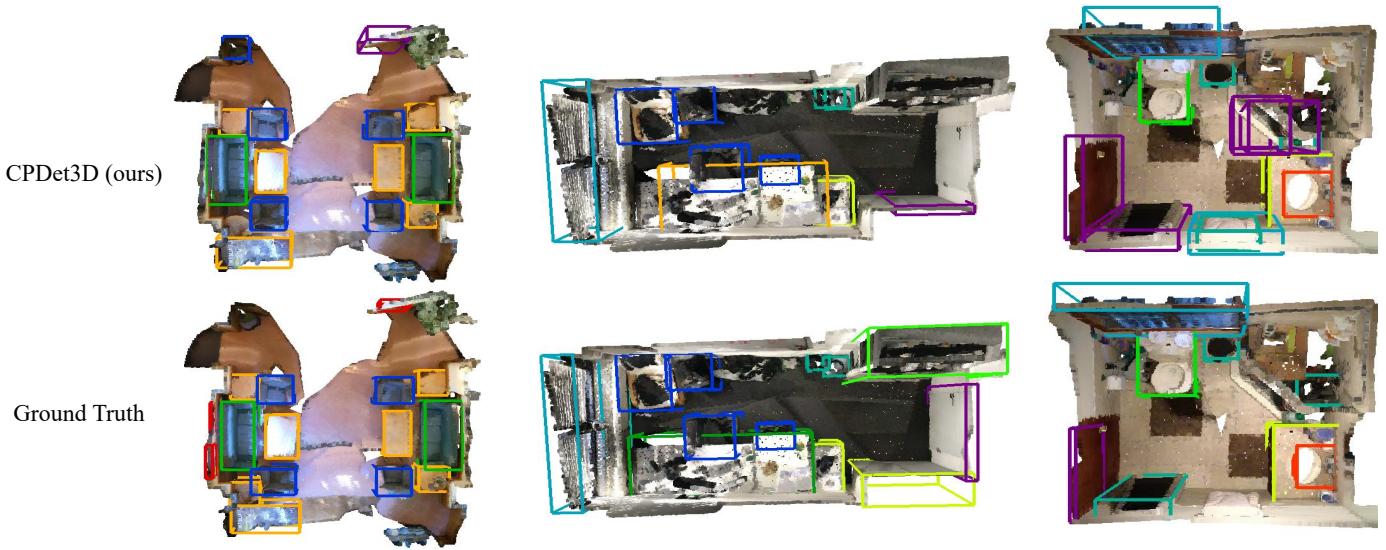
In ScanNet V2 (above), the model detects sofas, chairs, and tables that align almost perfectly with the ground truth, despite the sparse training signal.
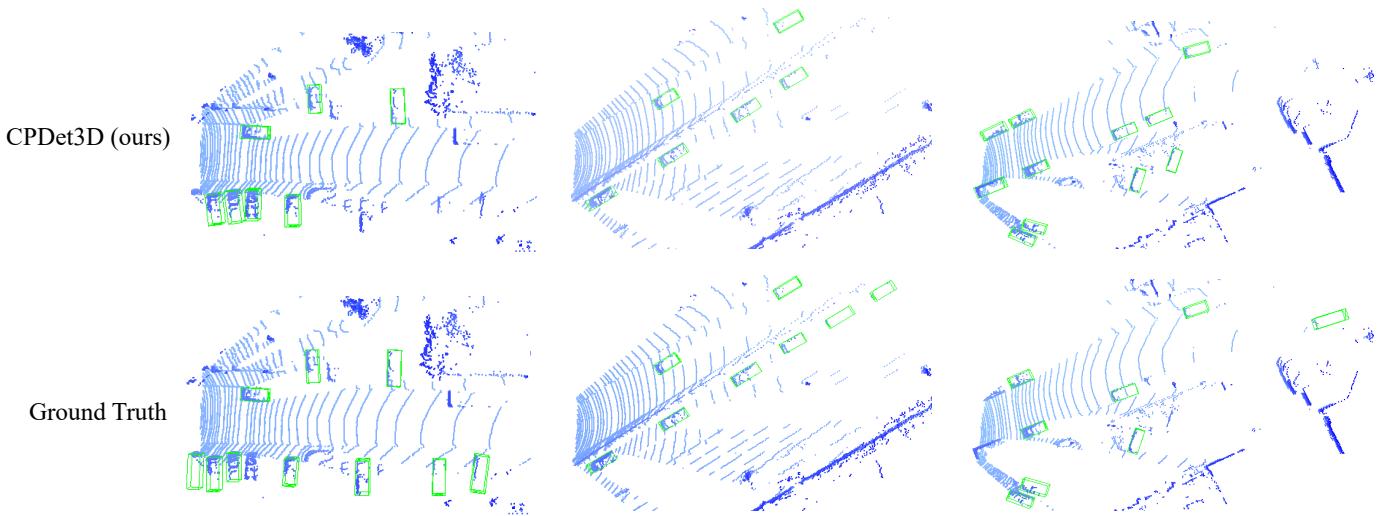
Similarly, on KITTI (above), the detection of cars (green boxes) is precise, even in dense point clouds.
Ablation Studies
The researchers also conducted ablation studies to verify which parts of the model contribute most to the success.
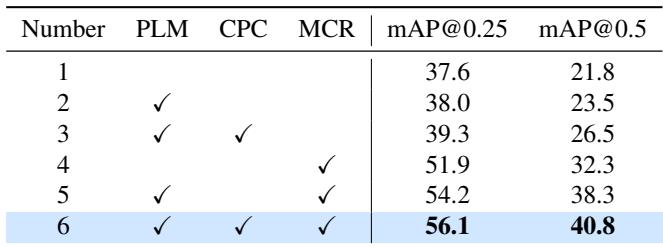
- PLM (Prototype Label Matching) alone improves performance slightly.
- CPC (Class-aware Prototype Clustering) adds significant gains by making the prototypes more distinct.
- MCR (Multi-label Cooperative Refinement) provides the biggest jump, confirming that properly combining different types of labels is the key to robustness.
They also analyzed the hyperparameters, such as the IoU and collision thresholds.
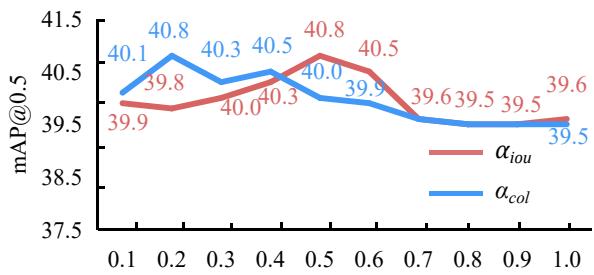
Figure 8 shows that performance is relatively stable across different thresholds, though specific “sweet spots” (like 0.5 for IoU) yield the best results.
Conclusion
The paper Learning Class Prototypes for Unified Sparse Supervised 3D Object Detection presents a compelling step forward for 3D perception. By moving away from scene-specific assumptions and leveraging the global statistics of the dataset through Class Prototypes, CPDet3D solves the “indoor problem” that plagued previous sparse supervision methods.
Key Takeaways:
- Unified Solution: Works for both indoor living rooms and outdoor highways.
- Prototype Power: Learning what a class “looks like” globally allows the model to find objects locally, even without labels.
- Efficiency: It achieves near-fully-supervised performance with a tiny fraction of the annotation cost (e.g., just one label per scene).
This work paves the way for more scalable robotic systems that can learn to understand their environments without requiring millions of dollars in manual data labeling. As we move toward more general-purpose robots, techniques that can squeeze more information out of less data will be essential.