](https://deep-paper.org/en/paper/2503.23094/images/cover.png)
Grounding the Avatar: How Geometric Priors and Massive Data Solve Egocentric Motion Capture
If you have ever used a modern Virtual Reality (VR) headset, you have likely noticed something missing: your legs. Most current VR avatars are floating torsos with hands, ghosts drifting through a digital void. This isn’t a stylistic choice; it is a technical limitation.
Tracking a user’s full body from a headset (egocentric motion capture) is incredibly difficult. The cameras on the headset can barely see the user’s lower body, often blocked by the chest or stomach (self-occlusion). When the cameras do see the legs, the perspective is distorted by fisheye lenses, and the rapid movement of the head makes the video feed chaotic.
The result? Traditional deep learning models struggle. They produce “floating feet” that hover above the ground, “foot skating” where the avatar slides unnaturally, or limbs that clip through the floor.
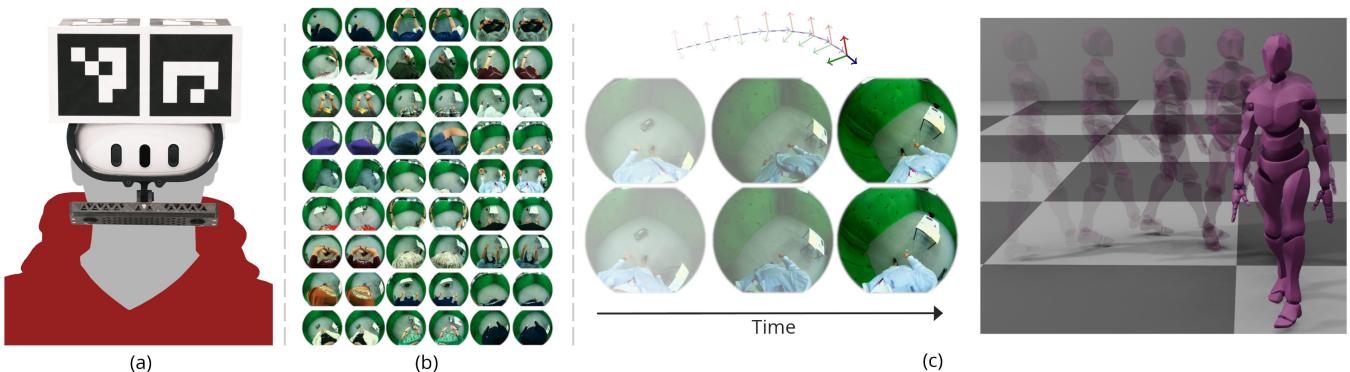
In this post, we are diving deep into FRAME (Floor-aligned Representation for Avatar Motion from Egocentric Video), a new research paper that proposes a robust solution. The researchers tackle the problem by combining two powerful forces: a massive new real-world dataset and a clever architectural decision to anchor predictions in a “floor-aligned” coordinate system.
The Problem with Current Datasets
To train a neural network to predict body pose, you need data—specifically, video of people moving paired with accurate 3D skeletal ground truth.
In the past, researchers faced a dilemma. They could either use synthetic data (video game characters rendered in 3D engines), which gives perfect labels but looks “fake” to the AI, or they could capture real-world data.
Real-world capture for egocentric video is notoriously hard. To get ground truth labels, you need an external motion capture system (like a studio with 100+ cameras). To get the input video, you need a camera on the person’s head. But how do you align the two?
Previous solutions involved mounting giant checkerboards or heavy structures on top of the helmet so the external cameras could track the headset’s position.
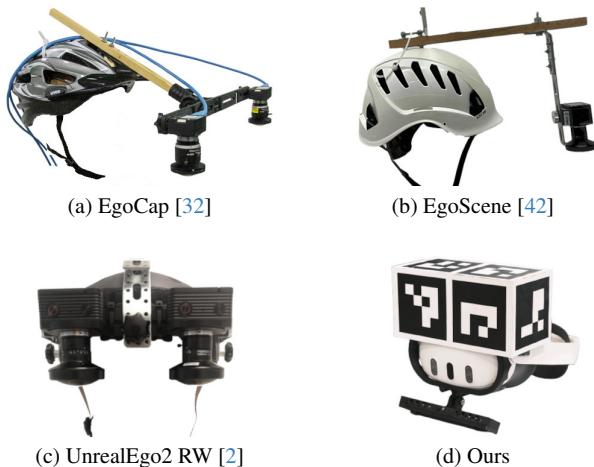
As shown in Figure 2, previous rigs were top-heavy and cumbersome. If a user is wearing a 2kg tower on their head, they don’t move naturally. They walk stiffly to balance the weight. This biases the data. Furthermore, the cameras were often placed on “stalks” sticking out from the face (to get a better view), which doesn’t reflect the actual camera position of a consumer product like the Meta Quest 3.
The SELF Dataset
The authors of FRAME introduce the SELF Dataset, which addresses these hardware limitations. They built a custom rig based on a Meta Quest 3, equipped with stereo fisheye cameras that look downwards.
Key features of this dataset include:
- Scale: It contains 1.6 million frames (over 7 hours of footage), making it 6x larger than the previous largest real-world dataset.
- Realism: The rig is lightweight, allowing participants to perform sports and dynamic actions naturally.
- Ground Truth: They utilized a studio with 120 calibrated cameras to capture the skeletal motion (the “label”) while the headset captured the egocentric video (the “input”).
To ensure the headset’s internal tracking (which runs on its own clock and coordinate system) matched the studio’s motion capture system, they used a rigorous mathematical alignment process. They minimized the error between the studio’s view of the headset and the headset’s view of the world:

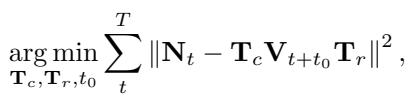
By solving these optimization problems, they ensured that every pixel in the video feed was perfectly synchronized in time and space with the 3D skeleton.
The FRAME Architecture
With a massive dataset in hand, the researchers developed the FRAME architecture. The core philosophy here is multimodal integration.
Most previous methods treated this as a pure computer vision problem: Input Image \(\rightarrow\) Black Box \(\rightarrow\) Output Pose.
FRAME treats it as a geometric problem supported by computer vision. Modern VR headsets provide excellent 6-DoF (Degrees of Freedom) tracking via SLAM (Simultaneous Localization and Mapping). We know exactly where the headset is and how it is tilted. FRAME explicitly uses this information.

Let’s break down the pipeline shown in Figure 3.
Step 1: Fisheye-based Pose Estimation (The Backbone)
The process begins with the raw stereo images (left and right). A shared backbone (ResNet50) extracts features from both images.
The model doesn’t jump straight to 3D coordinates (x, y, z). Instead, it predicts a 2.5D representation consisting of:
- 2D Heatmaps: Probability distributions of where joints are in the image (\(u, v\)).
- Depthmaps: The distance of that joint from the camera (\(d\)).
To convert the heatmap into precise coordinates, they use a Soft-Argmax operation. Then, the depth is calculated by combining the predicted depth map with the heatmap intensity:
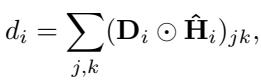
Using the known calibration of the fisheye lenses, these 2.5D points are “unprojected” into 3D space relative to the camera.
Step 2: The Floor-Aligned Reference Frame
This is the “secret sauce” of the paper.
If you predict a body pose relative to the camera, and the user looks down, the coordinate system rotates. This makes it incredibly hard for a neural network to learn that “feet stay on the floor.” In camera space, the floor is constantly moving.
FRAME solves this by transforming the predictions into a stable, Floor-Aligned Frame (\(\mathcal{F}\)).
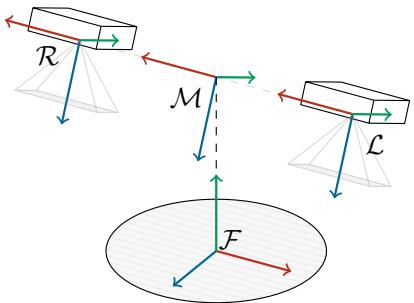
As illustrated in Figure 4, the system calculates a transformation chain:
- Camera Frames (\(\mathcal{L}, \mathcal{R}\)): The raw view from the sensors.
- Headset Frame: Known via the VR device’s internal tracking.
- Floor Frame (\(\mathcal{F}\)): A frame where the Y-axis is perfectly vertical (aligned with gravity) and the origin is on the ground.
The system uses the known device pose (\(T_D\)) and the fixed camera offsets (\(M_L, M_R\)) to calculate the global position of the cameras:

Then, it transforms the initial 3D joint predictions (\(J_L, J_R\)) from the unstable camera frame into the stable floor frame:

By forcing the network to refine poses in this stable \(\mathcal{F}\) frame, the model implicitly learns about gravity and ground contact. The floor is always at \(y=0\). This dramatically reduces “floating foot” artifacts.
Step 3: Stereo Temporal Fusion (STF)
Even with floor alignment, individual frame predictions can be jittery. To solve this, FRAME uses a Transformer-based module called Stereo Temporal Fusion (STF).
The STF takes a sequence of past predictions (aligned to the current floor frame) and merges them. It looks at the history of motion to smooth out noise and fill in gaps where occlusions might have occurred. It effectively asks, “Given where the leg was 100ms ago, and where the left and right cameras think it is now, where is it mostly likely to be?”
A Novel Training Strategy: Cross-Training Caching
There is a subtle problem when training a two-stage pipeline like this.
If you train the Backbone (Step 1) on the training set, it will eventually memorize the data and become extremely accurate on that specific data. If you then train the STF Refiner (Step 3) using the output of the Backbone on that same data, the Refiner gets lazy. It receives near-perfect inputs from the Backbone, so it learns that “I don’t need to do much correction.”
However, when you run the model on new, unseen data, the Backbone will make mistakes. The Refiner, having never seen mistakes during training, won’t know how to fix them.
To solve this, the authors introduce Cross-Training Caching.
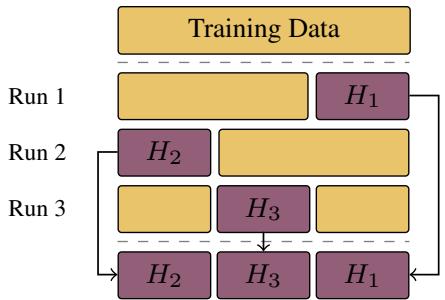
Inspired by k-fold cross-validation, they split the training data into subsets.
- They train the Backbone on subsets A and B, and run inference on subset C (which it hasn’t seen). The result is “realistic” noisy predictions.
- They repeat this rotation until they have noisy predictions for the whole dataset.
- They train the STF Refiner on these cached, noisy predictions.
Now, the Refiner learns how to clean up the messy errors that actually occur in the real world.
Experimental Results
The combination of the massive SELF dataset, the floor-aligned architecture, and the cross-training strategy yields impressive results.
Quantitative Performance
The model runs at a blistering 300 FPS on an NVIDIA RTX 3090, making it more than fast enough for real-time VR applications.
In terms of accuracy, FRAME outperforms state-of-the-art baselines like EgoGlass, UnrealEgo, and EgoPoseFormer.

The most striking metric in the table above is NPP (Non-Penetration Percentage). This measures how often the feet stay above the floor rather than clipping through it.
- Competitors range from 49% to 58%.
- FRAME achieves 100.0%.
This is the direct result of the floor-aligned representation. The model knows exactly where the floor is.
Qualitative Performance
The numbers are backed up by visual evidence. In the figure below, you can see how FRAME handles challenging poses, such as crouching.
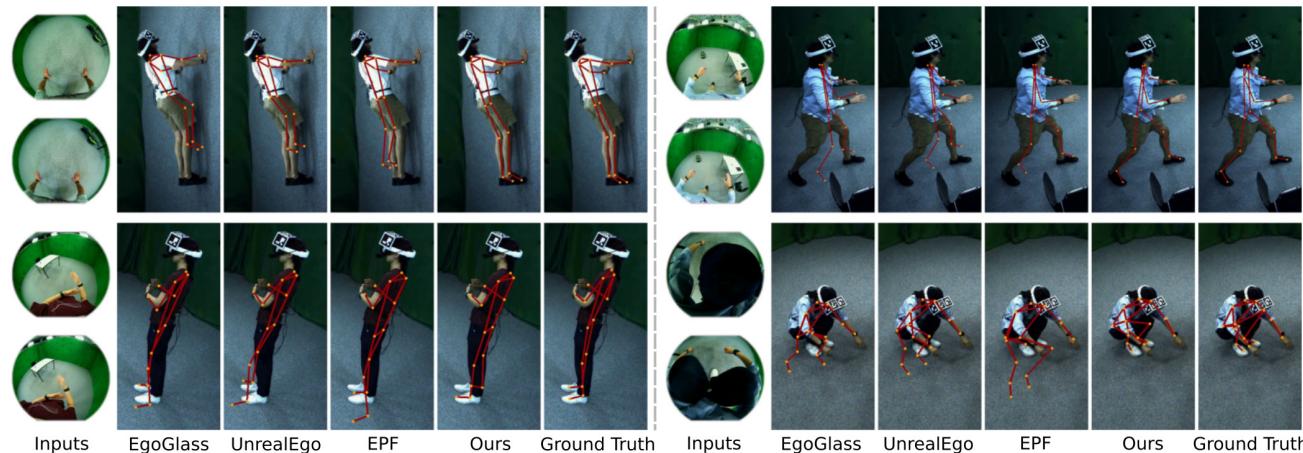
While other methods (like EgoGlass or EgoPoseFormer) struggle with the depth of the crouch—often leaving the avatar floating in mid-air or distorting the legs—FRAME correctly estimates the contact with the ground.
Why Floor Alignment Matters
The authors performed an ablation study to prove that the coordinate transformation was indeed the key factor.
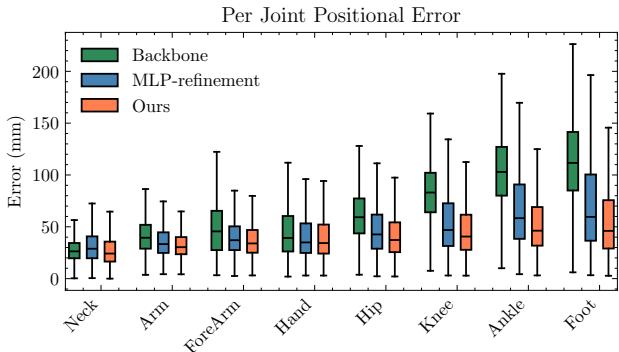
In Figure 7, look at the “Foot” category on the far right.
- Green (Backbone): High error. This is the raw prediction in camera space.
- Blue (MLP Refinement): Lower error. This is using a neural network to refine the pose, but without the time history.
- Orange (Ours): Lowest error. This is the full pipeline with floor alignment and temporal fusion.
The floor-aligned frame drastically tightens the error distribution for the lower body.
Conclusion
The FRAME paper demonstrates that solving complex computer vision problems often requires more than just “more layers” or “bigger transformers.”
By stepping back and analyzing the geometry of the problem, the authors realized that the VR headset itself provides crucial context (gravity and floor position) that was being ignored. By explicitly injecting this geometric prior into the deep learning pipeline, and by training on a dataset that truly reflects the difficulty of real-world motion, they achieved a leap forward in avatar realism.
For students and researchers, the takeaways are clear:
- Don’t ignore the hardware: Sensors like IMUs and SLAM tracking provide valuable constraints.
- Coordinate systems matter: The frame of reference you choose for your loss function can determine whether your model learns physics or just memorizes pixels.
- Realism in data collection is king: If your training data requires users to walk like robots because of heavy equipment, your model will predict robot-walking avatars.
As VR hardware continues to shrink and improve, techniques like FRAME pave the way for a future where our digital selves move just as naturally as we do.