](https://deep-paper.org/en/paper/2503.23771/images/cover.png)
We live in an era where Multimodal Large Language Models (MLLMs) like GPT-4o and Gemini can describe a photo of a cat on a couch with poetic detail. They can explain memes, read charts, and even help fix your coding errors based on a screenshot. But what happens when you ask these same models to look at the world from 20,000 feet up?
Imagine asking an AI to analyze a satellite image of a sprawling port city. You don’t just want to know “is this a city?” You want to know: How many ships are docked? Is that traffic jam near the bridge caused by an accident? What is the safest route for a truck to get from the warehouse to the pier?
This is the domain of Remote Sensing (RS), and it turns out, our current state-of-the-art AI models are struggling to keep up.
In this post, we are diving into a fascinating new research paper titled “XLRS-Bench.” The researchers behind this work have exposed a significant gap in AI capabilities by creating a benchmark that tests models on extremely large, ultra-high-resolution images. If you are interested in Computer Vision, huge datasets, or the future of autonomous systems, you will want to understand why this benchmark is a game-changer.
The Problem: When “Big” Data Isn’t Big Enough
To understand why XLRS-Bench is necessary, we first need to look at how we currently test AI models. Most standard vision-language benchmarks use images that are relatively small—typically around \(512 \times 512\) or perhaps \(1024 \times 1024\) pixels. These are fine for snapshots of daily life.
However, real-world remote sensing images—satellite or aerial photography—are massive. A single scene capturing a city district might be \(10,000 \times 10,000\) pixels or more.
When you take a massive satellite image and shrink it down to fit into a standard AI model, you lose the details that matter. A car becomes a single pixel. A person disappears entirely.
Furthermore, existing RS benchmarks suffer from three main issues:
- Tiny Images: They usually crop big maps into tiny squares, losing the “big picture” context.
- Bad Annotations: Many rely on automated captions generated by older AI models, which often “hallucinate” (make things up).
- Simple Tasks: They mostly ask “what is this object?” rather than “why is this object here?”
The authors of XLRS-Bench decided to fix this by building a dataset that respects the scale and complexity of the real world.
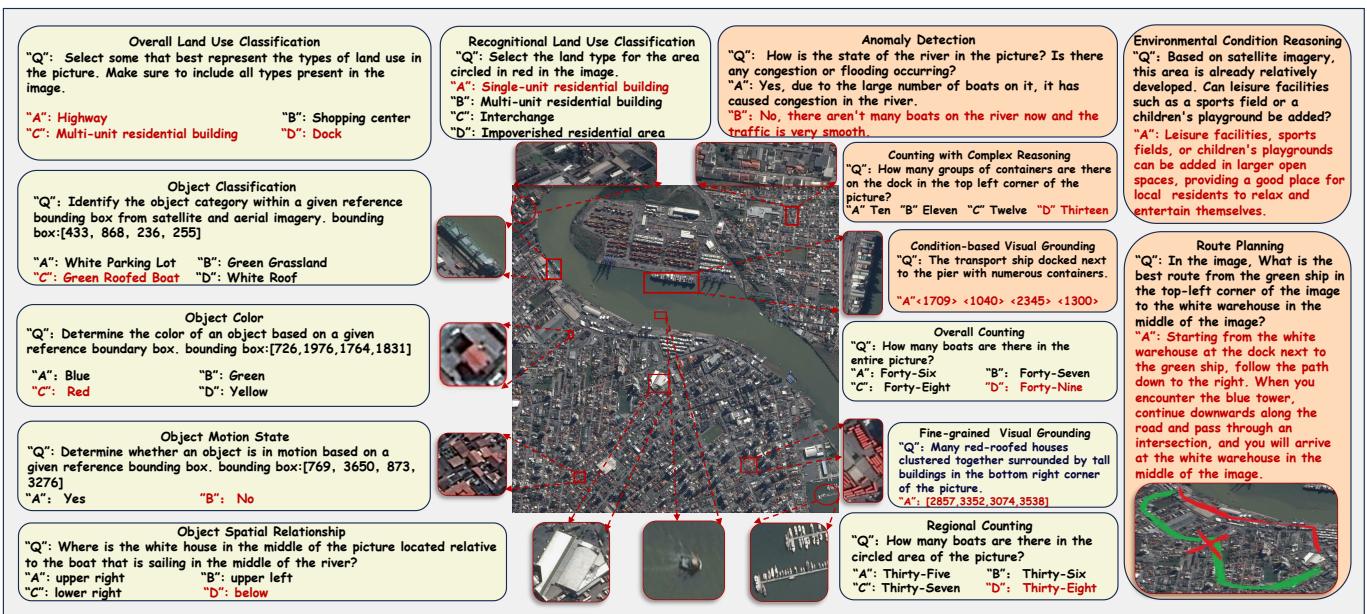
As shown in Figure 1, the benchmark isn’t just about identifying a “ship.” It asks complex questions like: How many container groups are at the top-left? Is the object in the green box moving? Plan a route from point A to B.
Introducing XLRS-Bench: The Heavyweight Champion
The researchers collected 1,400 real-world ultra-high-resolution images. The average size of these images is a staggering \(8,500 \times 8,500\) pixels. To put that in perspective, that is roughly 24 times larger than the images used in standard datasets.
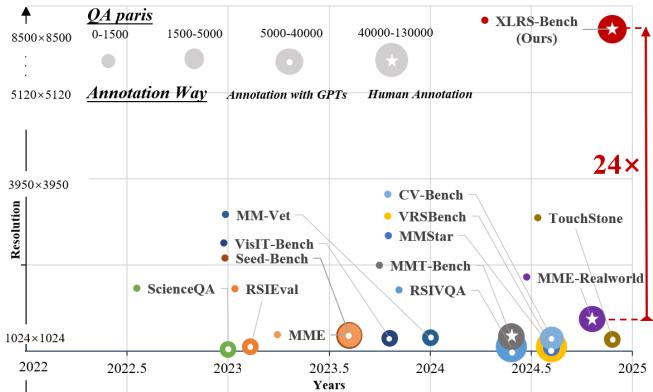
Figure 2 visualizes just how much of an outlier this benchmark is. While most datasets cluster at the bottom (low resolution) and left (older), XLRS-Bench sits alone at the top—representing a massive leap in resolution while maintaining high-quality human annotation.
The Anatomy of Intelligence: Perception vs. Reasoning
One of the most educational aspects of this paper is how the researchers categorize “intelligence” in vision tasks. They break down the evaluation into two primary pillars: Perception and Reasoning.
If you are building an AI application, this distinction is critical.
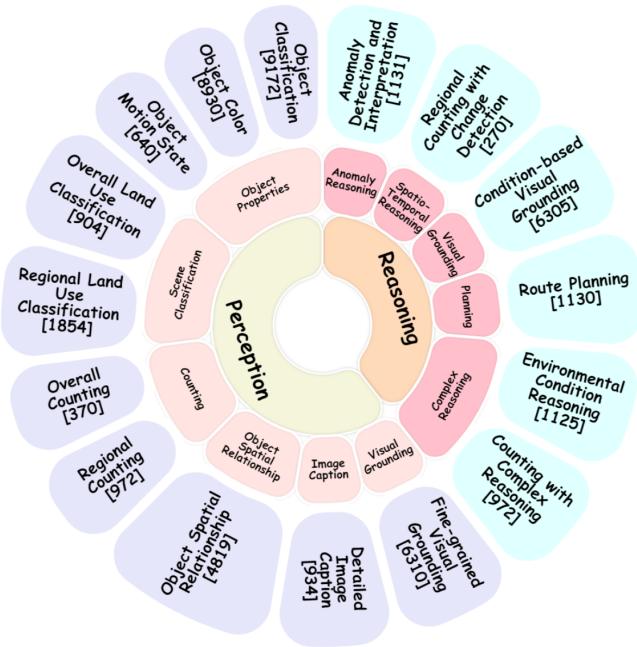
As illustrated in Figure 3, the benchmark tests 16 specific sub-tasks:
1. Perception (The “What”)
This measures the model’s ability to process raw visual data.
- Scene Classification: Is this a farm, a port, or a residential area?
- Counting: How many cars are in this parking lot? (A nightmare task for AI when cars are tiny dots).
- Object Properties: What color is that roof? Is that ship moving (based on the wake in the water)?
- Visual Grounding: Can you give me the exact coordinates of the “white warehouse next to the red truck”?
2. Reasoning (The “Why” and “How”)
This is where it gets difficult. The model has to use the visual data to think critically.
- Route Planning: Navigating from point A to point B while obeying traffic rules visible in the image.
- Anomaly Detection: Noticing something weird, like a flooded road or a landslide risk based on terrain.
- Spatiotemporal Reasoning: Comparing two images taken at different times to count how many new buildings were constructed.
How Do You Caption a 100-Megapixel Image?
Creating the “ground truth” (the correct answers) for this benchmark was a massive engineering challenge. You can’t just ask a human to “caption this image” when the image contains three towns, a river, and 500 ships. They would miss the details.
The authors developed a Semi-Automated Pipeline to solve this.
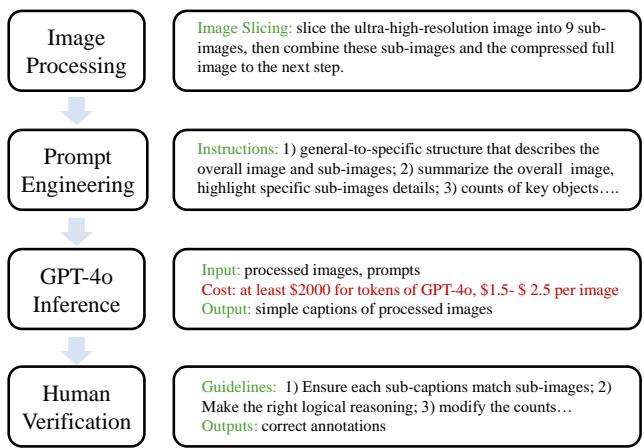
Here is how the pipeline works (see Figure 4):
- Image Slicing: They chop the massive image into 9 sub-images plus one compressed global view.
- AI Drafting: They feed these slices into GPT-4o with very specific prompts to describe every detail and count objects.
- Human Verification: This is the crucial step. Humans review the AI’s work, fixing hallucinated objects, correcting counts, and ensuring the logic holds up.
This “Human-in-the-loop” approach ensures the dataset is large enough to be useful but accurate enough to be a reliable test.
The Experiments: Man vs. Machine
So, how do the world’s best AI models fare against XLRS-Bench? The researchers tested a variety of models, including proprietary giants like GPT-4o and open-source models like Qwen2-VL and LLaVA.
The results were a reality check for the AI industry.
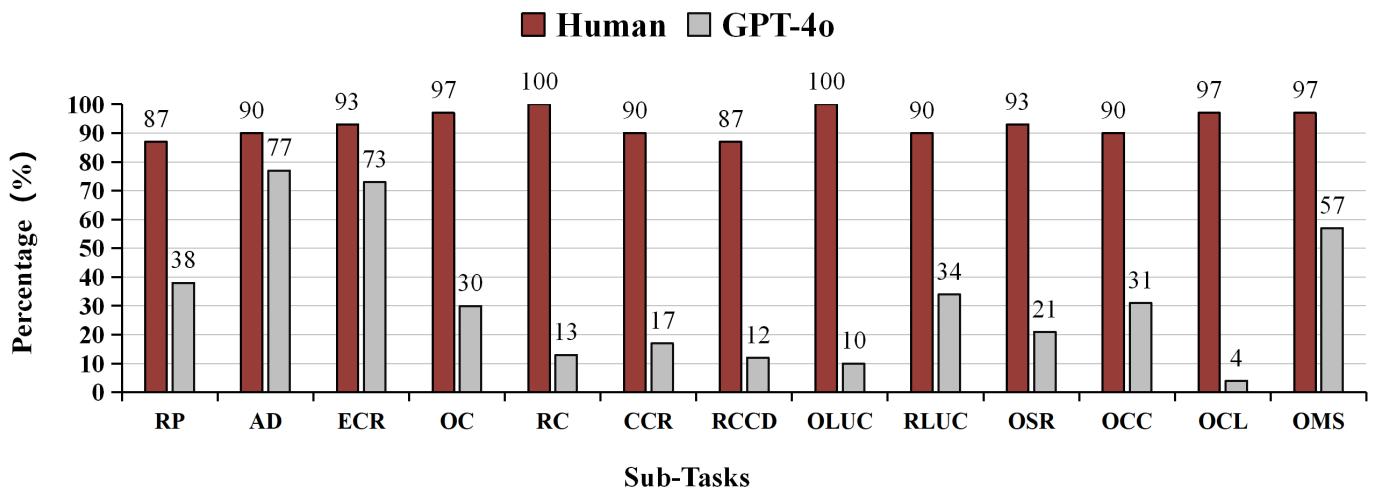
Figure 5 reveals a stark truth:
- Humans (Red bars): consistently achieve >90% accuracy across tasks.
- GPT-4o (Gray bars): struggles significantly. Look at “OC” (Overall Counting)—the accuracy drops below 30%.
Key Findings
- The Resolution Bottleneck: Current MLLMs generally accept images up to 4K resolution. When an \(8500 \times 8500\) RS image is squashed down to 4K, tiny details vanish. This explains why models failed hard at fine-grained tasks like Visual Grounding.
- Counting is Hard: AI models are notoriously bad at counting many small objects. In tasks asking to count cars or ships, the models often just guessed.
- Reasoning without Perception: Interestingly, models performed decently on abstract reasoning (like “is this area prone to flooding?”) because that relies on broad visual patterns. But they failed at tasks that required combining perception and reasoning (e.g., “Find the specific red car and tell me if it is moving”).
A Look at Failure Cases
To make this concrete, let’s look at a specific failure case in Visual Grounding (locating objects).
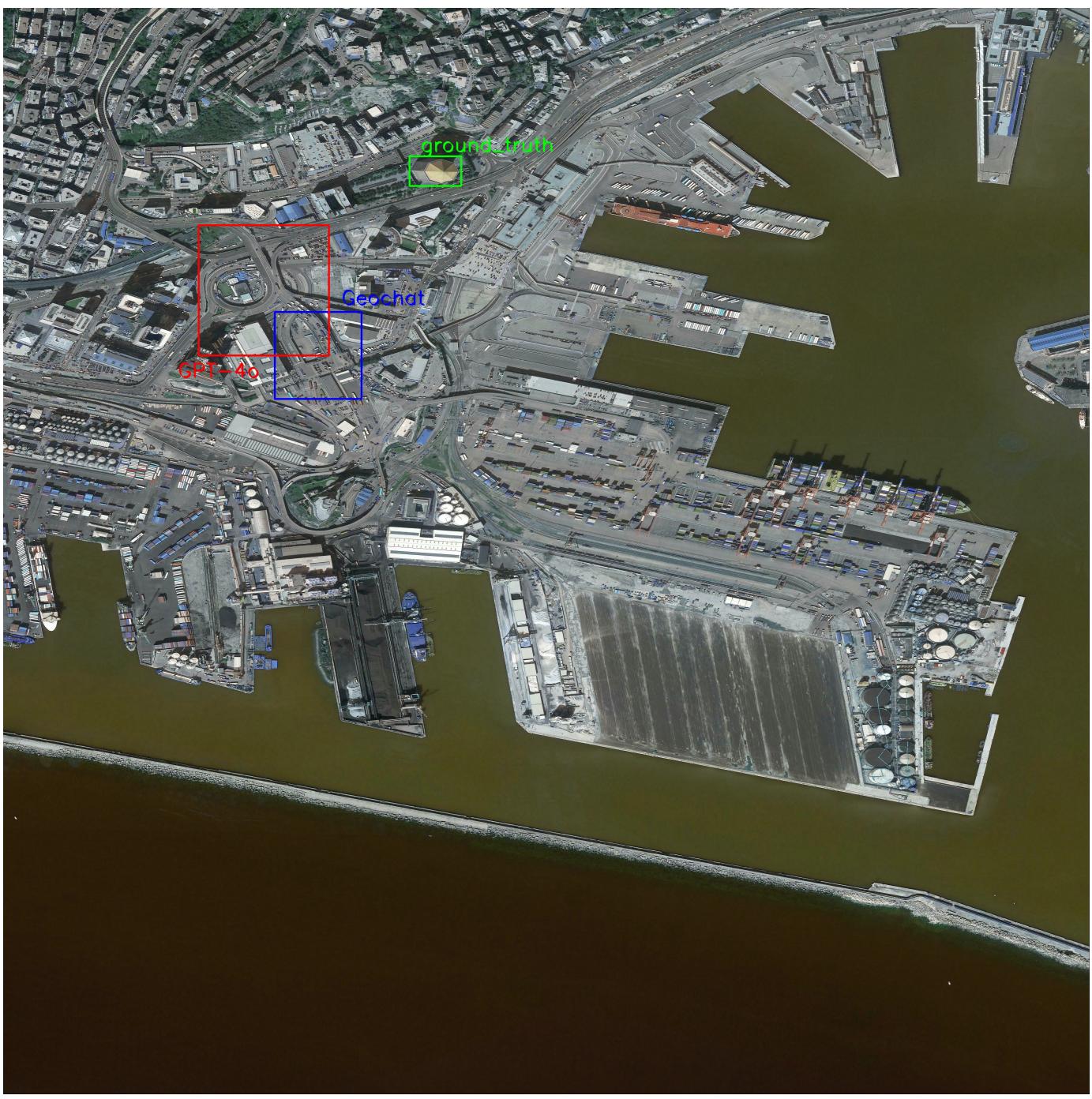
In Figure 7, the model is asked to find a “multi-sided building.”
- Ground Truth (Green): Identifies the correct small building.
- GPT-4o (Red): Confidently identifies a roundabout (road infrastructure) as the building.
- GeoChat (Blue): Selects an irregularly shaped parking lot.
This highlights that while these models “know” what a building is in theory, the complex, cluttered, top-down view of remote sensing imagery confuses them completely.
Conclusion: The Future of Remote Sensing AI
XLRS-Bench is a wake-up call. It demonstrates that while Multimodal LLMs are advancing rapidly, they are not yet ready to fully automate the analysis of satellite imagery. The gap between identifying a cat in a living room and planning a disaster relief route through a damaged city is still massive.
Why does this matter to you? If you are a student or researcher, this is a massive area of opportunity. We need:
- New Architectures: Models that can handle native high-resolution inputs without aggressive down-sampling.
- Better Pre-training: Models trained specifically on “top-down” aerial views, not just internet photos.
- Hybrid Approaches: Systems that combine traditional computer vision (like sliding window detection) with the reasoning power of LLMs.
XLRS-Bench provides the measuring stick we need to track this progress. Until AI can look at a 100-megapixel map and count the cars as well as a human can, the “final frontier” of remote sensing remains unconquered.