](https://deep-paper.org/en/paper/2503.24278/images/cover.png)
Introduction
Imagine you have just trained a new, cutting-edge “generalist” robot policy—a brain capable of controlling a robot arm to do everything from folding laundry to sorting groceries. You are excited to see how well it works. But here is the problem: to statistically prove your model is good, you need to run it thousands of times across different scenarios.
Who is going to sit there for 100 hours, putting the laundry back in the basket every time the robot successfully folds it? Who is going to reset the scene when the robot knocks a can of soup off the table?
Until now, the answer has sadly been “a graduate student.”
This is the evaluation bottleneck in robotics. As robot models get larger and more capable (like OpenVLA or Octo), evaluating them requires an immense amount of human labor. This bottleneck slows down progress significantly.
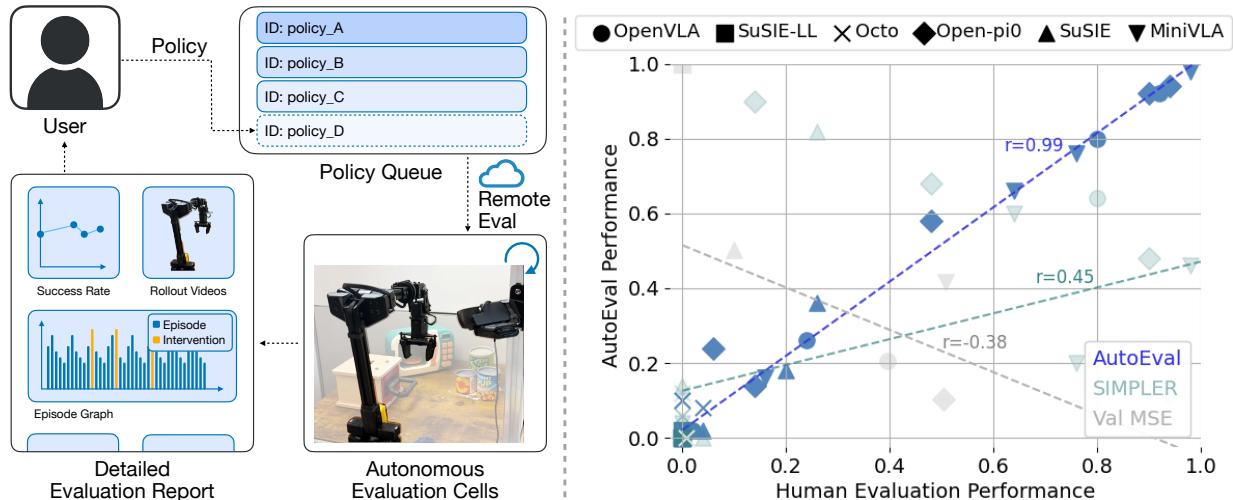
In this post, we are diving into AutoEval, a fascinating paper from UC Berkeley researchers that proposes a solution: let the robots evaluate themselves. By combining learned “reset policies” with vision-language models for success detection, AutoEval allows real robots to run experiments 24/7 with almost zero human supervision.
The Problem: Why is Evaluation So Hard?
In fields like Computer Vision or NLP, evaluation is usually static. You run a test set of images or text through your model, compute the accuracy, and you’re done. In robotics, evaluation is dynamic. The robot interacts with the physical world.
To evaluate a manipulation policy, you need to:
- Set up the physical scene (put the object in a specific starting spot).
- Run the robot policy.
- Judge if the robot succeeded (did the drawer actually close?).
- Reset the scene to the initial state to run the next trial.
If you are building a generalist model, you might need 2,500+ rollouts to get a reliable signal. That is weeks of human time.
Why not use simulation?
You might ask, “Why not just run these tests in a simulator?” This is a common approach, used by benchmarks like SIMPLER. However, simulations often suffer from the sim-to-real gap. Physics engines struggle to perfectly model friction, soft deformable objects (like cloth), or complex lighting.
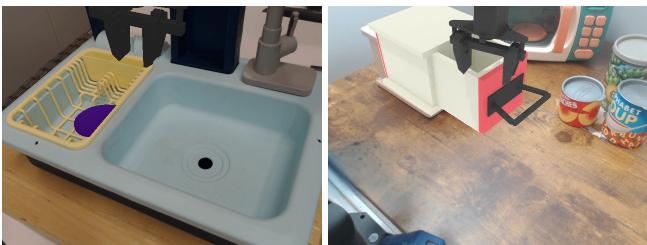
As shown in Figure 6, simulators can look realistic, but if the physics aren’t perfect, a policy might fail in the sim but work in reality (or vice versa). AutoEval argues that for the most reliable results, you must evaluate in the real world—but you must make it scalable.
The AutoEval System
AutoEval is designed to function like a cluster scheduling system for physical robots. A user submits a “job” (a policy to evaluate), and the system handles the rest.
The core of AutoEval is a loop that replaces the human operator with learned models. The system consists of three main learned components:
- The Policy Under Test: The model you want to evaluate.
- The Success Classifier: A model that decides if the task was completed.
- The Reset Policy: A model that puts the world back to its starting state.
1. The Success Classifier
Instead of writing brittle code to detect success (e.g., “if the gripper z-height is < 0.1”), AutoEval uses a Vision-Language Model (VLM). The researchers fine-tuned PaliGemma, a VLM, to answer binary questions about the scene.
For example, the system feeds the VLM an image of the robot workspace and asks, “Is the drawer open? Answer yes or no.” This approach is robust to lighting changes and slight camera bumps, unlike hard-coded sensors.
2. The Reset Policy
This is the cleverest part of the system. How do you automate resetting a scene without building complex conveyor belts or mechanical contraptions? You simply train another robot policy to do it.
The researchers collected a small dataset (about 100 trajectories) of a human teleoperating the robot to “undo” the task—opening a closed drawer, taking an object out of the sink, or unfolding a cloth. They then trained a robust policy (using behavioral cloning) to perform these resets.
Because the reset policy is trained on diverse data, it can handle various “end states” left behind by the policy being evaluated.
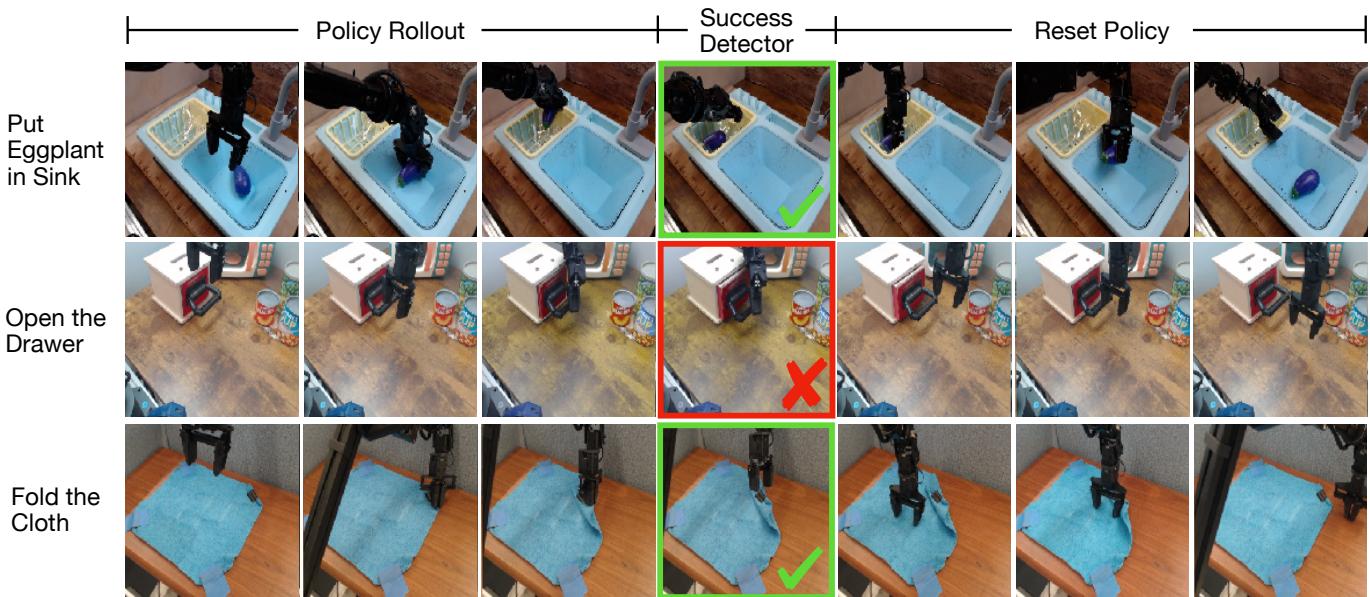
3. The Loop in Action
When put together, the system runs autonomously.
- Rollout: The robot attempts the task (e.g., “Put eggplant in sink”).
- Judge: The VLM checks if it succeeded.
- Reset: The reset policy moves the object back to the starting distribution.
- Repeat: The loop continues for as many trials as requested.
The Hardware: Bridge-AutoEval
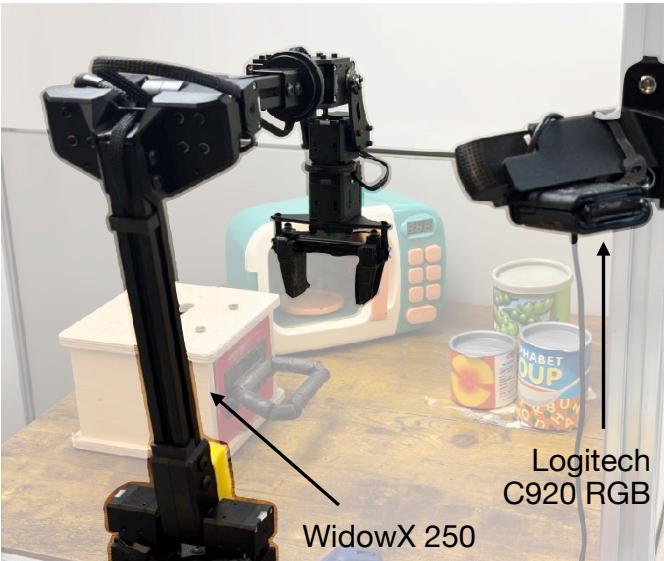
To prove this works, the authors built Bridge-AutoEval, a physical instantiation of their system using WidowX robot arms.
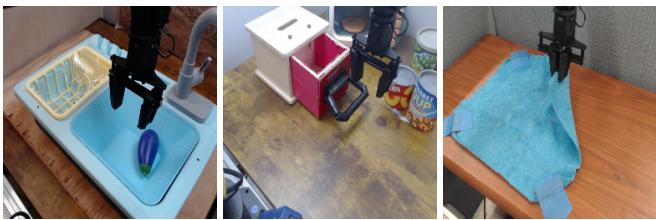
They set up three distinct environments:
- Sink: Pick-and-place tasks (e.g., putting objects in a sink or drying rack).
- Drawer: Articulated object manipulation (opening/closing drawers).
- Cloth: Deformable object manipulation (folding a cloth).
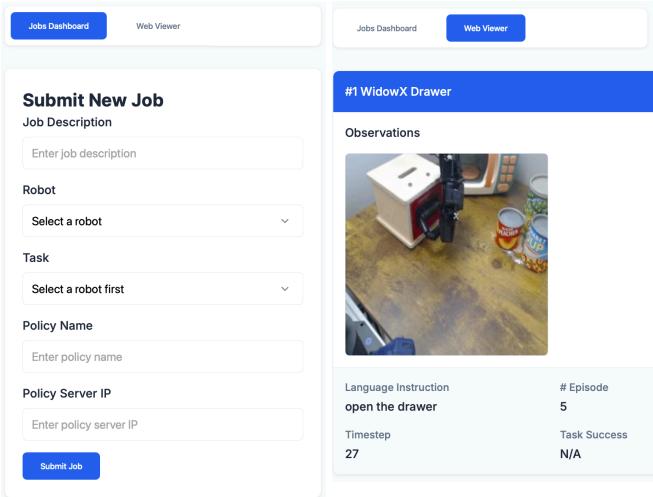
What makes this setup particularly powerful is its accessibility. The team created a web interface where researchers can submit their own policy checkpoints. The system queues the job, runs it on the physical robot, and emails a report to the user.
Experimental Results: Does It Work?
The biggest question for any automated evaluation system is: Does it agree with human judgment?
If AutoEval says a policy has a 70% success rate, but a human watching the videos says it’s only 40%, the system is useless.
AutoEval vs. Humans vs. Simulators
The researchers compared AutoEval against:
- Human Oracle: The “Gold Standard” manual evaluation.
- SIMPLER: A state-of-the-art simulation benchmark.
- Val-MSE: A common offline metric (measuring error on a validation dataset).
The results were stark.

As shown in Figure 7, AutoEval achieved a Pearson correlation of 0.94 with human evaluations.
- Offline Metrics (Val-MSE) were essentially random noise, sometimes even negatively correlated with real-world performance.
- Simulation (SIMPLER) worked okay for rigid objects (like the drawer) but failed significantly on tasks involving specific physics or visual domain gaps.
Reliability Over Time
One of the main selling points of AutoEval is its ability to run “around the clock.” The authors tested the system by running it continuously for 24 hours.
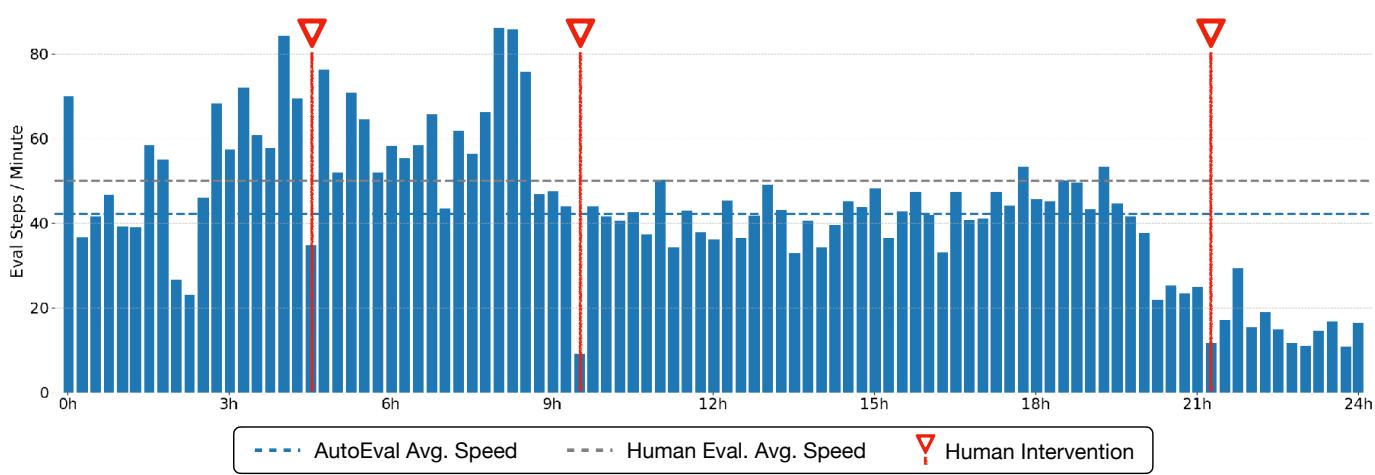
In a 24-hour period, a single AutoEval cell performed roughly 850 evaluation episodes.
- Human Interventions Required: Only 3.
- Total Human Time: ~3 minutes (vs. 16 hours if done manually).
This represents a >99% reduction in human supervision time. The system isn’t just a theoretical prototype; it’s a practical tool that drastically accelerates the iteration cycle.
Conclusion
AutoEval represents a shift in how we think about robotics workflows. As we move toward “Foundation Models” for robots, the bottleneck is no longer just collecting training data—it is validating that the model actually works.
By leveraging the capabilities of modern models (VLMs for perception, robust policies for resetting), we can offload the drudgery of evaluation to the robots themselves.
Key Takeaways:
- Real World > Simulation: For subtle manipulation tasks, physical evaluation provides the only reliable signal.
- Automation is Possible: We don’t need expensive engineering fixtures to reset scenes; we can just learn a “reset policy.”
- Scale: AutoEval turns evaluation from a manual bottleneck into a scalable cloud service.
The authors have open-sourced their code and access to the Bridge-AutoEval cells, hoping to standardize how the community benchmarks generalist policies. In the future, we might see a distributed network of these cells, allowing researchers to test their code on hardware across the globe without ever leaving their desks.
For more details, technical implementation, and code, you can refer to the full paper: “AutoEval: Autonomous Evaluation of Generalist Robot Manipulation Policies in the Real World”.