](https://deep-paper.org/en/paper/2504.01383/images/cover.png)
Imagine you show a child a red apple. They learn what an “apple” is. Later, you show them a green apple, or perhaps a plastic toy apple painted blue. The child immediately recognizes it as an apple because they understand its shape and structure, not just its color or texture.
Now, try the same experiment with a standard computer vision model. If trained only on red apples, many models will fail spectacularly when presented with a blue one. Why? Because deep neural networks are notoriously lazy: they often cheat by memorizing textures (like the specific shiny red skin) rather than learning the underlying geometry of the object.
This limitation is a massive hurdle for Open-World Instance Segmentation—the task of detecting and segmenting objects that the model has never seen before during training.
In this post, we will dive deep into a research paper titled “v-CLR: View-Consistent Learning for Open-World Instance Segmentation.” The researchers propose a clever framework that forces AI models to ignore texture and focus on what matters: the object’s structure. By the end of this article, you’ll understand how “blinding” a model to texture can actually help it see better.
The Problem: The Texture Trap
Standard object detectors (like Mask R-CNN or YOLO) rely on a closed-world assumption: they assume that during testing, they will only encounter the specific categories of objects they saw during training. If you train a model on cats and dogs, and then show it a giraffe, it won’t know what to do.
In the Open World, however, we want models to be “class-agnostic.” We want a model to look at an image and say, “I don’t know what that object is called, but I know it is an object, and here are its boundaries.”
The problem is that current networks are biased toward appearance information. They rely on specific textures to identify objects. If an object has a texture the model hasn’t seen before, the model treats it as background noise.
The authors of v-CLR demonstrate this issue with a “toy example” using the CLEVR dataset (a dataset of 3D shapes).
![Figure 1. Toy example on the CLEVR[33] dataset. The model regards red-metal objects as the known class and is evaluated on different subsets.](/en/paper/2504.01383/images/001.jpg#center)
In Figure 1 above, look at the top row (a). The researchers trained a model treating only “red metal” objects as known.
- Without depth (b): When the model looks at objects that are “Metal” or “Red-Metal,” it does okay (Pink bars). But look at the “Non-Red” or “Non-Metal” categories. The performance collapses. The model simply cannot find objects that don’t look like red metal.
- With depth (c): When the model is forced to incorporate depth information (which contains shape but no color), the performance on novel objects (Blue bars) skyrockets.
This experiment proves a crucial point: To generalize to the open world, models must learn appearance-invariant representations. They need to see the shape, not just the paint job.
The Solution: View-Consistent Learning (v-CLR)
The researchers propose v-CLR, a framework designed to unlearn this texture bias. The core idea is simple yet profound: if we show the model two completely different “views” of the same image—one looking normal, and one where the texture is destroyed but the shape remains—and force the model to extract the same features from both, the model must learn to rely on shape.
1. The Views: Destroying Appearance
To make this work, v-CLR needs different versions of the training images. The researchers use off-the-shelf tools to generate these views automatically.

As shown in Figure 5, the method utilizes three types of inputs:
- Natural Images (Left): The standard RGB photo.
- Art-Stylized Images (Middle): The image processed through a style transfer network. The content is the same, but the texture is radically changed to look like a painting.
- Colorized Depth Images (Right): A depth map of the scene. This is the most critical view because it contains zero original texture information. It purely represents the 3D structure of the scene.
During training, the model will see the Natural image and randomly one of the transformed images. The goal is to force the model to realize that the “Sheep” in the photo and the “Sheep-shaped blob” in the depth map are the exact same entity.
2. The Architecture
v-CLR is built on top of Transformer-based detectors (specifically DINO-DETR and Deformable DETR). Unlike older CNN-based detectors, these models use “object queries”—learnable vectors that probe the image to find objects.
Here is the high-level architecture of the v-CLR framework:

The framework, illustrated in Figure 2, consists of two parallel branches:
- The Natural Image Branch (Top): This branch takes the standard image. It uses a “Teacher” model (updated via Exponential Moving Average, or EMA) to extract features.
- The Transformed Image Branch (Bottom): This branch takes the depth map or stylized image. It uses the “Student” model (the one being actively trained via gradient descent).
The objective is Consistency. The model should produce similar “queries” (features) for the Natural image and the Transformed image. If the Transformed branch (which can’t see texture) produces the same feature vector as the Natural branch (which can), it implies the Natural branch has learned to encode geometry rather than just memorizing texture.
3. The Anchor: General Object Proposals
There is a risk in simply forcing two views to match. The model could cheat by mapping everything to a constant vector, or by matching background features to background features. We need to ensure the model is matching objects.
To solve this, v-CLR uses CutLER, a state-of-the-art unsupervised object proposal network. CutLER is great at finding “blobs that look like objects” even if it doesn’t know what they are.
The workflow for matching is distinct:
- CutLER provides a set of “Object Proposals” (bounding boxes).
- The model looks at the queries from the Natural branch and the Transformed branch.
- It matches the queries that correspond to the same CutLER proposal.
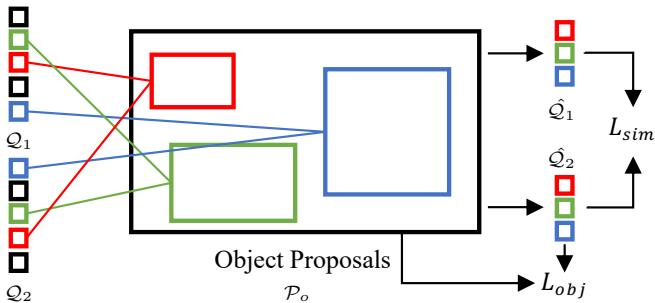
Figure 3 visualizes this matching process.
- \(Q_1\) (Teacher Queries) and \(Q_2\) (Student Queries) are generated.
- They are filtered and matched against the Object Proposals (\(P_0\)).
- Only queries that align with a valid object proposal are selected for the consistency loss.
This ensures that the model is optimizing its representation specifically for objects, not for the sky, grass, or walls.
4. The Mathematics of Consistency
How do we mathematically force these views to align? The researchers introduce a matching loss function.
First, they calculate the Cosine Similarity between the matched queries. The goal is to maximize the similarity (or minimize the distance) between the query from the natural image (\(q_1\)) and the query from the transformed image (\(q_2\)).
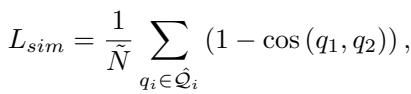
In this equation:
- \(\hat{\mathcal{Q}}_i\) represents the set of queries that were successfully matched to object proposals.
- The loss minimizes \(1 - \cos(q_1, q_2)\), effectively pulling the vectors \(q_1\) and \(q_2\) closer together in the feature space.
In addition to this similarity loss, the model is still trained to perform the actual segmentation task. It uses a standard set of object detection losses (\(L_{obj}\)) including Dice loss (for masks) and box regression loss:

The final total loss function combines the matching objective with the standard ground-truth segmentation loss:

By minimizing this combined loss, the model learns to detect objects accurately (using ground truth) while simultaneously ensuring its internal feature representation is consistent across drastic visual changes (using the matching loss).
Experimental Results
The theory sounds solid, but does it work? The researchers tested v-CLR on several difficult benchmarks where the training classes and testing classes are completely disjoint.
1. VOC \(\to\) Non-VOC
In this experiment, the model is trained only on the 20 classes from the Pascal VOC dataset (e.g., person, car, dog) but tested on the 60 other classes found in the COCO dataset (e.g., giraffe, kite, donut).

Table 1 shows the results. The metric here is Average Recall (AR), which measures how many of the unknown objects the model successfully found.
- Baselines: Standard detectors like Mask-RCNN and vanilla DINO-DETR struggle. For example, DINO-DETR achieves an AR@100 of 31.1%.
- v-CLR: The proposed method achieves 40.9%, a massive improvement of nearly 10 points. This confirms that removing texture bias significantly helps in finding novel objects.
2. Qualitative Analysis
Numbers are good, but seeing is believing. Let’s look at what the model actually detects in complex scenes.

In Figure 4, the model (trained only on VOC classes) is finding objects it has likely never explicitly learned to segment.
- Top Left: It segments the lamp, the painting, and the books on the shelf.
- Bottom Middle: It cleanly segments computer monitors, keyboards, and a mouse—complex shapes that are distinct from the “natural” objects in VOC.
- Bottom Right: Notice the segmentation of the messy desk items. A texture-biased model might blend the black keyboard into the dark desk, but v-CLR sees the structural difference.
3. Robustness Analysis
One of the most interesting findings in the paper is how v-CLR behaves when images are noisy or distorted. If a model relies on structure rather than pixel-perfect texture, it should be more robust to noise (which corrupts texture).
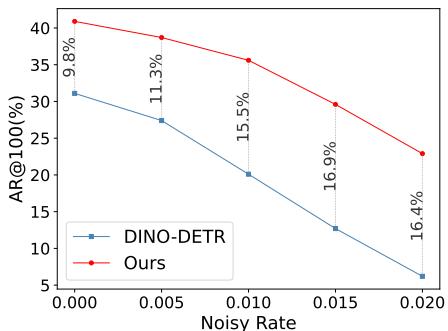
Figure 6 plots the performance (AR) as the “Noisy Rate” (parameter perturbation) increases.
- Blue Line (DINO-DETR): As noise increases, performance drops sharply.
- Red Line (Ours/v-CLR): The slope is much flatter. The model maintains its performance much better even as the network is perturbed.
Similarly, the researchers tested the model against image distortions like contrast changes, snow, and frost.
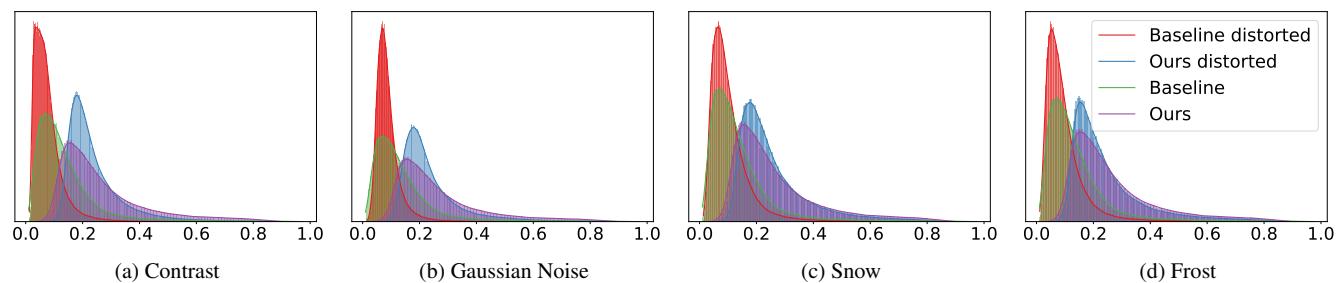
Figure 8 shows the distribution of confidence scores.
- Red line (Baseline Distorted): The baseline model loses confidence when images are distorted (the curve shifts left/up).
- Purple/Blue lines (Ours): v-CLR’s confidence distribution remains incredibly stable, almost identical to its performance on clean images. Because the shape of a car doesn’t change when it’s snowy or foggy, v-CLR remains confident.
4. Cross-Dataset Generalization
Finally, the authors pushed the model even further by training on VOC and testing on the UVO (Unidentified Video Objects) dataset, which is designed specifically for open-world segmentation.
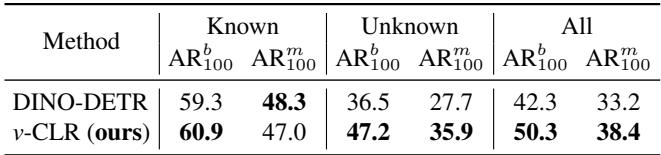
Table 10 highlights a critical success:
- On Known classes, v-CLR performs comparably to the baseline (slightly better).
- On Unknown classes, v-CLR jumps from 36.5% to 47.2% (AR@100).
This proves that the gain in open-world performance doesn’t come at the cost of forgetting the known classes. It’s a “best of both worlds” scenario.
Conclusion and Implications
The “v-CLR” paper provides a compelling argument against the texture bias inherent in modern computer vision. By forcing models to learn representations that are consistent across natural photos, depth maps, and stylized paintings, the researchers successfully decoupled object recognition from object appearance.
Key Takeaways:
- Texture is a Crutch: Deep learning models naturally over-fit to texture, which hurts their ability to find new, unseen objects.
- Multi-View Consistency: We can break this habit by forcing the model to extract the same features from texture-less views (like depth maps).
- Proposals Matter: Using unsupervised proposals (CutLER) ensures that the “consistent features” we learn are actually relevant to objects.
For students and practitioners, this paper serves as a reminder that Data Augmentation isn’t just about preventing overfitting; it’s about defining what the model should learn. By choosing augmentations that destroy texture, the authors explicitly programmed the model to learn structure. As we move toward more general-purpose robots and AI agents that need to operate in messy, unpredictable real-world environments, techniques like v-CLR will be essential for building vision systems that actually “see” the world, rather than just matching patterns.