](https://deep-paper.org/en/paper/2504.01512/images/cover.png)
Introduction
One of the most captivating challenges in computer vision is the “Holy Grail” of 3D generation: taking a single, flat photograph of an object and instantly reconstructing a high-fidelity, 3D model that looks good from every angle. Imagine snapping a photo of a toy on your desk and immediately importing it into a video game or a VR environment.
While generative AI has made massive strides in 2D image creation, lifting that capability to 3D has proven significantly harder. The core problem is geometric ambiguity. A single image tells you what an object looks like from one specific angle, but it leaves the back, sides, and internal geometry completely up to interpretation.
Recent approaches have tried to bridge this gap using Multi-View Diffusion (MVD) models—AIs trained to hallucinate the missing views of an object. However, these hallucinations are often inconsistent; the side view might not perfectly match the front view, leading to 3D models that look blurry, distorted, or filled with artifacts.
Enter GS-RGBN, a new architecture presented by researchers from Zhejiang University, UCL, and the University of Utah. Their approach introduces a novel RGBN-volume (Red-Green-Blue + Normal) strategy combined with Gaussian Splatting. By structurally fusing color data with geometric surface normal data, they achieve a leap in reconstruction quality.
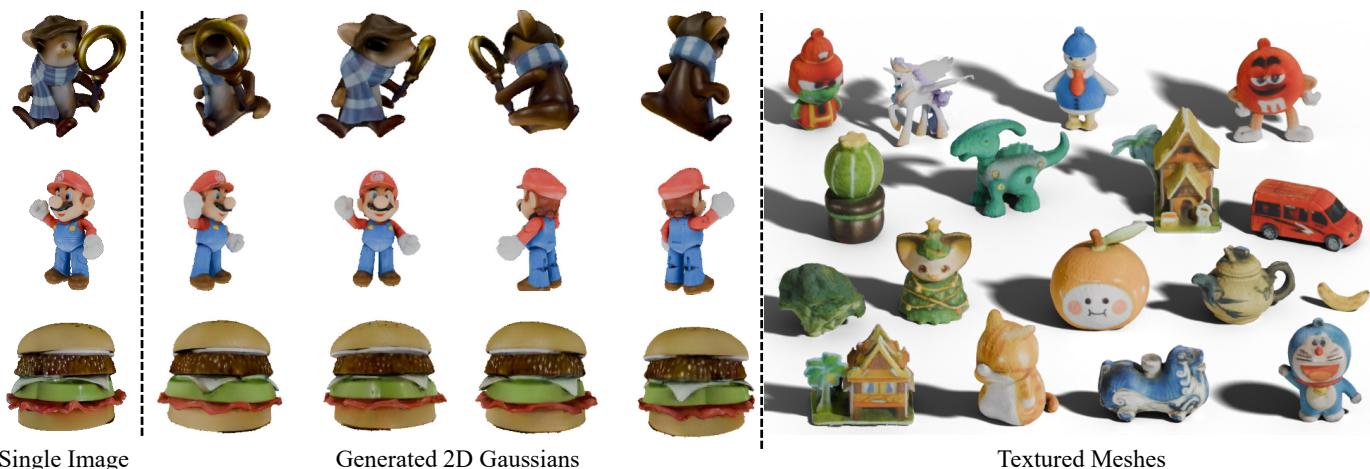
As shown above, GS-RGBN can take a single input image (left) and generate high-quality 3D representations (middle and right) that capture distinct geometries—like the thin racket of a mouse character or the layers of a burger—without the typical artifacts seen in previous methods.
In this post, we will tear down the GS-RGBN paper, exploring how it uses a hybrid voxel-Gaussian architecture and a clever cross-volume fusion mechanism to solve the inconsistency problem in 3D generation.
Background: The 3D Generation Landscape
To understand why GS-RGBN is significant, we need to contextualize it within the current state of 3D generation.
The Problem with Optimization
Early deep learning approaches to 3D, such as DreamFusion, used a technique called Score Distillation Sampling (SDS). These methods essentially “sculpted” a 3D model (like a NeRF) by constantly checking 2D renders against a text-to-image model. While revolutionary, this process is optimization-based. It requires thousands of iterations for a single object, making it slow (taking minutes or hours) and computationally expensive.
The Rise of Feed-Forward Models
To speed things up, the field moved toward feed-forward models. Instead of optimizing a single object for hours, these are massive neural networks trained to predict the 3D structure in a single pass—taking just seconds.
Models like LRM (Large Reconstruction Model) act as “big transformers” for 3D. They look at input images and directly output a 3D representation. Recently, 3D Gaussian Splatting (3DGS) has become the representation of choice for these models because it renders incredibly fast and handles high-frequency details better than NeRFs.
The Missing Piece: Structure and Geometry
However, current feed-forward Gaussian models face two major hurdles:
- Unstructured Representations: 3D Gaussians are essentially point clouds with attributes. Without a rigid structure, neural networks struggle to predict their positions accurately from a single image, often resulting in “floaters” or distorted shapes.
- Inconsistent Priors: Most methods rely purely on RGB images generated by diffusion models. If the diffusion model generates a side view that doesn’t align with the front view (e.g., the color changes slightly), the 3D reconstruction algorithm gets confused, resulting in blurriness.
GS-RGBN addresses these specific failures by introducing Voxels (to provide structure) and Normal Maps (to provide explicit geometry).
The Core Method: GS-RGBN
The architecture of GS-RGBN is designed to enforce consistency. It doesn’t just look at the color of the object; it looks at the surface geometry (normals) and fuses these two streams of information into a unified 3D grid.
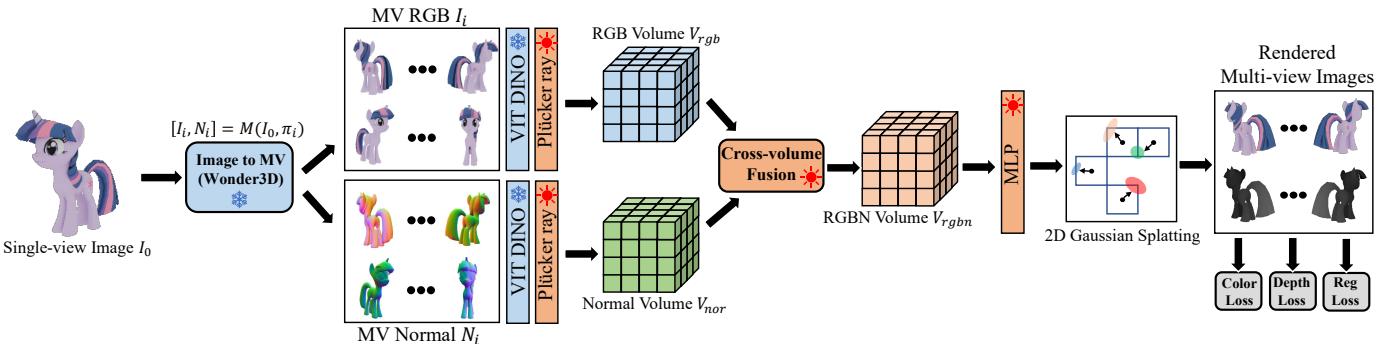
As illustrated in the pipeline above, the process can be broken down into three distinct stages:
- Multi-View Generation & Feature Lifting: Converting a single image into multi-view RGB and Normal data.
- Cross-Volume Fusion (CVF): Merging semantic (RGB) and geometric (Normal) data in 3D space.
- 2D Gaussian Decoding: Generating the final renderable primitives.
Let’s dive deep into each stage.
1. Hybrid Voxel-Gaussian Representation
The first innovation is how the model represents 3D space. Instead of letting Gaussians float freely in void space (which is hard for a network to predict), GS-RGBN anchors them to a Voxel Grid.
The process starts with an off-the-shelf Multi-View Diffusion model called Wonder3D. Given a single input image (\(I_0\)), Wonder3D generates a set of images from different viewpoints, along with their corresponding Normal Maps.
- RGB Images: Provide color and semantic texture.
- Normal Maps: Provide explicit information about surface orientation and shape.
The system processes these images using a ViT-DINO model to extract deep features. But here is the trick: 2D features aren’t enough. The model needs to understand where these features exist in 3D space.
To do this, the authors utilize Plücker Ray Embeddings. This is a mathematical way to represent the camera rays relative to the camera position. The features from the 2D images are “lifted” into 3D space by combining the image features with the ray information.
The fusion of the image feature \(c_i\) and the ray geometry is formulated as:

Here, the features are normalized alongside the cross product of the camera origin (\(o_i\)) and direction (\(d_i\)). These lifted features are then averaged into two distinct 3D volumes:
- \(V_{rgb}\): The RGB Feature Volume.
- \(V_{nor}\): The Normal Feature Volume.
This voxel-based approach solves the “unstructured” problem. By locking information into a grid, the network can use 3D convolutions (standard tools in deep learning) to understand the relationship between neighboring parts of the object.
2. Cross-Volume Fusion (CVF)
Now the system has two 3D volumes: one carrying semantic color info (\(V_{rgb}\)) and one carrying geometric shape info (\(V_{nor}\)). Simply averaging them wouldn’t work well because they contain fundamentally different types of data.
The authors propose a Cross-Volume Fusion (CVF) module. This is the engine room of the architecture, designed to align the semantic and geometric cues.
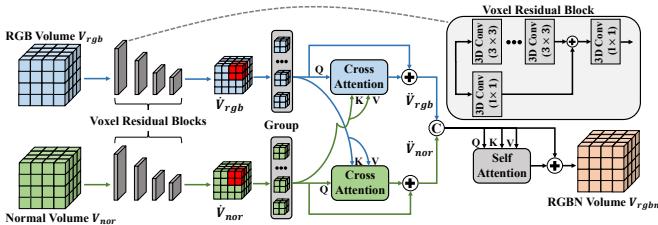
The CVF module uses a mechanism called Cross-Attention. In neural networks, attention allows one stream of data to “query” another stream to find relevant information.
In this specific design:
- RGB-Guided Fusion: The semantic volume (\(V_{rgb}\)) acts as the “Query,” searching the geometric volume (\(V_{nor}\)) for structure. This helps the model understand where color boundaries should align with physical edges.
- Normal-Guided Fusion: The geometric volume acts as the “Query,” searching the RGB volume for consistency. This ensures that the shape explains the texture.
The mathematical formulation for the RGB-guided branch looks like this:

And for the Normal-guided branch:

Here, \(CA_s\) and \(CA_g\) represent the cross-attention blocks. The model unfolds the 3D volumes into groups to make this computation efficient.
After the cross-attention swaps information between the two streams, the results are concatenated (\(\oplus\)):
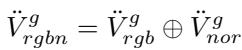
Finally, a Self-Attention (SA) block processes this combined volume to balance the weights between semantic and geometric information, producing the final, high-fidelity volume \(V_{rgbn}\):

This fused volume contains a rich, consistent representation of the object, derived from inconsistent input views.
3. 2D Gaussian Generation and Rendering
With a refined 3D volume \(V_{rgbn}\), the final step is to generate the actual 3D object.
Standard Gaussian Splatting uses 3D ellipsoids. However, 3D ellipsoids can be structurally ambiguous when representing thin surfaces (like a sheet of paper or a leaf). The authors instead adopt 2D Gaussians (often called “surfels” or surface elements). 2D Gaussians are flat disks defined by a center point, two scaling factors, and a rotation. This representation is naturally better at modeling the surfaces of solid objects.
For every voxel in the final grid, a decoder network (\(\phi_g\)) predicts the attributes of the Gaussian inside that voxel:

The network predicts:
- \(\Delta x_i\): The offset position (refining the position within the voxel).
- \(s_i\): Scaling factors (how wide/tall the splat is).
- \(q_i\): Rotation (quaternion).
- \(\alpha_i\): Opacity.
- \(sh_i\): Spherical Harmonics (color coefficients).
Why this matters
By constraining the Gaussian to exist near the voxel center (\(x_i = v_i + r \cdot \Delta x_i\)), the model ensures the “points” don’t fly away or clump together unnaturally. It enforces a structural regularization that pure point-cloud methods lack.
4. Training Objectives
How does the network learn to do this? It is trained using a combination of loss functions that compare the generated 2D Gaussian renders against ground truth images.
The total loss is a weighted sum of three components:

- Color Loss (\(\mathcal{L}_c\)): Ensures the rendered image looks like the target photo. It combines pixel-level differences (L1 loss) and perceptual differences (LPIPS), which measures how similar images look to the human eye.

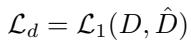
- Depth Loss (\(\mathcal{L}_d\)): This is crucial. Since the input includes depth information (derived from normals/geometry), this loss forces the 3D shape to be accurate, not just the color.
- Regularization Loss (\(\mathcal{L}_{reg}\)): This prevents the Gaussians from becoming too distorted or overlapping in weird ways, ensuring a clean mesh surface.
Experiments and Results
The authors trained GS-RGBN on the massive Objaverse-LVIS dataset (46K 3D objects) using high-end GPUs for nearly a week. To test it, they used the Google Scanned Objects (GSO) dataset, ensuring the model was tested on objects it had never seen before.
Novel View Synthesis (NVS)
The primary metric for success is “Novel View Synthesis”—can the model generate a view of the object that wasn’t in the input?
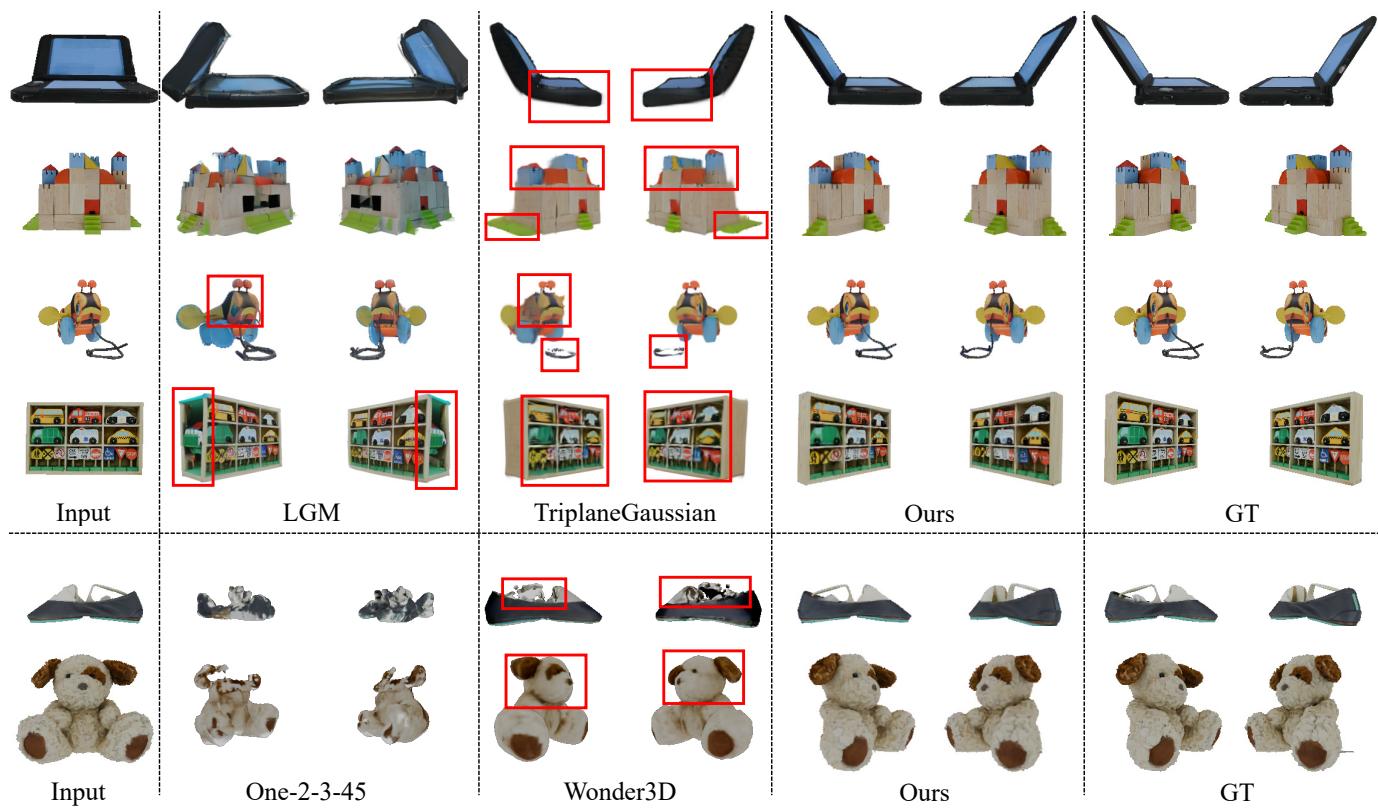
In the comparison above, look closely at the “LGM” and “TriplaneGaussian” columns versus “Ours” and “GT” (Ground Truth).
- The Laptop (Row 1): LGM flattens the screen. GS-RGBN preserves the angle.
- The Castle (Row 2): TriplaneGaussian makes the castle look overly thick and blobby. GS-RGBN captures the distinct turrets.
- The Robot (Row 3): Note the crispness of the texture in the GS-RGBN result compared to the blurriness of Wonder3D.
These visuals confirm that the Voxel-Gaussian structure prevents the distortion common in other feed-forward methods.
Quantitative Analysis
The numbers back up the visuals. The table below compares GS-RGBN against state-of-the-art methods like DreamGaussian, LGM, and Wonder3D.
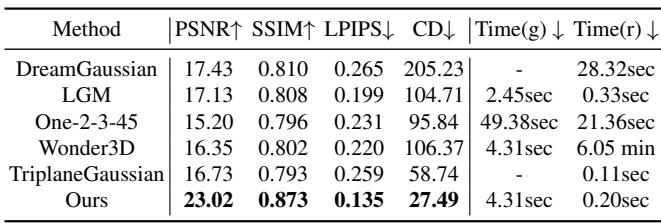
Key Takeaways from Table 1:
- PSNR (Higher is better): GS-RGBN scores 23.02, significantly higher than the runner-up (DreamGaussian at 17.43). This is a massive jump in image fidelity.
- LPIPS (Lower is better): With a score of 0.135, GS-RGBN produces images that are perceptually much closer to reality than competitors (typically >0.200).
- Time: While generating the multi-view images takes about 4 seconds (Time(g)), the actual reconstruction (Time(r)) takes only 0.20 seconds. This is practically real-time reconstruction once the views are generated.
Single View Reconstruction
The method also shines in preserving the overall 3D shape, not just the rendering from specific angles.
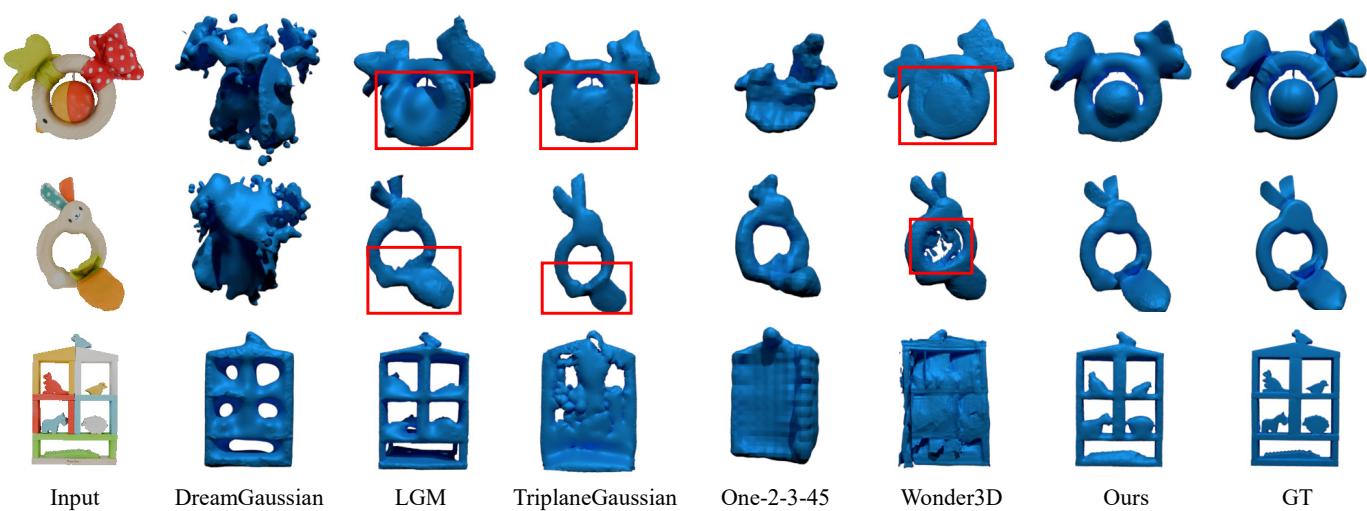
Notice the “Rattle” toy in the top row. Methods like “One-2-3-45” and “Wonder3D” fail to close the loop of the ring or create disconnected geometry. GS-RGBN maintains a watertight, coherent shape that matches the Ground Truth (GT) almost perfectly.
Why the Components Matter (Ablation Studies)
One of the most educational parts of the paper is the ablation study, where the researchers disable parts of the system to see what breaks.
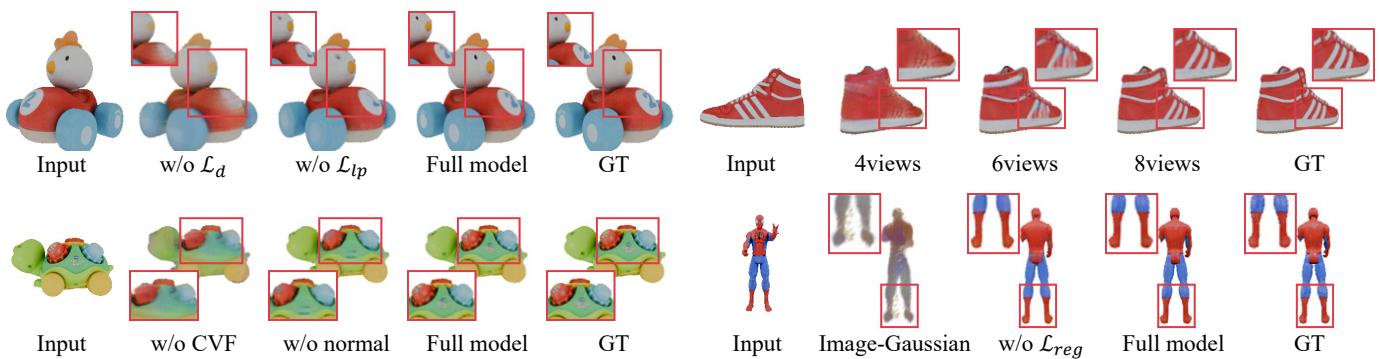
- w/o Normal Input (Middle Row, green turtle): Without the normal maps, the geometry collapses. The shell of the turtle becomes lumpy and undefined. This proves that RGB alone isn’t enough for high fidelity.
- w/o CVF (Middle Row): Removing the Cross-Volume Fusion module results in a loss of detail. The fusion is essential for aligning the sharp edges of the normals with the textures of the RGB.
- Image-Gaussian (Bottom Row, Spider-Man): If they remove the Voxel structure entirely and try to predict Gaussians directly from the image (like LGM does), the limbs of the figure become detached and messy. The voxel grid is essential for spatial coherence.
The quantitative impact of these components is detailed in Table 2:
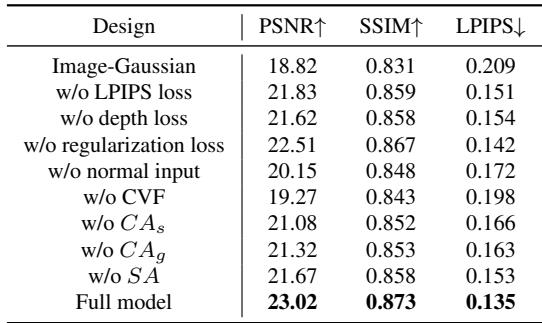
Removing the Normal input causes the PSNR to drop from 23.02 to 20.15. Removing the Cross-Volume Fusion (CVF) drops it to 19.27. This empirically proves that the fusion of geometry and color is the primary driver of the model’s performance.
Finally, the authors analyzed how the number of views affects performance:
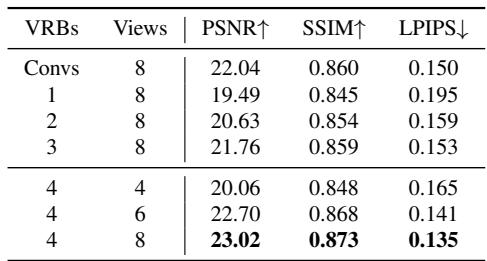
Interestingly, even with only 4 input views, GS-RGBN outperforms previous methods trained on more data. However, as expected, feeding it 8 views yields the best results (PSNR 23.02).
Conclusion and Implications
GS-RGBN represents a significant maturity in the field of single-image 3D reconstruction. It moves away from the “black box” approach of purely image-based transformers and reintroduces explicit 3D structure (Voxels) and explicit geometry (Normals) into the deep learning pipeline.
Key Takeaways:
- Structure wins: Anchoring 2D Gaussians to a Voxel grid prevents the “floaters” and distortions seen in unstructured models.
- Fusion is key: You cannot rely on RGB alone. Fusing RGB with Normal maps via Cross-Attention allows the model to correct inconsistencies in the input data.
- Speed and Quality: It is possible to achieve high-fidelity results without hour-long optimization processes.
Limitations: The authors note that the method is still dependent on the quality of the Multi-View Diffusion model (Wonder3D). If the initial hallucinated views are too inconsistent, the reconstruction will suffer. Additionally, using voxels limits the resolution for very large scenes due to memory constraints—future work may look into Octree structures to solve this.
For students and researchers, GS-RGBN is a perfect example of how hybrid representations (combining explicit geometric grids with learnable neural primitives) often outperform pure end-to-end neural approaches in 3D tasks.