](https://deep-paper.org/en/paper/2504.01955/images/cover.png)
Can AI Understand Complex Scenes Without Labels? Inside CUPS
Imagine you are teaching a child to recognize objects in a busy city street. You point to a car and say “car,” point to the road and say “road.” Eventually, the child learns. This is essentially how Supervised Learning works in computer vision: we feed algorithms thousands of images where every pixel is painstakingly labeled by humans.
But what if you couldn’t speak? What if the child had to learn purely by observing the world? They might notice that a “car” is a distinct object because it moves against the background. They might realize the “road” is a continuous surface because of how it recedes into the distance.
This is the goal of Unsupervised Panoptic Segmentation: teaching machines to understand a scene—identifying distinct objects (“things”) and background textures (“stuff”)—without a single human-annotated label.
While this technology has existed in limited forms, it has historically struggled with complex, cluttered environments like driving scenes. In this post, we are diving deep into a new paper, “Scene-Centric Unsupervised Panoptic Segmentation” (CUPS). This research proposes a novel framework that uses motion and depth cues to allow AI to teach itself how to see the world, achieving state-of-the-art results.
The Problem: Things, Stuff, and The “Object-Centric” Bias
To understand why this paper is important, we first need to define the task. Panoptic Segmentation combines two sub-tasks:
- Semantic Segmentation: Labeling every pixel with a category (e.g., sky, road, tree).
- Instance Segmentation: Distinguishing separate instances of the same category (e.g., Car #1 vs. Car #2).
Doing this without supervision is incredibly difficult. Previous state-of-the-art methods, such as U2Seg, relied on techniques designed for “object-centric” images—pictures like those in ImageNet where a single object sits clearly in the center of the frame. These methods often use a technique called MaskCut to identify foreground objects.
However, the real world isn’t object-centric; it is scene-centric. A view from a dashboard camera contains dozens of overlapping objects, complex geometries, and vast background regions. When you apply object-centric assumptions to these scenes, the models fail.
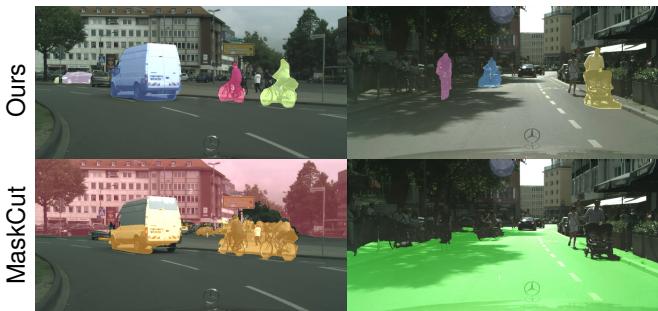
As shown in Figure 2, when the previous method (MaskCut) tries to segment a street scene, it gets confused. It groups unrelated areas based on semantic correlation rather than identifying distinct objects. It fails to separate the “things” (cars) from the “stuff” (road). The proposed method, CUPS, clearly distinguishes individual cars and pedestrians, even without supervision.
The CUPS Solution: Learning from Gestalt Principles
The researchers behind CUPS took inspiration from Gestalt psychology, which describes how humans perceptually group visual elements. specifically:
- Common Fate: Elements that move together belong together.
- Similarity: Elements that look similar often belong to the same region.
CUPS is the first unsupervised panoptic method trained directly on scene-centric imagery. To achieve this, it doesn’t just look at a static picture. It leverages stereo video (left and right camera frames over time) during the training generation phase to extract two critical signals: Motion and Depth.
Here is the high-level workflow:
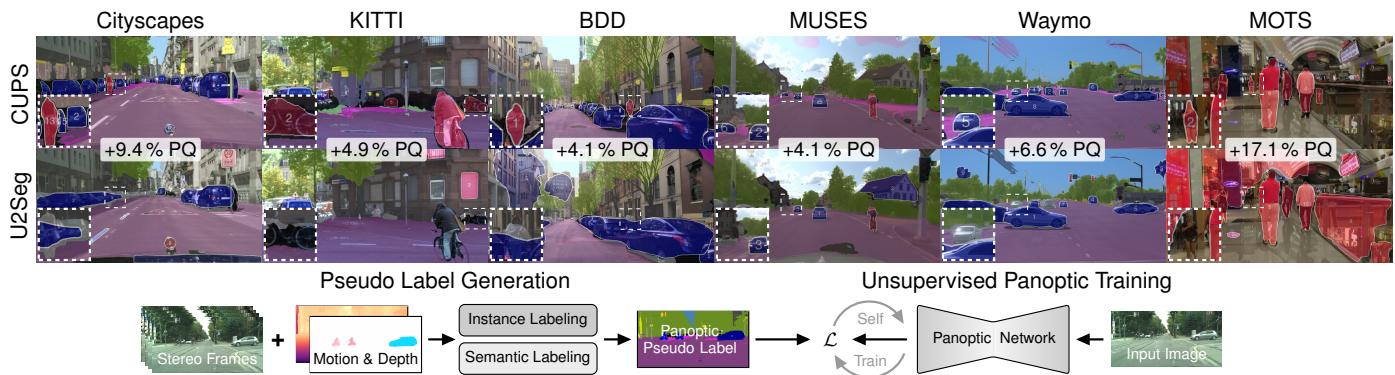
As illustrated in Figure 1, the system uses motion and depth from stereo frames to generate Pseudo Labels. These labels are then used to train a standard panoptic network (like Mask R-CNN) on single images.
Let’s break down the three distinct stages of this method.
Stage 1: Generating Panoptic Pseudo Labels
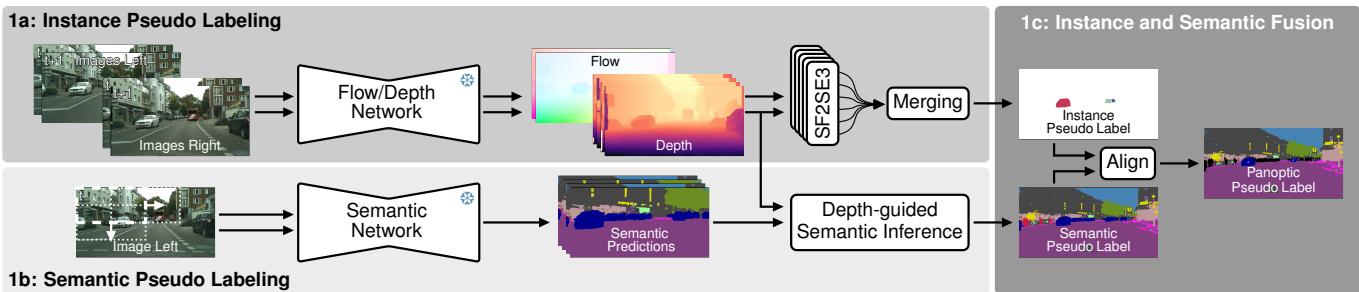
The core innovation of CUPS is how it creates its own training data. Since there are no human labels, the system must generate “pseudo labels” that are accurate enough to learn from. It does this by fusing two streams of information: Instance Pseudo Labeling (finding moving objects) and Semantic Pseudo Labeling (understanding textures and surfaces).
1a. Mining Scene Flow for Instances
To find specific objects (instances), the model looks for things that move. Using two consecutive stereo frames, the system estimates scene flow—the 3D motion of every pixel.
The researchers employ a technique called SF2SE3, which clusters this flow into rigid bodies. If a group of pixels moves together in 3D space, it is likely a rigid object (like a car or bus).
However, motion estimation can be noisy. To fix this, they run the clustering algorithm multiple times and look for consistency. They compute a consistency score, \(c_i\), for each potential mask:

Only masks that appear in at least 80% of the runs are kept. This ensures that the system only generates labels for objects it is confident about, filtering out random noise.
1b. Depth-Guided Semantic Labeling
While motion finds the “things,” we also need to segment the “stuff” (roads, buildings, sky). For this, the researchers use DINO, a self-supervised Vision Transformer that creates rich visual features.
A major challenge with DINO is that it operates at a low resolution. If you simply upsample DINO features, you get blurry boundaries, losing the fine details of traffic signs or pedestrians in the distance. Conversely, if you process high-resolution crops, you lose the global context for nearby objects.
The CUPS authors propose Depth-Guided Inference. They generate semantic predictions at both low resolution (\(P^{\text{low}}\)) and high resolution (\(P^{\text{high}}\)). Then, they use the depth map (\(D\)) to fuse them.
They calculate a mixing weight \(\alpha\) based on distance:

This weight is then applied to merge the semantic predictions:

The logic here is elegant: pixels with small depth values (close to the camera) rely on low-resolution features which capture large-scale context. Pixels with large depth values (far away) rely on high-resolution sliding-window features to capture fine details.
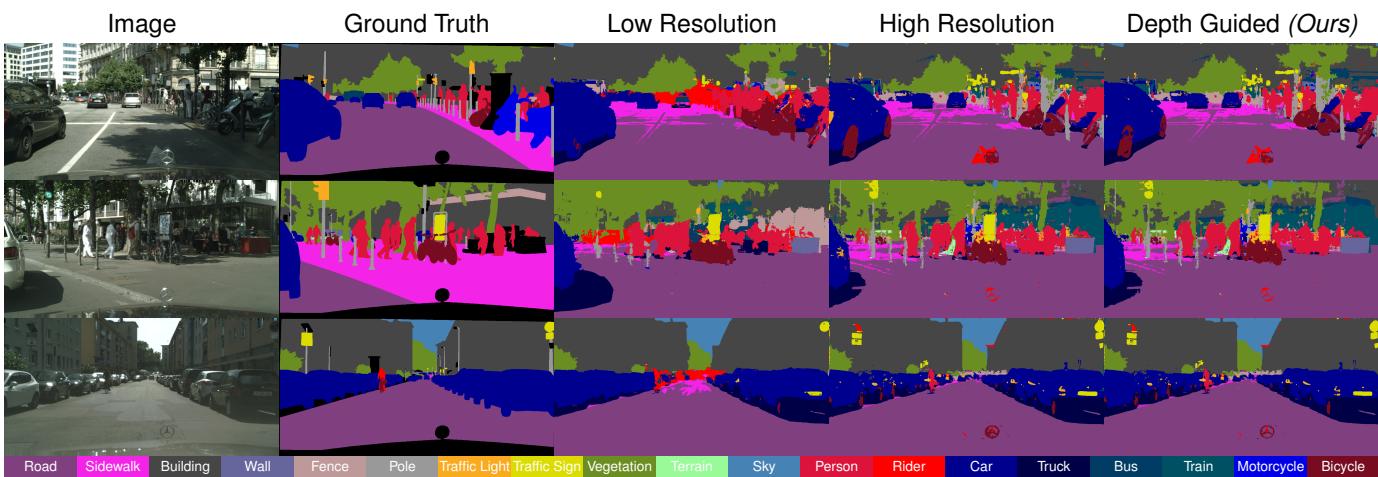
Figure 6 demonstrates the power of this approach. Notice how the “Low Resolution” column blurs the distant buildings and cars, while the “High Resolution” column introduces noise. The “Depth Guided” result creates a sharp, accurate segmentation that closely matches the Ground Truth.
1c. Fusion
Finally, the instance masks (from motion) and semantic maps (from depth-guided DINO) are fused. The system automatically categorizes semantic classes as “things” or “stuff” based on how often they overlap with the motion masks. This results in a single, comprehensive Panoptic Pseudo Label.
Stage 2 & 3: Training the Panoptic Network
Once the pseudo labels are generated, the system moves to training a standard segmentation network (Panoptic Cascade Mask R-CNN). This training happens in two phases: Bootstrapping and Self-Training.

Stage 2: Panoptic Bootstrapping
The pseudo labels generated in Stage 1 are high quality, but sparse. They only capture objects that happened to be moving in the video clips. The network needs to learn to recognize static cars as well.
To handle this, the authors use a loss function called DropLoss:

This equation essentially tells the network: “Only penalize the model if it fails to predict a ’thing’ that overlaps with our pseudo-masks. If the model predicts a car where we don’t have a label, don’t punish it—it might be a static car we missed.” This allows the network to generalize beyond the moving objects found in Stage 1.
Stage 3: Panoptic Self-Training
To further refine accuracy, the researchers employ a self-training strategy (Figure 4b). This involves a “Teacher-Student” setup (specifically, a momentum network).
- Augmentation: The input image is flipped and scaled to create different views.
- Teacher Prediction: The Teacher network predicts labels for these views.
- Self-Labeling: These predictions are averaged to create a robust “Self-Label.”
- Student Update: The Student network tries to match this self-label on a photometrically augmented version of the image.
Crucially, they use confidence thresholding to ignore uncertain predictions:

This ensures the network only learns from its most confident predictions, gradually expanding its knowledge base.
Experimental Results
So, how well does CUPS work? The researchers evaluated the method on several challenging datasets, including Cityscapes (urban driving), KITTI, and Waymo.
State-of-the-Art Performance
On the Cityscapes validation set, CUPS significantly outperforms the previous best method, U2Seg.

As shown in Table 1, CUPS achieves a Panoptic Quality (PQ) of 27.8%, a massive 9.4 percentage point increase over U2Seg. It shows improvements in both segmentation quality (SQ) and recognition quality (RQ).
Visual Quality
The quantitative numbers are backed up by visual evidence.
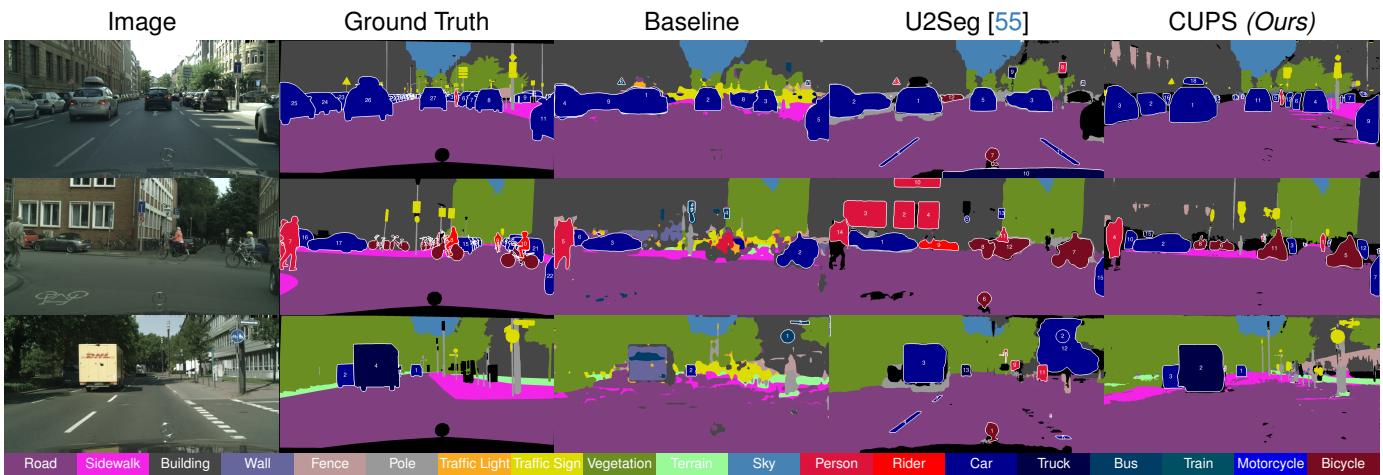
In Figure 8a, compare the “Baseline” and “U2Seg” columns with “CUPS.” The baseline methods struggle to form coherent object shapes, often scattering pixel predictions (noise). CUPS produces clean, coherent masks for cars, pedestrians, and road surfaces, looking remarkably similar to the Ground Truth.
Generalization
A common issue in machine learning is overfitting to one dataset. However, CUPS demonstrates strong generalization capabilities. The model trained on Cityscapes was tested on completely different datasets without retraining.

Table 2 shows that CUPS generalizes far better than supervised methods. While a supervised model drops significantly in performance when moving from Cityscapes to KITTI or BDD, CUPS maintains a strong lead over other unsupervised methods. It even performs well on MOTS (Multi-Object Tracking and Segmentation), which is considered out-of-domain data.
Label-Efficient Learning
One of the most promising applications of unsupervised learning is “Label Efficiency”—reducing the amount of human annotation required. The researchers fine-tuned their pre-trained CUPS model using only small fractions of the labeled data.
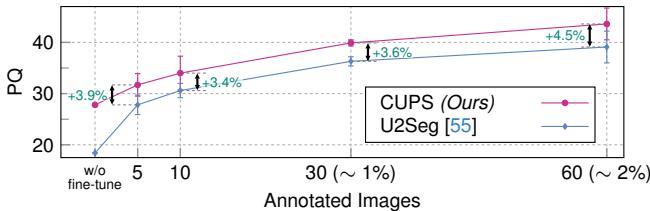
Figure 5 reveals a stunning result: By fine-tuning CUPS on just 60 annotated images (approx. 2% of the dataset), the model achieves a PQ of 43.6%. This is roughly 70% of the performance of a fully supervised model that used thousands of labels. This suggests that CUPS could massively reduce the cost and time required to annotate data for autonomous driving systems.
Conclusion
CUPS (Scene-Centric Unsupervised Panoptic Segmentation) represents a significant leap forward in computer vision. By moving away from object-centric assumptions and embracing the complexity of real-world scenes, the authors have created a system that learns much like a biological vision system might: using motion to segregate objects and depth to understand scale.
The combination of scene flow for instance discovery and depth-guided feature distillation for semantic understanding solves the difficult “Thing vs. Stuff” problem without human supervision.
While the method currently relies on stereo video for training (which is widely available in robotics and driving datasets), the resulting model works on standard monocular images. This opens the door for robust, scalable perception systems that can adapt to new environments without needing thousands of hours of human labeling labor.