](https://deep-paper.org/en/paper/2504.01956/images/cover.png)
Imagine taking two casual photos of a room—perhaps one of the desk and one of the bookshelf—and instantly generating a fully navigable 3D video of the entire space. No expensive scanning equipment, no hours of processing time, and no “hallucinated” geometry where walls warp into furniture.
This is the “Holy Grail” of computer vision: Sparse-view 3D reconstruction.
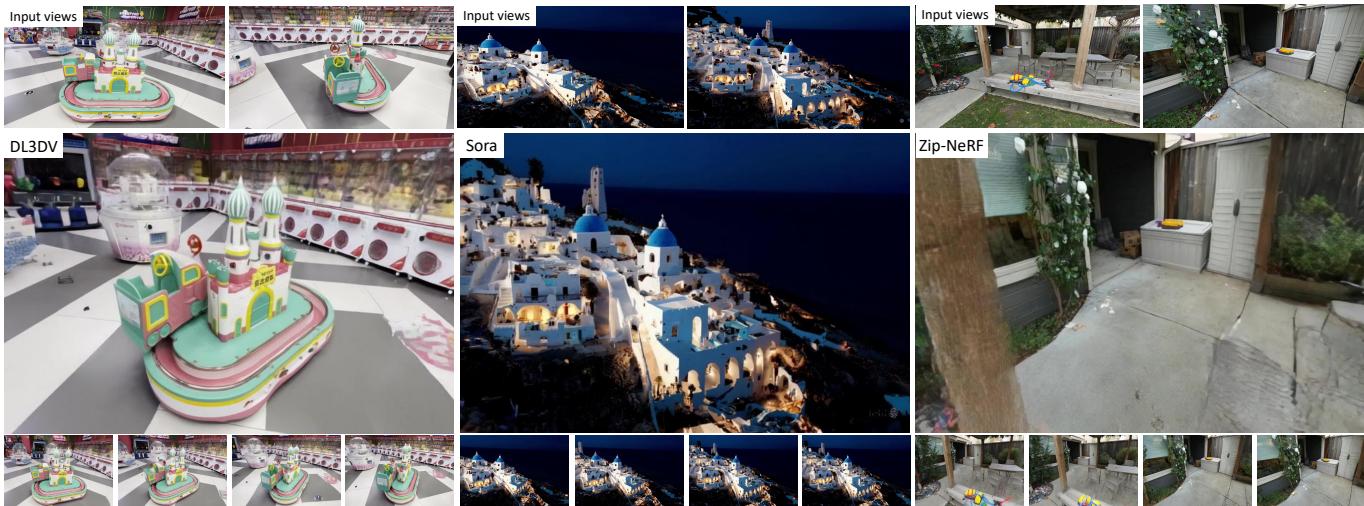
While recent advancements in AI video generators (like Sora) are impressive, they struggle with this specific task. They often lack 3D consistency—meaning as the camera moves, the shape of the room might subtly morph. Furthermore, they are slow, requiring dozens of denoising steps to produce a single second of video.
In a recent paper titled VideoScene: Distilling Video Diffusion Model to Generate 3D Scenes in One Step, researchers from Tsinghua University propose a groundbreaking framework. VideoScene creates high-quality, 3D-consistent videos from just two input images in a single inference step.
In this deep dive, we will unpack how VideoScene bridges the gap between generative video AI and precise 3D reconstruction.
The Challenge: The Gap Between Video and 3D
To understand why VideoScene is necessary, we first need to look at the limitations of current technology.
The Problem with Sparse Views
Recovering a 3D scene from only two images (sparse views) is an “ill-posed problem.” There simply isn’t enough visual information to know exactly what the 3D geometry looks like in the blind spots.
- Traditional Methods (NeRF/3DGS): Methods like Neural Radiance Fields (NeRF) or 3D Gaussian Splatting usually require dense capture (hundreds of images) to work well. With only two images, they produce artifacts or “floaters.”
- Feed-Forward Models: Newer models like pixelSplat or MVSplat are fast and can guess the 3D structure, but they often produce blurry results in areas that aren’t visible in the original photos.
The Problem with Video Diffusion
Video diffusion models are trained on massive amounts of data, giving them a strong “prior” (general knowledge) about what the world looks like. They can hallucinate missing details beautifully. However, they have two major flaws when applied to 3D:
- Sluggishness: They use iterative denoising. Transforming random noise into a video might take 50 steps. This is too slow for real-time applications.
- Lack of 3D Geometry: These models are trained on 2D pixels, not 3D geometry. They prioritize making the video look real over making it spatially accurate. This leads to “wobbly” rooms where objects shift size or position as the camera moves.
The Solution: VideoScene
The researchers developed VideoScene to combine the best of both worlds: the 3D consistency of reconstruction models and the generative power of video diffusion models, all while optimizing for speed.
The core of their approach relies on a technique called Consistency Distillation. In simple terms, they train a “student” model to jump directly to the final result in one step, mimicking what a “teacher” model (a large video diffusion model) does in many steps.
However, standard distillation wasn’t enough. The team introduced two key innovations:
- 3D-Aware Leap Flow Distillation: Starting with a rough 3D draft rather than pure noise.
- Dynamic Denoising Policy Network (DDPNet): An intelligent agent that decides exactly how much noise to clean up.
Let’s break down the architecture.
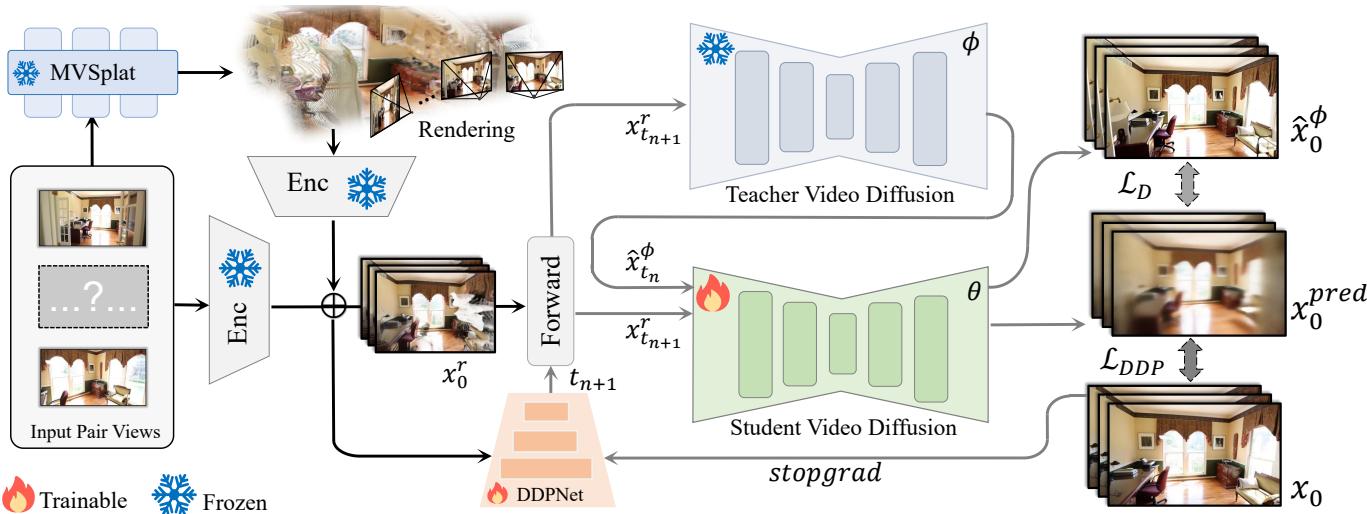
As shown in Figure 2, the pipeline begins with two input views. Instead of feeding these directly into a diffusion model, the system first creates a coarse 3D representation using a rapid model called MVSplat. This creates a “rough draft” video. This draft has perfect camera trajectory control (it moves correctly in 3D) but might be blurry or have artifacts.
This rough video serves as a strong 3D prior. The diffusion model’s job is no longer to generate a scene from scratch, but to “polish” this rough draft into a high-quality video.
Core Method 1: 3D-Aware Leap Flow Distillation
Standard diffusion models work by taking a random noise distribution (Gaussian noise) and slowly removing the noise to reveal an image. This is inefficient because the model has to figure out the scene layout and the fine details simultaneously.
The researchers observed that the early steps of denoising (starting from pure noise) are the hardest and most uncertain. By the time the model gets halfway through, the structure is usually determined.
Leaping Over the Noise
VideoScene employs a Leap Flow strategy. Instead of starting the inference (generation) process from pure noise (\(t=T\)), they start from an intermediate timestep (\(t < T\)).
They take the rendered video from the coarse 3D model (MVSplat), encode it into a latent space (\(\mathbf{x}_0^r\)), and add a specific amount of noise to it. This creates a starting point that already possesses the correct 3D structure. The model then “leaps” over the difficult early stages and focuses on refining the details.
This is mathematically grounded in the Consistency Function, defined as:

This equation essentially states that the function \(\mathbf{f}\) should map any point along the noisy trajectory \(\mathbf{x}_t\) directly to the clean origin \(\mathbf{x}_\epsilon\) (the final image/video).
To train the model to do this, they use a distillation loss function. The goal is to minimize the difference between the student’s one-step prediction and the teacher’s prediction:

Here, the student \(\mathbf{f}_{\theta}\) tries to match the teacher \(\mathbf{f}_{\theta^{-}}\). By minimizing this difference, the student learns to condense the teacher’s multi-step knowledge into a single forward pass.
This strategy ensures that the output retains the strong structural consistency of the initial 3D model while gaining the high-fidelity texture and lighting from the diffusion model.
Core Method 2: Dynamic Denoising Policy Network (DDPNet)
The second major innovation solves a subtle but critical problem: How much noise should we add to the initial 3D draft?
- Too little noise: The diffusion model doesn’t have enough room to work. It will output something very similar to the input—meaning it won’t fix the blurriness or artifacts from the coarse 3D model.
- Too much noise: The 3D structure gets destroyed. The model starts hallucinating new geometries that don’t match the input images, leading to consistency errors.
In standard approaches, this noise level (timestep \(t\)) is chosen randomly or fixed. VideoScene replaces this with an intelligent agent called the Dynamic Denoising Policy Network (DDPNet).
The Bandit in the Network
The researchers framed this as a Contextual Bandit problem. In machine learning, a “bandit” is an agent that selects actions to maximize a reward.
In this context:
- The State: The input video latent from the coarse 3D model.
- The Action: Selecting a specific timestep \(t\) (the noise level).
- The Reward: The quality of the final reconstruction (measured by how close it is to the ground truth).
The DDPNet analyzes the quality of the incoming coarse video. If the draft is high quality, it selects a small \(t\) (light polishing). If the draft has artifacts or distortions, it selects a larger \(t\) (heavy renovation).
The training objective for this policy network is maximizing the reward, or minimizing the negative Mean Squared Error (MSE):

This adaptive approach allows VideoScene to be robust. It knows when to trust the 3D prior and when to rely on the generative model to fix mistakes.
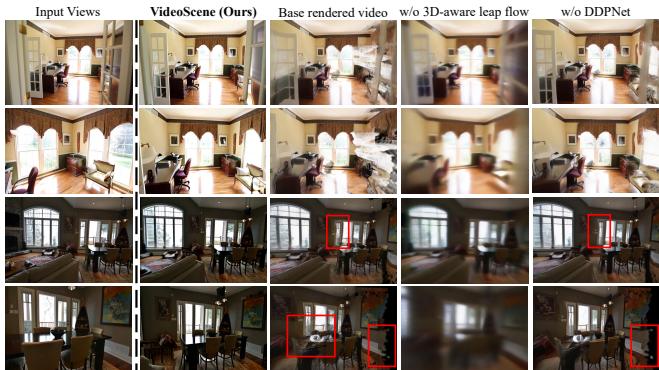
Figure 6 above visualizes why this matters.
- Base rendered video: Blurry and low fidelity.
- w/o 3D-aware leap: Loses structure completely.
- w/o DDPNet: Often retains artifacts or introduces ghosting (see the red boxes).
- VideoScene (Ours): Sharp, clear, and structurally accurate.
Experiments and Results
The researchers tested VideoScene on the RealEstate10K dataset (indoor scenes) and the ACID dataset (outdoor nature scenes). They compared it against state-of-the-art video diffusion models like Stable Video Diffusion (SVD), DynamiCrafter, and CogVideoX.
Qualitative Comparison: Visual Fidelity
The visual differences are striking. In Figure 3 (below), look at the columns for Step-1 and Step-50.
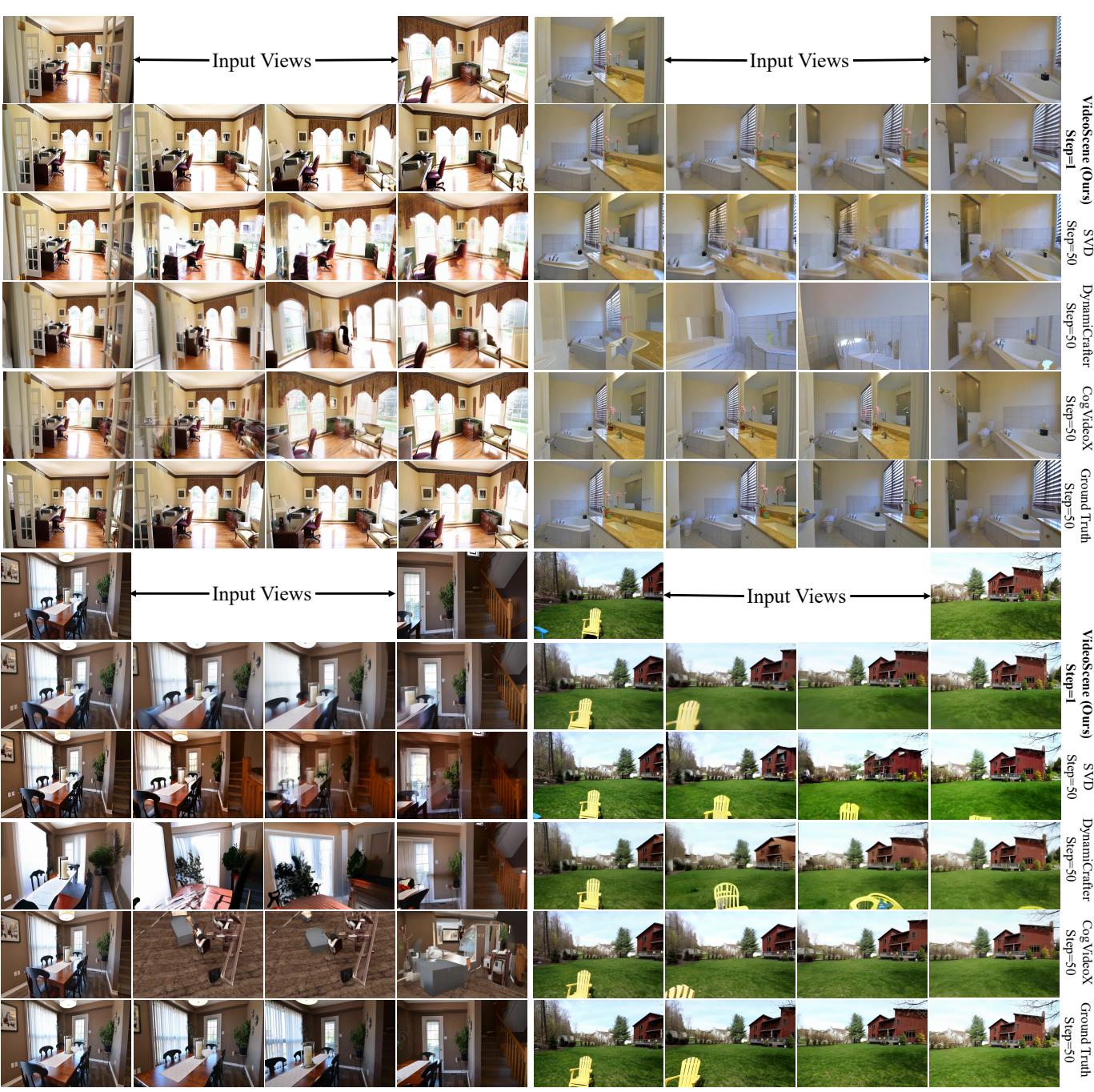
Baseline models like SVD and CogVideoX struggle immensely at 1 step (Step-1), producing noisy, incoherent messes. Even at 50 steps, they often exhibit “frame skipping” or distort objects (like the chair in the top row). VideoScene, however, produces crisp, stable video in just one step.
Quantitative Comparison: The Numbers
The quantitative metrics confirm the visual results. The researchers used FVD (Fréchet Video Distance), a standard metric where lower is better, indicating the video looks more natural.
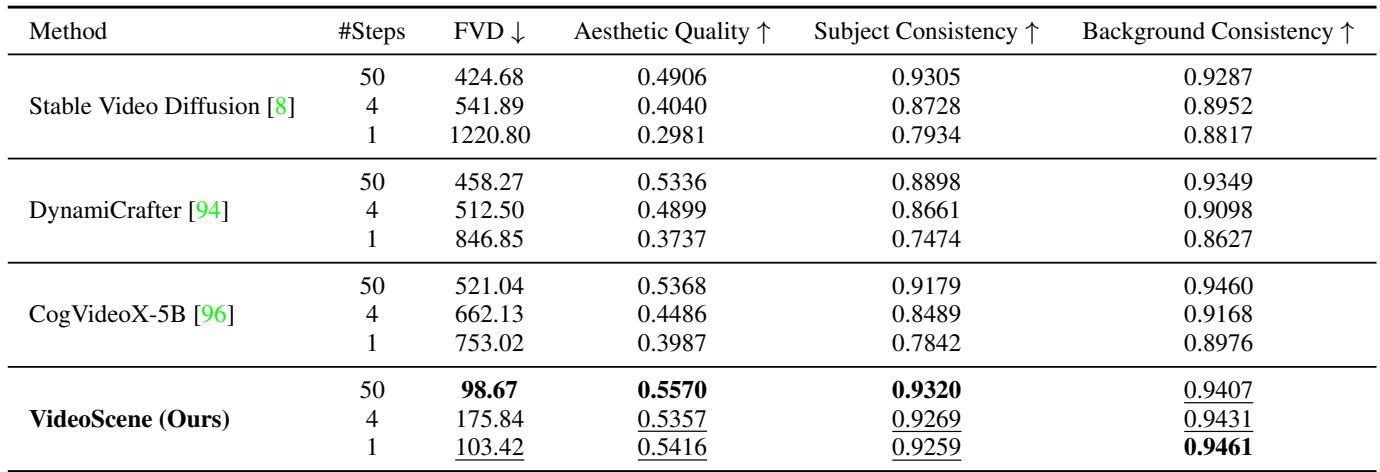
In Table 1, look at the FVD scores for the “1 Step” row.
- Stable Video Diffusion: 1220.80
- DynamiCrafter: 846.85
- VideoScene: 103.42
VideoScene is an order of magnitude better at one-step generation. More impressively, its 1-step performance (103.42) is nearly identical to its 50-step performance (98.67), proving that the distillation was successful. The other models degrade massively when forced to run in one step.
Consistency and Generalization
A major claim of the paper is “3D Consistency.” To prove this, they ran a matching algorithm to track feature points across the generated video frames.
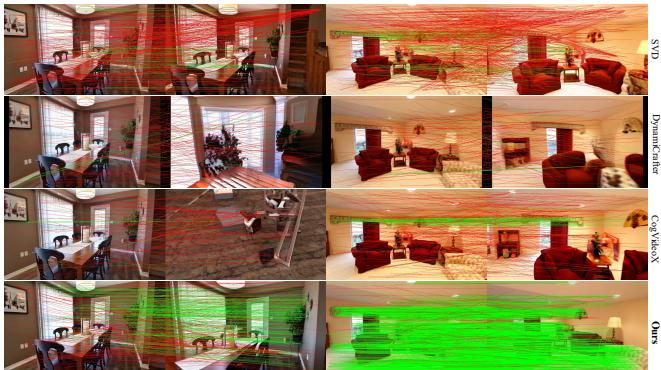
In Figure 5, green lines indicate valid geometric matches between views. The VideoScene column is dense with green lines, showing that the geometry remains stable as the camera moves. The baseline methods (SVD, CogVideoX) show red lines or sparse matches, indicating that objects are shifting or vanishing—a hallmark of hallucination.
Furthermore, the model generalizes well. Even when trained on indoor real estate data, it performs admirably on outdoor beach scenes (the ACID dataset), as seen in Figure 4.
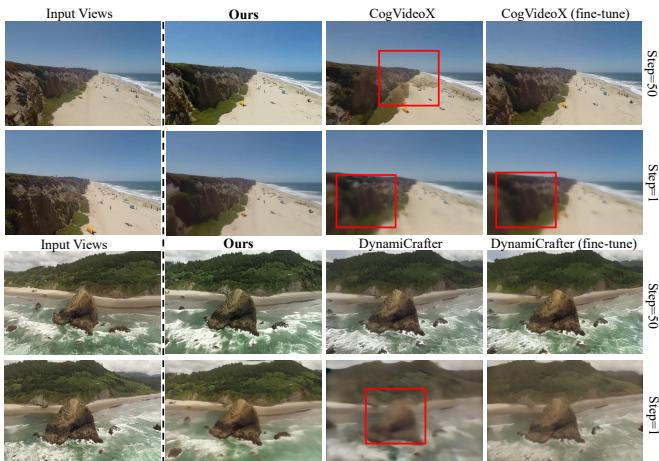
While fine-tuned baselines (CogVideoX fine-tuned) improve, they still fail at 1-step inference. VideoScene maintains high quality and structure even on this unseen data.
Conclusion and Implications
VideoScene represents a significant leap forward in generative 3D. By cleverly combining a cheap, fast 3D prior (MVSplat) with the rich texture generation of a distilled video diffusion model, the authors have solved the “speed vs. quality” trade-off.
Key Takeaways:
- Speed: It generates 3D scenes in one step, making it potentially viable for real-time applications.
- Consistency: Unlike standard video AI, it respects the physics of the scene thanks to the 3D-aware initialization.
- Adaptability: The DDPNet allows the model to intelligently decide how much “fixing” a scene needs, optimizing the balance between preservation and generation.
This technology bridges the gap between simply watching a video and stepping inside it. Future applications could range from instant VR content creation to more robust autonomous navigation systems that need to imagine 3D environments from sparse camera feeds.
The era of “Video to 3D” is just beginning, and VideoScene has set a new speed limit.