](https://deep-paper.org/en/paper/2504.02199/images/cover.png)
Introduction
In the era of GDPR and increasing privacy concerns, the “right to be forgotten” has become a critical requirement for technology companies. For deep learning, this poses a massive engineering challenge. If a user requests their data be removed from a trained AI model, how do we ensure the model actually “forgets” them?
The standard approach is Machine Unlearning (MU). The goal is to update a model to look as if it never saw specific data, without having to retrain the whole thing from scratch (which is expensive and slow). However, recent research reveals a disturbing reality: most current unlearning methods are superficial. They might change the model’s final output, but the sensitive “knowledge” often remains hidden deep within the neural network’s feature extractor.
In this post, we dive into a paper that proposes a solution to this deep-seated problem: Erasing Space Concept (ESC). The researchers introduce a method to mathematically identify and surgically remove the specific feature spaces where “forbidden” knowledge resides, ensuring true Knowledge Deletion (KD).
The Problem: The Illusion of Forgetting
To understand why ESC is necessary, we first need to understand where standard Machine Unlearning fails. A typical deep learning model consists of two parts:
- The Feature Extractor (Backbone): Layers that learn to understand shapes, textures, and high-level concepts.
- The Classification Head: The final layer that maps those features to a specific class label (e.g., “Dog” or “Cat”).
Most existing unlearning methods (like Negative Gradient or Random Labeling) focus on minimizing the loss on the specific data we want to forget. The researchers analyzed where these changes actually happen inside the model.
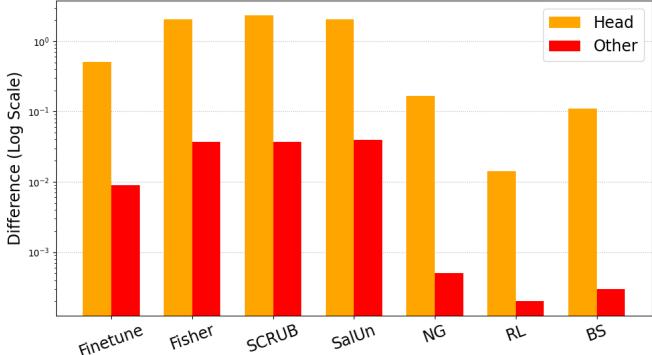
As shown in Figure 2 above, the vast majority of weight changes in existing methods happen in the Head (orange bars). The Other layers (the feature extractor) see very little change.
The Recovery Risk
This creates a “masked” effect. The model might stop classifying the image as “User A,” but the deep features representing “User A” are still there. If a malicious actor simply freezes the backbone and retrains a new head (a process called linear probing), the “forgotten” knowledge resurfaces immediately.
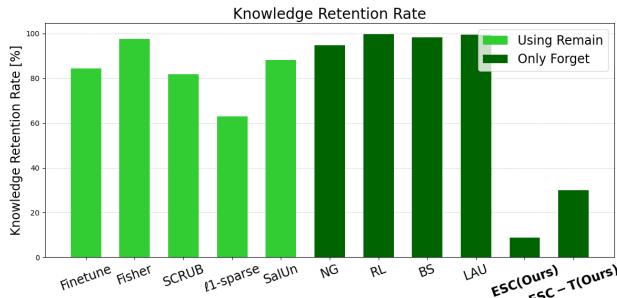
Figure 1 illustrates this Knowledge Retention problem. The green bars show the “Recovery Rate.” High bars mean that after a simple linear probe, the model regained high accuracy on the data it was supposed to forget. Standard methods like SCRUB, Fisher, and Finetuning all suffer from high recovery rates.
To address this, the paper proposes a new standard called Knowledge Deletion (KD), which demands that information be erased from the feature space, not just the output. They also introduce the Knowledge Retention (KR) score—a metric specifically designed to test if a feature extractor still holds onto forbidden info.
The Solution: Erasing Space Concept (ESC)
The core insight of the ESC method is geometric. Deep learning models map data points into high-dimensional feature spaces. Knowledge about a specific class (like a specific face or object) tends to exist in specific “directions” within this space.
If we can identify the specific geometric directions that represent the “forgetting data,” we can collapse them. This flattens the feature space in those specific dimensions, effectively lobotomizing the model’s ability to represent that concept.
Step 1: Extracting Principal Directions
The authors use Singular Value Decomposition (SVD) to find these directions. SVD is a linear algebra technique that breaks a matrix down into its constituent parts.
When we pass the “forgetting data” (the images we want to remove) through the model’s feature extractor, we get a feature matrix, \(\mathbf{Z}_f\). We decompose this matrix:

Here, \(\mathbf{U}\) represents the principal directions in the feature space. These are the mathematical vectors that essentially define “what makes this data unique.”
Step 2: Pruning the Space (ESC)
In the standard ESC method (which requires no training), the process is straightforward:
- Identify the top principal directions in \(\mathbf{U}\) that correspond to the forgetting data.
- Prune (remove) a percentage of these directions.
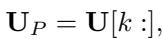
By removing these vectors, we force the model’s feature space to collapse along the axes that store the sensitive knowledge. The model doesn’t just “decide” not to classify the user; it physically loses the ability to represent the features required to identify them.
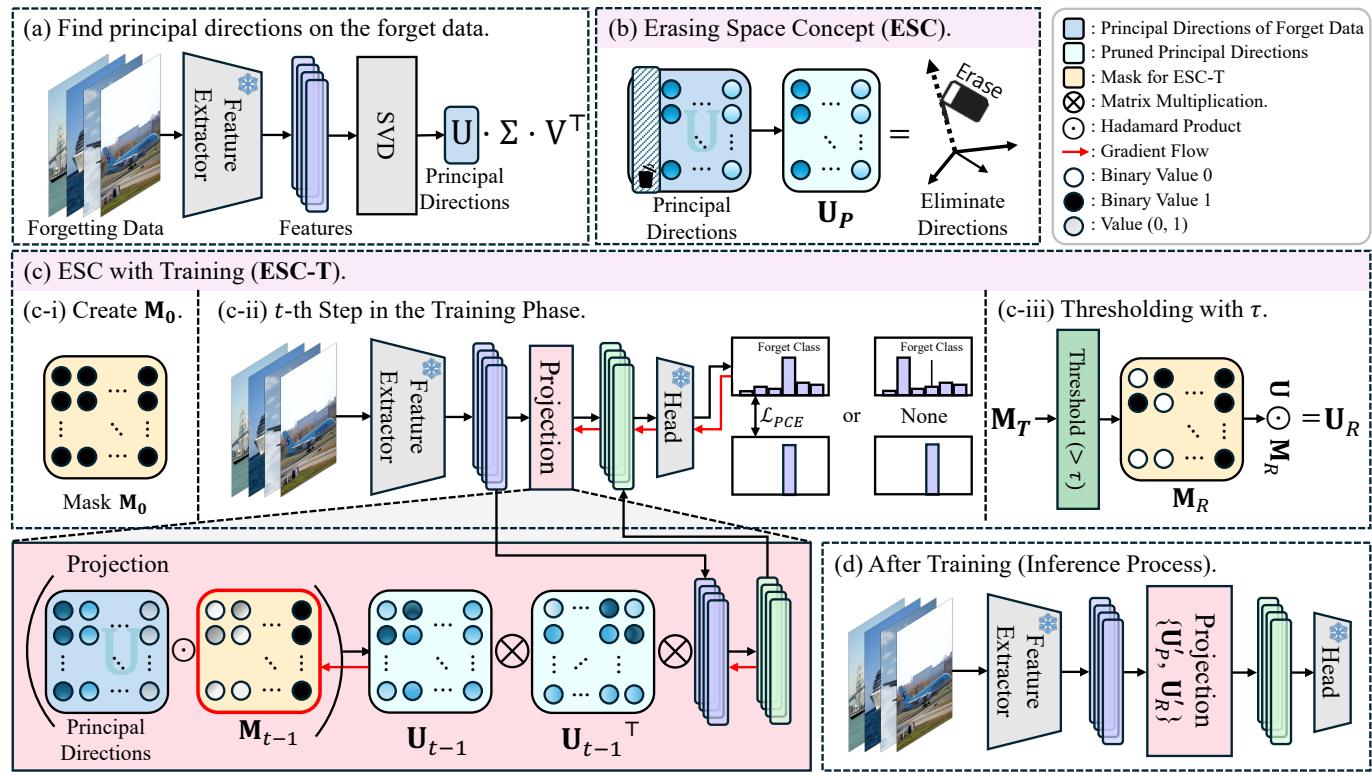
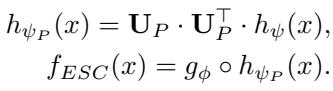
Figure 4 (a and b) visualizes this. We take the original feature space \(\mathbf{U}\), identify the “Forget” directions, and apply an erasing operation to create a pruned space \(\mathbf{U}_P\).
This creates a new “unlearned” feature extractor \(h_{\psi_P}\) and model \(f_{ESC}\):
This method is incredibly fast because it only requires one forward pass and an SVD calculation—no gradient descent iterations are needed.
Advanced Method: ESC with Training (ESC-T)
While standard ESC is fast, removing entire principal directions is a blunt instrument. Sometimes, a direction that helps identify a “forget” class might also be useful for a “remain” class (e.g., the concept of “ears” is needed for the forbidden class “Wolf” but also for the remaining class “Dog”). Hard pruning might hurt the model’s accuracy on the remaining data.
To solve this, the authors propose ESC-T (ESC with Training).
The Learnable Mask
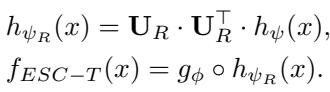
Instead of deleting entire directions, ESC-T learns a mask (\(\mathbf{M}\)) that selectively suppresses specific elements within the principal directions.

Here, the refined directions \(\mathbf{U}_R\) are the element-wise product of the original directions and the learned mask.
The Optimization Process
The mask is initialized as all 1s (no changes). It is then optimized using a Penalized Cross-Entropy (PCE) loss function.

This loss function does something clever:
- If the model correctly predicts the class we want to forget, the loss is high (penalizing knowledge).
- The optimizer updates the mask to minimize this loss, effectively finding the minimum necessary suppression to make the model fail at identifying the forbidden data.
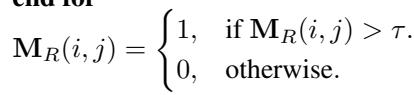
Once the training is done, the mask is thresholded to become binary (0s and 1s).
This results in a refined feature space that balances privacy (erasing the concept) and utility (keeping useful features for other classes).
Experimental Results
The researchers tested ESC and ESC-T against state-of-the-art unlearning methods on datasets like CIFAR-10, CIFAR-100, and face recognition benchmarks.
1. Does it actually delete the knowledge?
The primary goal was to lower the Knowledge Retention (KR) score (where lower is better, meaning the knowledge can’t be recovered).

In Table 1, look at the KR (Knowledge Retention) section on the right.
- Original: High accuracy on forgotten data (bad for privacy).
- Retrain (Gold Standard): Low accuracy on forgotten data.
- Competitors (Finetune, SCRUB, NegGrad): They still show high accuracy on forgotten data in the KR setting (meaning the features are still there).
- ESC / ESC-T: They achieve very low accuracy on the forgotten data, comparable to the Retrain baseline, while maintaining high accuracy on the remaining data (\(D_r\)).
2. Visualizing the Erasure
One of the most compelling proofs comes from visualizing the feature space.
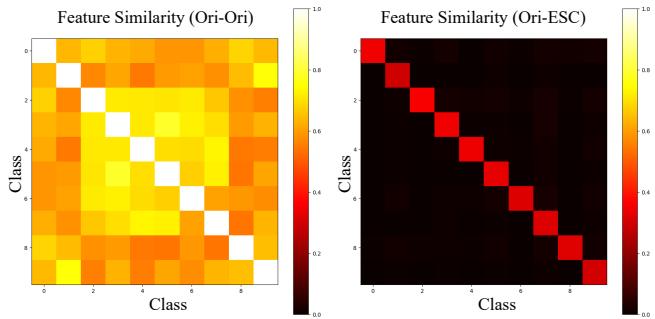
Cosine Similarity: In Figure 3 below, the Left heatmap shows the original features—high similarity (bright colors) between the features of the same class. The Right heatmap shows ESC features. The diagonal is dark. The features of the forgotten class no longer align with each other; the concept has been scattered.
t-SNE Visualization: The authors also mapped the feature space using t-SNE. In Figure 12 (below), the red dots represent the “forget” class (Deer).
- In the Original and LAU (a competitor) plots, the red dots are clustered tightly—the model still groups them together.
- In ESC (Ours), the red dots are dispersed into a cloud. The model no longer sees them as a coherent category.

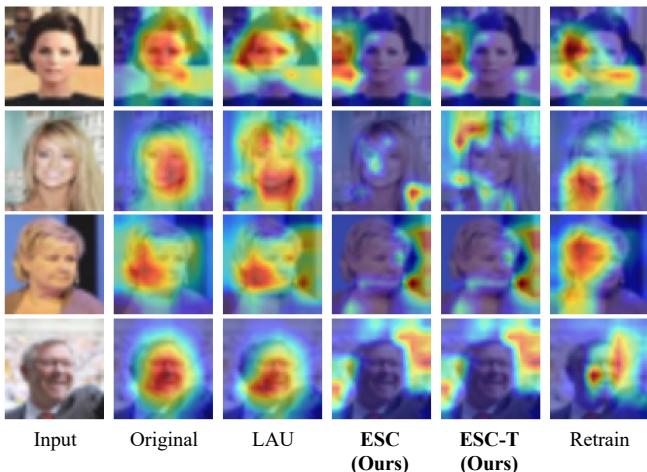
What is the model looking at? Using Grad-CAM (which shows which parts of an image the model focuses on), we can see the attention shift. In the original model, it looks at the face (the identity). In ESC/ESC-T, the attention shifts entirely to the background. The model literally cannot “see” the face features anymore.
3. Speed and Efficiency
Because ESC uses SVD and ESC-T uses a lightweight mask optimization (rather than retraining weights), they are incredibly fast.
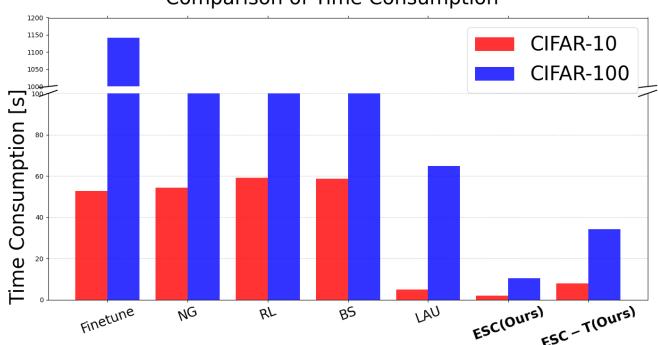
As shown in Figure 5, ESC (red bar) is near-instant compared to methods like Finetuning or SCRUB. Even ESC-T is a fraction of the time required by other algorithms.
Conclusion
The “Right to be Forgotten” requires more than just masking the output of an AI model; it requires deep surgery on the model’s internal representations. The Erasing Space Concept (ESC) paper highlights a critical flaw in current unlearning methods: they leave “ghosts” of the data in the feature space.
By leveraging Singular Value Decomposition, ESC provides a geometric solution to a privacy problem. It identifies the “direction” of a concept in the neural network’s mind and deletes it.
- ESC offers a blazing fast, training-free method for immediate unlearning.
- ESC-T offers a refined, learnable approach that maximizes the retention of useful knowledge while ensuring the forbidden data is truly gone.
This work sets a new bar for Machine Unlearning, moving the goalposts from simple output error to true Knowledge Deletion. As AI models become more integrated into our lives, tools like ESC will be essential for maintaining user trust and privacy.