](https://deep-paper.org/en/paper/2504.03193/images/cover.png)
Imagine training a self-driving car algorithm entirely inside the video game Grand Theft Auto V. The roads look realistic, the lighting is perfect, and the weather is controlled. Now, take that same car and drop it onto a rainy street in London at night. Does it crash?
This scenario represents the core challenge of Domain Generalized Semantic Segmentation (DGSS). We want models that learn from a “source” domain (like a simulation or a sunny dataset) and perform flawlessly in “target” domains (real-world, bad weather, night) without ever seeing them during training.
Recent strides in AI have given us two superpowers: Vision Foundation Models (VFMs) like DINOv2, which are incredible at seeing fine-grained details, and Vision-Language Models (VLMs) like CLIP, which understand the semantic concepts of objects through text alignment.
Ideally, we would combine them to get the best of both worlds. But simply stitching these massive models together creates a computational nightmare and a “sequence length” bottleneck that traditional Transformers struggle to handle.
In this post, we dive into a new paper, “Mamba as a Bridge,” which proposes a novel framework called MFuser. This architecture uses the efficient Mamba (State-Space Model) architecture to fuse these two giants, achieving state-of-the-art results in domain generalization.
The Problem: The Granularity vs. Semantics Trade-off
To understand why we need to fuse models, we first need to look at what existing foundation models actually “see.”
- VFMs (e.g., DINOv2): These are trained on massive amounts of visual data using self-supervision. They excel at feature locality. They know exactly where the edges of a car are, but they lack a strong semantic understanding of what a “car” is in relation to human language.
- VLMs (e.g., CLIP): These are trained to align images with text descriptions. They have powerful semantic understanding and are robust to style changes (a cartoon car and a real car are both “cars”). However, because they are often trained on image-level labels, their spatial awareness is coarse. They know a car is in the image, but they struggle to pinpoint its exact pixels.
The researchers visualized this discrepancy effectively using Principal Component Analysis (PCA) on the feature maps of both models.
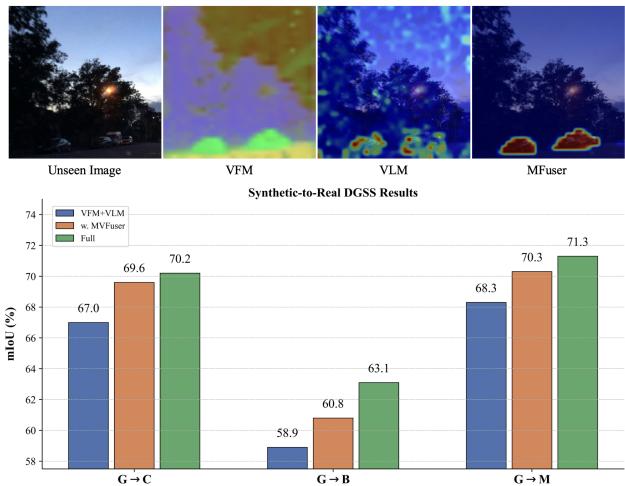
As seen in Figure 1 above:
- VFM (DINOv2): The features (left) show sharp, fine-grained details. You can clearly see the structure of the trees and vehicles.
- VLM (EVA02-CLIP): The heatmap (center) for the query “car” lights up the general area of the car but is blurry and imprecise.
- MFuser (Right): The proposed method combines the two, resulting in sharp, localized features that are also semantically aligned.
The Challenge: The Sequence Length Bottleneck
Why not just fine-tune both models together? Two reasons:
- Computational Cost: Fine-tuning massive models like EVA02-CLIP and DINOv2 simultaneously requires immense GPU resources.
- Sequence Length: Transformers process images as sequences of “patches” (tokens). If you concatenate the features from a VFM and a VLM, you double the sequence length. Standard attention mechanisms in Transformers have quadratic complexity (\(O(N^2)\)). Doubling the tokens quadruples the computation, making it prohibitively slow.
This is where Mamba enters the story. Mamba is a State-Space Model (SSM) that offers linear complexity (\(O(N)\)) with respect to sequence length. It allows the model to process extremely long sequences of data efficiently, making it the perfect candidate to act as a “bridge” between two massive visual encoders.
The Solution: MFuser Architecture
The researchers propose MFuser, a framework that keeps the giant backbones of the VFM and VLM frozen (to save memory and preserve their pre-trained knowledge) and inserts lightweight, trainable modules to fuse their information.
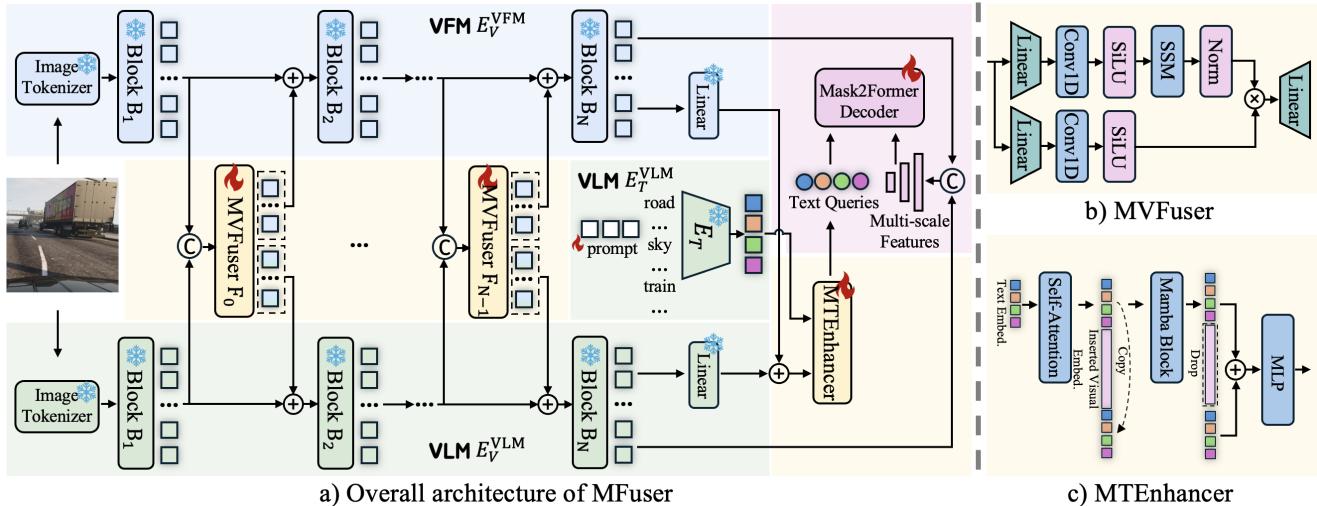
As shown in Figure 2, the architecture consists of three main parts:
- Frozen Encoders: Two parallel streams (VFM and VLM) process the image.
- MVFuser (Visual Adapter): A Mamba-based module that sits between the layers of the encoders to fuse visual features.
- MTEnhancer (Text Adapter): A module that refines the text embeddings (used as queries) by injecting visual information.
Let’s break down the two novel components: MVFuser and MTEnhancer.
1. MVFuser: The Visual Bridge
The goal of the MVFuser is to take the features from the VFM (\(x^{VFM}\)) and the VLM (\(x^{VLM}\)) at layer \(i\), mix them to learn from each other, and inject the refined features back into the stream.
First, let’s look at the standard processing of the transformer blocks in the frozen models:

The MVFuser acts as a “co-adapter.” It takes the concatenated features from both models and outputs “offsets” (\(\Delta x\)) that refine the original features.

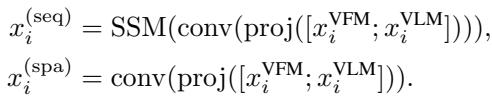
Inside the MVFuser: The researchers recognized that visual data contains both sequential patterns and spatial structural patterns. To capture both, the MVFuser splits the processing into two parallel branches:
- Sequential Branch (SSM): Uses the Mamba Selective Scan mechanism to model long-range dependencies across the combined token sequence.
- Spatial Branch: Uses convolution layers to capture local 2D spatial relationships.
Finally, these two branches are fused using a gating mechanism (element-wise multiplication, denoted by \(\otimes\)) and projected back to the original dimensions.

This design allows the high-granularity features of the VFM to sharpen the VLM, while the semantic robustness of the VLM guides the VFM, all with linear computational cost.
2. MTEnhancer: Refining Text Queries
In modern segmentation frameworks (like Mask2Former, which this paper is built upon), “queries” are used to ask the decoder to find specific objects. Usually, these queries are static text embeddings (e.g., the vector for the word “car”).
However, a static text embedding doesn’t know about the specific lighting or style of the current image. MTEnhancer fixes this by injecting visual priors into the text embeddings.
It uses a hybrid approach:
- Self-Attention: To understand the relationship between different class names (e.g., “road” and “sidewalk” are related).
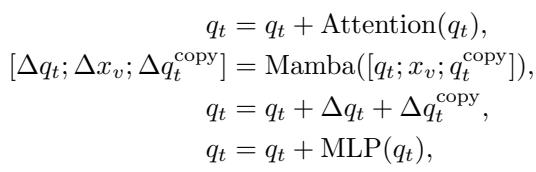
- Conditional Mamba Block: To condition the text queries (\(q_t\)) on the fused visual features (\(x_v\)).
To utilize Mamba’s unidirectional scanning effectively for cross-modality (text-to-image), the researchers use a clever “sandwich” technique: they concatenate the text queries on both sides of the visual features before passing them into the Mamba block.
Loss Function
To train this system, the authors use a standard segmentation loss combination (Binary Cross Entropy, Dice Loss, and Classification Loss) alongside an alignment loss to ensure pixel-text consistency.


Experimental Results
The researchers tested MFuser on demanding benchmarks, specifically Synthetic-to-Real (training on GTAV, testing on Cityscapes, BDD100K, and Mapillary) and Real-to-Real (Cityscapes to other datasets).
Synthetic-to-Real Performance
This is the “Holy Grail” test—training on a video game and testing on real streets.
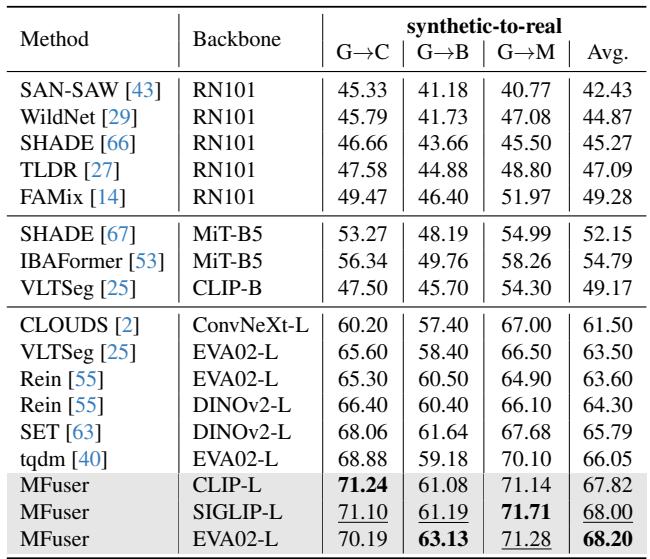
In Table 1, MFuser (gray rows) consistently outperforms existing state-of-the-art methods like “Rein” and “tqdm”.
- On the GTAV \(\to\) Mapillary (G \(\to\) M) task, MFuser with EVA02-CLIP achieves 71.28 mIoU, significantly higher than the competition.
- The “Average” column shows a clear dominance across different VLM backbones (CLIP, SIGLIP, EVA02).
Qualitative Analysis
Numbers are great, but visual results tell the story of robustness.
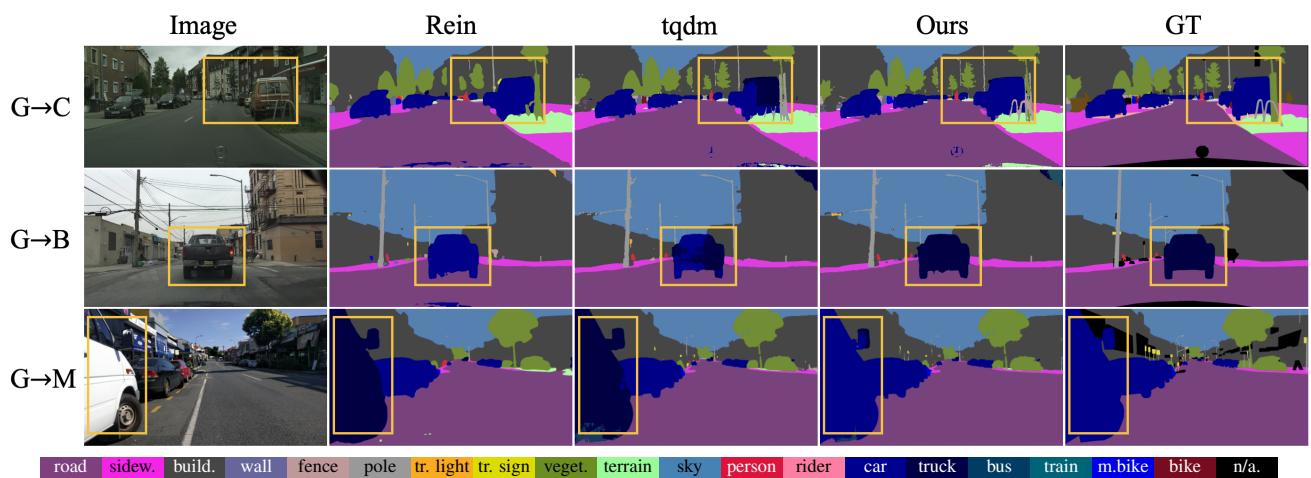
In Figure 3, look at the comparison between “Rein” (a strong competitor) and “Ours” (MFuser).
- Row 1 (G \(\to\) C): Notice the rider/bicycle detection. Rein misses parts of the bike, while MFuser captures the silhouette accurately.
- Row 2 (G \(\to\) B): This is a low-light/night scene. Rein hallucinates noise in the dark areas. MFuser maintains a clean segmentation of the road and sky, demonstrating the power of fusing DINOv2’s local detail with CLIP’s semantic robustness.
Real-to-Real Generalization
The model also shines when transferring between different real-world datasets, which often have different camera setups and city layouts.
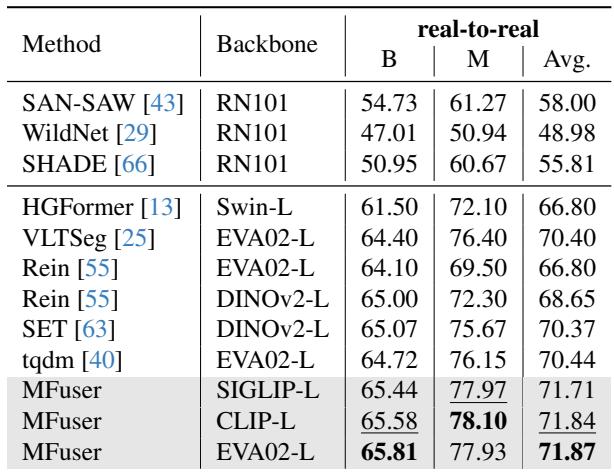
As shown in Table 2, MFuser again takes the top spot, achieving an average mIoU of 71.87% with the EVA02-CLIP backbone.
Efficiency: Why Mamba Matters
One of the paper’s main claims is that Mamba is more efficient than using standard Attention for fusion. Table 3 proves this.
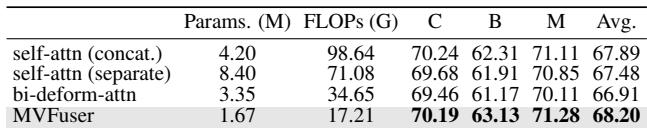
- Self-Attention (concat): Requires 98.64 G FLOPs and 4.2M parameters.
- MVFuser (Ours): Requires only 17.21 G FLOPs and 1.67M parameters.
The Mamba-based approach is nearly 5x more computationally efficient while achieving higher accuracy (68.20 vs 67.89 Avg mIoU). This confirms that Mamba is an excellent choice for handling the long sequences resulting from concatenated visual tokens.
Does Fusion Actually Change the Features?
To verify that the MVFuser is actually doing meaningful work, the authors visualized the feature distributions before and after adaptation using PCA.
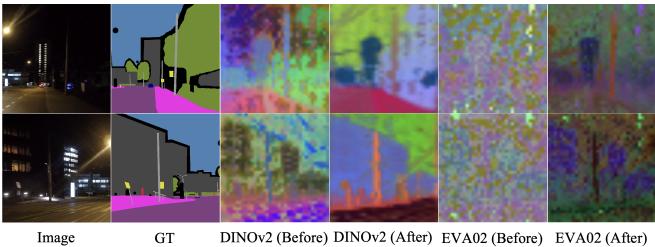
In Figure 4, look at the transition from “Before” to “After.”
- DINOv2 (Before): Noisy in certain areas.
- DINOv2 (After): The segmentation of the road and objects becomes much more distinct and uniform.
- EVA02 (Before): Very abstract and blocky.
- EVA02 (After): Significantly sharpened, showing that the VLM has learned spatial precision from the VFM.
Ablation Studies: Do we need both models?
Is it possible that just one model is doing all the work? The researchers tested this by running the system with VFM-only, VLM-only, and various combinations.
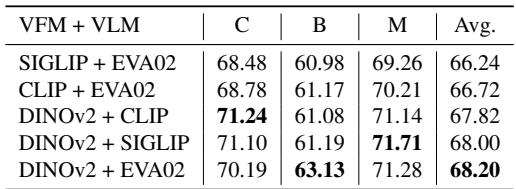
Table 4 (included in text analysis, referencing Table 5 image context) and Table 5 reveal:
- VFM-only: 65.13 Avg.
- VLM-only: 66.15 Avg.
- MFuser (Both): 68.20 Avg.
Furthermore, simply combining two VLMs (e.g., CLIP + EVA02) performs worse (66.72) than combining a VFM + VLM (68.20). This proves that the heterogeneous nature of the two models (one detailed, one semantic) is the key to success. They are complementary, not redundant.
Finally, does the text enhancement (MTEnhancer) matter?
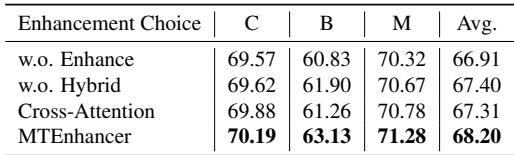
Table 6 shows that removing the MTEnhancer drops the average performance from 68.20 to 66.91, proving that conditioning text queries on visual data is crucial for domain adaptation.
Conclusion
MFuser represents a significant step forward in robust computer vision. By identifying the complementary strengths of Vision Foundation Models (detail) and Vision-Language Models (semantics), the authors created a system that sees better than either model could alone.
Crucially, they solved the engineering bottleneck of fusing these massive models by leveraging Mamba. This allows for the processing of long, concatenated sequences with linear complexity, making the fusion process efficient and scalable.
For students and researchers, this paper serves as a blueprint for how to perform Parameter-Efficient Fine-Tuning (PEFT) in the era of foundation models. Rather than retraining massive networks, we can use smart, lightweight adapters like MVFuser to bridge the gap between different AI modalities.
As we move toward more autonomous systems, techniques like MFuser will be essential for ensuring that the AI trained in the lab is ready for the chaos of the real world.