](https://deep-paper.org/en/paper/2504.04612/images/cover.png)
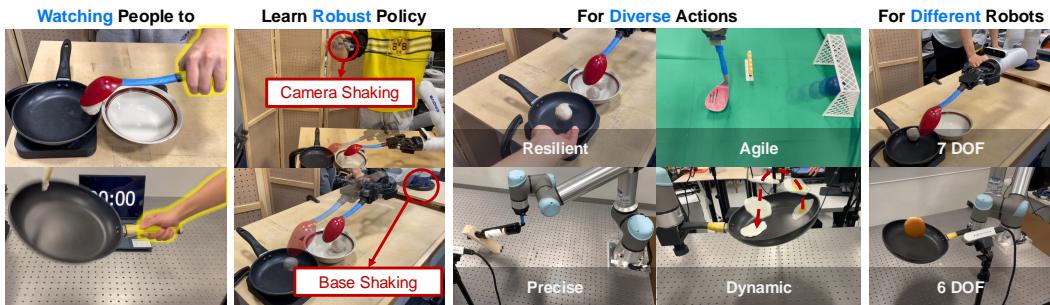
Humans are master tool users. From using a hammer to drive a nail to flipping a pancake with a spatula, our ability to extend our physical capabilities through objects is a defining characteristic of our species. For robots, however, this remains a significant hurdle. While robots have become proficient at simple pick-and-place operations, dynamic tool use—which requires understanding the tool, the object, and the interaction between them—is far more complex.
Traditionally, teaching a robot these skills involves teleoperation (controlling the robot remotely) or using specialized handheld grippers to collect data. These methods are often slow, expensive, and result in jerky, unnatural movements.
But what if a robot could learn simply by watching a human?
In the paper “Tool-as-Interface: Learning Robot Policies from Observing Human Tool Use,” researchers from the University of Illinois Urbana-Champaign, UT Austin, and Columbia University propose a novel framework. Their approach allows robots to learn robust manipulation policies directly from videos of humans using tools, bypassing the need for expensive hardware or laborious teleoperation.
The Two Great Gaps: Embodiment and Viewpoint
To learn from human video, a robot must overcome two fundamental discrepancies, often referred to as “gaps”:
- The Embodiment Gap: Humans act with hands; robots act with grippers and mechanical arms. A robot cannot simply copy the joint angles of a human arm because their bodies are mechanically different.
- The Viewpoint Gap: The camera angle recording the human demonstration might differ from the camera angle the robot sees during deployment. Furthermore, in the real world, cameras shake and move.
The authors propose a clever solution: The Tool-as-Interface. Instead of focusing on the arm or the hand, the system focuses on the tool. Since both the human and the robot hold the same tool rigidly, the tool becomes the common interface for the task. If the robot can make the tool move exactly as the human did relative to the task, the “embodiment” of the arm holding it matters much less.
The “Tool-as-Interface” Framework
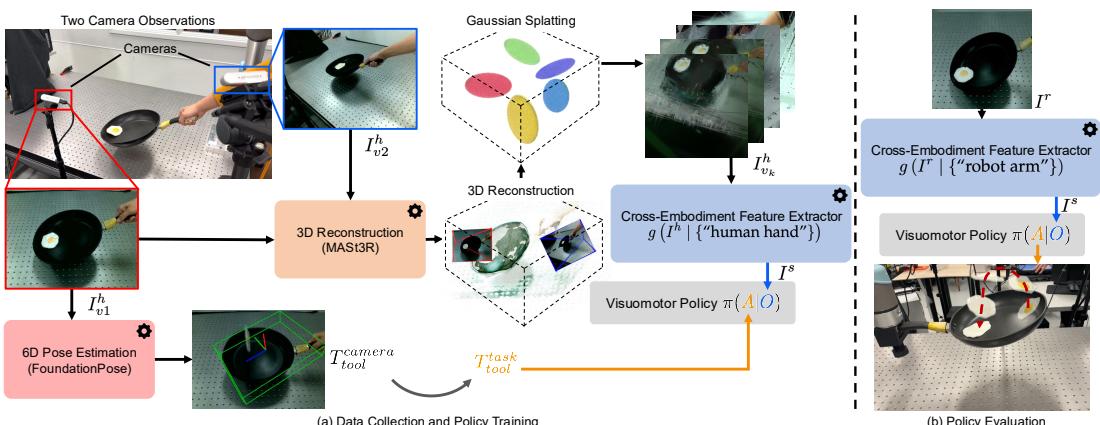
The researchers developed a pipeline designed to be scalable, using low-cost cameras (like smartphones) rather than expensive depth sensors or motion capture suits. The framework consists of several key stages: 3D reconstruction, augmentation, embodiment segmentation, and a specific action representation.
1. 3D Reconstruction and Augmentation
The process begins with collecting data using two standard RGB cameras. To understand the spatial relationship of the scene without depth sensors, the team utilizes a foundation model called MASt3R. This model reconstructs a 3D point cloud of the scene from the stereo images.
A major contribution of this work is how they handle the viewpoint gap. They use a technique called 3D Gaussian Splatting to synthesize novel views. Essentially, they take the 3D reconstruction and generate “fake” camera angles from different perspectives. By training the robot on these varied views, the policy becomes robust to camera movement. The robot learns that the task is the same, even if the camera shifts or shakes.
2. Bridging the Embodiment Gap via Segmentation
Even if we focus on the tool, the visual presence of a human hand in the training data (and a robot arm in the test data) can confuse the learning model. The model might falsely associate the texture of human skin with the success of the task.
To solve this, the researchers use Embodiment Segmentation. They employ a vision model (Grounded-SAM) to identify and mask out the human hand during training and the robot arm during deployment. This ensures the robot’s policy relies solely on the visual information of the tool and the object interactions, effectively making the data “embodiment-agnostic.”
3. Tool-Centric Action Representation
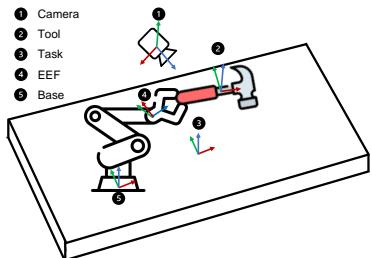
How does the robot know where to move? The framework defines actions in a Task-Space.
Traditional methods might calculate where the tool is relative to the camera or the robot’s base. However, if the camera moves or the robot’s base wiggles, those calculations fail. Instead, this framework calculates the transformation of the tool relative to the task frame.
The relationship is defined mathematically as:

Here, \(T_{tool}^{task}\) represents the tool’s motion in the task space. This representation is invariant to the camera’s position or the robot’s morphology.
During deployment, the robot calculates the necessary end-effector (gripper) position using the known relationships between its base, the task, and the tool:

This coordinate system design is crucial for robustness. It allows the robot to execute the correct tool motion even if its base is shaking or the camera is bumped.
Putting it to the Test: Real-World Experiments
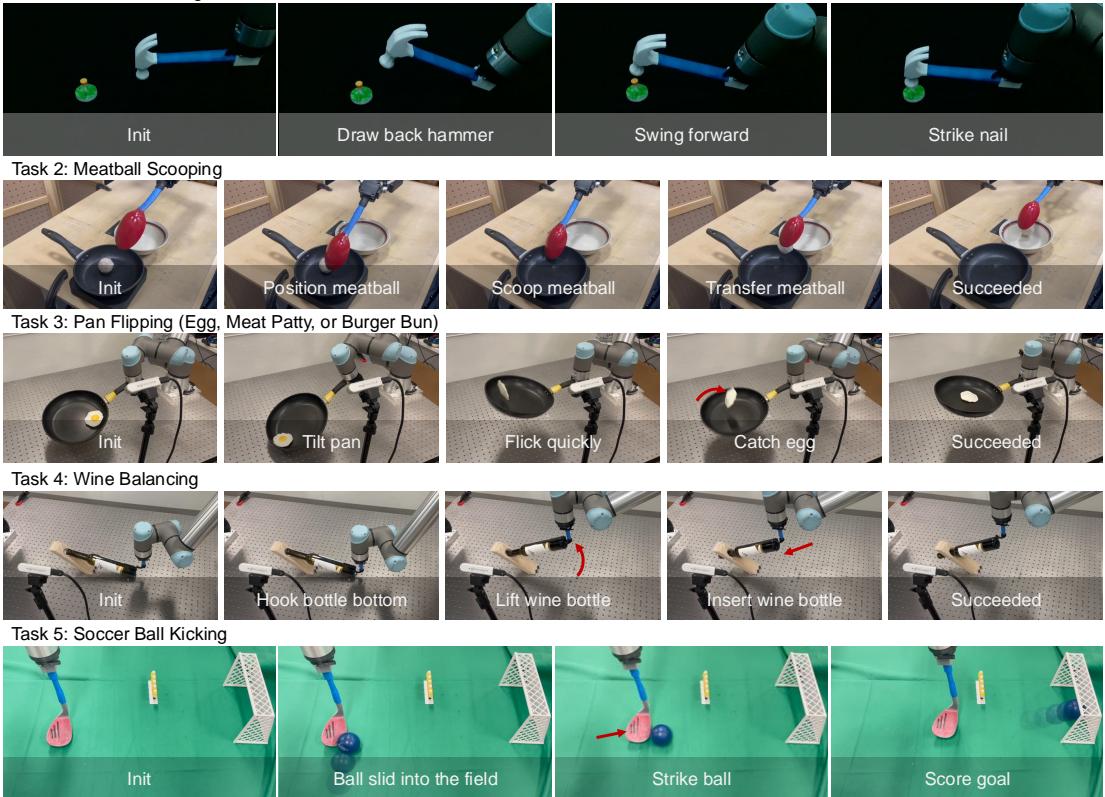
The researchers evaluated their framework on five distinct, challenging tasks using robotic arms (Kinova Gen3 and UR5e):
- Nail Hammering: High precision required to hit a small target.
- Meatball Scooping: Handling deformable objects in a constrained bowl.
- Pan Flipping: A highly dynamic task requiring speed and momentum (flipping eggs, buns, and patties).
- Wine Balancing: Inserting a bottle into a rack; requires precision and handling geometric constraints.
- Soccer Ball Kicking: Hitting a moving target (dynamic interception).
Performance vs. Baselines
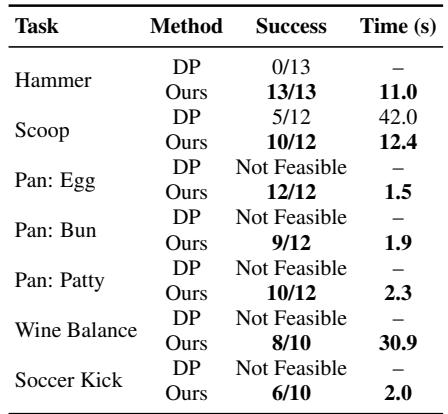
The results were compelling. The “Tool-as-Interface” method significantly outperformed traditional imitation learning methods trained via teleoperation (using devices like SpaceMouse or Gello).
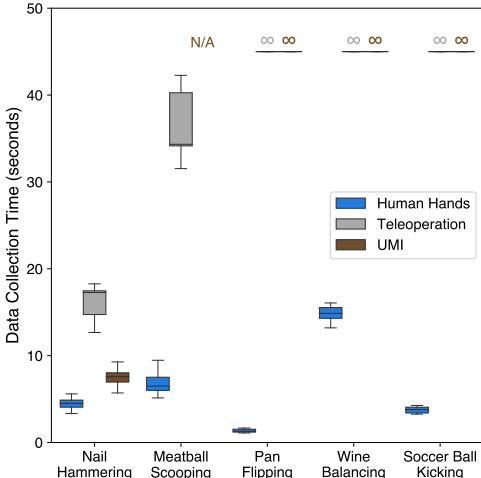
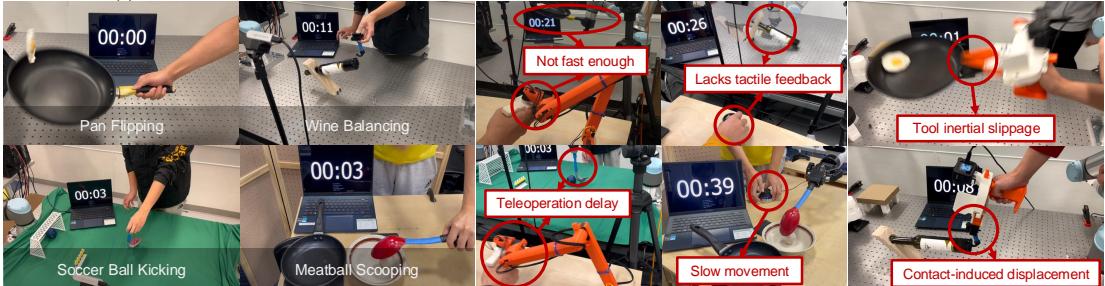
In dynamic tasks like Pan Flipping, teleoperation methods were marked “Not Feasible” because human operators simply couldn’t control the robot fast enough or naturally enough to generate the momentum needed to flip an egg. The robot learning from natural human video, however, achieved a high success rate.
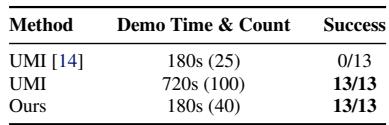
The team also compared their method against a state-of-the-art handheld gripper system called UMI. While UMI is effective, it requires specialized hardware. In the Nail Hammering task, the Tool-as-Interface method achieved a 100% success rate with just 180 seconds of data collection, while UMI failed completely with the same amount of data (requiring 4x more data to succeed).
Robustness: The “Chicken Head” Effect
One of the most impressive results of this work is the system’s resilience to disturbances. Because the policy is trained with augmented views and calculates actions in task-space, it is remarkably stable.
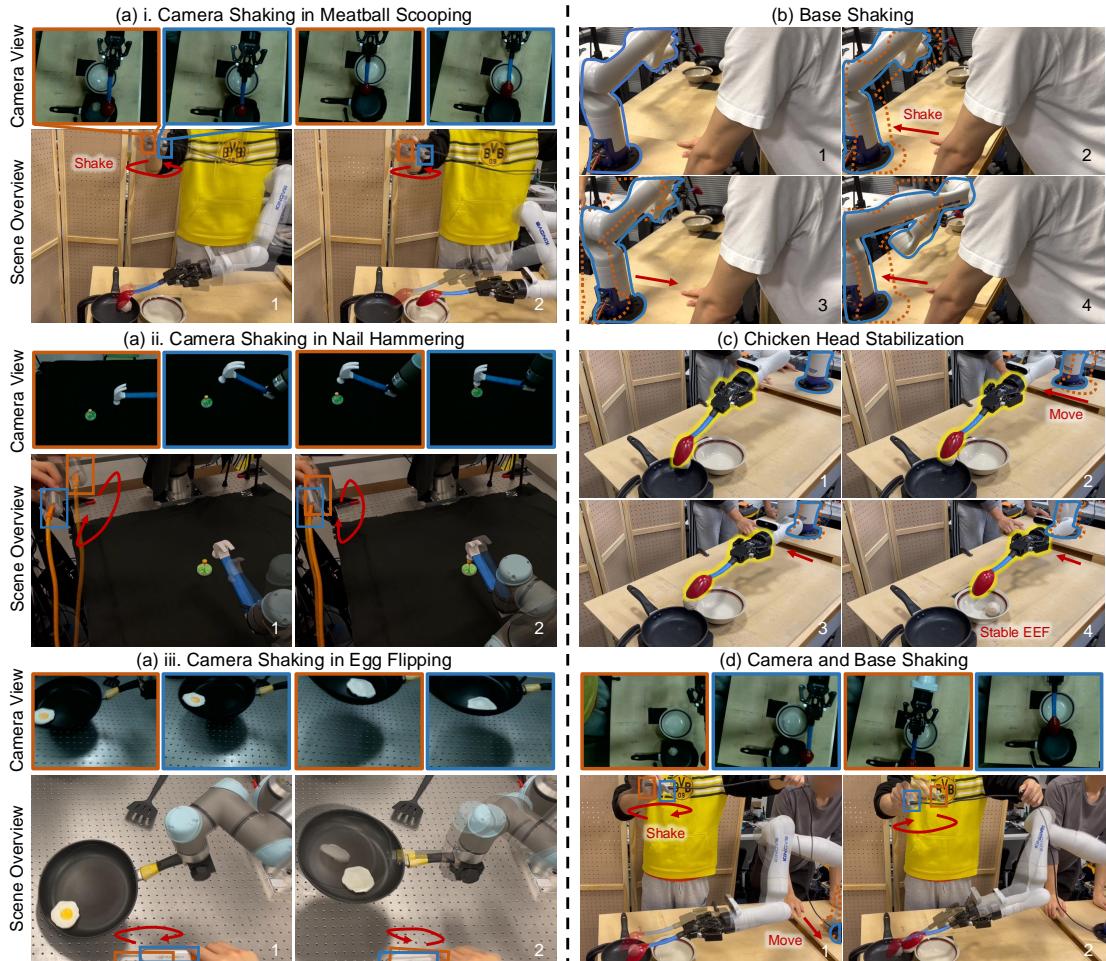
The researchers tested this by physically shaking the camera and the robot’s base during operation.
- Camera Shaking: The robot continued to hammer nails and scoop meatballs accurately, despite the visual input being jittery.
- Base Shaking: When the robot’s base was shaken, the end-effector naturally compensated to keep the tool steady relative to the task. The authors liken this to the “Chicken Head Stabilization” effect, where a bird keeps its head perfectly still while its body moves.
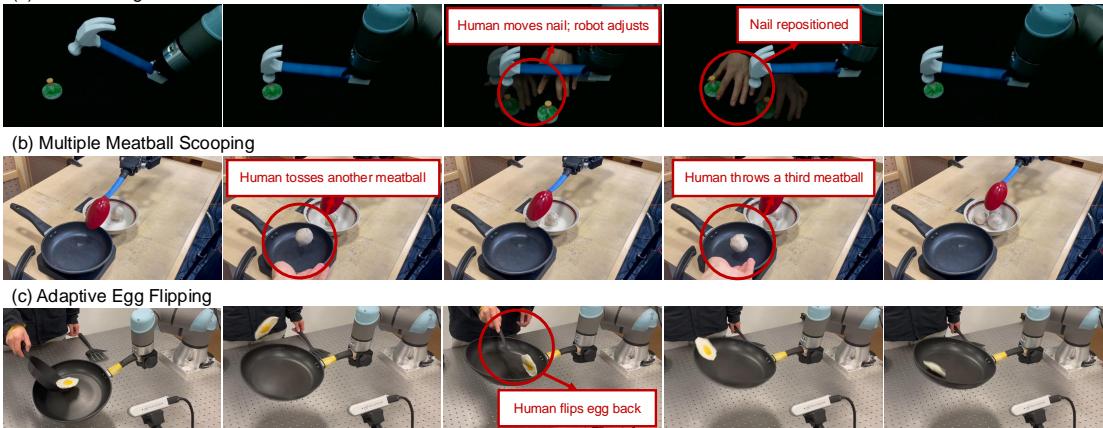
This robustness extends to human interference as well. In experiments, humans moved the nail or threw new meatballs into the scene mid-task. The robot adapted on the fly, tracking the new positions seamlessly.
Why Human Data is Better
A significant portion of the paper is dedicated to analyzing why this method works better than teleoperation. The answer lies in the quality of the data.
Human movement is naturally smooth and efficient. When we use a tool, we instinctively use the right amount of force and speed. Teleoperation, by contrast, is often plagued by lag and the “disconnect” of controlling a robot arm remotely.
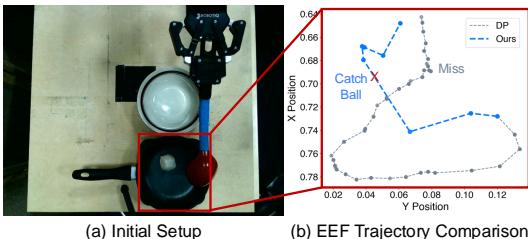
As shown in the trajectory comparison below, the path generated by the Tool-as-Interface policy (blue) is smooth and direct. The policy trained on robot teleoperation data (gray) is jittery and erratic.
Efficiency and Cost
Finally, the “Tool-as-Interface” framework is incredibly cheap and fast. It requires no specialized hardware—just a camera and the tools themselves.
- Time: Data collection was 73% faster for nail hammering compared to teleoperation.
- Failures: Teleoperation often resulted in collisions or safety stops during data collection. Human demos had zero such issues.
Conclusion
The “Tool-as-Interface” framework represents a significant step forward in robotic manipulation. By accepting that humans are the experts at tool use and finding a way to bridge the visual and physical gaps between man and machine, this research unlocks a scalable path for teaching robots complex skills.
Instead of building expensive control rigs or writing complex code for every new tool, we might soon be able to teach a robot to cook, clean, or build simply by letting it watch us do it first.
