](https://deep-paper.org/en/paper/2504.05046/images/cover.png)
Have you ever watched a CGI character in a movie or a humanoid robot trying to walk, and something just felt… off? The graphics might be perfect, and the robot’s joints might be shiny chrome, but the feet slide slightly across the floor as if they are skating, or the body seems to float without weight.
This is a classic problem in Human Motion Capture (MoCap). Most modern AI systems rely purely on vision—RGB cameras—to estimate human poses. They are excellent at matching the visual geometry of a person (where the elbow is relative to the shoulder), but they are terrible at understanding physics. A camera sees a person, but it doesn’t “feel” the ground. It ignores the mass, the gravity, and the friction that dictate how we move.
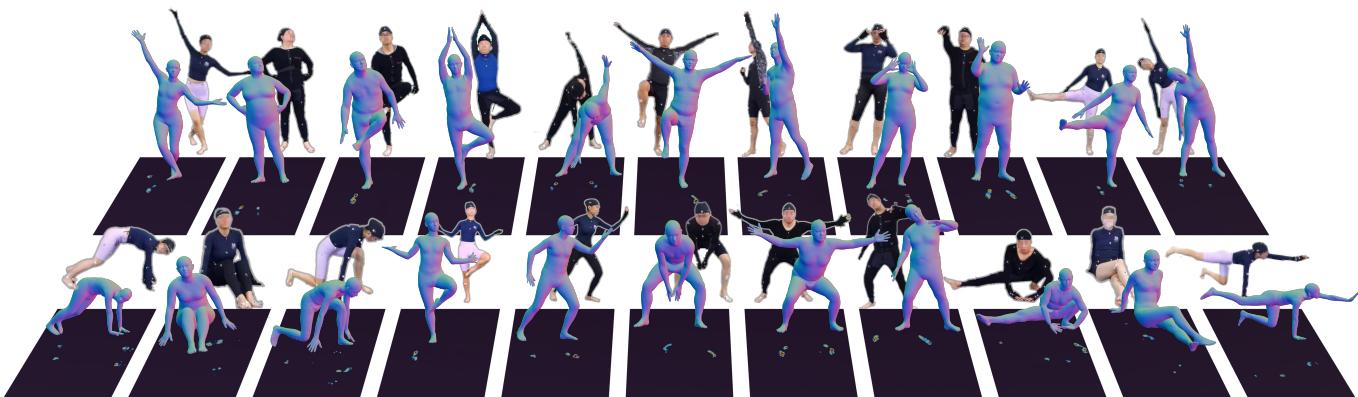
In a fascinating paper titled “MotionPRO: Exploring the Role of Pressure in Human MoCap and Beyond,” researchers from Nanjing University and Tsinghua University propose a solution: giving AI a sense of touch through pressure maps. They introduce a massive new dataset and a novel neural network architecture called FRAPPE that fuses visual data with floor pressure readings to create motion capture that is not just visually similar, but physically plausible.
The Problem with Vision-Only MoCap
Before diving into the solution, let’s define the problem. Current State-of-the-Art (SOTA) methods often treat pose estimation as a visual matching game. They take a 2D image and try to guess the 3D shape (often using the SMPL body model).
However, without depth information, this is an “ill-posed” problem. The AI might guess a pose that looks correct from the camera’s perspective but is physically impossible—like a person leaning too far forward without falling, or hovering 5 centimeters off the ground. When applied to 3D scenes or robotics, these errors result in foot sliding, jitter, and penetration (where feet clip through the floor).
The researchers hypothesized that pressure signals—the distribution of force exerted by the body on the ground—could act as the missing link. Pressure reflects gravity, balance, and contact, serving as a hard physical constraint that vision alone cannot provide.
Building the Foundation: The MotionPRO Dataset
To teach an AI about pressure, you need data. Unfortunately, existing datasets were too small, focused only on specific activities like Yoga or sleeping, or lacked synchronized whole-body pressure data.
To bridge this gap, the authors constructed MotionPRO, a large-scale multimodal dataset.
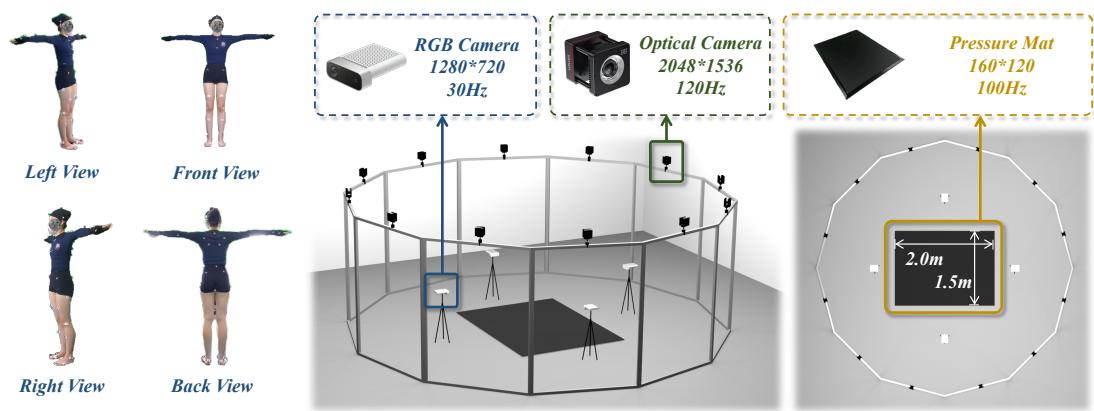
As shown in the setup above, the data collection system is comprehensive. It includes:
- Optical MoCap System: 12 cameras providing ground-truth joint positions (the gold standard).
- RGB Cameras: 4 views providing the visual input.
- Pressure Mat: A high-resolution (120x160 cm) mat capturing the interaction with the ground.
The scale of MotionPRO is massive compared to its predecessors. It features 70 volunteers performing 400 types of motion, resulting in over 12.4 million pose frames.
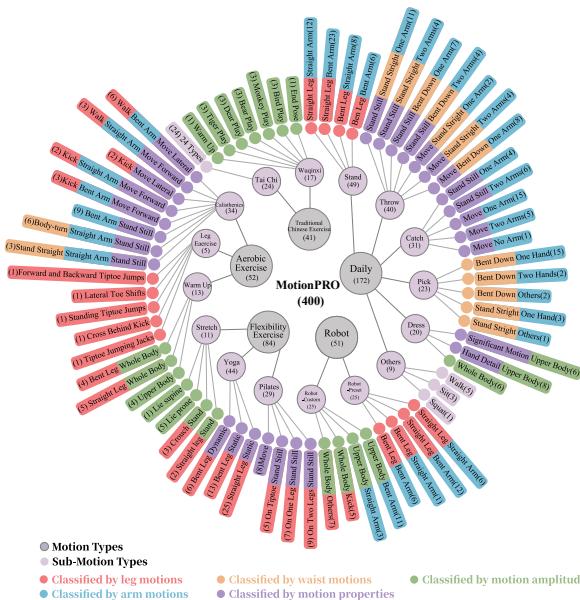
Crucially, the variety of motions ensures the model generalizes well. As seen in the hierarchy above, the dataset isn’t just walking and running; it covers aerobics, flexibility exercises, daily activities (like picking things up), and specific movements designed for humanoid robot control. This diversity allows the neural networks trained on this data to understand the correlation between body dynamics and pressure patterns across a wide spectrum of human behaviors.
The Intuition: Why Pressure?
Why is pressure so informative? Consider the difference between standing and squatting. Visually, from certain angles, the occlusion might make it hard to tell exactly where the center of mass is. But the pressure map tells a different story.
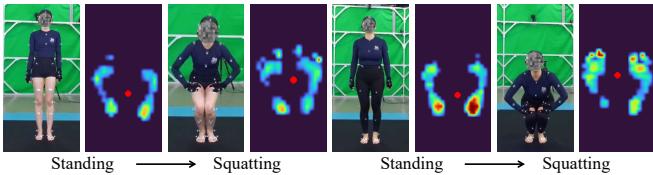
When standing (Figure 15, left), the Center of Pressure (CoP) is near the heels. When squatting (right), the weight shifts forward to the toes to maintain balance. This shift provides a strong prior for the AI to infer the pose of the lower body, even if the legs are visually occluded.
Method 1: Seeing with Your Feet (Pressure-Only Estimation)
The authors first asked a fundamental question: Can we estimate full-body pose using only pressure maps?
This seems impossible—how do you know where the hands are just by looking at footprints? However, human motion follows kinetic chains. If you know the pressure distribution over time, you can infer acceleration and balance, which constrains the possible positions of the upper body.
To test this, they developed a network utilizing a Long-Short-Term Attention Module (LSAM).
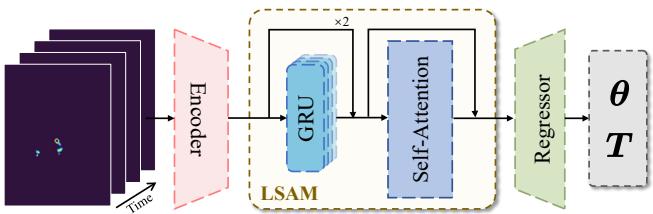
The architecture works by encoding the pressure frames and passing them through the LSAM.
- GRU (Gated Recurrent Unit): Captures short-term contextual actions.
- Self-Attention: Captures long-term dependencies (e.g., how the start of a squat relates to the bottom of the movement).
The results were surprising: while it couldn’t perfectly predict hand gestures (naturally), the pressure-only model achieved highly accurate global trajectory and plausible lower-body poses. This proved that pressure data contains rich, latent information about full-body dynamics.
Method 2: FRAPPE – Fusing RGB and Pressure
The ultimate goal, however, is to combine the best of both worlds: the detailed geometry from RGB images and the physical grounding from pressure. The authors proposed FRAPPE (Fuses RGB And Pressure for human Pose Estimation).
The Architecture
FRAPPE adds an RGB branch to the previous architecture and introduces a Fusion Cross-Attention Module (FCAM).
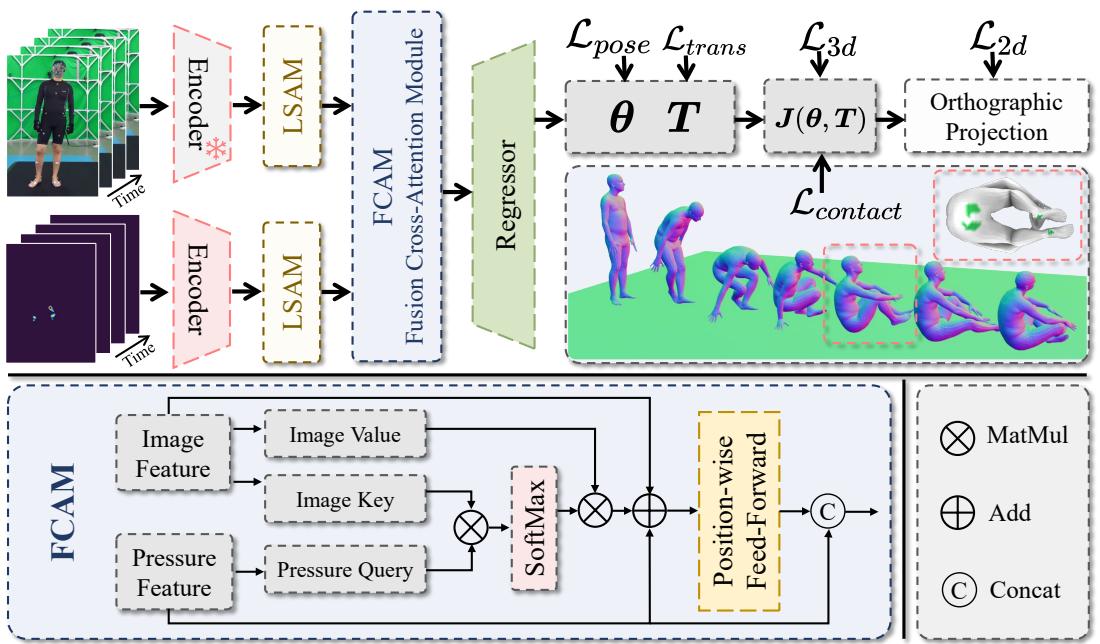
Here is how the fusion works, which is the “secret sauce” of the paper:
- Dual Encoders: One branch processes the video (using a pre-trained HRNet), and the other processes the pressure map.
- Cross-Attention (FCAM): Instead of just concatenating the features, the model uses an attention mechanism. It treats the Pressure features as the Query and the Image features as Key and Value.
Why this order? The authors argue that pressure contains the “truth” about physical interaction. By using pressure as the Query, the model asks the image features: “Based on this physical contact I feel on the ground, what visual features match this configuration?” This forces the visual features to align with physical reality.
The Orthographic Projection Constraint
A subtle but critical innovation in FRAPPE is the camera model. Most 3D pose estimators use “weak perspective projection,” which allows the AI to “cheat” by shrinking or growing the 3D human model to fit the 2D image, often messing up the depth.
FRAPPE uses orthographic projection. This preserves the scale in the depth direction. It forces the model to predict a trajectory that is consistent in 3D space, rather than just looking good when flattened onto a 2D image.
The loss function (the score the network tries to optimize) combines several factors:
\[ \begin{array} { r } { \mathcal { L } _ { F R A P P E } = \lambda _ { p o s e } \mathcal { L } _ { p o s e } + \lambda _ { 3 d } \mathcal { L } _ { 3 d } + \lambda _ { 2 d } \mathcal { L } _ { 2 d } } \\ { \lambda _ { t r a n s } \mathcal { L } _ { t r a n s } + \lambda _ { c o n t a c t } \mathcal { L } _ { c o n t a c t } , } \end{array} \]Notably, \(\mathcal{L}_{contact}\) ensures the predicted feet actually touch the ground when the pressure map says they should.
Experiments and Results
Does adding pressure actually help? The quantitative and qualitative results suggest a resounding yes.
Visual Quality
In the comparison below, look at the “Squat” and “Bend” rows.
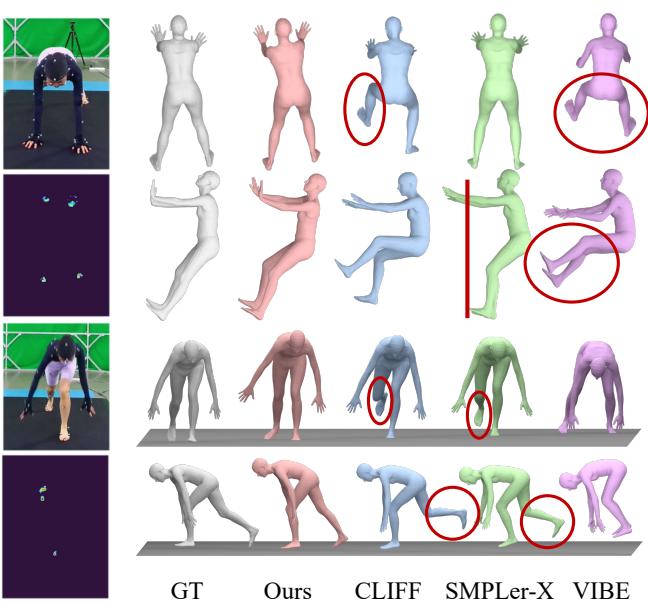
- CLIFF & VIBE (RGB only): Notice how the legs often look unnatural or float. In the squat, the knees and feet alignment is often guessed incorrectly.
- Ours (FRAPPE): The pose is grounded. The feet are planted where the physics dictates they must be.
Global Trajectory
The improvement is even more obvious when tracking a person’s movement through 3D space over time.
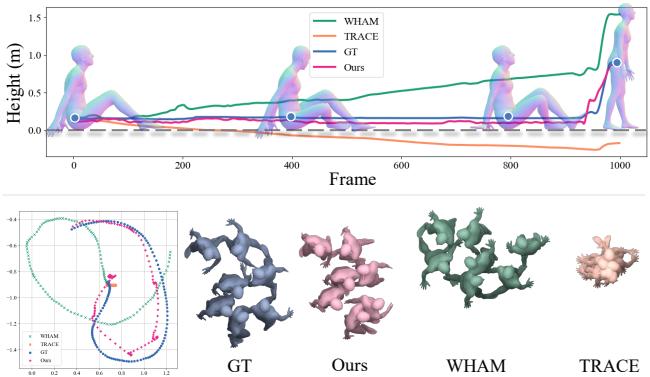
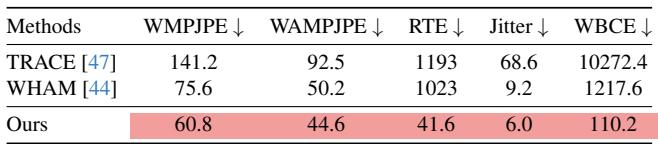
In the top graph (vertical height over time), look at the standard methods like WHAM (green) and TRACE (orange). They drift significantly, showing the person floating up or sinking into the floor. FRAPPE (pink) tracks the Ground Truth (GT, blue) almost perfectly. This stability is crucial for animation and robotics; you cannot have a character gradually floating into the sky during a cutscene.
The table below confirms this numerically. The Root Translation Error (RTE) and Jitter scores for FRAPPE are drastically lower than the competitors.
Beyond MoCap: Driving Humanoid Robots
The authors took their research a step further by applying it to Embodied AI—specifically, humanoid robots.
Transferring human motion to robots is difficult because robots are heavy and rigid. If you feed a robot a “floating” or “sliding” pose from a standard vision algorithm, the robot will lose its balance and fall over. The Center of Pressure (CoP) must be accurate.
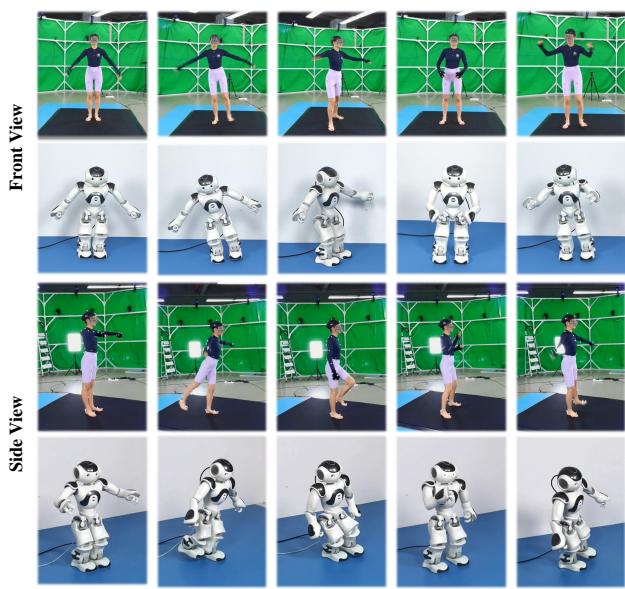
The authors developed a pipeline to retarget the FRAPPE output to a NAO humanoid robot.
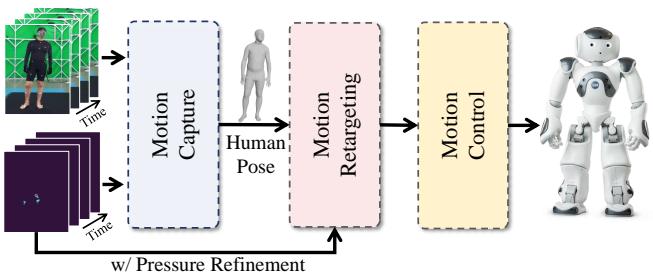
By using the pressure-refined poses, the robot was able to imitate human motions with higher stability and less risk of falling compared to using poses from standard RGB methods like CLIFF. This implies that datasets like MotionPRO could be instrumental in training the next generation of general-purpose robots that learn by watching humans.
Conclusion
The MotionPRO paper makes a compelling argument that we have hit a ceiling with vision-only motion capture. While cameras give us texture and geometry, they miss the fundamental forces that govern movement.
By integrating pressure maps, the authors demonstrated that we can:
- Eliminate foot sliding and penetration.
- Drastically improve global trajectory tracking.
- Enable more stable control for humanoid robots.
For students entering this field, this research highlights an important trend: Multimodal Learning. The future of Computer Vision isn’t just about better cameras; it’s about fusing vision with other sensors—touch, depth, and pressure—to build AI that truly understands the physical world.