](https://deep-paper.org/en/paper/2504.05576/images/cover.png)
Imagine walking through a virtual museum or a digital twin of a historical site. The visuals are photorealistic, thanks to recent advances in 3D reconstruction and NeRF (Neural Radiance Fields) technology. But close your eyes, and the illusion often breaks. The sound might be flat, static, or incorrectly spatialized.
While we have mastered Novel-View Synthesis for eyes (creating new visual angles from sparse photos), Novel-View Acoustic Synthesis (NVAS)—generating accurate sound for a specific location in a room based on recordings from other spots—remains a massive challenge. Real-world sound is messy. Ambient noise isn’t just a single speaker; it’s the hum of a refrigerator, the distant traffic outside, the reflection of footsteps off a concrete wall, and the muffling effect of a sofa.
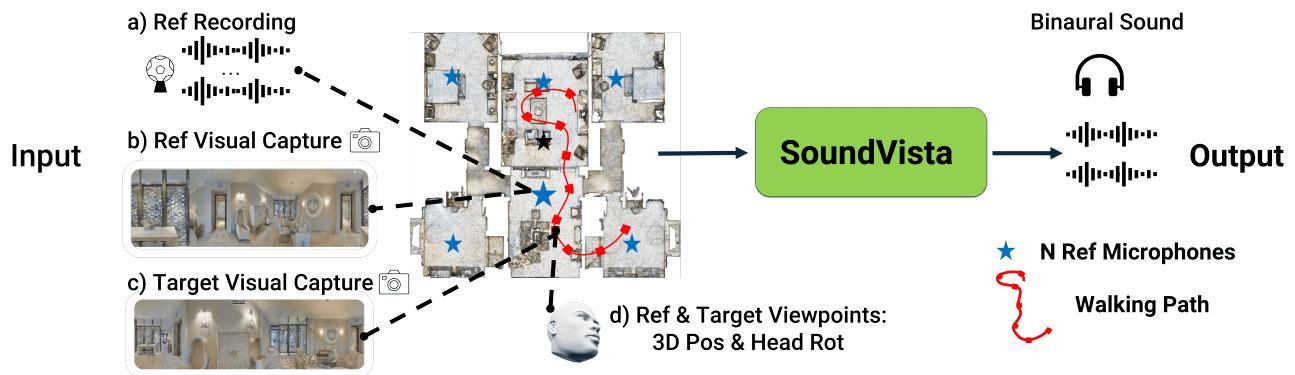
In this post, we dive into SoundVista, a research paper that proposes a groundbreaking method to solve this. The researchers introduce a system that “sees” the room to understand how it should “hear” the room, allowing for the generation of realistic, binaural (3D) audio at any location in a scene, using only a few sparse reference recordings.
The Core Problem: Why is Audio So Hard?
In an ideal theoretical world, if we knew the exact position of every sound source and had a perfect 3D model of the room, we could calculate how sound bounces around using “Room Impulse Responses” (RIRs). But in the real world, we rarely have that data. We don’t know exactly where the air conditioner hum is coming from, and we can’t easily model every acoustic reflection.
Current solutions usually involve placing a grid of microphones and interpolating between them. However, this doesn’t scale well. If there is a wall between Microphone A and your target location, simply blending the sound from Microphone A is wrong—the wall should block the sound.
SoundVista approaches this by asking: Can we use visual data to inform acoustic synthesis? By analyzing panoramic images of a room (RGB-D data), the system learns to predict acoustic properties, allowing it to synthesize accurate sound even for locations it hasn’t heard before.
The SoundVista Architecture
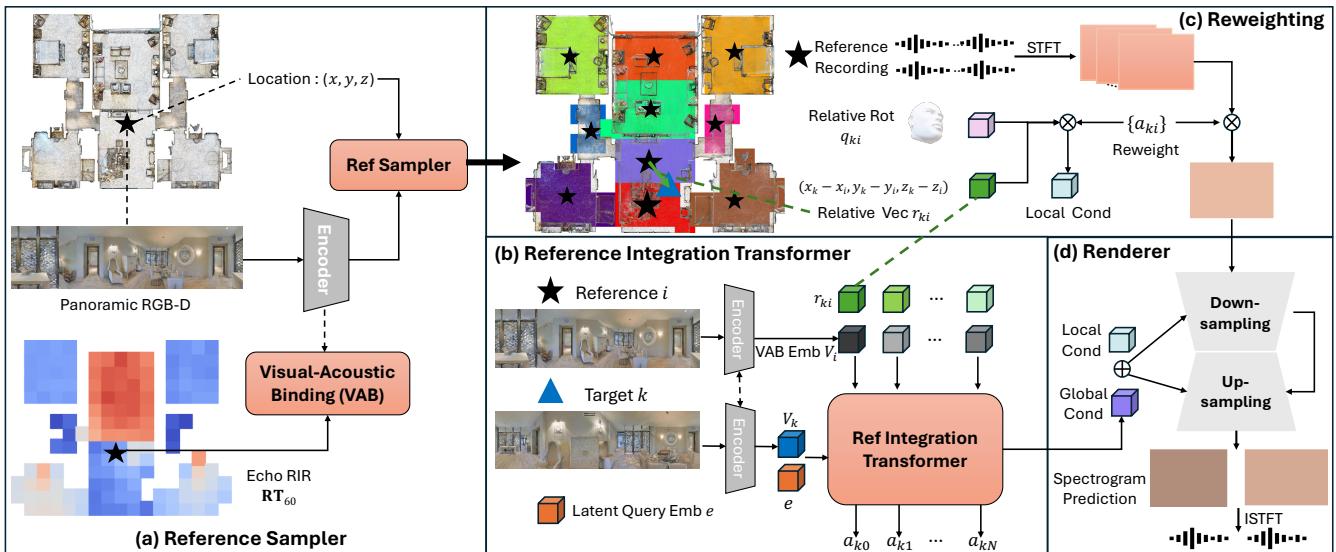
The SoundVista pipeline is designed to transform “reference recordings” (audio captured at known spots) into “target audio” (audio at a new, specific spot). The architecture is composed of four main pillars:
- Visual-Acoustic Binding (VAB): Learning to “see” sound.
- Reference Location Sampler: Deciding where to place microphones.
- Reference Integration Transformer: Weighing the importance of each microphone.
- Spatial Audio Renderer: Generating the final 3D waveform.
Let’s break down the pipeline visualized below:
1. Visual-Acoustic Binding (VAB)
The most innovative part of this paper is the VAB module. Acoustic properties, like reverberation time (\(RT_{60}\)—how long it takes sound to decay by 60dB), are heavily influenced by the physical environment. A small tiled bathroom sounds different than a carpeted living room.
The researchers realized that RGB-D images (color + depth) contain enough information to predict these acoustic properties. They trained a neural network to look at a panoramic view of a room and generate a “VAB embedding”—a digital fingerprint that represents the local acoustic environment.
By doing this, the system doesn’t need to measure the acoustics of a new room explicitly; it can infer them just by looking at the geometry and textures in the visual data.
2. The Reference Location Sampler
If you have a limited budget for microphones, where should you put them? Random placement is inefficient. A grid is rigid.
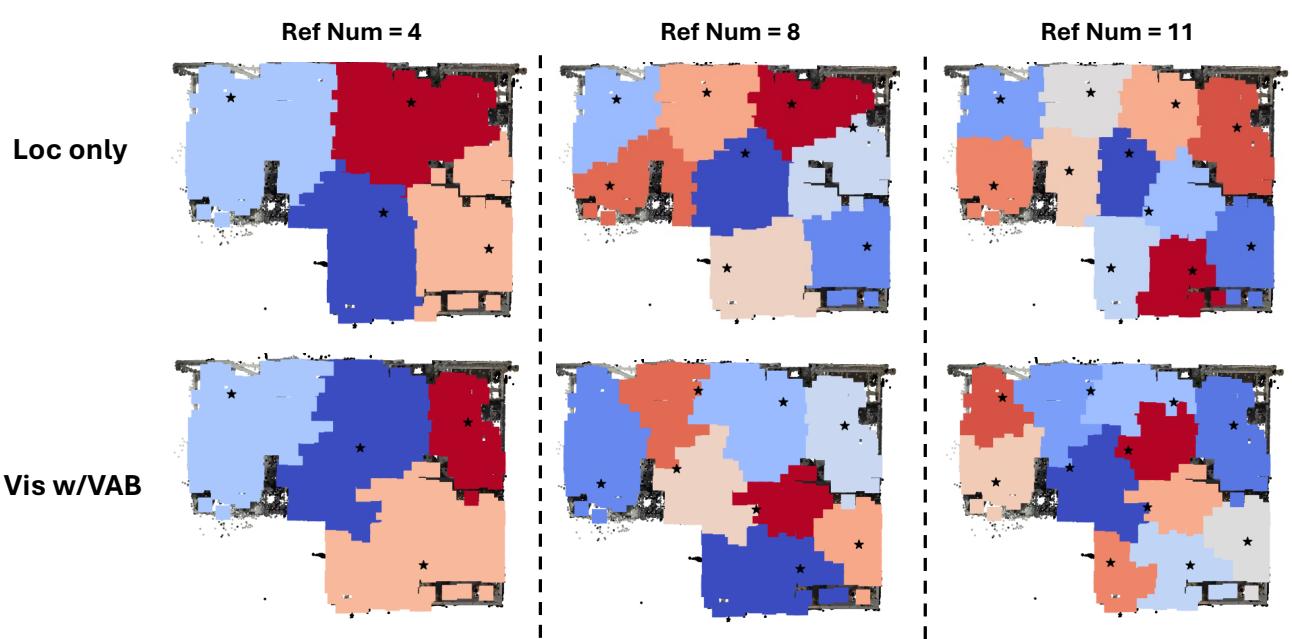
SoundVista uses the VAB embeddings to cluster the room into “acoustic partitions.” It identifies areas that share similar acoustic properties and places microphones (virtual or real) at the center of these clusters. This ensures that the reference recordings capture a representative sample of all the distinct acoustic zones in the scene (e.g., one mic in the hallway, one in the bedroom, rather than two in the bedroom and none in the hallway).
3. The Reference Integration Transformer
Once we have our reference recordings, how do we combine them to create sound for a new location (the target)?
We cannot simply treat all microphones equally. If the target listener is in the kitchen, the microphone in the kitchen is much more relevant than the one in the living room, even if they are equidistant. To solve this, the researchers treat the reference recordings as a sequence and process them through a Transformer network.
The goal is to learn a transfer function \(\mathcal{F}\) that maps references to the target:
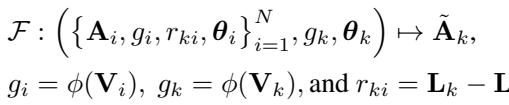
Here, \(g_i\) and \(g_k\) are the VAB embeddings (visual-acoustic features) for the reference and target locations, respectively. The system calculates an “attention weight” (\(a_{ki}\)) for each reference microphone. This weight determines how much that specific microphone contributes to the final sound.

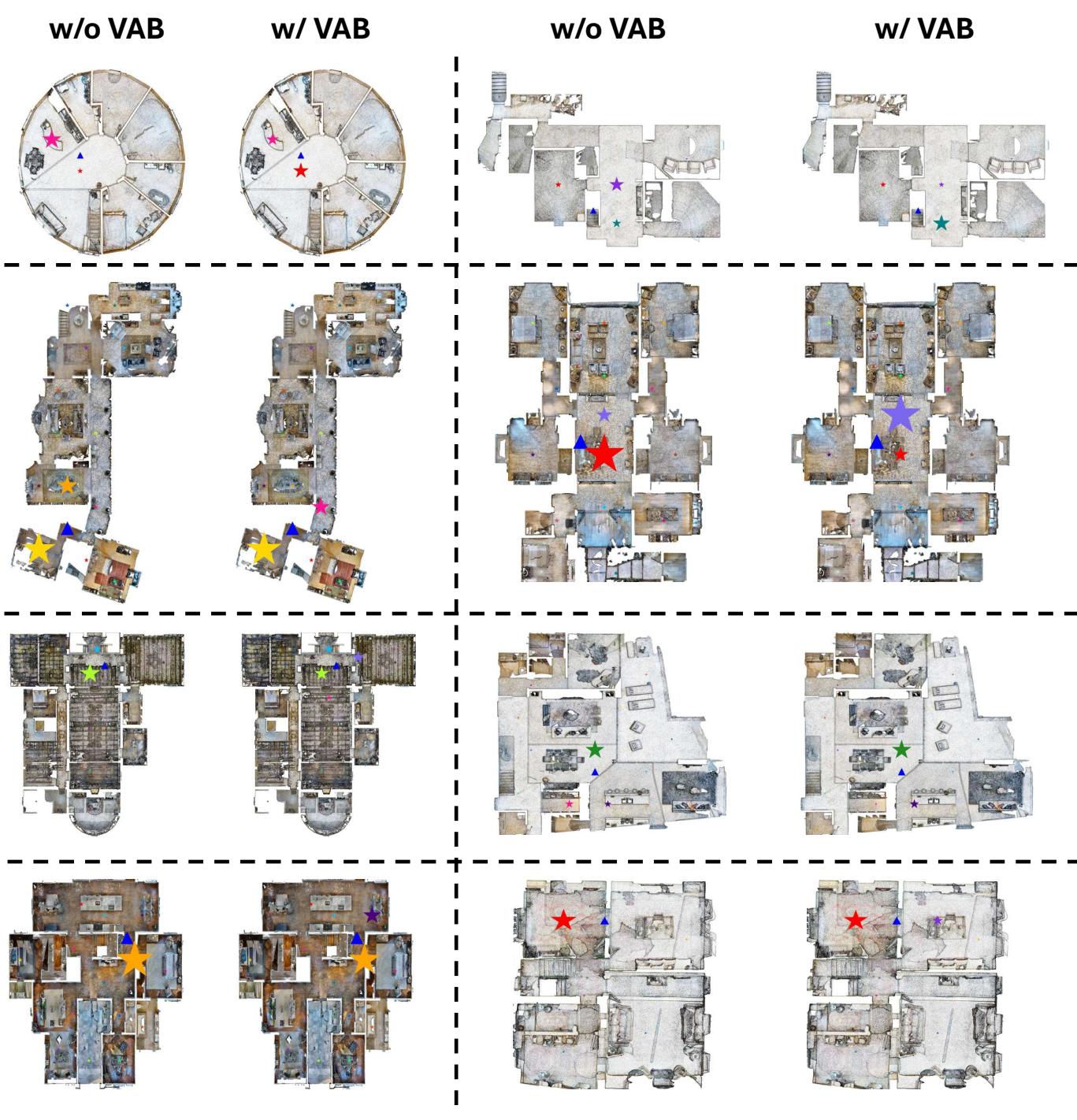
This attention mechanism is crucial. It allows the model to dynamically “listen” to the microphones that are acoustically relevant to the target position, ignoring those blocked by walls or situated in different acoustic zones.
4. The Spatial Audio Renderer
Finally, the system needs to generate the actual binaural audio. This is done by a Spatial Audio Renderer, designed as a U-Net architecture.
The renderer takes the weighted audio features from the Transformer and combines them with “conditioning” information. The researchers decouple this conditioning into two parts:
- Global Condition (\(c_g\)): Related to the distance and relative position of the target in the room.
- Local Condition (\(c_l\)): Related to the specific head orientation (rotation) of the user.
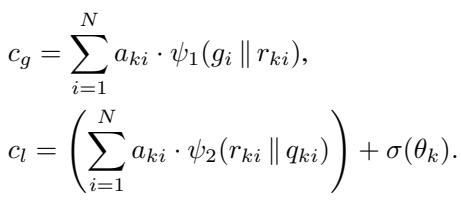
By separating these, the model can accurately simulate how sound changes not just when you walk (translation), but when you turn your head (rotation)—a critical requirement for immersive VR.
Experiments and Results
The researchers tested SoundVista on two challenging benchmarks:
- SoundSpaces-Ambient: A massive simulated dataset based on Matterport3D, featuring complex homes with multiple sound sources (fans, TVs, speech).
- N2S (Real-World): A real-world dataset captured in an office space with multiple rooms and ambient noise.
Quantitative Success
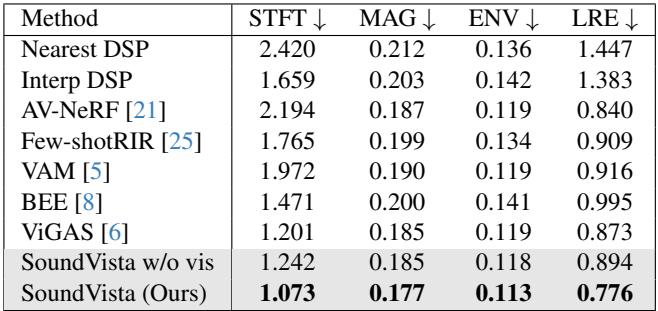
The primary metrics used were STFT (spectral distance), Magnitude distance, Envelope error, and LRE (Left-Right Energy ratio, which measures binaural accuracy). In all cases, lower numbers are better.
Looking at the results on the SoundSpaces benchmark (Table 1 below), SoundVista significantly outperforms existing methods like AV-NeRF and ViGAS.
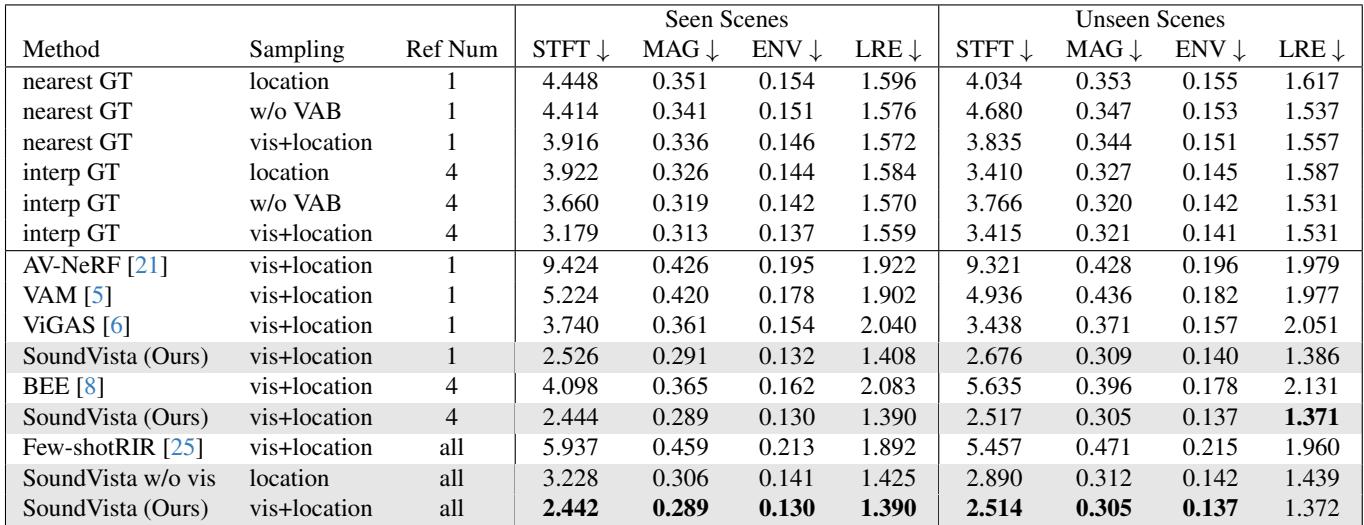
Notably, even when restricted to using only 1 or 4 reference microphones, SoundVista achieves lower error rates than competitors. The improvement in LRE (Left-Right Energy) is particularly important because it indicates that the stereo/3D effect is much more accurate.
The system also showed impressive results in the real-world N2S benchmark:
Qualitative Visualization
Ideally, we want to see if the model creates a “Loudness Map” that matches reality. In the figure below, compare the Ground Truth (GT) with SoundVista and other baselines (ViGAS, BEE).
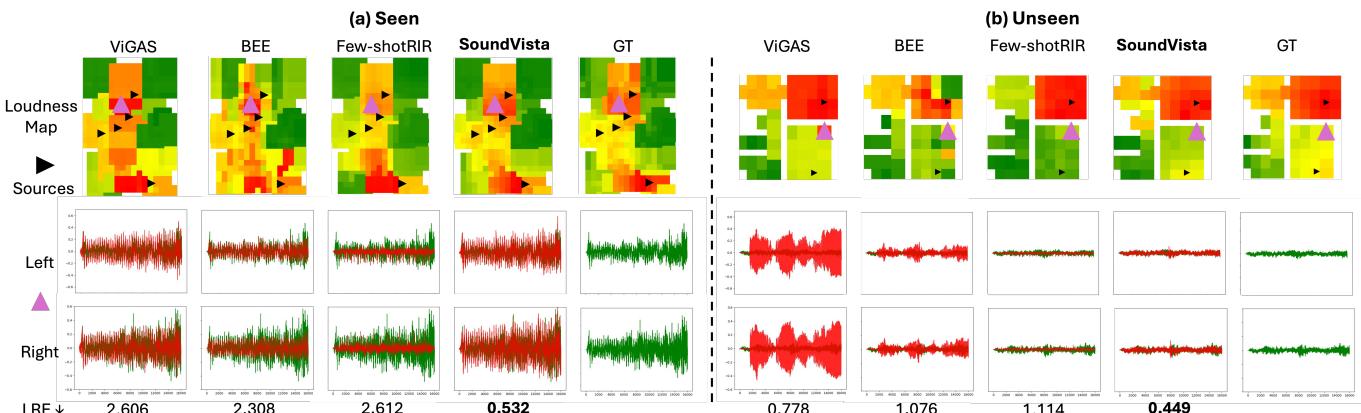
Notice how baselines like ViGAS produce discrete, blocky loudness maps (the first row), failing to handle smooth transitions or obstacles. SoundVista, however, produces a heatmap that closely resembles the Ground Truth, respecting the geometry of the room. The waveforms (second row) also show that SoundVista captures the signal phase and amplitude much more accurately.
Why Visuals Matter
A major claim of the paper is that seeing helps hearing. To prove this, the researchers ran ablations (tests where they removed specific features).
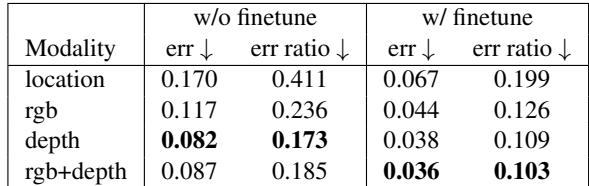
They tested how accurately the VAB module could predict the reverberation time (\(RT_{60}\)) using different data inputs. As shown in Table 3, using RGB + Depth resulted in significantly lower errors than using location alone.
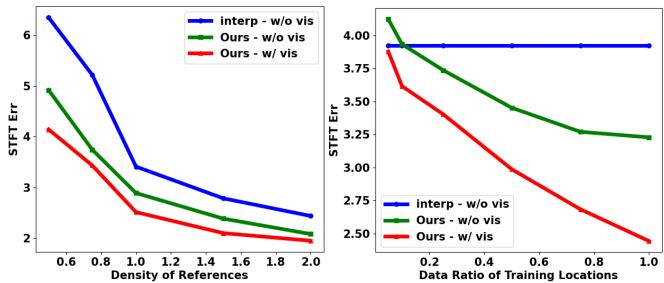
Furthermore, the graphs below demonstrate the robustness of the system. The red line (SoundVista with Visuals) maintains low error rates even when the density of reference microphones drops (Left chart) or when training data is scarce (Right chart).
Visualizing the “Brain” of the System
To understand how SoundVista makes decisions, we can look at the clustering and attention weights.
Clustering: The VAB-based sampler (bottom row in the figure below) groups the room into logical acoustic zones. Notice how the colors align with room partitions. Simple location-based clustering (top row) often crosses walls, grouping acoustically distinct areas together just because they are physically close.
Attention Weights: The image below visualizes which microphones the model “listens” to. The size of the star corresponds to the attention weight. The model utilizing VAB (Right column) intelligently selects microphones that are in the same room or acoustic zone as the target (blue triangle), whereas a simple distance-based approach might select a microphone through a wall.
Conclusion and Implications
SoundVista represents a significant step forward in immersive media. By binding visual data with acoustic properties, the researchers have created a system that can synthesize realistic ambient sound for novel viewpoints without needing a dense grid of microphones or perfect knowledge of sound source locations.
Key Takeaways:
- Cross-Modal Power: Visual data (RGB-D) is a powerful predictor of acoustic behavior.
- Smart Sampling: We don’t need microphones everywhere; we just need them in distinct acoustic zones, which vision can help identify.
- Adaptive Synthesis: Using Transformers allows the system to dynamically weigh inputs, ignoring irrelevant or blocked audio sources.
This technology paves the way for truly immersive Virtual Reality tours and mixed-reality experiences where the sound is as free and navigable as the visuals. Instead of static background tracks, future virtual environments will have living, breathing audio that reacts naturally as you explore.