](https://deep-paper.org/en/paper/2504.08541/images/cover.png)
Bridging Reality and Simulation: A Deep Dive into the Digital Twin Catalog (DTC)
In the rapidly evolving worlds of Augmented Reality (AR), Virtual Reality (VR), and robotics, one concept stands as the “holy grail”: the Digital Twin.
A digital twin isn’t just a 3D model. A 3D model might be a hollow shell that looks roughly like a cup. A digital twin, however, is a virtual entity so precise that it is indistinguishable from its physical counterpart. It captures exact geometry, surface textures, how light interacts with the material (reflectance), and physical properties.
If we want robots to learn how to grab a slippery glass, or if we want AR glasses to render a virtual apple that looks edible on your real-world desk, we need data. specifically, we need high-quality 3D data.
The problem? Until now, we haven’t had enough of it.
This post explores the Digital Twin Catalog (DTC), a groundbreaking dataset and research paper from Meta Reality Labs and Stanford University. We will unpack how they created 2,000 photorealistic objects, how they bridged the gap between synthetic and real-world data, and why this matters for the future of Computer Vision.
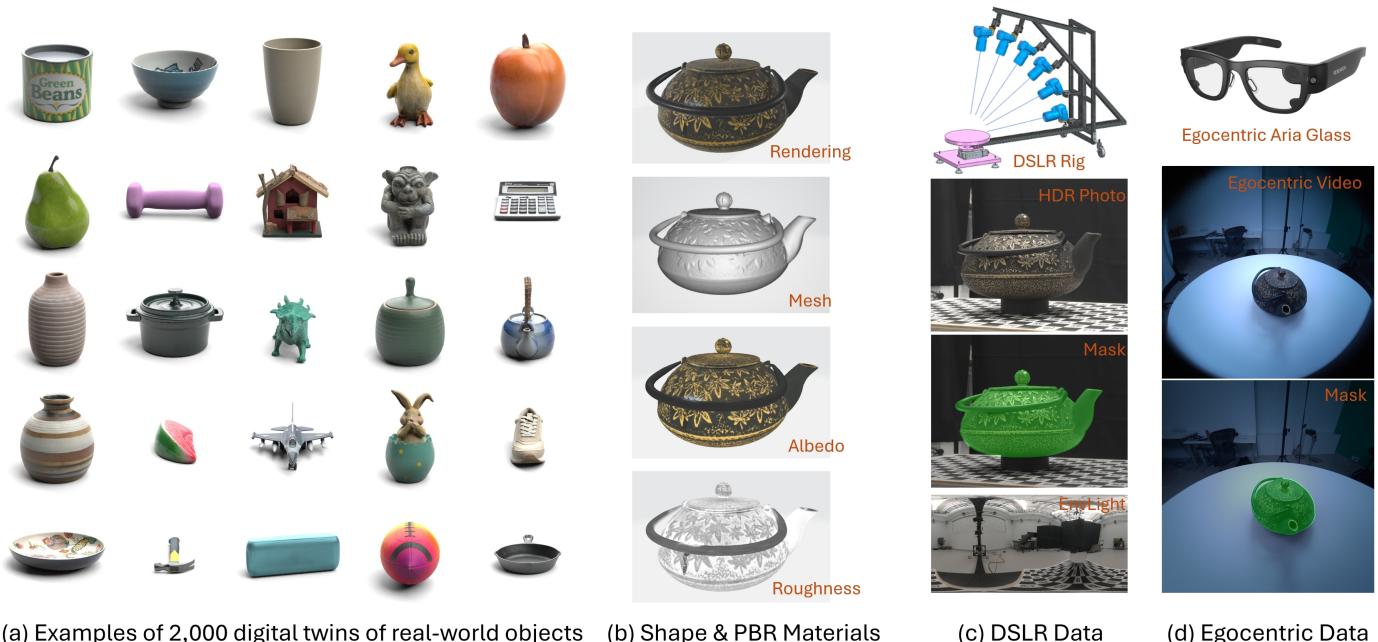
As shown in Figure 1 above, the DTC isn’t just a pile of 3D meshes. It is a comprehensive ecosystem including digital twins, DSLR capture data, and egocentric video from AR glasses.
The Bottleneck: Quantity vs. Quality
To understand why the DTC is significant, we first need to look at the landscape of 3D computer vision.
For years, researchers have relied on datasets to train neural networks to reconstruct 3D objects from 2D images (a process called inverse rendering). However, there has always been a painful trade-off:
- Synthetic Datasets: These contain thousands of objects (like ShapeNet). They are great for scale, but they look fake. A neural network trained on perfect, noise-free synthetic data often fails when shown a real photograph.
- Real-World Datasets: These capture real objects. However, capturing a real object with high fidelity is incredibly hard. Previous datasets were either too small (only a few dozen objects), lacked material properties (they just had color, not shininess or roughness), or had noisy geometry.
The table below summarizes this landscape. Notice how few datasets check all the boxes for “Real,” “Multi-view,” “Shape,” and “PBR Materials” (Physically-Based Rendering materials).
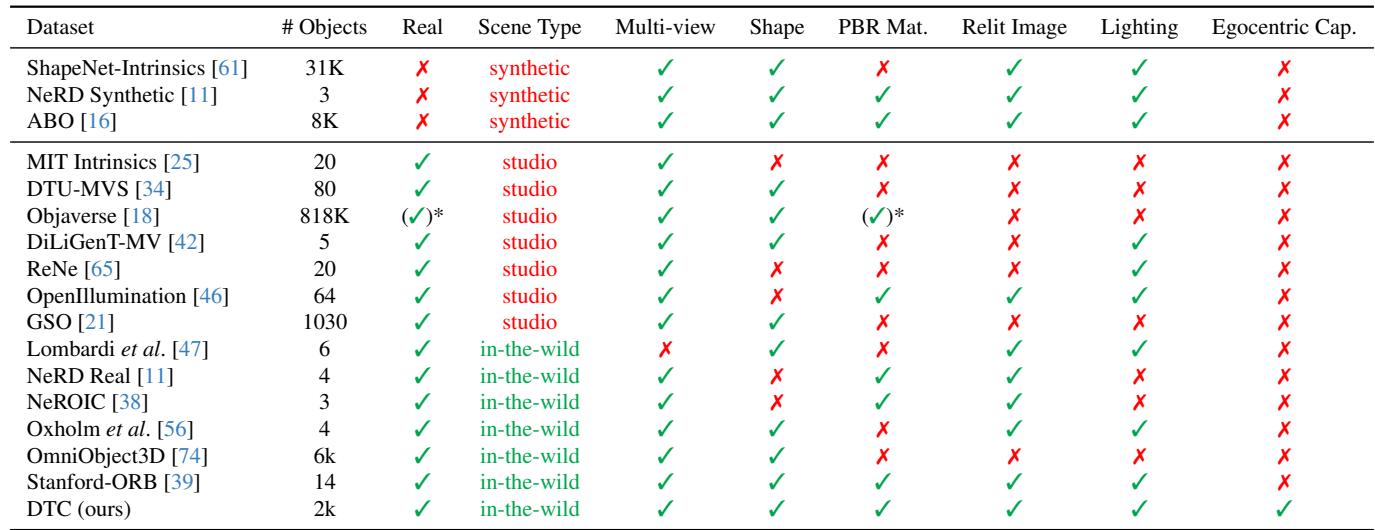
The DTC (Digital Twin Catalog) fills this void. It provides 2,000 scanned real-world objects with millimeter-level geometric accuracy and photorealistic PBR materials. Furthermore, it is the first dataset to provide aligned “egocentric” data—video captured from the perspective of a person wearing smart glasses.
Building the Digital Twin: The Scanning Pipeline
How do you create a digital twin that mimics reality perfectly? You cannot simply take a few photos with a phone. The researchers utilized a state-of-the-art industrial scanning pipeline.
The Hardware Setup
The team employed a specialized 3D object scanner by Covision Media. This isn’t a simple turntable; it is a sophisticated dome equipped with:
- 8 Structured Light Cameras: These project patterns onto the object to calculate precise depth and geometry.
- 29 Spotlights and 29 Cameras: These capture the object from every angle under varying lighting conditions to estimate how the surface reflects light.
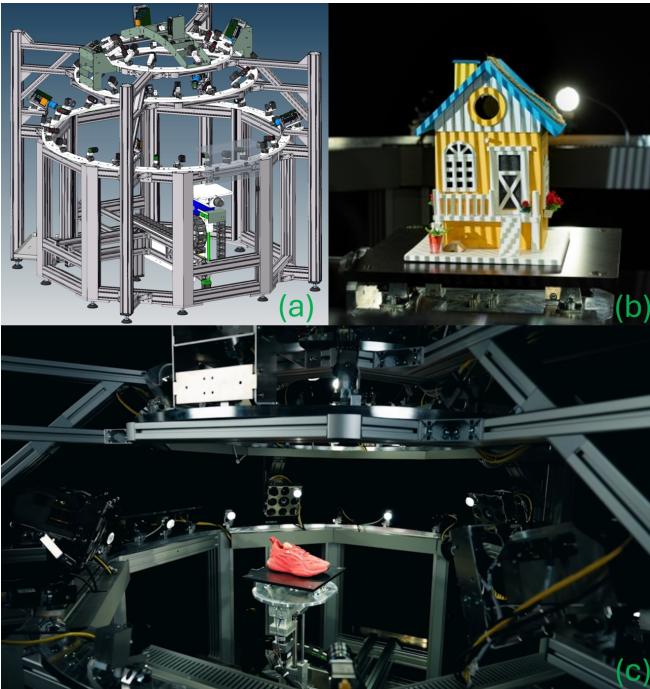
As visualized in Figure 3, the scanner (a) creates a controlled environment. The object (b) is placed on a holder, and the machine captures it. To get the bottom of the object, the object is flipped, re-scanned, and the scans are stitched together.
From Scan to PBR Materials
The raw scan gives us the shape, but “appearance” is more complex. To achieve photorealism, the dataset uses Physically-Based Rendering (PBR).
In computer graphics, we don’t just paint a color on a shape. We define materials using a set of “maps” (textures):
- Albedo: The base color of the object (without shadows or reflections).
- Roughness: How microscopic bumps on the surface scatter light. (Is it matte like chalk or glossy like a billiard ball?)
- Metallic: Whether the surface behaves like a metal (conducting electricity and reflecting color differently) or a dielectric (plastic, wood).
- Normal Map: Fine details (like the texture of an orange peel) that are too small for the geometry mesh but affect how light bounces.
The DTC pipeline automatically optimizes these maps. However, automated systems often struggle with shiny or glossy objects. The researchers went a step further by employing technical artists to manually refine materials, ensuring the “Digital Twin” standard.
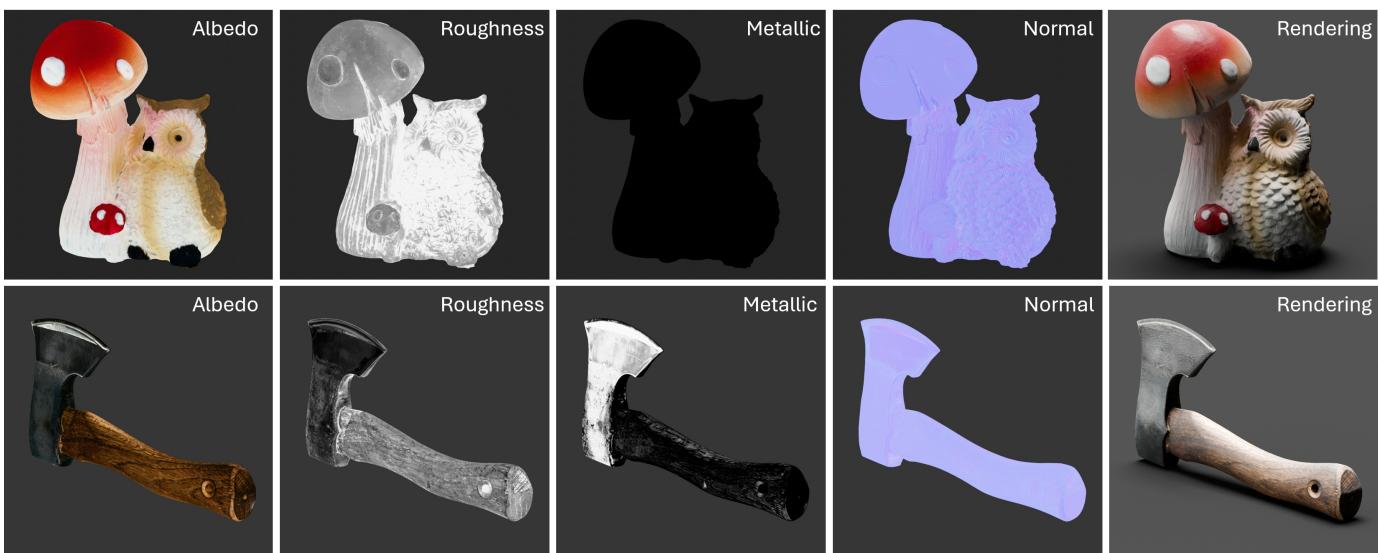
Figure 2 shows the output. Notice the “Roughness” map on the axe—the handle is rougher (whiter) than the blade. This level of detail is what allows these objects to be “relit” in any virtual environment and look real.
Verification: The “Box” Test
How do we know the digital twin is accurate? The researchers performed a rigorous verification. They built a real-world light box and photographed the physical objects inside it. Then, they built a virtual replica of that light box and rendered the digital twin inside it.

The results, shown in Figure 4, are striking. The rendered image (Left) and the real photo (Right) are nearly identical. This confirms that the dataset successfully disentangles the object’s intrinsic properties from the lighting.
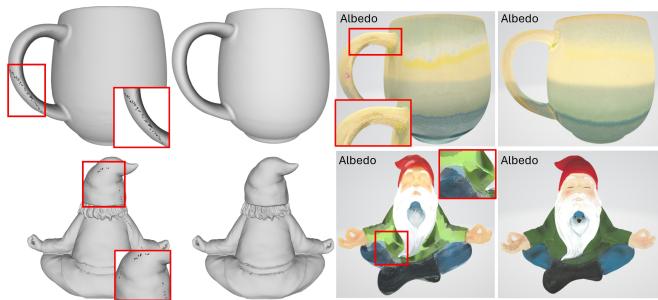
Compare this to previous benchmarks. In Figure 5 below, we see a comparison with the Stanford-ORB dataset. The Stanford models (left) show noisy geometry and “baked-in” lighting artifacts. The DTC models (right) are clean and sharp.
Evaluation Data: Bridging the Gap
A dataset of 3D models is useful, but to train AI, we need to see how these models look in the real world. The DTC provides two massive sets of evaluation data.
1. The DSLR Control Group
For a controlled benchmark, the researchers built a custom robotic gantry (the “DSLR Rig”).
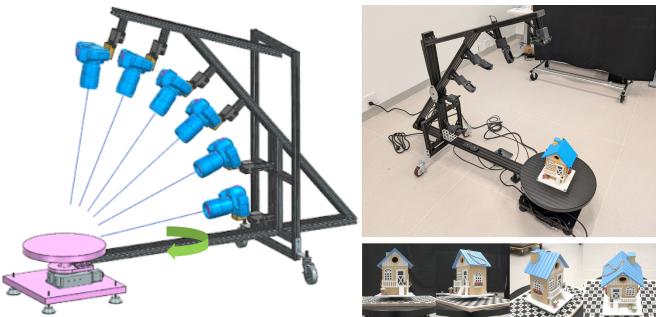
This rig rotates three high-end DSLR cameras around the object, capturing 120 images per object at specific angles. They also captured the environment lighting using a chrome ball (which reflects the entire room). This provides a “Ground Truth” dataset where we know exactly where the camera was, exactly what the lighting was, and exactly what the object looks like.
2. The Egocentric Frontier (Project Aria)
This is where the DTC truly innovates. As we move toward Augmented Reality, we need computers to understand objects from the perspective of a human wearing glasses. This is called Egocentric Vision.
The team used Project Aria glasses to capture video of the objects in real-world settings. They recorded two types of trajectories:
- Active: The user intentionally walks around the object to scan it.
- Passive: The user walks by the object casually, capturing only partial views.

The Alignment Challenge: Aligning a shaky, handheld video to a millimeter-perfect 3D model is incredibly difficult. The researchers developed a novel workflow (visualized below) utilizing “Neural-PBIR” (Neural Physically-Based Inverse Rendering).
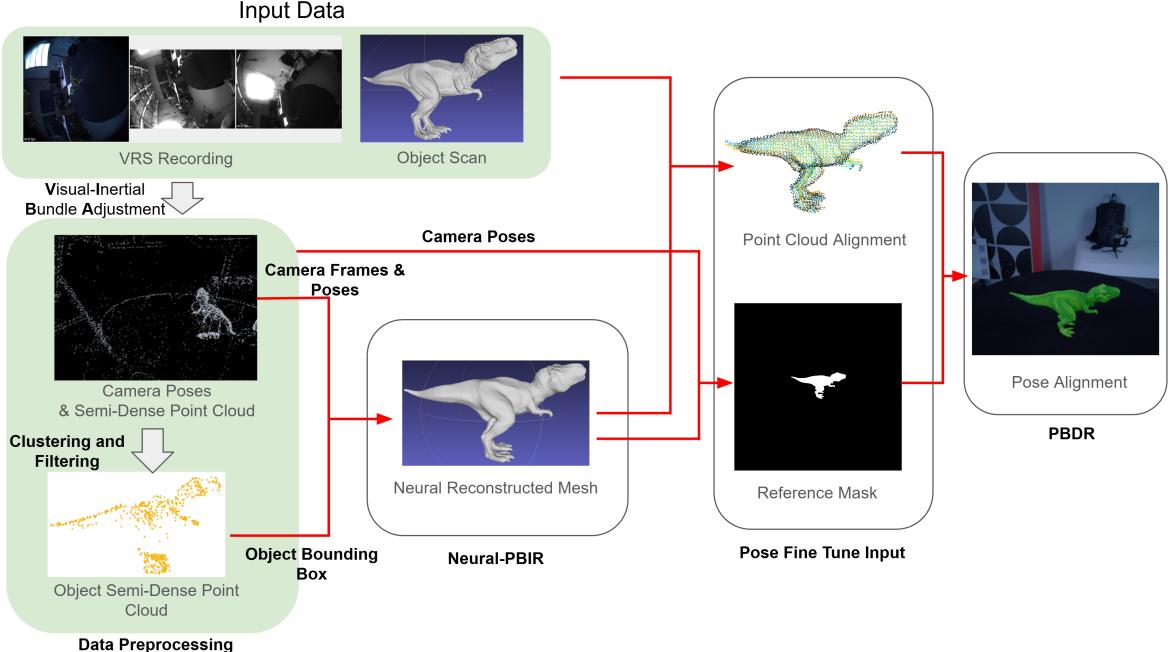
They reconstruct the scene from the video, generate a mask, and then use physics-based differentiable rendering to “snap” the digital twin into the perfect position within the video frame. This creates a dataset where we have real-world video of an object and the perfect 3D ground truth aligned to it.
Benchmarking & Applications
The researchers didn’t just release the data; they used it to benchmark the current state of computer vision.
Inverse Rendering (DSLR)
Inverse rendering tries to take images and figure out the shape and material. The team tested several state-of-the-art methods (like NeRD, PhySG, and NVDiffRec) against the DTC dataset.
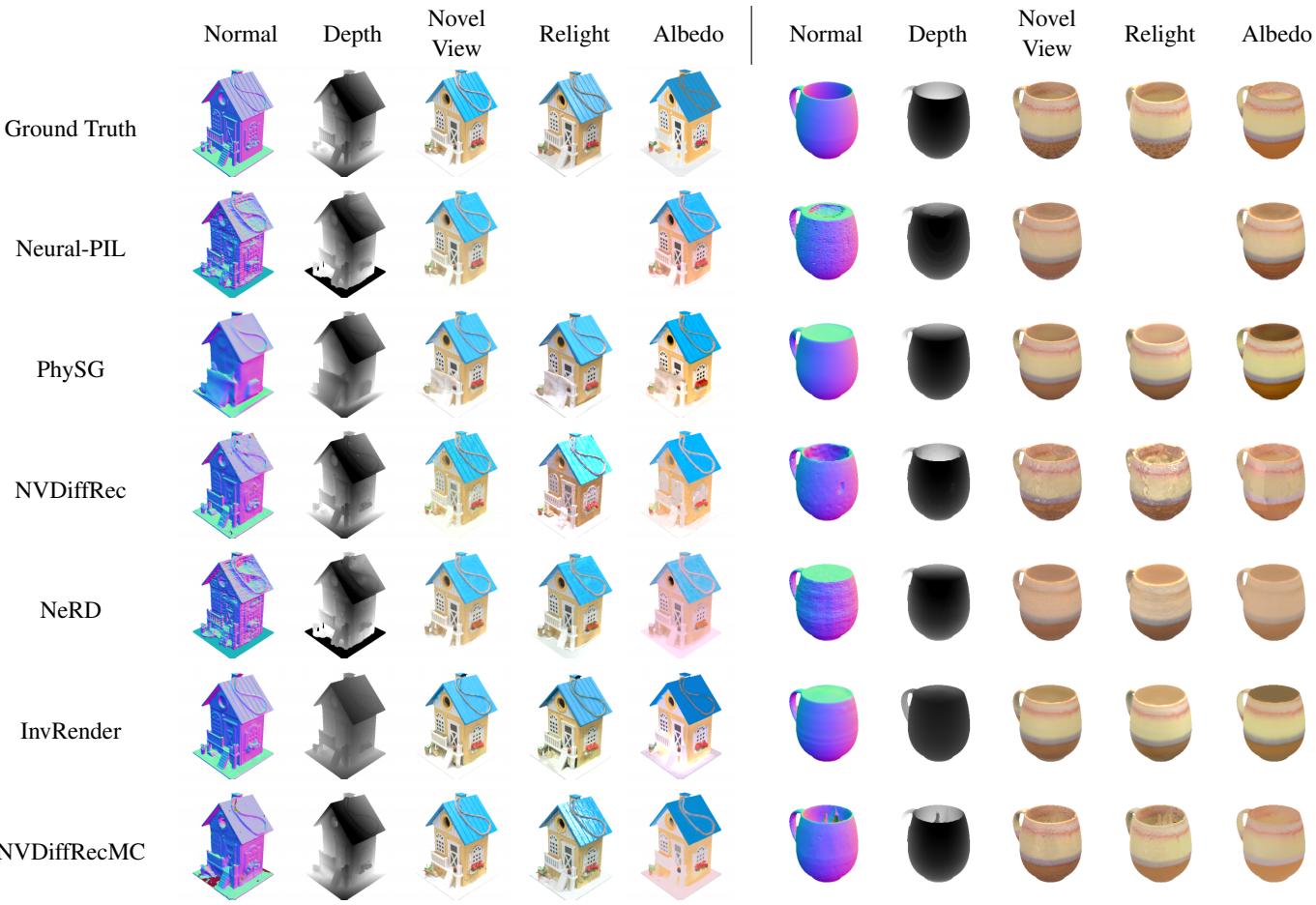
As seen in Figure 18, current methods still struggle.
- NeRF-based methods (like NeRD) often result in noisy, “cloudy” geometry.
- SDF-based methods (like PhySG) produce smoother shapes but often lose high-frequency details (look at the loss of detail on the birdhouse roof).
The quantitative results (below) confirm that while we are making progress, no method has perfectly solved the problem of extracting digital twins from images yet. The DTC provides the “hard” benchmark needed to push this field forward.

Egocentric Reconstruction (Gaussian Splatting)
3D Gaussian Splatting (3D-GS) is a popular new technique for real-time rendering. The team tested how well 3D-GS works on the egocentric data.
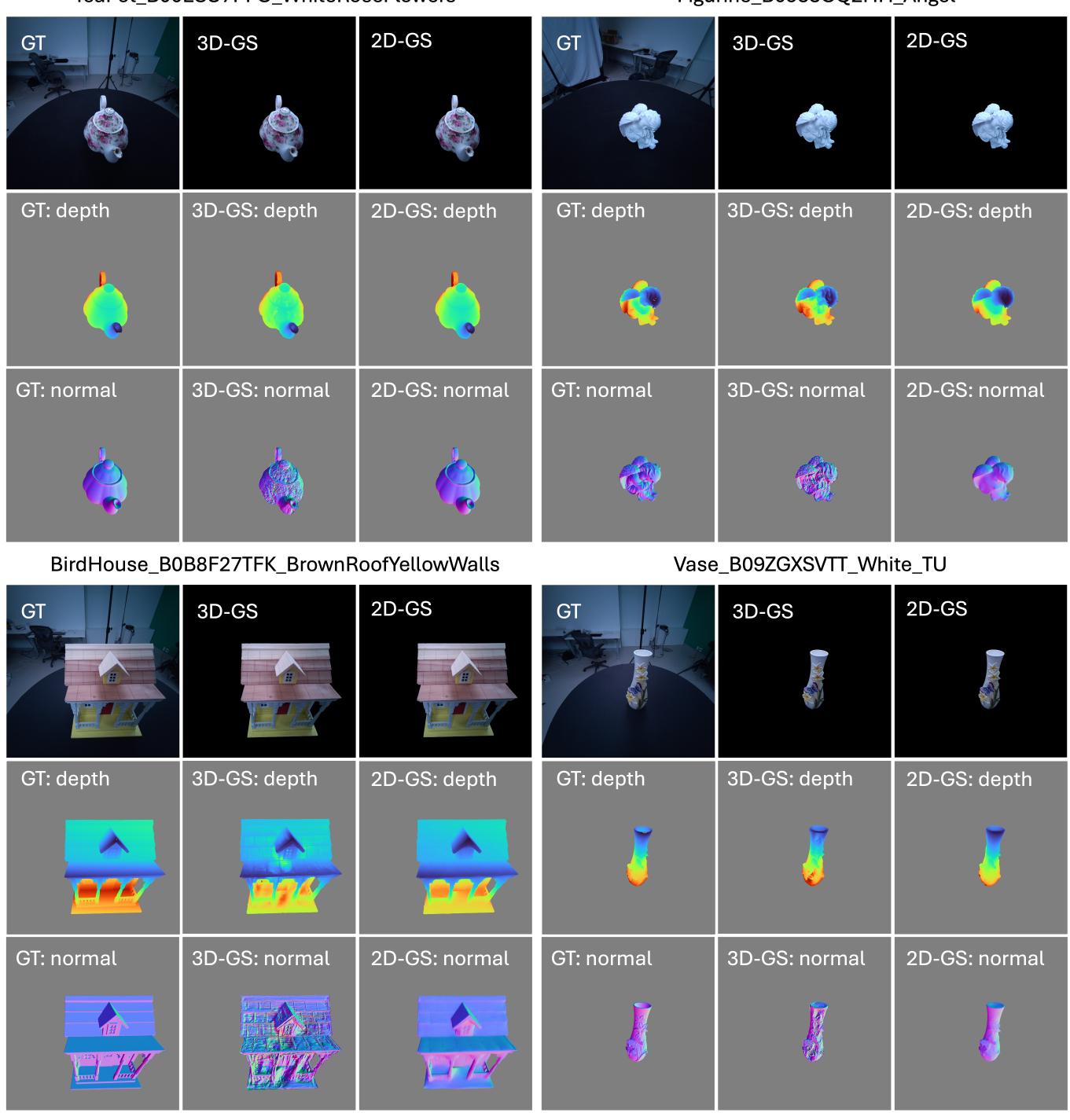
The results (Figure 22) show that while Gaussian Splatting is great at synthesizing novel views (the images look nice), the underlying geometry (the “Normal” row) is often noisy and inaccurate compared to the Ground Truth (GT). This highlights a critical gap: methods that look good for graphics might not be precise enough for physics or robotics.
Robotics: Sim-to-Real Transfer
Finally, the researchers demonstrated why high-quality digital twins matter for robotics.
They trained robot arms in a simulation to perform two tasks:
- Pushing: Moving an object to a target location.
- Grasping: Picking up an object.
They trained one policy using the high-quality DTC objects and another using objects from Objaverse-XL (a massive but lower-quality dataset).
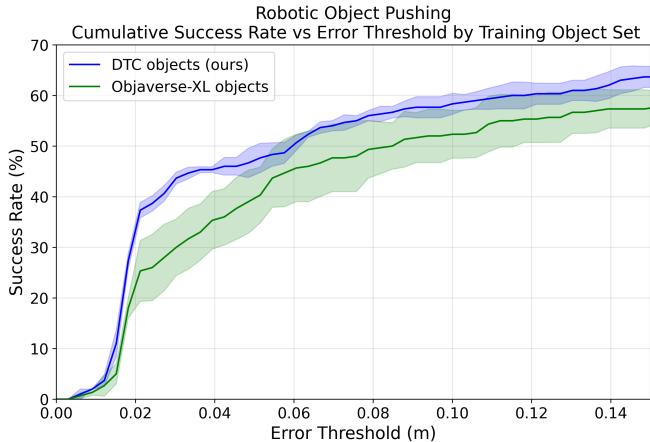
The graph above (Figure 8) tells a compelling story. The blue line (policies trained on DTC) consistently outperforms the green line (Objaverse).
Why? Because geometry matters. If a simulator thinks a cup has a smooth bottom, but the real cup has a concave rim, the robot will fail when it tries to push it in the real world. The millimeter-level accuracy of the DTC allows the robot to learn the true physical dynamics of everyday objects.
Conclusion
The Digital Twin Catalog represents a significant step up in 3D computer vision resources. By moving away from synthetic approximations and low-fidelity scans, DTC offers a dataset that respects the complexity of the real world.
Key Takeaways:
- Digital Twin Quality: We now have 2,000 objects with verified geometry and PBR materials.
- Egocentric Focus: This is the first benchmark specifically designed to help AR glasses understand and reconstruct objects.
- Better Simulation: High-fidelity data leads to better robot performance, bridging the “Sim-to-Real” gap.
For students and researchers, DTC serves as both a resource and a challenge. The benchmarks show that even our best algorithms (like Gaussian Splatting or Inverse Rendering) struggle to match the ground truth of a digital twin. With this dataset, the community has the roadmap needed to build the next generation of 3D reconstruction AI.