](https://deep-paper.org/en/paper/2504.12609/images/cover.png)
Introduction
Imagine you want to teach a robot how to pour a glass of water or place a dish in a rack. In an ideal world, you would simply show the robot how to do it once—perhaps by performing the task yourself—and the robot would immediately understand and replicate the skill.
In reality, teaching robots “dexterous manipulation” (using multi-fingered hands to handle objects) is notoriously difficult. Traditional methods like Imitation Learning (IL) often require hundreds of demonstrations to learn a robust policy. Furthermore, capturing high-quality data of human hand motion typically involves expensive wearable sensors or complex teleoperation rigs.
Video data seems like the perfect alternative. It is cheap, scalable, and intuitive. However, using a video of a human hand to control a robot hand introduces the embodiment gap. Humans have soft tissue, five fingers, and specific joint limits; robots are rigid, may have three or four fingers, and move differently. Trying to mathematically force a robot to copy a human’s exact finger movements often results in awkward, failed grasps.
This brings us to a fascinating new framework: HUMAN2SIM2ROBOT.
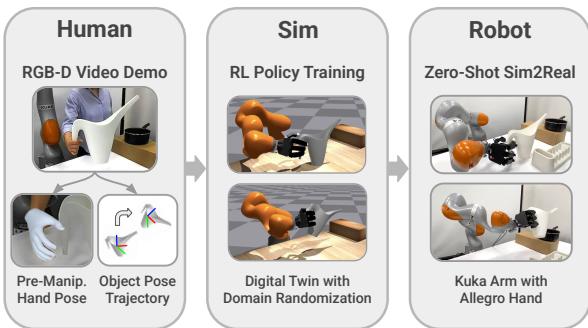
As shown in Figure 1, this method proposes a novel pipeline that bypasses the need for expensive equipment or massive datasets. Instead, it learns robust manipulation policies from a single RGB-D video demonstration. By combining the intuition of human demonstration with the trial-and-error learning capabilities of Reinforcement Learning (RL), this approach successfully bridges the gap between human and robot bodies.
In this deep dive, we will unpack how HUMAN2SIM2ROBOT works, why it abandons the idea of perfect motion copying, and how it achieves zero-shot transfer to the real world.
Background: The Challenge of Dexterity
To appreciate the innovation here, we first need to understand why this problem is so hard.
The Limits of Imitation Learning
Imitation Learning (IL) treats the robot like a student trying to memorize the teacher’s movements. If you have a video of a human, you can try to extract the hand pose at every single frame and retarget it to the robot using Inverse Kinematics (IK).
However, this “frame-by-frame” copying fails for two reasons:
- Vision is Noisy: Estimating 3D hand poses from a 2D video is prone to jitter and error, especially when fingers are occluded by the object.
- Morphological Mismatch: Even with perfect tracking, a trajectory that works for a human hand might be physically impossible or unstable for a robot hand (e.g., an Allegro hand).
The Promise of Reinforcement Learning
Reinforcement Learning (RL) allows a robot to learn by doing. The robot tries an action, sees if it gets a reward, and adjusts. RL is great because it allows the robot to figure out how to use its own body to solve a task.
The downside? RL usually requires a carefully engineered reward function (mathematically defining “success” for every specific task is tedious) and millions of samples, making it impractical to train directly on physical hardware.
The Hybrid Solution
HUMAN2SIM2ROBOT combines the best of both worlds. It uses the human video not to dictate exact movements, but to define the task goals and provide a starting hint. The heavy lifting of learning the movement execution is then left to RL in a physics simulator.
Core Method: From Video to Policy
The framework operates in a “Real-to-Sim-to-Real” loop. The process begins with a human demonstration in the real world, moves to a digital twin simulation for training, and deploys the learned policy back to the real robot.
The researchers discovered that you don’t need high-fidelity human motion data for the entire video. Instead, you only need to extract two specific things:
- The Object Pose Trajectory: How the object moves through space.
- The Pre-Manipulation Hand Pose: How the hand is positioned just before it interacts with the object.
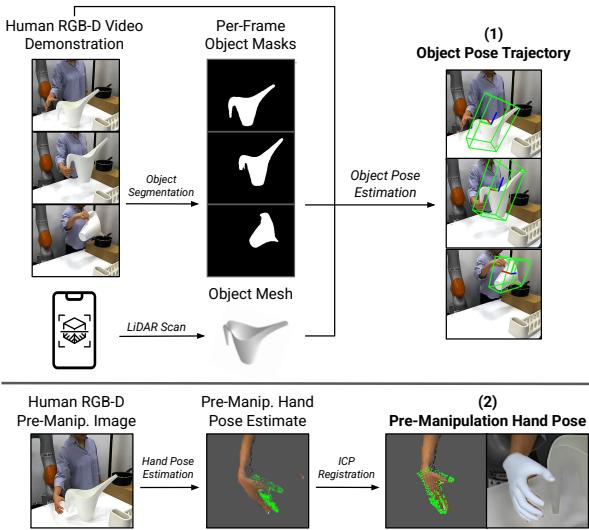
Let’s break down the pipeline visualized in Figure 2.
1. Extracting the “What” (Object Trajectory)
The first step is understanding the task. Rather than focusing on what the fingers are doing, the system looks at the object. Using tools like Segment Anything Model 2 (SAM 2) and FoundationPose, the system extracts the 6D pose (position and orientation) of the object for every frame of the video.
This trajectory becomes the “ground truth” for the task. It defines the goal: “The object needs to move from Point A to Point B along this specific path.” This is an object-centric, embodiment-agnostic reward. It doesn’t matter if you have a human hand, a claw, or a tentacle; if the object follows the path, the task is being done correctly.
2. Extracting the “Where to Start” (Hand Pose)
While RL is powerful, searching for a solution from scratch (starting with the hand anywhere in the room) is inefficient. The robot needs a hint.
The system identifies the pre-manipulation moment—the timestamp right before the object starts moving. It extracts the human hand pose from this single frame using a model called HaMeR (Hand Mesh Recovery).
Because human and robot hands are different, this pose must be “retargeted.”
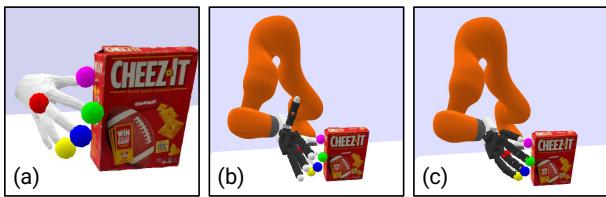
As shown in Figure 3, the retargeting is a two-step Inverse Kinematics (IK) process:
- Arm Alignment: The robot arm moves so that its “wrist” aligns with the human’s wrist/knuckle position.
- Finger Alignment: The robot’s fingers articulate to match the positions of the human fingertips.
This provides a Task Guidance initialization. It puts the robot in a “good enough” starting position that mimics the human’s strategy, drastically speeding up the exploration phase of RL.
3. Simulation-Based Policy Learning
With the task defined (move object along this path) and the starting point set (start with hand here), the system builds a “Digital Twin” of the environment in a simulator (Isaac Gym). This takes only about 10 minutes of human effort to scan the objects and scene.
The Reward Function
The robot is trained to minimize the difference between the object’s current pose in the simulation and the target pose from the video.
The researchers use a clever anchor point system to calculate this difference. Rather than just comparing the center of mass, they define virtual points (\(k_i\)) on the object geometry.
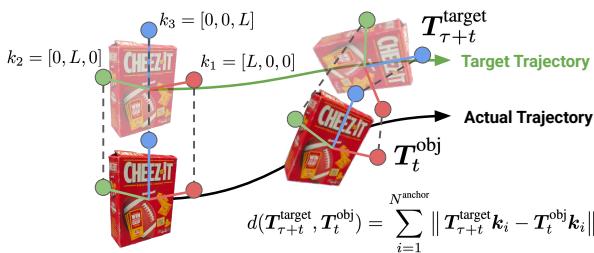
The reward function is defined as:

This formula effectively says: “Maximize the reward by making the distance (\(d\)) between the simulated object’s anchor points and the target trajectory’s anchor points as small as possible.”
Embodiment-Specific Learning
Here is the critical distinction: The policy does not penalize the robot for using its fingers differently than the human.
Once initialized at the pre-manipulation pose, the robot is free to deviate from the human’s finger strategy. The RL algorithm optimizes for the object’s stability and trajectory tracking using the robot’s own physics and collision geometry. This automatically solves the embodiment gap. If the robot needs to splay its fingers wider than a human to hold a box, the RL will learn that strategy because it yields a higher reward (better object tracking).
4. Robustness via Domain Randomization
To ensure the policy works in the real world (Sim-to-Real), the training involves extensive Domain Randomization.
- Physics: Randomizing friction, object mass, and gravity.
- Observation: Adding noise to the object pose inputs (simulating camera errors).
- Perturbations: applying random forces to the object during training.
This trains an LSTM-based policy that is robust to noise and physical disturbances.
Experiments & Results
The researchers tested HUMAN2SIM2ROBOT on a real robot setup: a Kuka LBR iiwa arm equipped with a 16-DoF Allegro Hand. They utilized an Intel RealSense camera for object tracking.
The Task Suite
The evaluation covered a diverse set of tasks ranging from simple pushing to complex, multi-step manipulation.
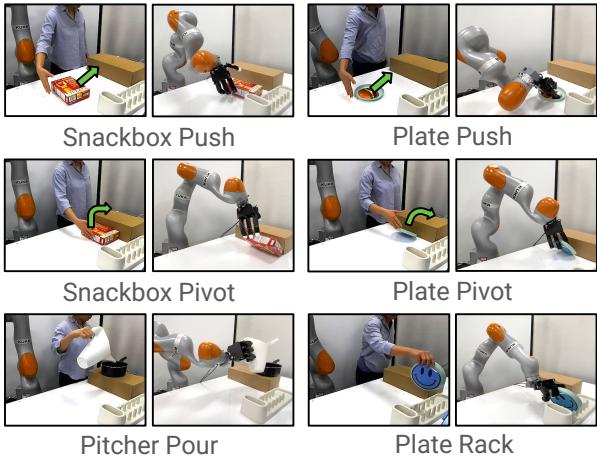
As seen in Figure 5, tasks included:
- Grasping: Pitcher Pour.
- Non-Prehensile: Pushing a snackbox or plate.
- Extrinsic Manipulation: Pivoting a box against a wall.
- Multi-Stage: Pivoting a plate, lifting it, and placing it in a rack.
Comparison with Baselines
The method was compared against three standard approaches:
- Replay: Open-loop playback of the retargeted human trajectory.
- Object-Aware (OA) Replay: Warping the trajectory to account for object position, but still just replaying the motion.
- Behavior Cloning (BC): A standard imitation learning technique trained on generated demonstrations.
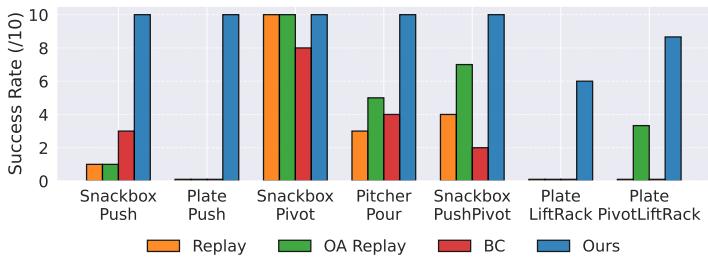
The results in Figure 6 are stark.
- Replay methods failed almost universally on complex tasks. The embodiment gap meant that blindly copying human angles resulted in dropped objects or missed grasps.
- Behavior Cloning struggled due to the noise in the generated dataset.
- HUMAN2SIM2ROBOT achieved significantly higher success rates, outperforming the next best baseline by over 55%.
Why Does It Work? (Ablation Studies)
The researchers performed several ablation studies to prove that their specific design choices were necessary.
1. The Power of Dense Rewards They compared their “Object Pose Trajectory” reward against simpler rewards, like just rewarding the robot for reaching the final goal (Fixed Target).
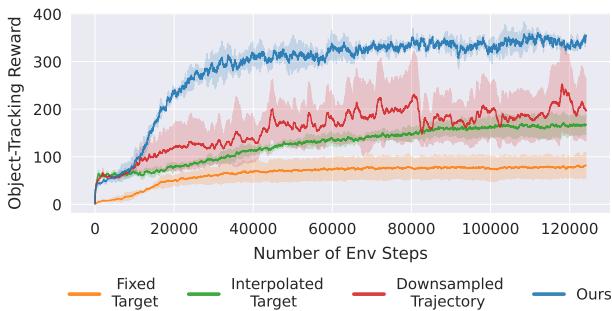
Figure 7 shows that tracking the full trajectory (Ours, blue line) is essential. Methods that only look at the final target (Orange) get stuck in local minima—for example, trying to grab a plate directly rather than sliding it to the edge of the table first. The trajectory forces the robot to learn the strategy (slide, then lift), not just the destination.
2. The Necessity of Good Initialization Is the pre-manipulation hand pose actually needed? Can’t RL just figure it out from scratch?
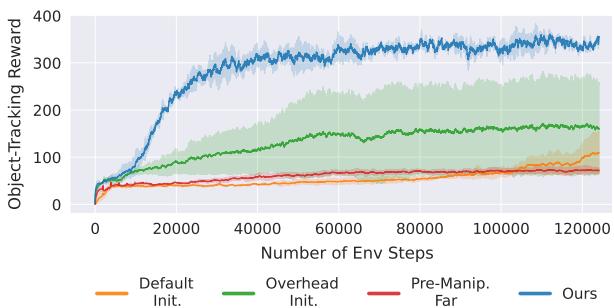
Figure 8 confirms that initialization is key. “Default Initialization” (starting with the hand far away) fails completely. Even “Overhead Initialization” (hovering above the object) performs poorly because it biases the robot toward a top-down grasp, which might be wrong for the specific task (like side-grasping a pitcher). The pre-manipulation pose provides the necessary inductive bias.
3. Ignoring the Hand Path Interestingly, the researchers tried adding a reward for tracking the human’s hand trajectory throughout the entire movement (not just the start).
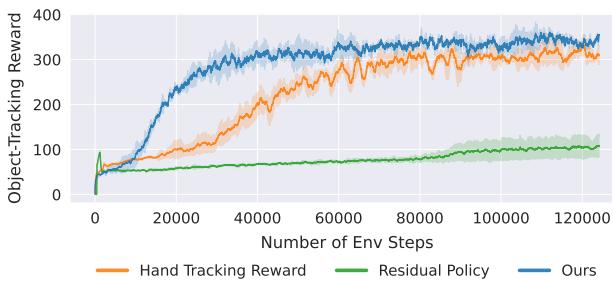
Figure 9 reveals that adding hand tracking (Orange) actually slows down learning compared to focusing solely on the object (Blue). Trying to force the robot to mimic the human hand during the complex manipulation phase constrains the RL agent, preventing it from finding the most stable grasp for its own embodiment.
Qualitative Analysis: Emergent Strategies
One of the most compelling aspects of HUMAN2SIM2ROBOT is observing the robot develop strategies that differ from the human demonstration.
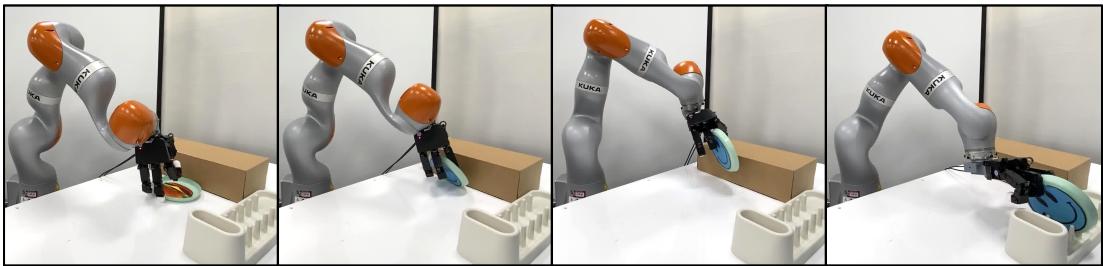
In the “Plate Pivot Lift Rack” task shown in Figure 13, the human uses a pinch grasp with fingers that the robot doesn’t have. The robot, starting from a similar position, learns through simulation that it needs to “clip” the plate between its middle and index fingers to lift it securely. This adaptation emerges naturally from the physics of the simulation—something strictly imitating the human would never achieve.
Deployment on Different Robots
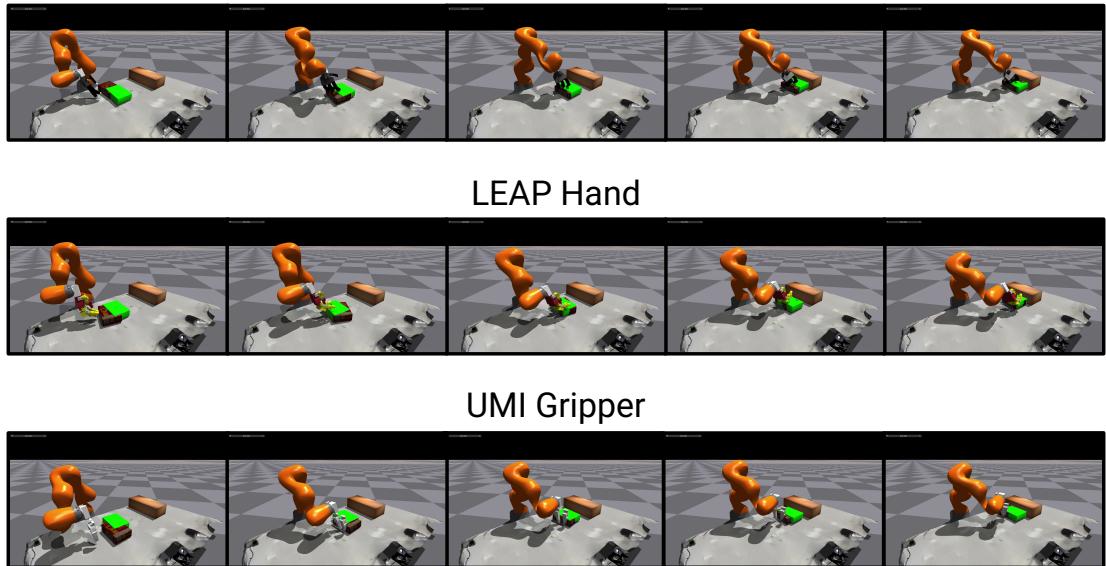
Because the reward is based on the object, not the robot, this framework is embodiment-agnostic. The researchers demonstrated preliminary success transferring the same method to entirely different hardware, such as the LEAP Hand and the UMI gripper.
Conclusion and Implications
HUMAN2SIM2ROBOT represents a significant step forward in robotic dexterity. By shifting the focus from imitating motions to imitating effects (object trajectories), it elegantly sidesteps the difficulties of the embodiment gap.
Key Takeaways:
- Efficiency: It requires only one video demonstration and about 10 minutes of setup, making it highly scalable.
- Robustness: By using RL in simulation, the robot learns to recover from errors and handle noise, leading to zero-shot real-world transfer.
- Flexibility: The use of pre-manipulation poses guides the robot just enough to start learning, but leaves enough freedom for the robot to adapt the grasp to its own physical constraints.
This work suggests that the future of robot teaching might not lie in perfect motion capture, but in clearer task specification. If we show the robot what to achieve and give it a rough idea of how to start, modern reinforcement learning is capable of figuring out the rest.