](https://deep-paper.org/en/paper/2504.12714/images/cover.png)
Imagine you are a chef who has perfected a specific soup recipe with your sous-chef. You know exactly when they will chop the onions, and they know exactly when you will stir the broth. You move like a well-oiled machine. Now, imagine you step into a stranger’s kitchen. The layout is different, the stove is in a weird spot, and your new partner chops vegetables at a completely different pace.
Suddenly, your “perfect” routine falls apart. You crash into each other. You both reach for the ladle at the same time. The soup burns.
This is the fundamental problem of Zero-Shot Coordination (ZSC) in Artificial Intelligence. Reinforcement Learning (RL) agents are often trained to be superhuman specialists, perfecting a task with a specific partner in a specific environment. But when they are paired with a new partner—whether it’s another AI or a human—they often fail spectacularly.
In a fascinating new paper, Cross-environment Cooperation Enables Zero-shot Multi-agent Coordination, researchers propose a counter-intuitive solution. Instead of training an agent with thousands of different partners to learn cooperation (the dominant approach today), they train a single agent across billions of different environments.
The results suggest a paradigm shift: to build agents that can get along with anyone, we shouldn’t focus on who they work with, but where they work.
The Problem: The Fragility of Self-Play
To understand why cooperation is so hard for AI, we first need to look at how they are usually trained. The standard method is Self-Play (SP). An agent plays a game against itself (or a copy of itself) millions of times. In zero-sum games like Chess or Go, this works beautifully. If you find a strategy that beats your clone, you are objectively getting stronger.
However, in cooperative games, Self-Play is a trap.
In a cooperative setting, agents need to agree on a shared strategy. If Agent A decides “I will always go left,” and Agent B (its clone) learns “I will always go right,” they succeed. They form a “handshake” or a convention. But this convention is often arbitrary. If Agent A is later paired with a stranger who goes left, they crash. The agent hasn’t learned how to coordinate; it has simply memorized a specific choreography.
The Dominant Solution: Population-Based Training
Until now, the leading solution to this fragility has been Population-Based Training (PBT). The logic is simple: if one partner makes you brittle, training with a whole “village” of diverse partners should make you robust.
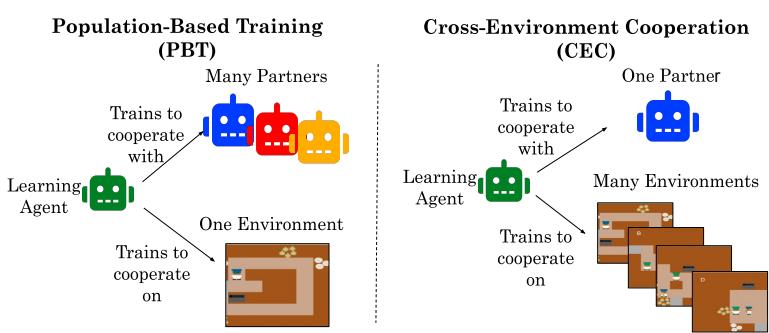
As shown on the left side of Figure 1, PBT involves training an agent against a population of diverse partners. The hope is that by seeing many different playstyles, the agent learns a general “best response” that works with anyone.
But there is a catch. PBT is computationally expensive (you have to train the whole population), and critically, it usually takes place in a single environment. The agent might learn to handle different partners, but only within the specific walls of the training room. As we will see, if you move the furniture even slightly, the PBT agent often falls apart.
The New Paradigm: Cross-Environment Cooperation
The authors introduce Cross-Environment Cooperation (CEC). Their hypothesis is elegant: if you force an agent to succeed in a constantly changing world, it cannot rely on brittle, map-specific conventions (like “always run to tile X”). Instead, it must learn general norms of cooperation—like “avoid collisions” or “pass the tool”—that apply universally.
By randomizing the environment, the researchers strip away the agent’s ability to “cheat” by memorizing a layout. The agent is forced to look at the game structure itself.
The Dual Destination Game
To test this hypothesis, the authors first designed a simple toy problem called the Dual Destination Game.
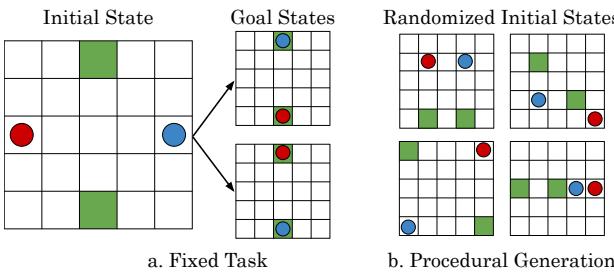
In this grid world (Figure 2), two agents (Red and Blue) spawn in random locations. There are green goals and pink goals. To get a reward, they must navigate to different green squares.
- Fixed Task (a): The goals are always in the same spot.
- Procedural Generation (b): The goals and start positions are randomized every episode.
The researchers compared the mathematical objectives of the two approaches. In Population-Based Training (PBT), the goal is to maximize the expected score across a distribution of partners (\(\pi_i\)) in a single environment (\(m\)):

In contrast, the CEC objective ignores partner diversity. It trains a single policy (\(\pi_C\)) against itself, but averages performance across a distribution of many different environments (\(m_i\)):

Toy Results
The results on this simple game were stark. The researchers trained agents using IPPO (a standard self-play algorithm) and FCP (a strong PBT method). They then tested how well these agents could coordinate with new partners they had never seen before.
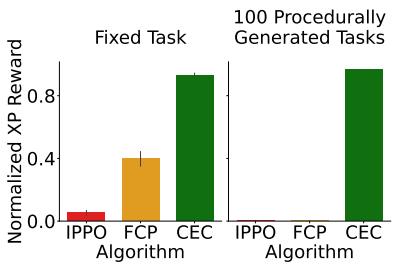
As Figure 3 shows, the standard Self-Play method (IPPO) failed almost completely (~0 score). The PBT method (FCP) did better on the fixed task but collapsed when the environment changed.
The CEC agent, however, dominated. It achieved nearly optimal performance with novel partners, both on fixed maps and randomized maps. By learning to survive in a changing world, it essentially learned a universal language of coordination for this game.
Scaling Up: Procedural Overcooked
To prove this works for complex tasks, the authors turned to Overcooked, the gold standard benchmark for AI cooperation. In Overcooked, agents must move through a kitchen, pick up onions, put them in pots, plate the soup, and serve it. It requires tight timing and pathfinding.
Standard research usually focuses on five specific, hand-designed layouts:

These layouts (Figure 4) are distinct and tricky. Coordination Ring requires agents to circle around without blocking each other. Asymmetric Advantages separates the agents, forcing them to pass ingredients across a counter.
To implement CEC, the authors built a procedural generator capable of creating \(1.16 \times 10^{17}\) unique, solvable kitchen layouts.

Using the JAX framework for high-performance computing, they could train agents on these billions of variations (Figure 5) at lightning speeds (10 million steps per minute).
Experiments and Key Findings
The evaluation was rigorous. The researchers compared their CEC agent against the best methods in the field:
- IPPO: Standard Self-Play.
- FCP: Fictitious Co-Play (Population-Based Training).
- E3T: Efficient End-to-End Training (The current State-of-the-Art for Zero-Shot Coordination).
They tested two scenarios:
- Generalizing to Partners: Can the agent play the original 5 maps with new partners?
- Generalizing to Environments: Can the agent play on entirely new procedurally generated maps with new partners?
Finding 1: Environment Diversity > Partner Diversity
The first major finding is that training on many environments makes you a better partner, even on known maps.
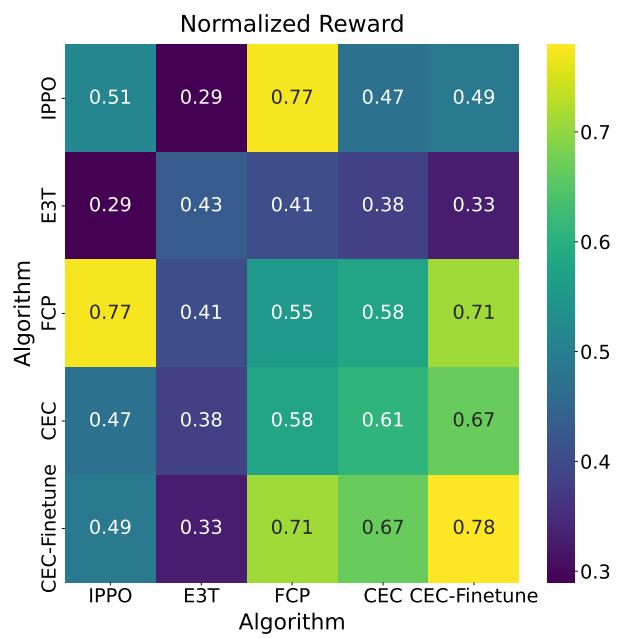
Figure 21 shows a “cross-play” matrix. The brighter the square, the better the two algorithms worked together. CEC (and its fine-tuned variant) shows strong performance across the board, capable of coordinating effectively with agents trained via completely different algorithms.
More impressively, when the researchers ran a Game Theoretic analysis (simulating an evolutionary process where better strategies propagate), the flow of the “meta-game” moved decidedly toward CEC.
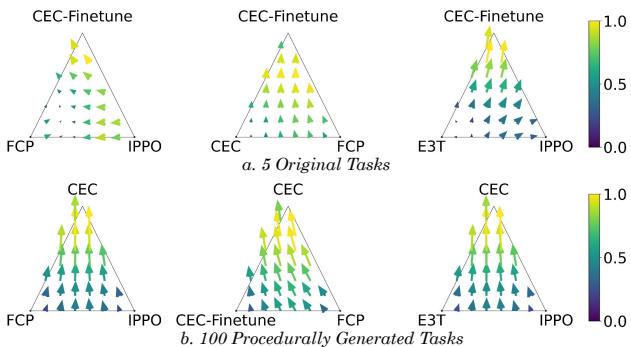
In Figure 8, the arrows represent the gradient of the population dynamics. In almost all cases, the arrows point toward CEC and CEC-Finetune, indicating they are the robust “equilibrium” strategies that defeat or outperform the others.
Finding 2: The Generalization Gap
The disparity becomes undeniable when agents are tested on the 100 held-out procedural maps—layouts that none of the agents (except the CEC agent) had ever seen.
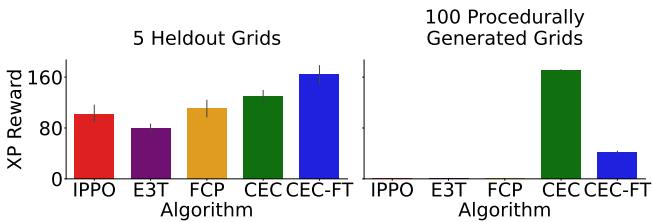
Figure 6 (Right) tells the whole story. The “Single-Task” methods (IPPO, FCP, E3T) score zero. They cannot function outside the specific kitchens they memorized. They learned a route, not a skill.
The CEC agent (Green bar), however, maintains high performance. It walks into a completely strange kitchen and immediately starts cooking.
Finding 3: Humans Prefer CEC
Perhaps the most important test for cooperative AI is whether it can work with us. The researchers recruited 80 human participants to play Overcooked with the different AI agents.
While the “State-of-the-Art” method (E3T) achieved slightly higher raw scores in terms of soups delivered on the specific known maps, the human experience told a different story.
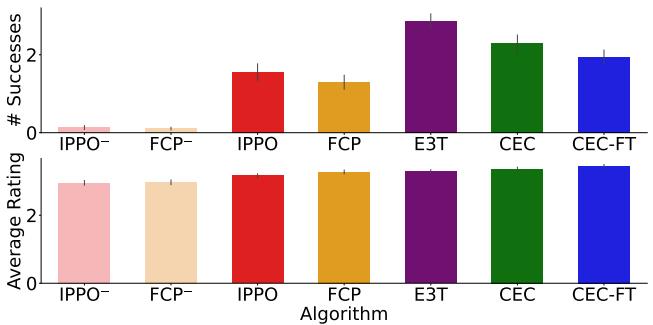
In Figure 9 (Bottom), humans rated CEC significantly higher on almost every subjective metric. They found CEC agents to be more adaptive, more consistent, and less frustrating.
Why did humans prefer CEC even if the score was slightly lower? The answer lies in collision avoidance.
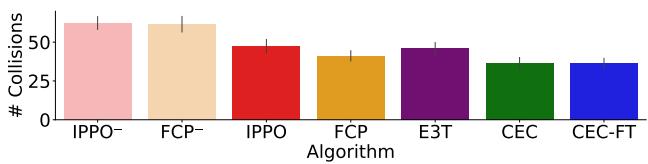
Figure 11 shows that CEC agents collided with their human partners far less often than other methods. Because CEC agents trained in shifting environments, they likely learned a general norm of “don’t block the path,” whereas standard agents essentially memorized an optimal “racing line” and refused to deviate from it, slamming into human players who got in their way.
Visualizing the Difference
We can visualize this behavioral difference by looking at “occupancy maps”—heatmaps of where the agents spent their time during the game.
Standard Self-Play (IPPO):
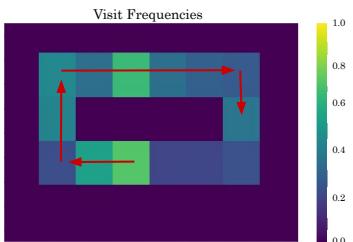
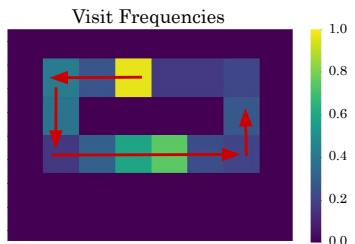
Figures 24 and 25 show two standard agents. They are extremely rigid. They stick to specific zones (dark patches) and rarely venture out. They have hyper-specialized roles. If a human disrupts this rigid role, the agent is lost.
Cross-Environment Cooperation (CEC):
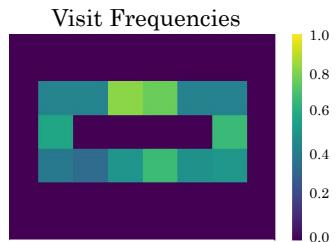
In contrast, Figure 26 shows the CEC agent. The heatmap is much more distributed. The agent is comfortable moving anywhere in the kitchen. It isn’t following a script; it is dynamically reacting to the task and the partner. This flexibility is what makes it a superior collaborator for humans.
Conclusion
This research highlights a crucial insight for the future of AI robotics and assistants. For years, the community assumed that the key to cooperation was social diversity—meeting many different people. While that is important, this paper suggests that environmental diversity might be even more powerful.
By forcing an agent to adapt to billions of unique situations, we prevent it from memorizing shortcut solutions. It strips away the ability to overfit. What remains is a distilled, general capability to coordinate: an understanding of personal space, shared goals, and adaptable roles.
As we move toward robots that operate in our messy, unpredictable homes, methods like CEC offer a promising path forward. We don’t need to train our robots in a simulation of our specific living room; we need to train them in a billion different living rooms, so they are ready for ours.