](https://deep-paper.org/en/paper/2504.13059/images/cover.png)
Introduction
In the world of robotics, we often marvel at videos of robots performing backflips or dancing. But ask a robot to coordinate two hands to place a pair of shoes neatly into a box, and you will likely see it struggle.
Dual-arm coordination is the next frontier in robotic manipulation. While single-arm tasks (like picking and placing an object) have seen massive success, bimanual (two-armed) manipulation introduces exponential complexity. The arms must avoid colliding with each other, coordinate handovers, and handle objects that are too large or awkward for a single gripper.
The biggest bottleneck to solving this isn’t just better mechanical hardware; it’s data. Training a robot usually requires thousands of expert demonstrations. Collecting this data in the real world via teleoperation (a human remotely controlling the robot) is slow, expensive, and tedious. Conversely, traditional simulations often fail to capture the diversity and “messiness” of the real world, leading to a “Sim-to-Real” gap where a robot works perfectly in code but fails in reality.
Enter RoboTwin.
In a new paper, researchers introduce a framework that leverages the power of modern Generative AI—specifically 3D foundation models and Large Language Models (LLMs)—to solve the data scarcity problem. By creating a “Generative Digital Twin,” they can synthesize diverse, realistic training data from a single 2D image.
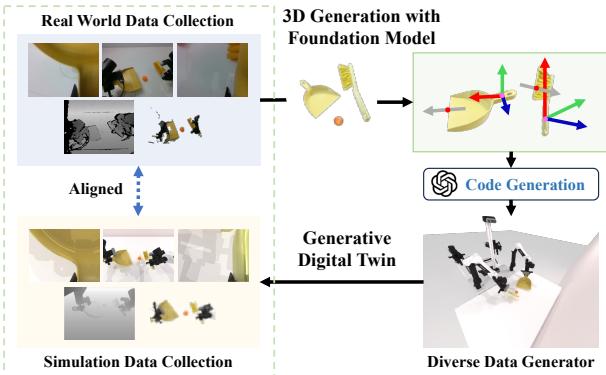
As shown in Figure 1, RoboTwin creates a bridge between the real and digital worlds, allowing robots to learn from thousands of simulated scenarios that are mathematically aligned with reality. In this post, we will break down how RoboTwin works, the clever way it generates expert data, and the impressive results it achieves in real-world benchmarks.
The Problem: The Data Bottleneck
To understand why RoboTwin is necessary, we first need to look at how robots are currently trained. The gold standard has been Imitation Learning, where a robot watches a human do a task and tries to copy the policy.
However, humans are expensive. Gathering enough data to cover every possible shape of a bottle or every possible starting position of a hammer is impractical. Researchers have tried to use algorithmic generators in simulations, but these are often rigid. They require hand-coding specific rules for every new task, which doesn’t scale well.
RoboTwin proposes a different approach: Automated Real-to-Sim Transfer. Instead of manually designing 3D assets and coding trajectories, why not let AI do it?
The RoboTwin Framework
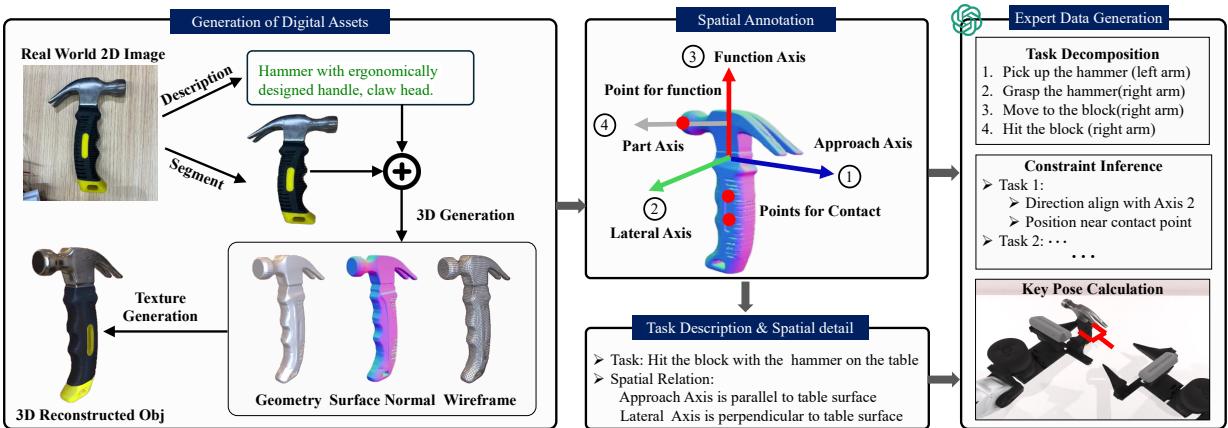
The RoboTwin pipeline is a masterclass in chaining together different AI technologies. It operates in three main stages: generating digital assets, annotating them spatially, and generating expert motion code.
1. Generating Diverse Digital Assets
The process begins with a single RGB image of an object from the real world (see Figure 2). The goal is to create a 3D simulation asset that looks and behaves like this real object.
- Description & Variation: The system uses GPT-4V (a vision-language model) to analyze the image and generate a text description. It then rewrites this description to create variations. For example, if the image is a Coke bottle, the system might generate descriptions for a Sprite bottle or a water bottle.
- 2D to 3D: These descriptions are fed into SDXL-Turbo (a diffusion model) to generate diverse 2D images. Finally, a 3D generative foundation model (specifically Rodin) turns these 2D images into high-fidelity 3D meshes with textures and surface normals.
- Physics: The system even estimates the physical material properties (like friction and mass) to ensure the object interacts realistically in the physics engine.
This means that from one photo of a hammer, the system can generate dozens of 3D hammers with different handle shapes, textures, and sizes.
2. The Spatial Annotation Framework
A 3D model is useless to a robot if it doesn’t know how to hold it. Does it grab the handle or the head? Which direction should the hammer face to hit a nail?
RoboTwin introduces a Spatial Annotation Framework. Instead of manually labeling every single generated object, the researchers use a feature-matching technique. They annotate one “anchor” object, and the system automatically transfers those annotations to all generated variants using feature extractors from Stable Diffusion.
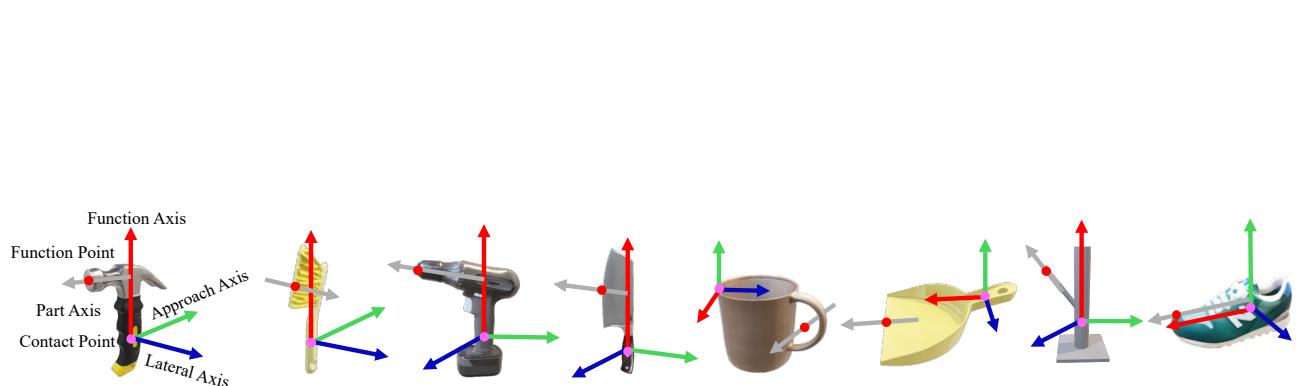
As visualized in Figure 3, the system identifies specific vectors and points:
- Point for Function: The part of the tool that does the work (e.g., the face of the hammer).
- Point for Contact: Where the robot should grab.
- Function Axis: The direction of the action (e.g., the swing direction).
- Approach Axis: The direction the gripper should approach from to avoid collisions.
This structured data turns a “dumb” 3D mesh into a semantically understood tool that an algorithm can reason about.
3. LLM-Driven Expert Data Generation
Now that we have the environment and the objects, we need the robot to actually do the task to generate training data. Traditionally, a human would joystick the robot in the simulator. RoboTwin automates this using Large Language Models (LLMs).
The researchers treat the task of moving the robot as a coding problem. They feed the LLM (like GPT-4) the task description (e.g., “pick up the hammer and hit the block”) and the spatial annotations derived in the previous step.
The LLM decomposes the task into sub-tasks (Grasp -> Approach -> Strike) and writes Python code to execute them. This isn’t just simple “move to X” code; it involves complex optimization.
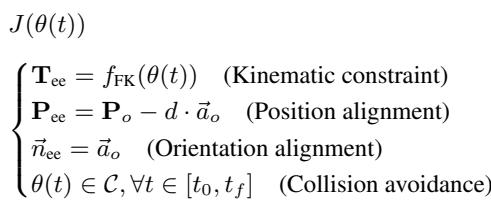
The generated code solves the optimization problem shown above. It minimizes a cost function \(J(\theta(t))\) subject to:
- Kinematics: The robot creates a valid chain of joint movements.
- Alignment: The end-effector aligns with the object’s annotated axes.
- Collision Avoidance: The trajectory \(\theta(t)\) must stay within the collision-free space \(\mathcal{C}\).
Because the LLM understands the “Approach Axis” and “Lateral Axis” from the annotation step, it can write code that effectively avoids collisions—a critical requirement for dual-arm setups where arms often cross paths.
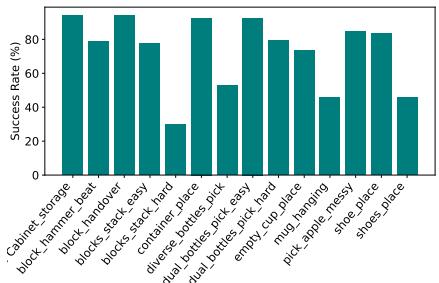
Figure 6 shows the success rate of this code generation. While not perfect, it is high enough to generate massive amounts of successful demonstration data. If the code fails, the error is fed back to the LLM, which “debugs” itself and tries again.
The Benchmark and Platform
To validate this framework, the authors built a standard benchmark using the Cobot Magic platform. This is a mobile robot equipped with dual arms and multiple RGB-D cameras.
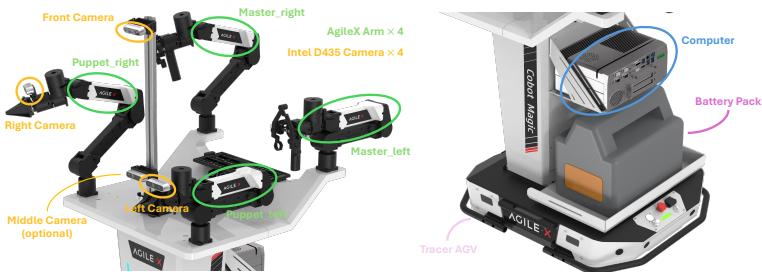
The benchmark includes 15 diverse tasks designed to test coordination. These aren’t just simple pick-and-place jobs; they include:
- Handover: Passing an object from the left hand to the right.
- Dual Shoes Place: Placing a pair of shoes into a box (requires tight packing).
- Mug Hanging: Carefully sliding a mug handle onto a rack.
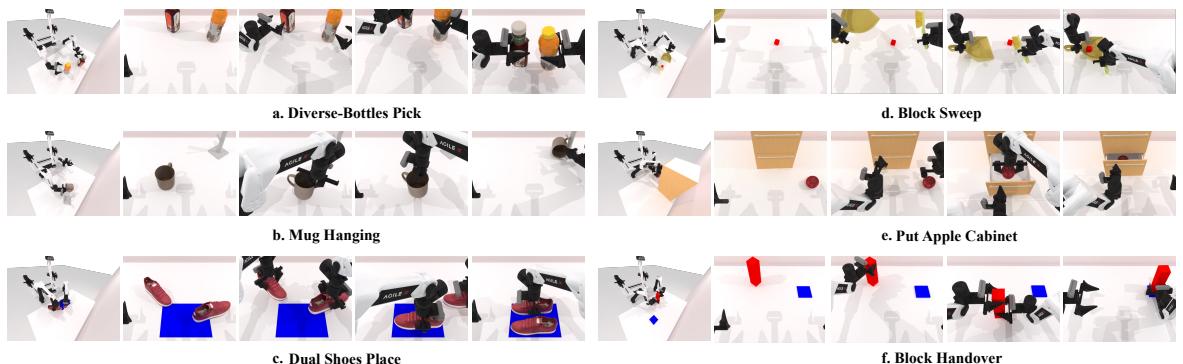
Figure 7 illustrates the complexity. Notice tasks like “Block Sweep,” where the robot must use a tool to manipulate other objects, or “Dual Bottles Pick,” which requires simultaneous coordinated movement.
Experiments & Results
The core hypothesis of the paper is that policies pre-trained on RoboTwin’s synthetic data and fine-tuned with a small amount of real-world data will outperform policies trained only on real-world data.
The researchers compared two state-of-the-art imitation learning algorithms:
- DP (Diffusion Policy): Takes 2D images as input.
- DP3 (3D Diffusion Policy): Takes 3D point clouds as input.
Simulation Results
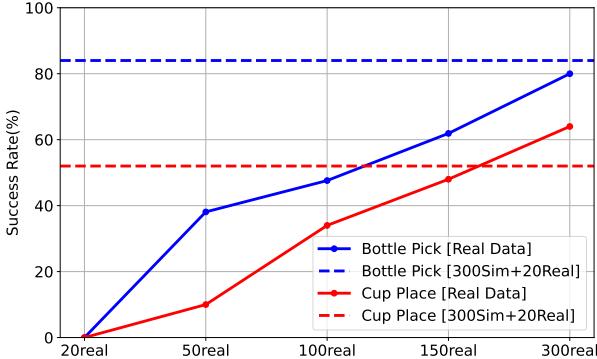
Table 1 displays the success rates in simulation. A key takeaway here is the scalability of the algorithms. While DP3 is excellent at few-shot learning (learning from just 20 demos), the standard DP algorithm scales better when given the massive amounts of data that RoboTwin can generate.
Real-World Validation (Sim-to-Real)
The true test is the real world. The researchers set up a “Real-to-Sim” pipeline where they:
- Pre-trained a policy on 300 RoboTwin-generated simulation episodes.
- Fine-tuned it with only 20 real-world teleoperated episodes.
- Compared it against a baseline trained only on the 20 real-world episodes.
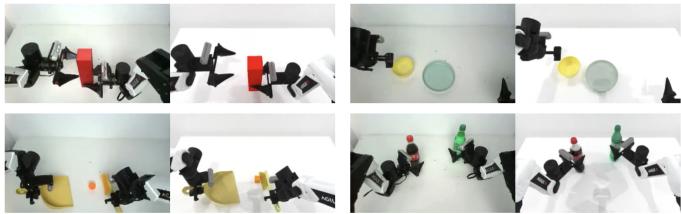
The visual fidelity between the real and simulated scenes is striking (see Figure 8). This close alignment allows the robot to transfer its learned skills effectively.
The Findings
The results were significant. As shown in the graph within the image deck (Figure 7 in the deck, referenced as scaling comparison), adding simulation data dramatically boosts performance.
Note: The image above contains both Table 1 and the scaling chart.
Specific real-world success rates were detailed in Tables 2 and 3:
- Single-Arm Tasks: The success rate jumped from 1.2% (using only 20 real samples) to 72% (using Sim + Real). This is a massive improvement, showing that the robot learned the fundamental mechanics in the simulator.
- Dual-Arm Tasks: The success rate improved from 20% to 62%. While dual-arm coordination remains difficult, the pre-training provided a 40% boost in reliability.
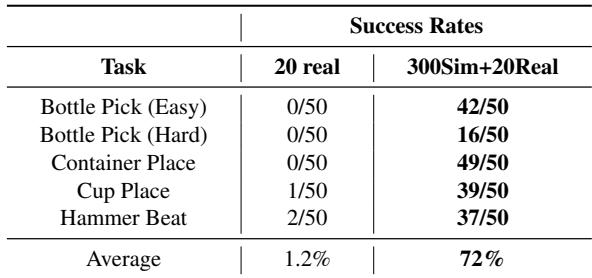
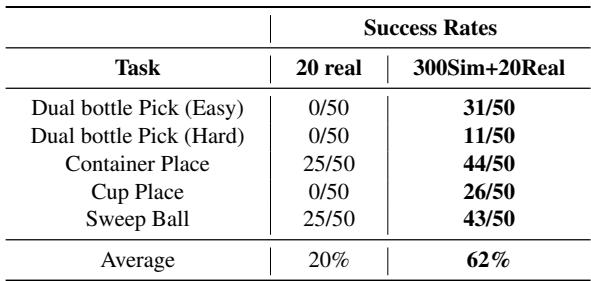
The data clearly shows that for complex tasks like “Container Place” or “Bottle Pick,” the synthetic data acts as effective “training wheels,” giving the robot a strong prior understanding of the task before it ever sees the real world.
Conclusion
RoboTwin represents a significant step forward in robotic learning. It addresses the “data hunger” of modern AI by synthesizing its own sustenance.
By combining the creativity of Generative AI (to make diverse assets) with the reasoning of LLMs (to create expert motions), RoboTwin creates a training ground that is both scalable and realistic. The results demonstrate that we don’t always need thousands of hours of human labor to train a robot; sometimes, we just need a digital twin and a little bit of imagination.
While challenges remain—particularly in highly complex dual-arm coordination where success rates are still under 70%—frameworks like RoboTwin are paving the way for general-purpose robots that can adapt to our messy, diverse world with minimal human instruction.