](https://deep-paper.org/en/paper/2504.13149/images/cover.png)
Imagine you are hiking through a dense, unfamiliar forest. Your goal is a campsite several kilometers away. You don’t have a detailed topographic map of every tree and rock between you and the destination. Instead, you look into the distance. You see a break in the tree line to your left, a steep cliff to your right, and a dense thicket straight ahead. Even though the campsite is technically straight ahead, you instinctively head toward the clearing on the left.
You are using long-range visual affordances—visual cues that tell you where travel is possible—to make a strategic decision.
Most autonomous robots, however, hike like they are staring at their boots. They build highly detailed “local metric maps” (usually a grid of safe vs. obstacle cells) covering a small radius (e.g., 20 to 50 meters). Beyond that radius lies a “fog of war”—unknown space. When a robot needs to go to a goal 1km away, standard algorithms often just assume the unknown space is empty and plan a straight line. This leads to myopic behavior: the robot marches straight into a cul-de-sac or a dense forest, only realizing it’s a dead end when it gets close enough to map it.
In the paper “Long Range Navigator (LRN): Extending robot planning horizons beyond metric maps,” researchers from the University of Washington, Google DeepMind, and Overland AI propose a solution. They introduce a system that allows robots to use visual intuition to “see” beyond their local map, identifying promising directions effectively extending their planning horizon without the computational cost of building a massive map.
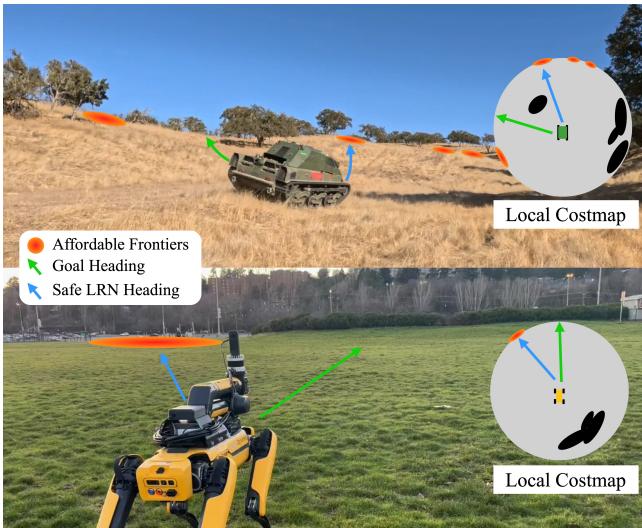
The Problem: The Fog of Unknown
The central limitation in off-road navigation is the trade-off between map resolution and range. Creating a high-fidelity metric costmap requires depth data (LiDAR or stereo cameras), which degrades rapidly with distance.
Standard navigation stacks typically operate as follows:
- Perceive: Sensors build a local costmap (e.g., 16m x 16m).
- Plan: An algorithm like A* finds a path to the edge of this map.
- Heuristic: For the space beyond the map, the robot assigns a fixed cost. Usually, this results in the robot trying to move in a straight line toward the GPS goal.
This approach fails in “bug trap” scenarios. If a long wall or a dense forest blocks the direct path, the robot will drive right up to it, then spend valuable time backtracking or getting stuck.
The researchers’ key insight is that we don’t need a full map of the distant world. To navigate effectively, the robot only needs to identify affordable frontiers. A frontier is the boundary between known and unknown space. An affordable frontier is a direction that looks navigable and promises a path toward the goal.
The Solution: Long Range Navigator (LRN)
LRN acts as a high-level guide for the robot’s local planner. Instead of replacing the local navigation stack (which handles immediate obstacle avoidance), LRN analyzes camera images to suggest a heading that is both traversable and aligned with the goal.
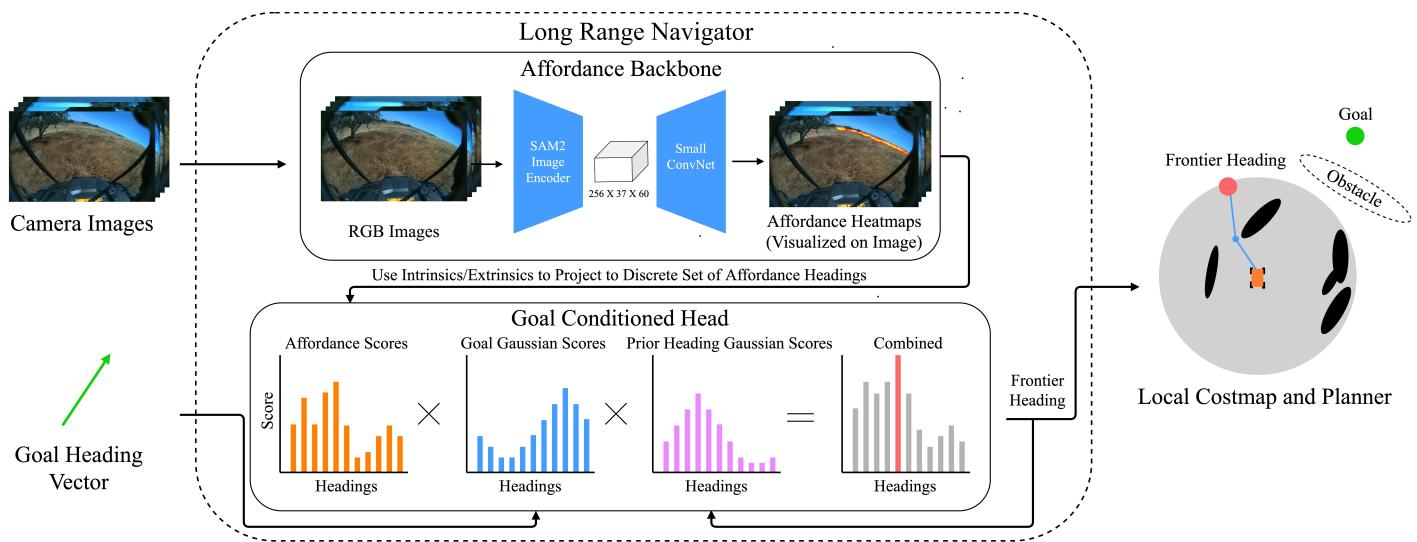
The system is designed with a bi-level architecture:
- Affordance Backbone: A vision model that predicts “heatmaps” of traversable areas from RGB images.
- Goal Conditioned Head: A selection mechanism that combines visual affordance with the desire to reach the specific GPS goal.
1. The Affordance Backbone
The core of LRN is its ability to look at a 2D image and predict which parts of the scene are navigable. The researchers use SAM2 (Segment Anything Model 2) as an image encoder. SAM2 is a “foundation model,” meaning it has been trained on massive amounts of data to understand visual features.
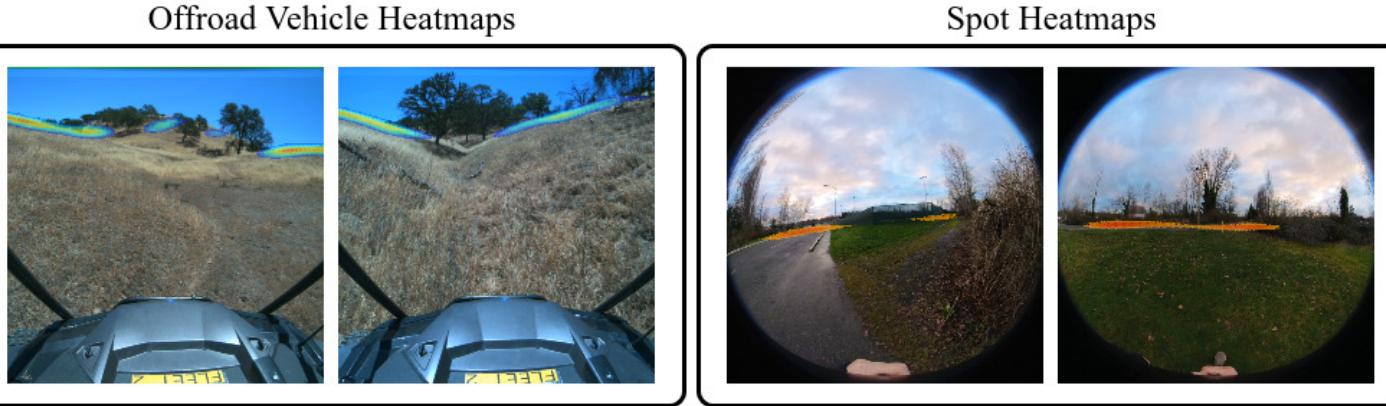
This encoder feeds into a small convolutional network that outputs an Affordance Heatmap. In this heatmap, “hot” (yellow/red) areas represent open paths or clear terrain, while “cold” (blue) areas represent obstacles like trees or walls.
The Challenge of Training: How do you teach a neural network what “traversable” looks like? Manually labeling thousands of images is tedious and unscalable.
The authors devised a clever self-supervised method using unlabeled egocentric videos. They collected videos of humans walking through various environments. The logic is simple: If a human walked there, it is traversable.
To generate labels automatically, they used a video point tracker called CoTracker.
- They take a video clip.
- They track points from the start of the clip to the end.
- The area where the camera eventually traveled is marked as a “hotspot” (score of 1).
- The path leading there is also traversable.
- Everything else is treated as unknown or non-traversable for the loss function.
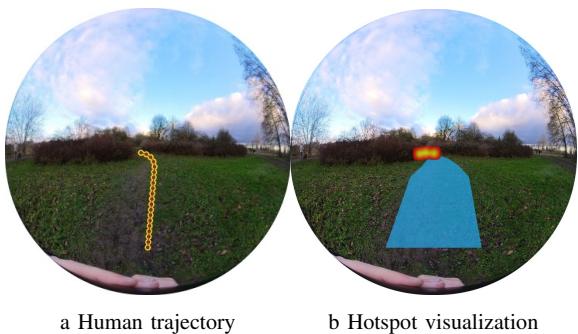
This allows the system to learn from massive amounts of video data without a human ever drawing a bounding box.
2. The Goal Conditioned Head
A heatmap tells the robot where it can go, but not where it should go. The robot still needs to reach a specific GPS coordinate.
The LRN formulation defines the value of a frontier \(f\) given a starting point \(s\) and a goal \(g\) as:
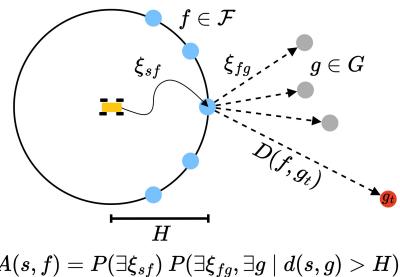
Here, \(A(s,f)\) is the affordability score (from the vision model), and \(D(f,g_t)\) is the estimated cost to reach the goal from that frontier.
To implement this, the system performs the following steps:
- Projection: The 2D heatmap is projected into a 1D array of angular “bins” (e.g., a histogram of directions around the robot).
- Goal Weighting: This array is multiplied by a Gaussian distribution centered on the goal direction. This penalizes affordable paths that go in the completely wrong direction (like walking back to the start).
- Consistency: To prevent the robot from jittering back and forth between two options, it also multiplies by a Gaussian centered on the previous chosen heading. This acts as a stabilizer.
The mathematical combination of these factors is elegant in its simplicity:
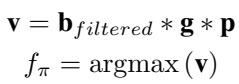
The robot selects the heading with the maximum value in vector \(\mathbf{v}\) and passes this to the local planner as a temporary waypoint.
Experimental Setup
The researchers tested LRN on two distinct robotic platforms in challenging outdoor environments:
- Boston Dynamics Spot: A nimble quadruped robot.
- Racer Heavy: A 12-ton tracked vehicle.
They compared LRN against several baselines:
- Goal Heuristic: The standard approach—plan straight toward the goal outside the local map.
- NoMaD: A state-of-the-art visual navigation policy.
- Traversability + Depth: A baseline that combines a standard traversability classifier with a monocular depth estimator (Depth Anything V2).
The tests were conducted on three courses with specific traps, such as large walls of bushes or buildings that block the direct line of sight to the goal.
Results: Seeing the Path Less Traveled
The results demonstrated that LRN significantly outperforms standard heuristics by making “less myopic” decisions.
Qualitative Performance
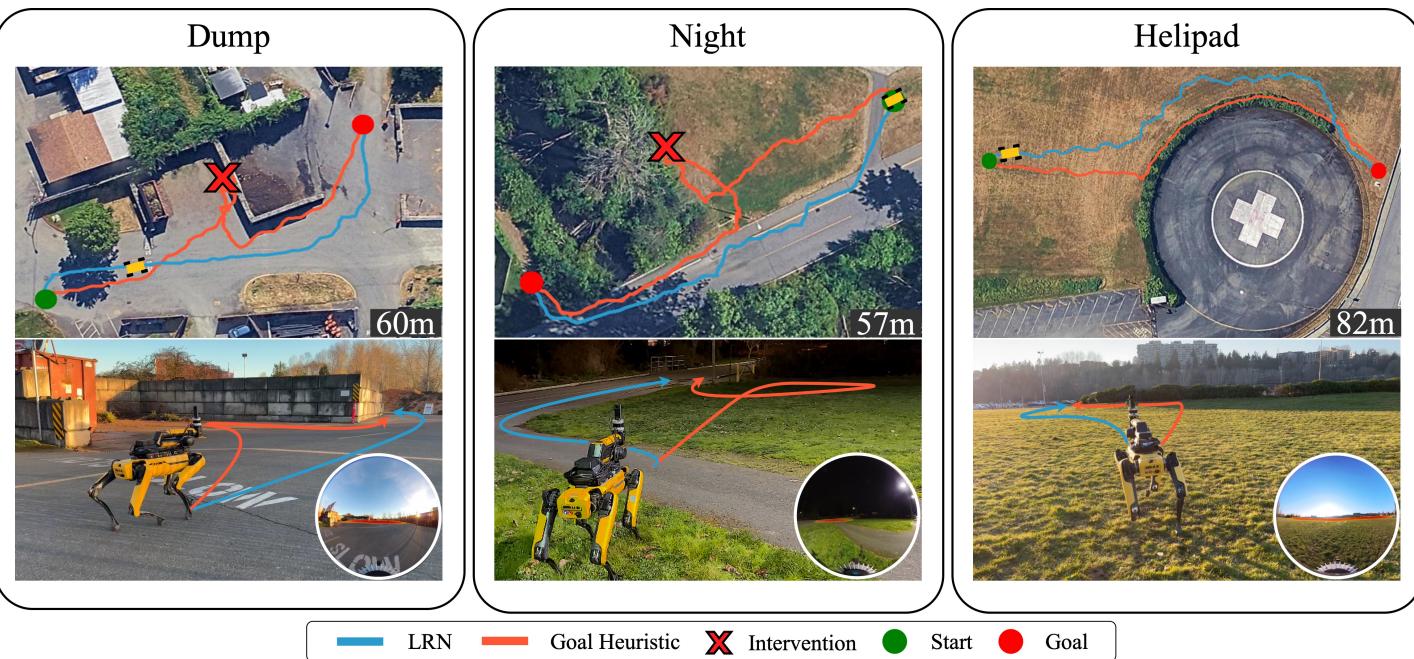
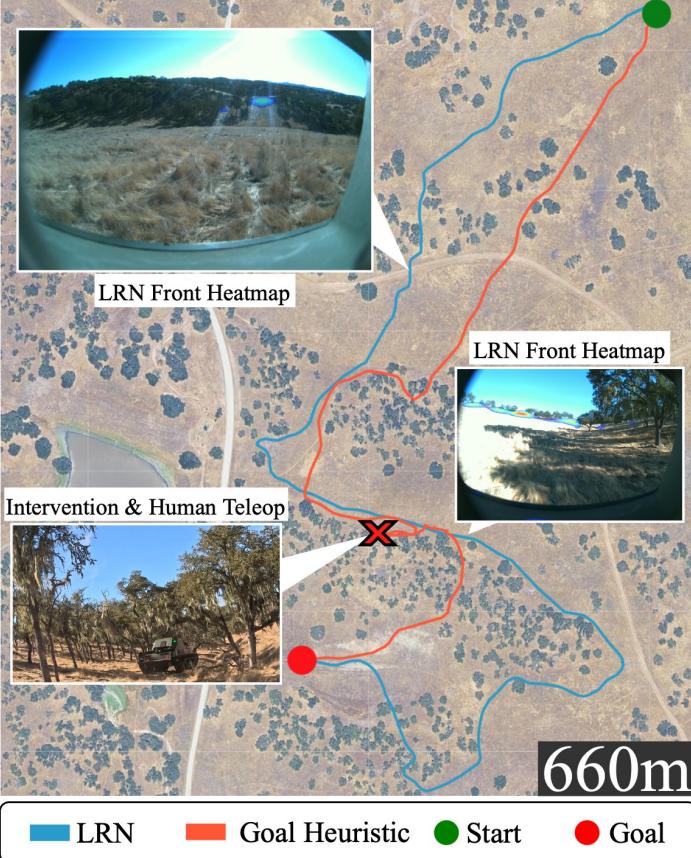
The GPS plots below tell the story clearly. Look at the “Dump” and “Helipad” scenarios. The red line (Goal Heuristic) tries to go straight, hits an obstacle (marked with an X for intervention), and gets stuck. The blue line (LRN) curves early. On the “Dump” course, LRN realizes the direct path is blocked by a wall and routes around it before the local planner even sees the wall.
The heatmaps generated by the robot in real-time show it successfully identifying gaps in trees and open sidewalks.
Quantitative Metrics
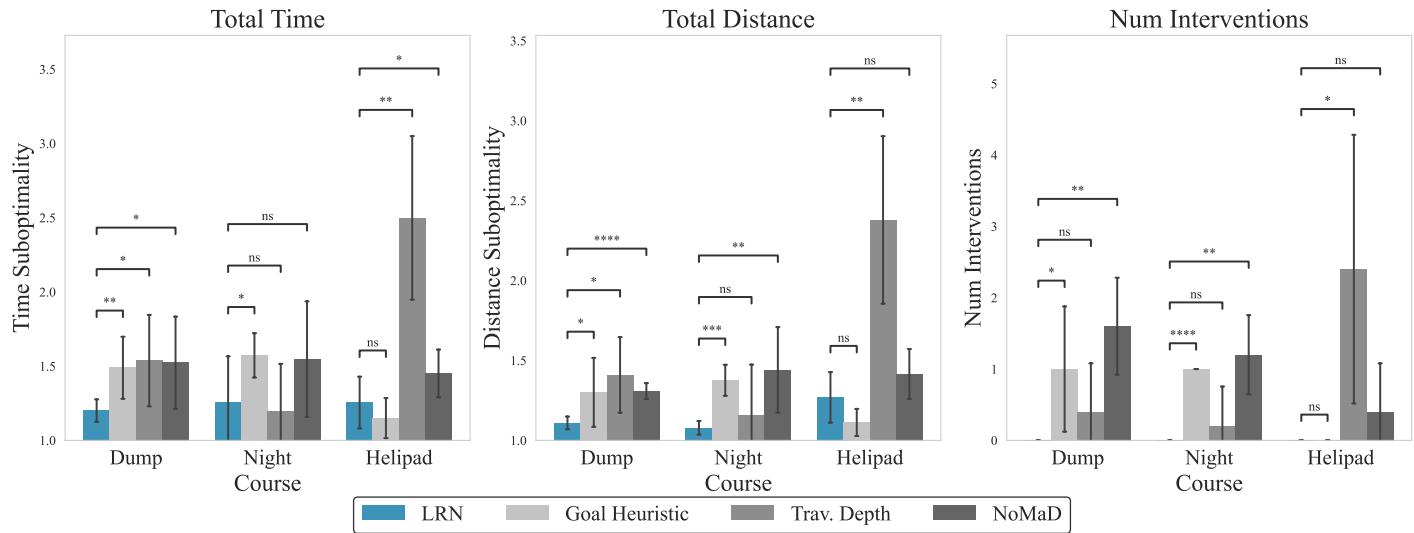
In the Spot experiments, LRN achieved the lowest “Total Distance Suboptimality” (meaning it took the most efficient paths relative to a human expert) and, crucially, required zero human interventions across all trials. The Goal Heuristic and other baselines frequently required the operator to take over when the robot got stuck.
The Racer Heavy Demo
The experiment on the 12-ton Racer Heavy was particularly impressive. Over a 660-meter course, the standard navigation stack drove straight into a dense tree line and got stuck. LRN, operating on the same platform, identified the dense forest as “low affordance” from a distance and navigated a path around the hills, completing the run autonomously.
Why “Better” Affordances Matter
An interesting question the researchers asked was: Does the quality of the heatmap actually change the navigation outcome?
They tested this by varying the “heatmap threshold”—essentially making the robot more or less picky about what it considers “affordable.”
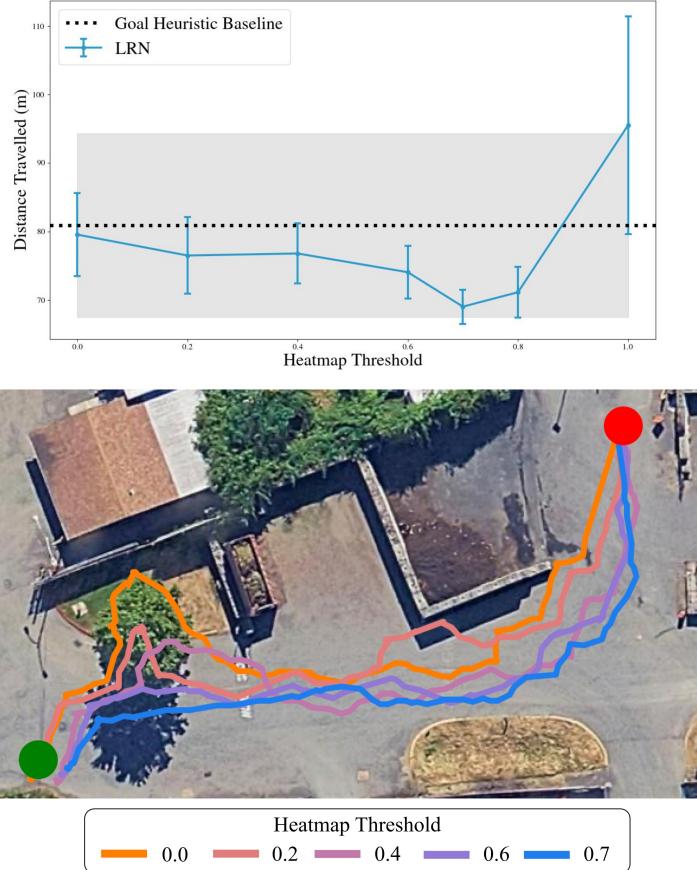
The data showed a “Goldilocks” zone. If the threshold is too low (everything is affordable), the robot acts like the baseline and runs into walls. If it’s too high (nothing is affordable), the robot freezes or wanders. An optimal threshold allows the robot to filter out difficult terrain while still finding valid paths, proving that the quality of the intermediate visual representation directly impacts physical navigation performance.
Conclusion and Future Implications
The Long Range Navigator paper presents a compelling argument: robots don’t need to map the entire world to navigate it. By learning an intermediate representation—affordance—from simple video data, robots can approximate long-range planning intuition.
Key Takeaways:
- Vision extends range: Cameras can see further than LiDAR-based maps. Using them for “frontier selection” rather than explicit mapping is computationally efficient.
- Self-supervision works: We can train navigation systems using unlabeled videos of humans walking, which solves the data bottleneck.
- Simplicity scales: LRN is a modular addition. It sits on top of existing navigation stacks, making it applicable to everything from small quadrupeds to massive off-road vehicles.
The “fog of war” in robot navigation is clearing, not because robots are building bigger maps, but because they are learning to look up and see the path ahead.