](https://deep-paper.org/en/paper/2504.19258/images/cover.png)
Introduction
Imagine you are driving an autonomous vehicle through a dense urban center—perhaps downtown Manhattan or a narrow European street. Suddenly, the skyscrapers block your GPS signal. The blue dot on your navigation screen freezes or drifts aimlessly. For a human driver, this is an annoyance; for a self-driving car, it is a critical failure.
To navigate safely without GNSS (Global Navigation Satellite Systems), a robot must answer the question: “Where am I?” based solely on what it sees. This is known as Place Recognition. Typically, this involves matching the car’s current sensor view (like a LiDAR scan) against a pre-built database.
Historically, this database has been a massive, storage-hungry 3D point cloud map. Storing a dense 3D map of an entire city requires gigabytes, if not terabytes, of data. It’s expensive to collect, hard to update, and difficult to scale.
But what if we could use a map that already exists, is lightweight, and is constantly updated by millions of volunteers? What if we could localize a high-tech LiDAR sensor against OpenStreetMap (OSM)?
That is the premise of a fascinating new paper titled OPAL. The researchers propose a framework that allows a vehicle to figure out its location by matching a sparse, 3D LiDAR scan against 2D OpenStreetMap data. It sounds deceptively simple, but matching 3D dots to 2D polygons is a massive “cross-modal” challenge.
In this post, we will break down how OPAL bridges this gap using two clever innovations: Visibility Masks and Adaptive Radial Fusion.
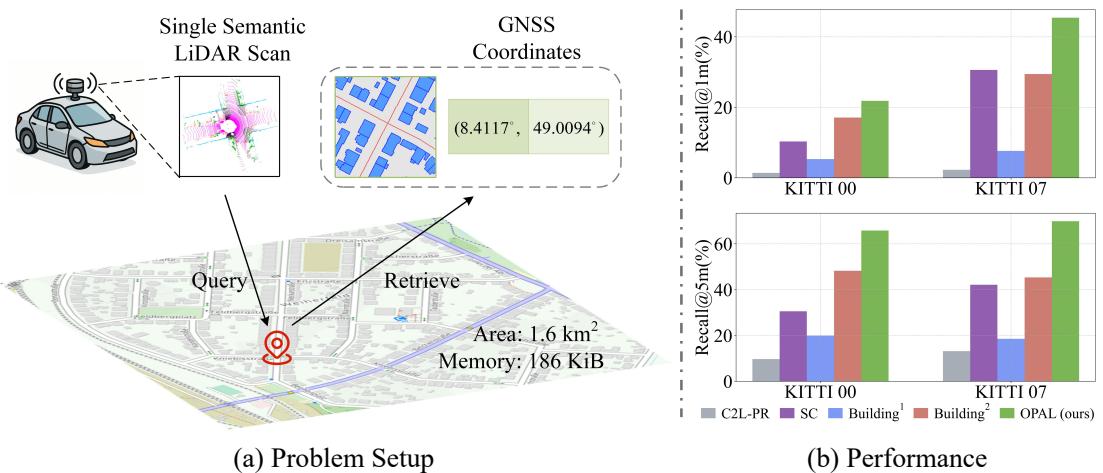
As shown in Figure 1 above, the efficiency gains are staggering. An OSM map consumes only 186 KiB, whereas a raw point cloud map of the same area could take nearly 10 GB.
The Challenge: Bridging the Modality Gap
To understand why this research is significant, we have to appreciate the difficulty of the problem. You are trying to match two completely different types of data:
- LiDAR Point Clouds: These are “ego-centric” (centered on the car). They provide precise depth but are sparse. Crucially, LiDAR suffers from occlusion—the sensor cannot see through a building to know what is behind it.
- OpenStreetMap (OSM): This is “allo-centric” (top-down view). It provides semantic information (this is a building, this is a road) and geometry. However, it has no occlusion; the map shows the front, back, and inside of a block layout regardless of where you are standing.
Previous attempts to solve this, such as “Point-to-Map” matching, often failed because they tried to compare the partial view of the LiDAR directly to the complete view of the map. They also struggled with rotation—if the car turns 90 degrees, the LiDAR scan changes completely, but the North-aligned map stays the same.
OPAL (which stands for OpenStreetMap Place recognition with Adaptive Learning) addresses these issues directly.
The OPAL Framework
The authors designed a pipeline that processes both the LiDAR scan and the OSM map to bring them into a shared feature space where they can be compared.
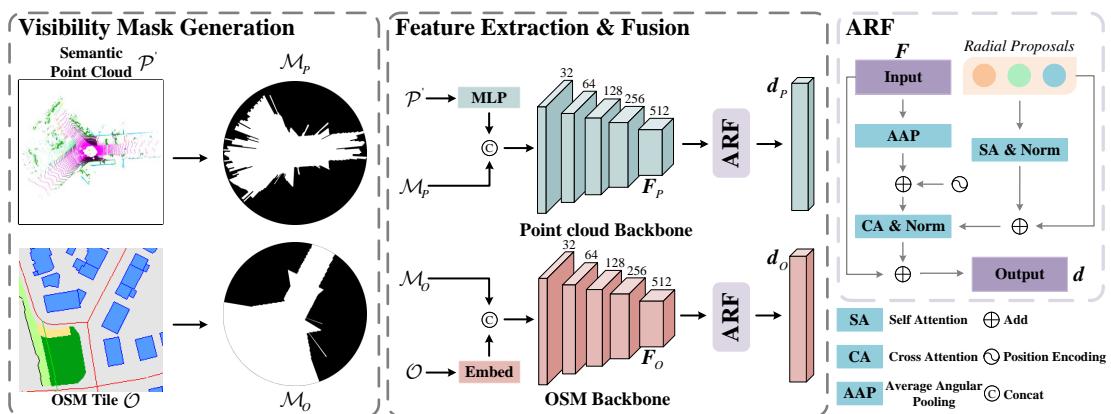
As illustrated in the overview above, the process consists of three main stages:
- Visibility Mask Generation: Simulating what the OSM map “looks like” from the car’s perspective.
- Feature Extraction: Using a Siamese Neural Network to extract features from both inputs.
- Adaptive Radial Fusion (ARF): A specialized mechanism to combine these features into a single “fingerprint” (descriptor) that is robust to the car’s orientation.
Let’s dive deep into each component.
1. The Visibility Mask: Solving the “X-Ray Vision” Problem
The biggest discrepancy between a map and a sensor is that the map has “X-ray vision”—it knows where every wall of a building is. The LiDAR only sees the wall facing the car. If you feed the full map to a neural network, it gets confused because it’s looking for back walls that the LiDAR can’t see.
OPAL solves this by computing a Visibility Mask.
Processing the LiDAR
First, the LiDAR point cloud is projected into a Polar Bird’s-Eye-View (BEV). Instead of using X and Y coordinates (Cartesian), the system uses Radius (\(r\)) and Angle (\(\phi\)). This creates a grid of rings and sectors.

The system performs Ray Casting. For every angular sector, it determines the maximum distance the LiDAR beam traveled. Any grid cell closer than that distance is “visible” (empty space). Any cell beyond the hit point is “occluded.”

This creates a binary mask \(\mathcal{M}_{P}\) where 1 means visible and 0 means occluded.
Processing the OSM
The OSM data is rasterized into a grid containing buildings, roads, and vegetation. To make the OSM tile comparable to the LiDAR, the system transforms the 2D map into the same Polar coordinate system:

Here is the clever part: Since OSM doesn’t have “depth” measurements, OPAL uses semantic cues. It assumes that “buildings” are tall structures that block vision. It runs a ray-casting algorithm on the map data. If a ray hits a pixel labeled “building,” every pixel behind it in that sector is marked as occluded.

Why this matters: By applying this mask to the OSM data, the system artificially introduces occlusions. It forces the map to look like a LiDAR scan, effectively removing the “X-ray vision” advantage and aligning the two data modalities.
2. Feature Extraction with PolarNet
With the visibility masks ready, the system now has four inputs:
- The LiDAR features (geometry + semantic labels).
- The LiDAR visibility mask.
- The OSM features (rasterized shapes).
- The OSM visibility mask.
These are fed into a Siamese Network—a neural network architecture with two identical branches (or slightly different weights, in this case) that process two different inputs. The authors use a backbone known as PolarNet.
PolarNet is designed specifically for LiDAR. It processes the grid cells in the polar coordinate system we established earlier. The output of this stage is a set of “local feature maps”—dense representations of what the environment looks like in every direction and at every distance.
3. Adaptive Radial Fusion (ARF)
This is the most technically sophisticated part of the paper. We now have feature maps, but we need to compress them into a single 1D vector (a global descriptor) to search our database efficiently.
Standard methods like Global Average Pooling are too simple—they blur out distinct details. Other methods aren’t robust to rotation; if the car turns slightly, the descriptor changes completely, causing the match to fail.
OPAL introduces the Adaptive Radial Fusion (ARF) module.
Step A: Average Angular Pooling (AAP)
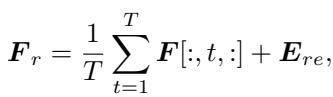
First, the system compresses the features along the ring dimension, preserving the “ring” structure while averaging across angles. It also adds a positional encoding (\(E_{re}\)) so the network knows which features are “near” and which are “far.”
Step B: The Attention Mechanism
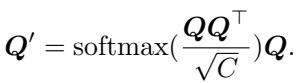
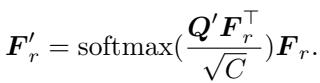
The authors use a Transformer-inspired approach. They introduce Learned Radial Proposals (\(Q\)). Think of these as trainable “questions” the network asks about the scene, such as “Is there a building corner nearby?” or “Is there an intersection far away?”
These proposals first talk to each other via Self-Attention to understand the global context:
Then, they look at the actual extracted radial features (\(F_r\)) using Cross-Attention. This allows the network to dynamically weight different parts of the scan. For example, it might learn to pay lots of attention to the geometry of nearby buildings (which are distinct) while ignoring distant, noisy bushes.
Step C: The Global Descriptor
Finally, the refined features are flattened and passed through a fully connected layer to create the final descriptor vector \(\pmb{d}\).

Because the Attention mechanism allows the proposals to “scan” the radial features flexibly, the resulting descriptor is highly distinct yet robust to small changes in viewpoint or rotation.
Experimental Results
The researchers evaluated OPAL on the famous KITTI and KITTI-360 datasets. These datasets provide real-world LiDAR scans and ground truth GPS locations, which can be cross-referenced with OpenStreetMap.
Quantitative Performance
The primary metric used is Recall@K, which asks: “If I look for the top 1 match in the database, is it within K meters of the true location?”
The results, presented in Table 1, show that OPAL dominates the baselines.
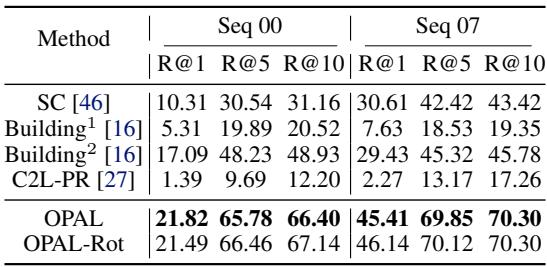
Looking at Recall@1m (finding the location within 1 meter precision):
- C2L-PR (a competing cross-modal method) achieves only 1.39%.
- Building (a method relying only on building geometry) achieves 17.09%.
- OPAL achieves 21.82%.
When we relax the threshold to 5 meters (R@5), OPAL reaches nearly 66% on Sequence 00 and roughly 70% on Sequence 07, massively outperforming the other approaches.
Qualitative Performance
Numbers are great, but visuals tell the story. Let’s look at the top-1 retrieved matches.
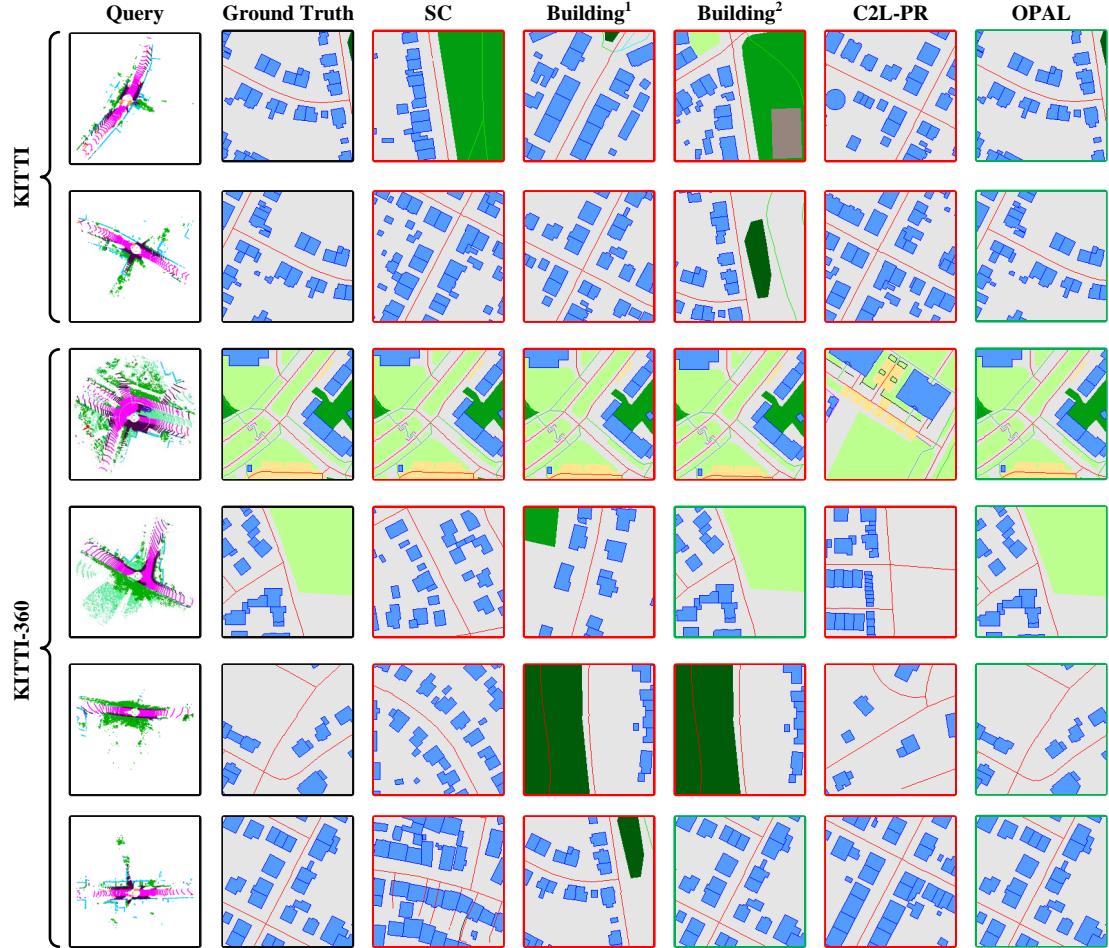
In Figure 9, the Query column shows the semantic LiDAR scan. The Ground Truth shows the correct OSM tile.
- Note how SC (Scan Context) and C2L-PR often retrieve tiles that look vaguely similar in terms of pixel distribution but are geometrically wrong (marked with red boxes).
- OPAL (last column) consistently retrieves the correct tile (green box), matching the complex intersections and building layouts accurately.
Generalization and Robustness
One of the hardest tests for AI is “Zero-Shot” generalization—training on one city and testing on another without retraining. The authors trained OPAL on KITTI and tested it on KITTI-360 (which contains different suburban environments).
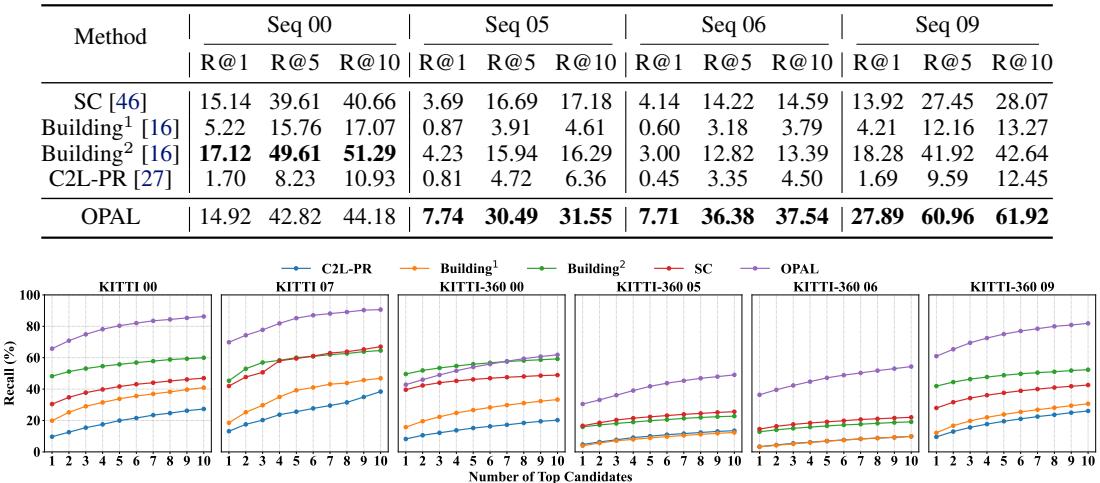
The recall curves in Figure 5 show that OPAL (purple line) consistently stays above the baselines across different datasets. This proves that the network isn’t just memorizing one city; it has learned the fundamental geometric relationship between LiDAR scans and map tiles.
Speed: Real-Time Capability
For a self-driving car, accuracy means nothing if the calculation takes 5 seconds. The car would have moved on by then.
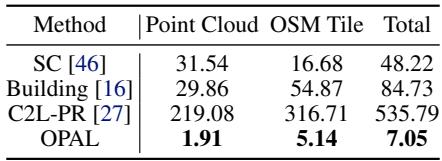
OPAL is incredibly fast. Processing the point cloud takes roughly 1.91 ms, and the OSM tile takes 5.14 ms. The total time is 7.05 ms, which translates to over 140 frames per second (FPS). This is magnitudes faster than the “C2L-PR” method, which takes over 500ms.
Understanding the Data
To appreciate the difficulty of this task, it helps to look at the raw data the system is working with.
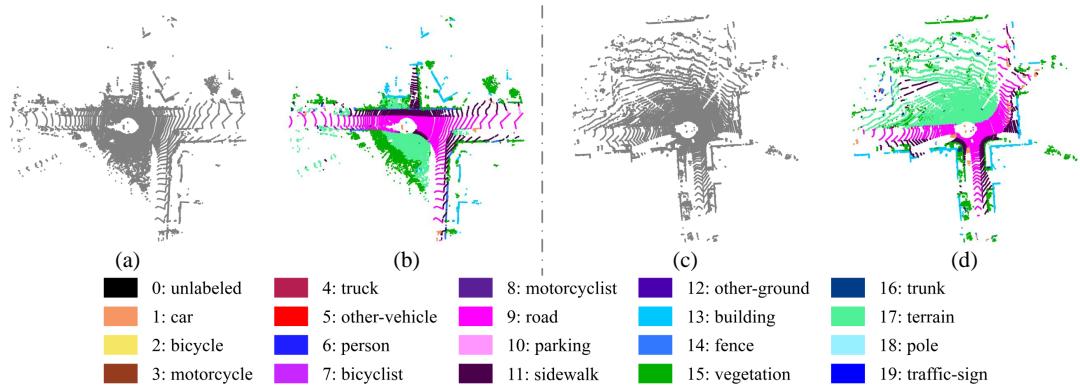
The Point Cloud
The input isn’t just raw XYZ coordinates; it includes semantic labels (car, road, building, vegetation).
The OpenStreetMap Data
The OSM data is parsed into three channels: Areas (polygons like buildings/parks), Ways (lines like fences/roads), and Nodes (points of interest).
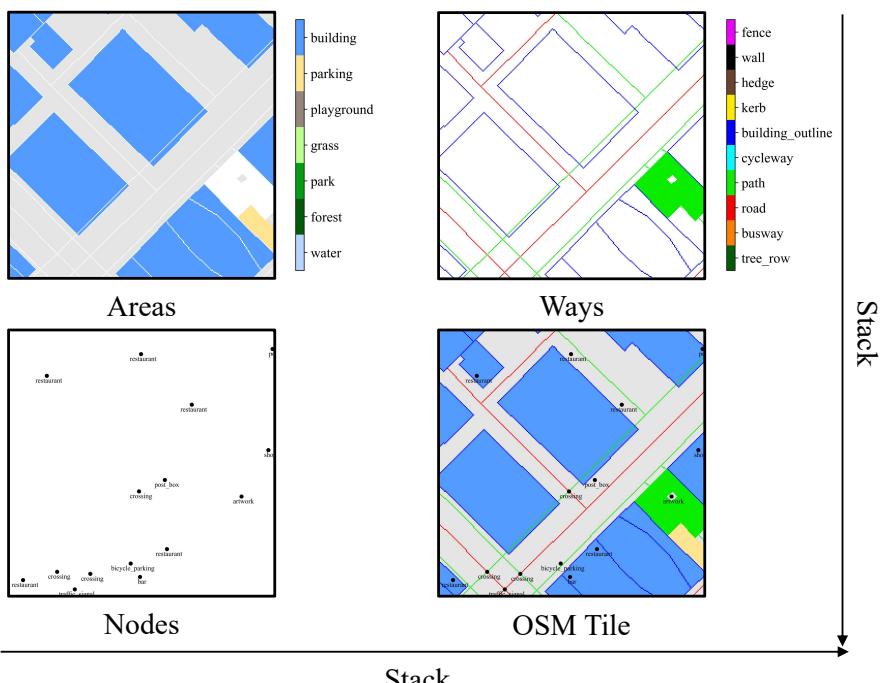
Figure 8 visualizes how these abstract map layers are stacked to create the “Image” that the neural network analyzes.
Conclusion and Implications
The OPAL framework represents a significant step forward in robotic localization. By effectively bridging the gap between sparse, ego-centric LiDAR data and dense, allo-centric OpenStreetMap data, the authors have unlocked a powerful capability: Localization without heavy maps.
Key Takeaways:
- Storage Efficiency: Using OSM reduces map storage requirements from Gigabytes to Kilobytes.
- Visibility Awareness: The use of ray-casting to create Visibility Masks is crucial for aligning the two different data modalities.
- Adaptive Fusion: The ARF module allows the network to learn which radial features matter, ensuring robustness against rotation and noise.
Limitations: The system isn’t perfect. It relies heavily on the presence of distinct static objects. In areas with few buildings or distinctive features (like a flat highway surrounded by fields), the performance drops. Additionally, it relies on the accuracy of the OSM data; if the map is outdated or missing buildings, the matching will fail.
However, as OpenStreetMap continues to improve and autonomous fleets scale up, approaches like OPAL offer a scalable, low-cost solution to the “Where am I?” problem, freeing robots from the burden of carrying heavy 3D maps.