](https://deep-paper.org/en/paper/2505.00690/images/cover.png)
Introduction
Imagine ordering a coffee or a small package to be delivered to your doorstep. In a futuristic city, a small robot navigates the chaotic urban jungle—dodging pedestrians, climbing curbs, and weaving through park benches—to bring you that item. This concept is known as micromobility.
While we often hear about autonomous cars on highways, the “last mile” of autonomy—sidewalks, plazas, and public spaces—presents a radically different set of challenges. Unlike cars, which operate on structured lanes with clear rules, micromobility robots must handle “unstructured” environments. They face stairs, grass, uneven cobblestones, dense crowds, and unpredictable obstacles.
Currently, most of these delivery robots aren’t truly autonomous; they are often teleoperated by humans sitting in call centers, or they possess very rudimentary intelligence that fails when faced with a flight of stairs or a crowded intersection. To bridge the gap between human control and full autonomy, robots need to learn from experience. But gathering millions of hours of data on physical sidewalks is dangerous, expensive, and slow.
This brings us to a pivotal research paper: “Towards Autonomous Micromobility through Scalable Urban Simulation.” The researchers propose a comprehensive solution to train robots in the digital world so they can perform in the real one. They introduce URBAN-SIM, a high-performance simulation platform, and URBAN-BENCH, a suite of tasks designed to test the limits of robotic agility and intelligence.
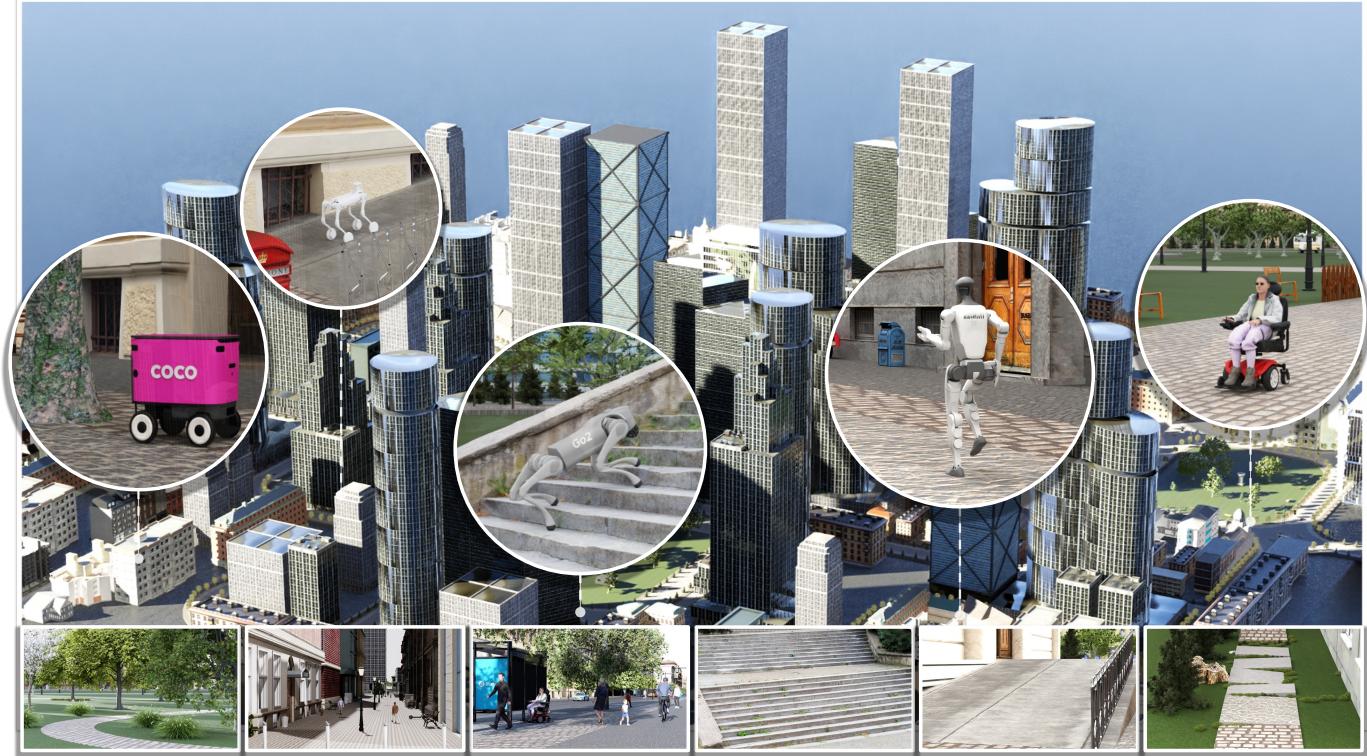
As shown in Figure 1, the goal is to take various robotic forms—from quadrupeds to humanoids—and teach them to handle the complex, varied terrains of public urban spaces. In this post, we will tear down the architecture of URBAN-SIM, explore how it generates infinite cities, and analyze how different robots perform when pushed to their limits.
The Background: Why is Micromobility So Hard?
Micromobility refers to lightweight mobile machines (under 350 kg) operating at low speeds (under 45 kph). This includes everything from electric wheelchairs and scooters to parcel delivery bots and humanoid assistants.
The primary bottleneck for autonomous micromobility is the simulation gap. To train a deep learning model (specifically Reinforcement Learning agents) to navigate a city, you need two things that usually conflict with each other:
- Complexity: The simulation must be rich, diverse, and realistic. It needs buildings, varying ground textures, moving pedestrians, and physics-accurate terrains.
- Speed: To learn effectively, an agent needs to experience millions of steps. This requires a simulator that runs extremely fast, ideally on a GPU.
Existing platforms usually pick one. Simulators like CARLA offer beautiful, complex towns but are computationally heavy and slow for end-to-end training. Platforms like Isaac Gym are incredibly fast (running entirely on the GPU) but are often restricted to simple, uniform environments (like a flat plane with a single box).
The researchers behind URBAN-SIM aimed to solve this contradiction: How do you simulate a realistic, diverse city at the speed required for large-scale robot learning?
Core Method: The URBAN-SIM Platform
URBAN-SIM is designed to be the “gym” where robots learn to live in a city. It is built on top of Nvidia’s Omniverse and PhysX 5, leveraging modern GPU capabilities. The platform stands on three pillars: Hierarchical Urban Generation, Interactive Dynamics, and Asynchronous Scene Sampling.
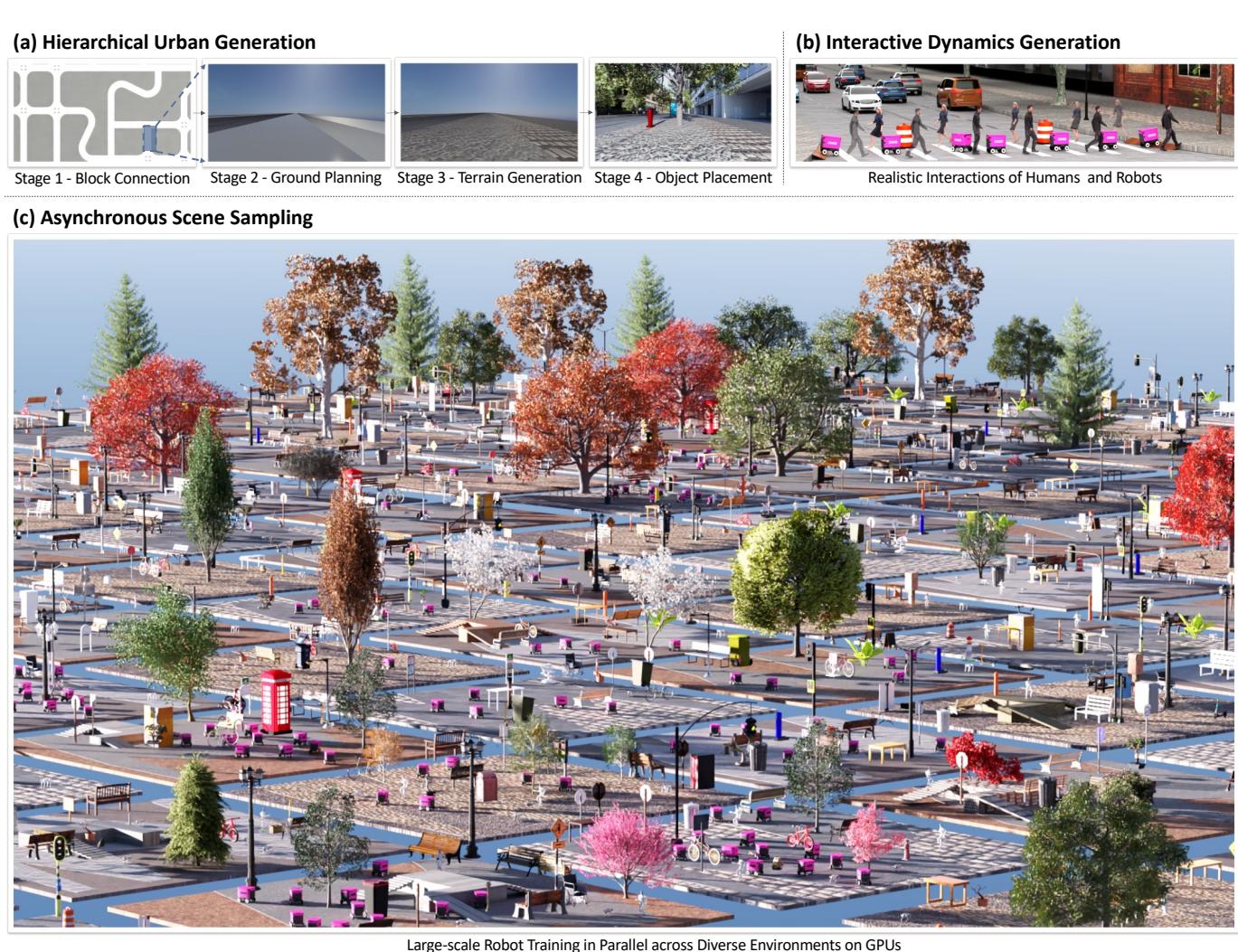
Let’s break down each module shown in Figure 2.
1. Hierarchical Urban Generation
To prevent robots from “overfitting” (memorizing a specific map), the environment must be constantly changing. The researchers developed a pipeline that procedurally generates infinite urban scenes. It works in four progressive stages:
- Block Connection: The system first lays out the macro-structure. It samples street blocks (straight roads, intersections, roundabouts) and connects them to form a road network.
- Ground Planning: It divides public spaces into functional zones. It decides where the sidewalks, crosswalks, plazas, and building footprints go.
- Terrain Generation: This is crucial for micromobility. Unlike cars that drive on flat asphalt, robots encounter stairs, slopes, and cracked pavement. The system uses an algorithm called Wave Function Collapse (WFC) to generate diverse terrains with specific physical properties (friction, bumpiness).
- Object Placement: Finally, it populates the world with static obstacles—trees, bus stops, benches, and hydrants—sourced from a library of over 15,000 3D assets.
This pipeline ensures that a robot never has to train on the exact same street corner twice, forcing it to learn generalizable skills rather than memorizing a map.
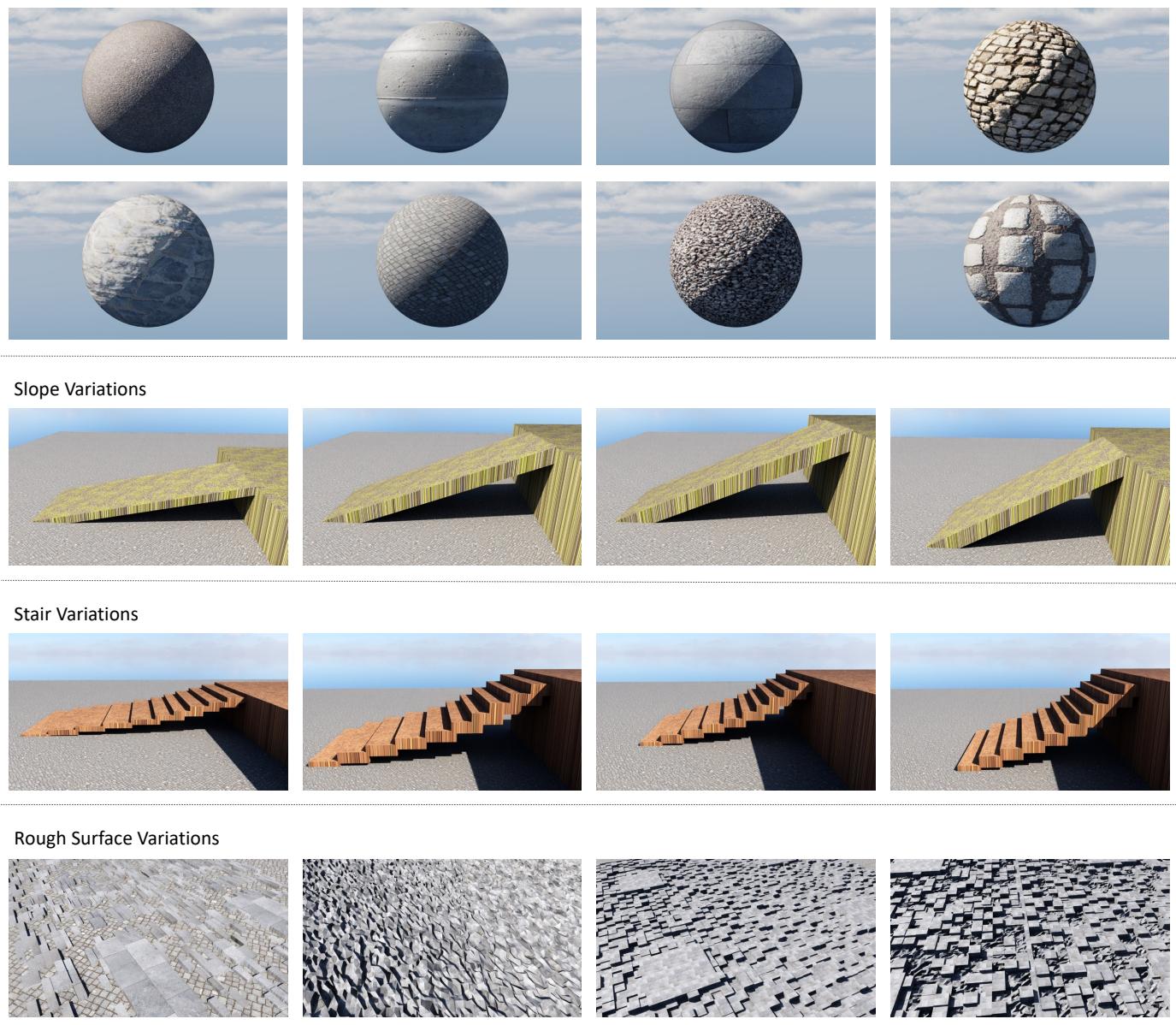
As seen in Figure 8 above, the texture and geometry variation is significant. A robot trained here must learn that a “slope” isn’t just a visual texture, but a physical incline requiring more torque to climb.
2. Interactive Dynamics Generation
A city without people is a ghost town. For a delivery robot, pedestrians are the most difficult “dynamic obstacles” to navigate.
Simulating crowds usually creates a bottleneck. Traditional methods run path planning on the CPU, while the robot learns on the GPU. This constant data transfer slows training down to a crawl.
URBAN-SIM moves the entire crowd simulation to the GPU. The researchers upgraded the ORCA (Optimal Reciprocal Collision Avoidance) algorithm—a standard method for preventing agents from bumping into each other—to run in parallel on the GPU using JAX. This allows the simulation to render thousands of pedestrians and vehicles that not only avoid each other but also react to the robot in real-time, all without slowing down the training loop.

The platform supports a massive variety of agents, as shown in Figure 16. The “dynamic assets” aren’t just hitboxes; they are rigged 3D models of people and vehicles that move realistically.
3. Asynchronous Scene Sampling
This is perhaps the most technical and impactful innovation of the platform.
In standard robot learning (like Isaac Gym), parallel training usually means running the same environment 1,000 times in parallel. If you want to train on a new environment, you have to reset all 1,000 instances. This is “synchronous” and bad for diversity.
URBAN-SIM uses an Asynchronous Scene Sampling scheme.
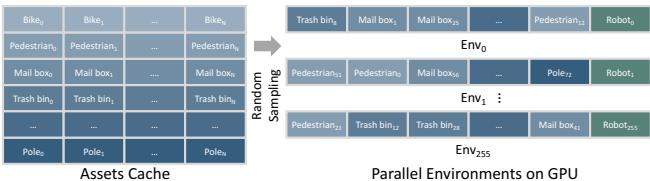
As illustrated in Figure 3, the system loads a massive “Assets Cache” into memory. When the GPU spins up parallel environments (e.g., 256 environments at once), each one can sample a completely different combination of assets, terrains, and layouts from the cache.
- Environment 1 might be a rainy plaza with stairs and a crowd of people.
- Environment 2 might be a sunny, flat sidewalk with a few trash cans.
- Environment 3 might be a steep ramp in a narrow alley.
All these run simultaneously on a single GPU. This allows the robot to experience a diverse distribution of data in every training batch, significantly speeding up the convergence of the neural network.
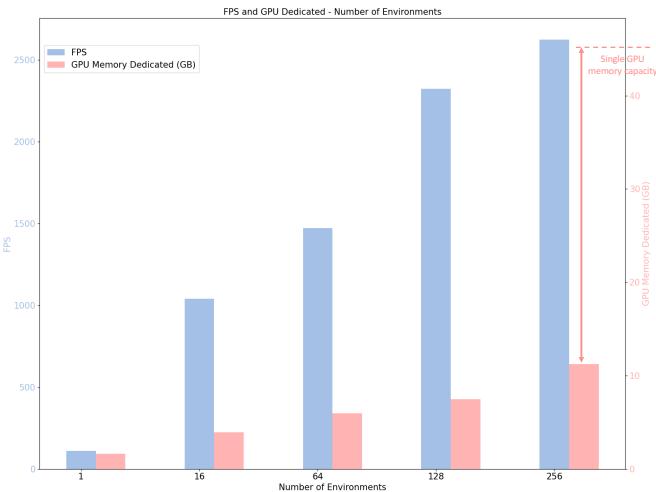
The performance benefits are massive. Figure 17 demonstrates that even with 256 complex parallel environments, the platform maintains over 2,600 Frames Per Second (FPS) while keeping GPU memory usage efficient. This high throughput is what makes “large-scale” training possible.
URBAN-BENCH: Testing the Limits
Having a simulator is one thing; having a standard way to measure success is another. The researchers introduced URBAN-BENCH, a suite of tasks categorized by the three core skills required for autonomous micromobility: Locomotion, Navigation, and Traverse.

1. Urban Locomotion
This focuses on the robot’s proprioception and balance. Can it move without falling over?
- LocoFlat: Walking on standard pavement.
- LocoSlope: Handling accessibility ramps (essential for wheelchair bots).
- LocoStair: Climbing steps (essential for quadrupeds/humanoids).
- LocoRough: Traversing cobblestones or damaged sidewalks.
2. Urban Navigation
This focuses on perception and pathfinding. Can it get from A to B?
- NavClear: Finding a path through open space.
- NavStatic: Avoiding benches, poles, and mailboxes.
- NavDynamic: Dodging moving pedestrians and cyclists.
3. Urban Traverse & Shared Autonomy
This is the “boss level.” It involves kilometer-scale navigation across a mix of all the above terrains. Because AI isn’t perfect yet, the researchers introduced a Human-AI Shared Autonomous Approach.

As shown in Figure 20, the system uses a layered control architecture:
- High-Level: A human (or high-level planner) makes critical decisions (e.g., “Take the left path,” or “This looks dangerous, I’ll take over”).
- Mid-Level: An AI navigation policy handles local pathing.
- Low-Level: An AI locomotion policy controls the motors and limbs.
This structure allows “stretchability”—the system can slide from full human control to full AI control depending on the difficulty of the situation.
Experiments and Results
The researchers benchmarked four distinct types of robots to see how morphology affects performance:
- Wheeled Robot: (Like a standard food delivery bot).
- Quadruped: (Four-legged dog robot).
- Wheeled-Legged: (A hybrid with wheels on the ends of legs).
- Humanoid: (Two-legged robot).
Emerging Behaviors
One of the most fascinating results was observing “emerging behaviors.” The robots weren’t explicitly told how to handle obstacles; they were just rewarded for reaching the goal. Yet, they developed strategies specific to their bodies.

Figure 5 highlights these unique adaptations:
- Panel 1 (Wheeled): The wheeled robot (COCO) learned to detour. Since it cannot climb curbs or rough terrain easily, it learned to take a longer path around obstacles to stay on smooth ground.
- Panel 2 (Quadruped): The legged robot, capable of handling rough terrain, learned to traverse directly over obstacles, taking the shortest path.
- Panel 4 (Humanoid): In narrow spaces, the humanoid robot learned to sidestep or edge through gaps, utilizing its vertical profile to squeeze past traffic cones.
Benchmarking Human vs. AI
In the Kilometer-scale “Urban Traverse” task, the researchers compared pure AI control against human control and shared autonomy.
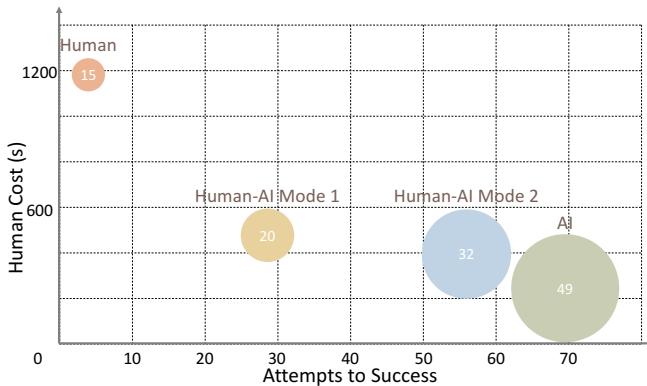
Figure 6 reveals the trade-off:
- AI (Green Circle): Requires zero human labor (Cost = 0), but it fails often (high attempts to success) and crashes frequently (large circle size).
- Human (Orange Circle): Highly successful and safe (small circle), but very expensive in terms of time/labor (high Human Cost).
- Shared Autonomy (Blue/Yellow): The “sweet spot.” By allowing humans to intervene only when necessary, they achieved a high success rate with significantly lower labor costs than full teleoperation.
The Power of Scale
Finally, the researchers asked: “Does training on more diverse scenes actually help?”
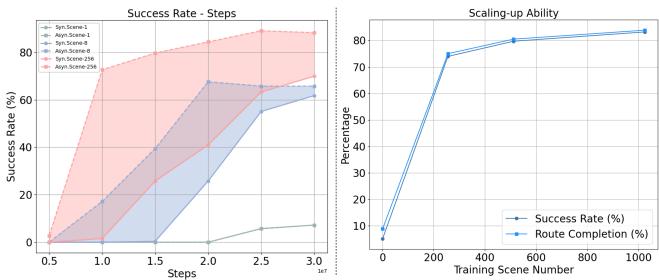
The results in Figure 7 are clear. The graph on the right shows that as the number of unique training scenes increases (from 0 to 1000), the success rate (blue line) shoots up, eventually plateauing near 80%. This proves that the diversity provided by URBAN-SIM’s procedural generation is critical. If you only train on 10 scenes, the robot fails to generalize; train on 1,000, and it becomes robust.
Conclusion and Implications
The “Towards Autonomous Micromobility” paper presents a compelling argument: to solve the chaos of the real world, we need simulation tools that can match its complexity.
URBAN-SIM solves the technical hurdle of simulating diverse, populated cities at GPU speeds. URBAN-BENCH provides the standardized metrics needed to track progress. Perhaps most importantly, the experiments show that with the right environment, robots begin to develop intelligent behaviors naturally—learning to sidestep, detour, or climb based on their own physical limitations.
The road to having a robot safely deliver your coffee is still long. It involves solving complex policy questions, safety regulations, and further refining AI capability. However, by moving the training ground from the physical sidewalk to a scalable, procedurally generated metaverse, we are likely to see these autonomous agents navigating our cities much sooner than we thought.