](https://deep-paper.org/en/paper/2505.01172/images/cover.png)
The world of generative AI is moving fast. We’ve gone from blurry images to photorealistic portraits, and now, the frontier is video. Models like Sora and Runway Gen-2 have dazzled the internet, but behind the scenes, researchers face a stubborn hurdle: duration.
Most open-source video diffusion models are trained on very short clips—often just 16 frames. When you ask these models to generate a longer video (say, 64 frames or more), they tend to break down. Objects morf bizarrely, the style shifts, or the video dissolves into noise. Training a model specifically for long videos requires massive computational resources and datasets that most labs simply don’t have.
So, how do we stretch these short-clip models to produce long, coherent movies without retraining them from scratch?
In this post, we’ll dive into FreePCA, a fascinating new research paper that proposes a training-free solution. The authors use a classic mathematical tool—Principal Component Analysis (PCA)—in a novel way to separate “what things look like” (appearance) from “how things move” (motion), allowing them to stitch together long videos that stay consistent from start to finish.
The Problem: The Tug-of-War Between Quality and Consistency
To understand why generating long videos is hard, we first need to look at the two standard “hacks” researchers use to extend short models.
1. The Global Aligned Method
In this approach, you feed the entire long sequence of noise into the model at once.
- Pro: The model sees the whole timeline, so the background and main subject tend to stay consistent (high consistency).
- Con: Because the model was only trained on short clips, this “stretched” input looks like alien data to it. The result is often blurry, objects disappear, and the motion becomes sluggish.
2. The Local Stitched Method (Sliding Window)
Here, you use a “sliding window.” You generate a short chunk, then slide the window forward and generate the next chunk, stitching them together.
- Pro: Each individual chunk looks crisp and high-quality because it matches the model’s training size.
- Con: The model forgets what happened in the previous window. A bear playing drums might suddenly turn into a dog or change color. The video flickers and lacks temporal coherence.
Figure 1 below perfectly illustrates this trade-off using a prompt about a teddy bear playing a drum kit.
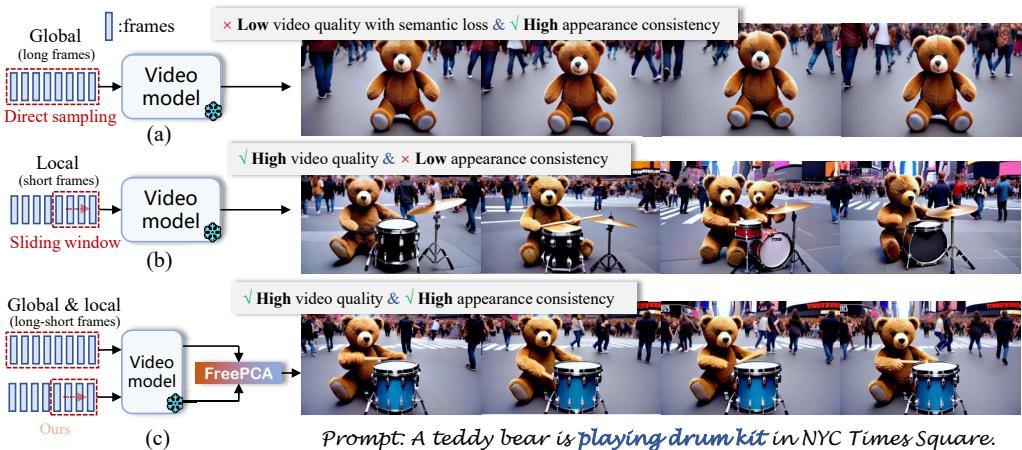
As you can see in (a), the “Global” method keeps the bear looking like a bear, but the drums turn into a blur. In (b), the “Local” method makes crisp drums, but the bear changes appearance significantly. The goal of FreePCA (c) is to get the best of both worlds: the consistency of the global method and the crisp quality of the local method.
The Core Observation: PCA as a Decoupler
The researchers’ key insight comes from a technique often used in background subtraction for surveillance video: Principal Component Analysis (PCA).
PCA is a dimensionality reduction technique usually used to simplify data. However, the authors discovered that if you apply PCA along the temporal dimension (time) of video features, it acts as a powerful separator.
When a video’s features are projected into “Principal Component space”:
- The first few components (which explain the most variance) tend to capture consistent appearance—the static background and the identity of the object.
- The later components capture motion intensity—the changes and movements.
The authors validated this by running PCA on videos and checking the consistency of the resulting components.
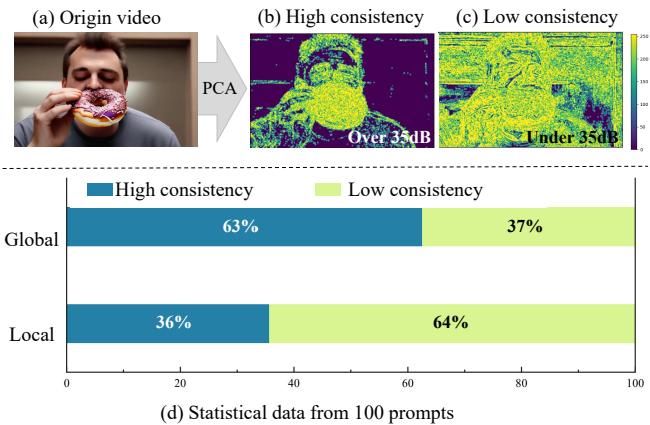
In Figure 2, you can see that after applying PCA, some components retain a clear structure (b), while others are chaotic (c). This suggests that the “Global” method (which is blurry but consistent) and the “Local” method (which is sharp but inconsistent) are actually producing very similar data in the “consistent appearance” components, but differ wildly in the “motion” components.
Visualizing the Split
To prove this, the researchers compared the features generated by the Global method against those from the Local method using Cosine Similarity in the PCA space.
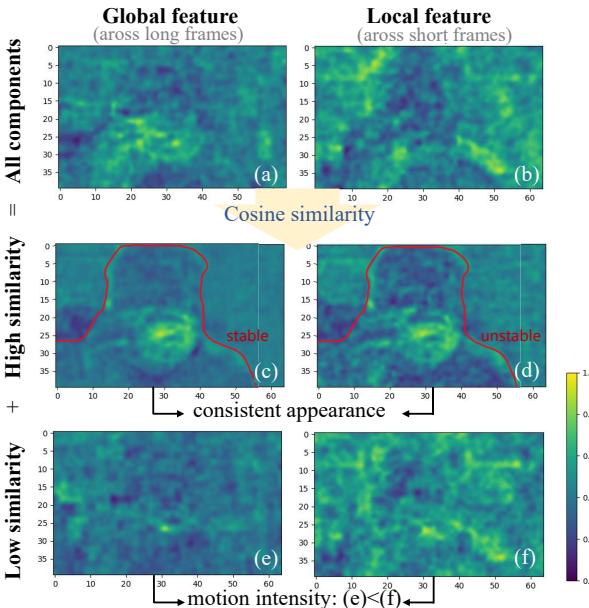
Figure 3 is revealing. Look at (c) and (d). These are the components where the Global and Local methods have high similarity. Notice how they look like clear outlines of the character? These represent the appearance.
Now look at (e) and (f). These are components with low similarity. The Local method (f) has much higher intensity values here than the Global method (e). This explains why the Local method has better motion and detail—it has richer information in these specific components.
The Strategy: Why not take the stable appearance from the Global features (which don’t flicker) and combine them with the rich motion intensity from the Local features (which are sharp)?
The FreePCA Method
FreePCA is a plug-and-play modification to the Temporal Attention layers of a video diffusion model (like VideoCrafter2 or LaVie). It doesn’t require any training.
Here is the high-level architecture:
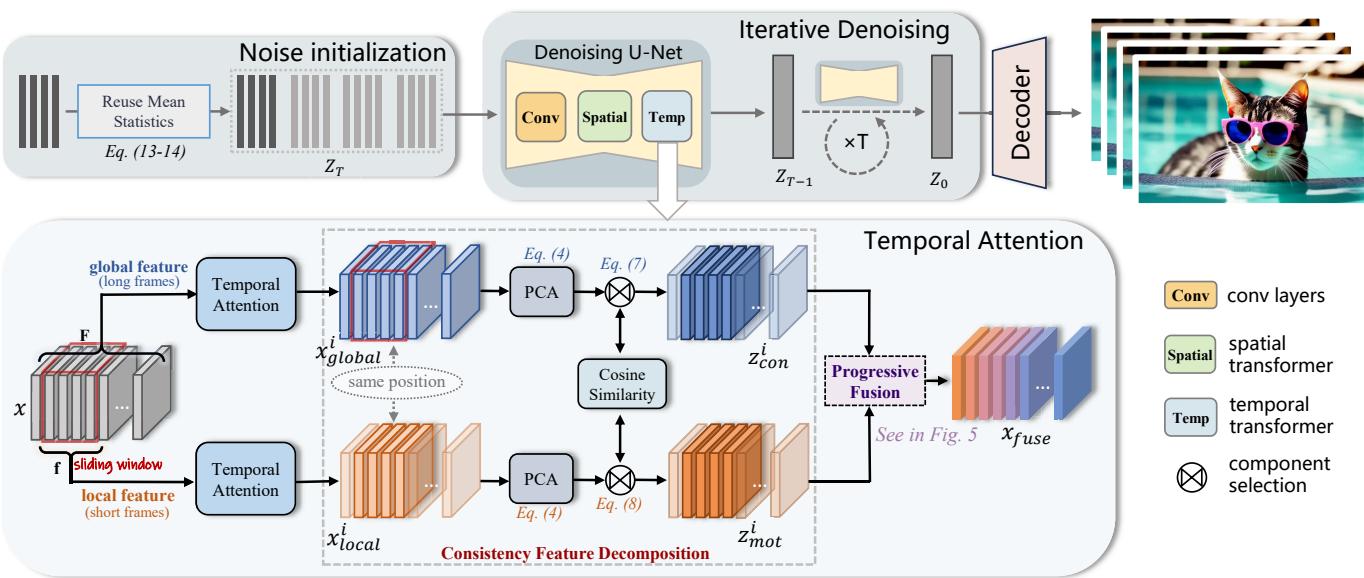
Let’s break down the process into three intelligible steps.
Step 1: Consistency Feature Decomposition
First, the model processes the video in two parallel ways during the denoising steps:
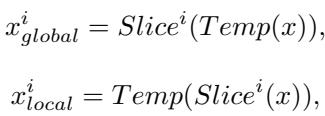
- Global Path: It looks at all frames (say, 64 frames) at once to get a “Global Feature” (\(x_{global}\)).
- Local Path: It uses a sliding window (e.g., 16 frames at a time) to get a “Local Feature” (\(x_{local}\)).
Because these two feature sets have different shapes (one is long, one is short), we first slice the global feature to match the current window of the local feature:
Next, the method calculates a PCA transformation matrix (\(P\)) based on the Global features. This matrix learns the “coordinate system” of the long, consistent video.

Both the Global and Local features are then projected into this PCA space (\(z\)):

Now comes the sorting hat. We calculate the Cosine Similarity (\(CosSim\)) between the global and local components.

We sort these components based on their similarity scores.

- High Similarity = Appearance: The top \(k\) components (where Global and Local agree the most) are selected from the Global features (\(z_{global}\)). These provide the stability.
- Low Similarity = Motion: The remaining components are taken from the Local features (\(z_{local}\)). These provide the sharp details and dynamic motion.


Step 2: Progressive Fusion
You might think we can just stick these features together and be done. However, abruptly swapping features can confuse the model. The authors introduce Progressive Fusion.
As the sliding window moves through the video (from the beginning to the end), the algorithm gradually increases the number of “consistency” components (\(k\)) borrowed from the Global view.
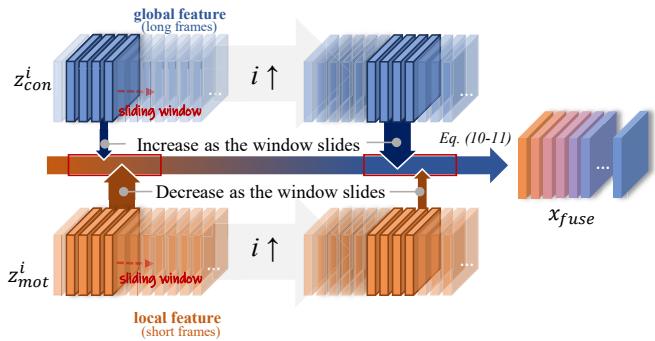
The number of components \(k\) is determined by the window index \(i\), capped at a maximum \(K_{max}\) (usually set to 3).

This means in the early frames, the model relies more on the local generation. As the video gets longer (where drift usually happens), the model leans more heavily on the global features to keep things on track.
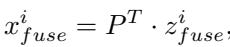
Finally, the selected appearance parts (\(z_{con}\)) and motion parts (\(z_{mot}\)) are concatenated and transformed back from PCA space to the original feature space (\(x_{fuse}\)).

Step 3: Reuse Mean Statistics
There is one final trick. To assist with consistency before the neural network even starts working, FreePCA manipulates the initial random noise.
Usually, noise is generated randomly for every frame.

FreePCA takes the statistical mean of the noise from the first window (the first 16 frames) and applies that mean to the subsequent noise chunks.

This essentially gives the entire video a shared “background static” DNA, which helps the model generate a consistent atmosphere and layout across all frames.

Experiments and Results
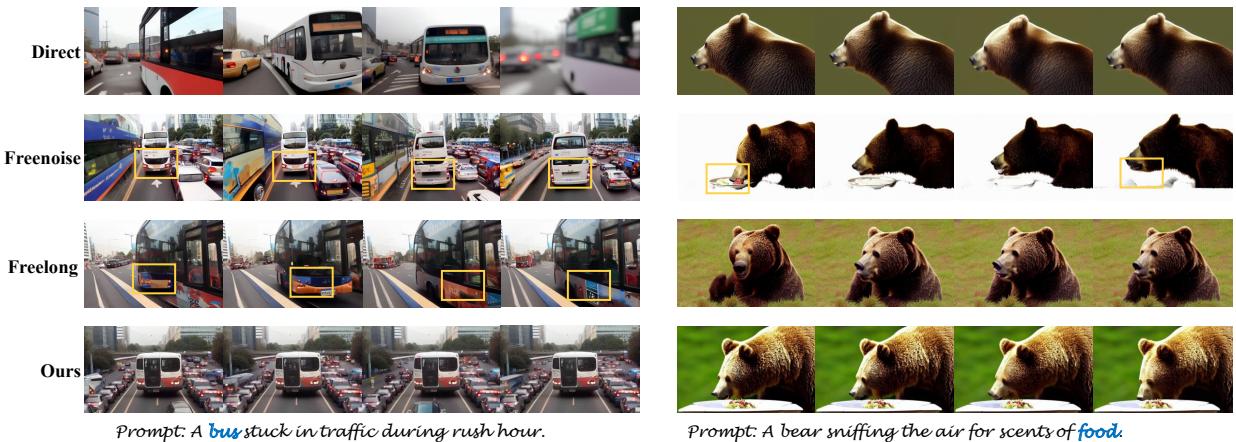
Does this mathematical juggling actually work? The authors tested FreePCA against two other state-of-the-art training-free methods: FreeNoise and FreeLong. They used standard benchmarks (VBench) and applied their method to two different base models (VideoCrafter2 and LaVie).
Quantitative Results
The table below shows the metrics. Key takeaways:
- Video Consistency: FreePCA (Ours) scores highest on Subject, Background, and Overall consistency.
- Video Quality: It also wins on Motion Smoothness and Dynamic Degree.

It is rare to see a method improve both consistency and dynamics simultaneously; usually, you trade one for the other.
Qualitative Results
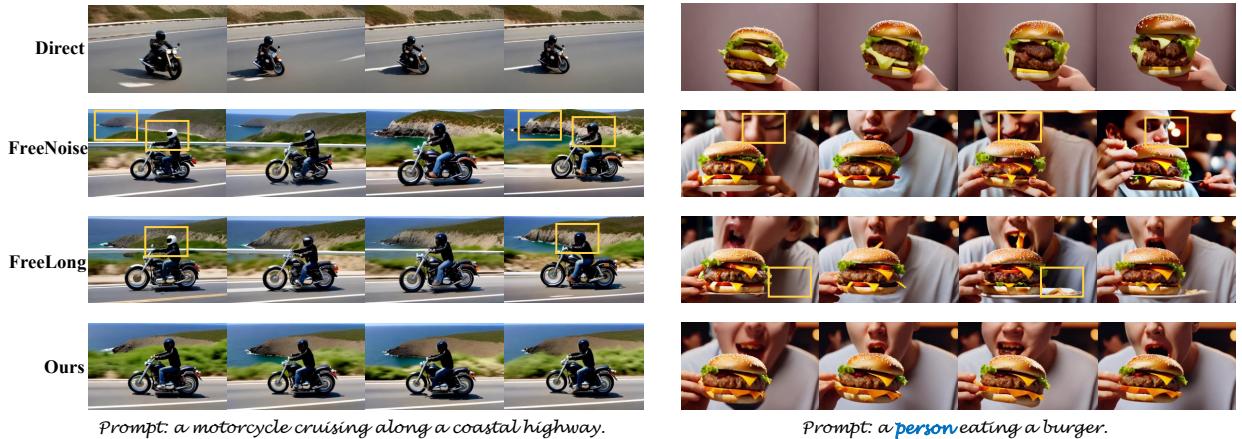
The visual comparisons are striking. In Figure 6 below, look at the “Motorcycle” row.
- Direct Sampling works okay but loses detail.
- FreeNoise and FreeLong introduce weird artifacts (look at the yellow boxes)—the motorcycle wheel gets distorted, or the background warps.
- FreePCA (Ours) maintains a clean rider and smooth road throughout the sequence.
We see similar results with the LaVie model in Figure 7. In the “Bus” example, other methods struggle with the complex geometry of the bus in traffic, causing parts of it to vanish or morph. FreePCA keeps the bus solid red and white.
Beyond Basic Generation
One of the strengths of FreePCA is its flexibility. Since it doesn’t require training, it can be adapted for other complex video tasks.
Multi-Prompt Generation
What if you want a video that changes context? For example, “A woman waving” transitions into “A woman dancing.” FreePCA handles this transition smoothly, maintaining the woman’s identity (the red dress, hair) while the motion dynamics shift.

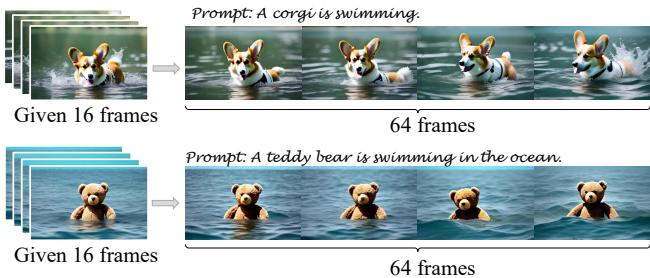
Video Extension
If you already have a short 16-frame video (generated or real) and want to extend it to 64 frames, FreePCA can do that too. It uses the initial video as the “Global” anchor and generates the subsequent frames while locking onto the appearance of the original clip.
Conclusion
FreePCA represents a clever application of classical linear algebra to modern deep learning. By recognizing that appearance is low-rank (consistent) and motion is high-rank (varying) in the temporal dimension, the authors built a bridge between the stability of global processing and the quality of local processing.
The key takeaways for students and practitioners are:
- Decomposition is Powerful: Splitting features into meaningful components (appearance vs. motion) allows for more targeted control than dealing with raw features.
- No Training Required: We can significantly boost the performance of existing models (like VideoCrafter2) purely through inference-time algorithms.
- The “Global vs. Local” Paradox: In sequence generation, you almost always face a trade-off between coherence (Global) and detail (Local). FreePCA offers a mathematical blueprint for solving this.
As we wait for open-source models to catch up to the capabilities of proprietary giants, methods like FreePCA provide essential tools to get more mileage—and footage—out of the models we have today.