](https://deep-paper.org/en/paper/2505.02833/images/cover.png)
Introduction
Imagine you are carrying two heavy grocery bags into your house. You approach the door, balance on one leg, and use your other foot to push the door open. To you, this action is trivial. To a humanoid robot, this is a nightmare of physics, balance, and coordination.
Humans possess an innate ability to couple locomotion (moving around) with manipulation (using hands) in a synchronized, “whole-body” manner. We crouch to reach under beds, we lunge to catch objects, and we adjust our stance to throw a ball. For humanoid robots to become truly useful in our homes, they need this same level of versatility.
However, bridging the gap between human motion and robot control is notoriously difficult. Most current teleoperation systems treat the top and bottom of the robot separately—using a joystick to drive the legs and VR controllers to move the arms. This decoupling makes complex, coordinated actions impossible.
Enter TWIST (Teleoperated Whole-Body Imitation System). Developed by researchers at Stanford University and Simon Fraser University, TWIST introduces a unified approach that allows a humanoid robot to mimic a human operator’s full-body movements in real-time. By using a single neural network controller, TWIST enables robots to perform actions previously out of reach, from lifting boxes while crouching to performing a Waltz.
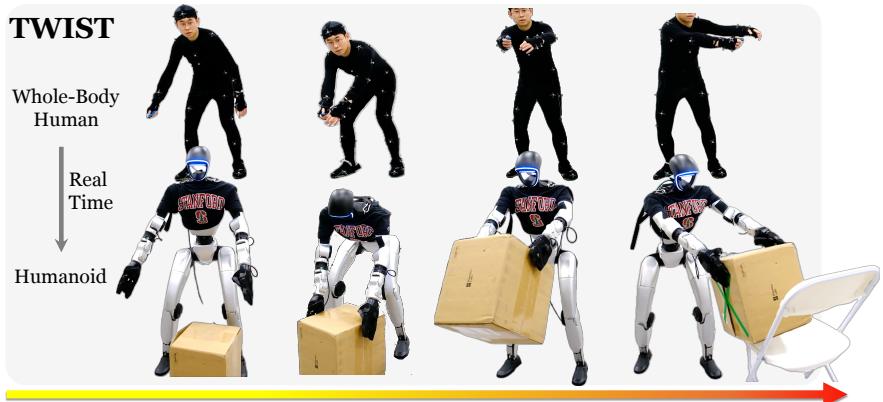
In this post, we will deconstruct how TWIST works, the novel training pipeline that makes it robust, and the results that suggest we are one step closer to general-purpose robotic avatars.
The Challenge: The Embodiment Gap
Before diving into the solution, we must understand the problem. Teleoperating a humanoid robot isn’t as simple as mapping a human joint to a robot joint. This is due to the embodiment gap.
- Kinematic Differences: Robots and humans have different limb lengths, joint limits, and degrees of freedom.
- Dynamics: A human has muscles and tendons; a robot has motors and gears. The physics required to balance a human body are different from those required to balance a rigid robotic frame.
- Data Quality: Offline human motion data (like animation datasets) is clean and smooth. Real-time teleoperation data is often noisy, jittery, and suffers from latency.
Previous attempts often used “modular” controllers—one algorithm for standing up, another for walking, and a separate one for moving arms. While stable, these systems lacked the fluidity to perform tasks where the upper and lower body must work together, such as generating force from the legs to throw an object.
The TWIST Methodology
TWIST approaches this as a real-time motion tracking problem. The goal is to take a stream of human motions, retarget them to the robot’s body, and have a controller execute them immediately without falling over.
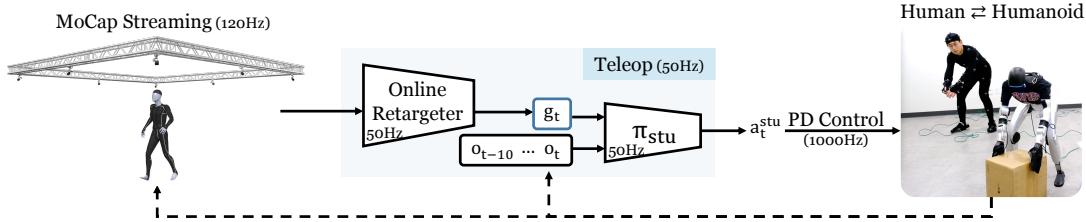
The system is built on three pillars, or stages, as visualized below:
Stage 1: Curating the “Fuel” (Motion Data)
Deep learning models are hungry for data. To train a controller that understands how to move like a human, the researchers compiled a massive dataset.
They started with over 15,000 motion clips from public datasets (AMASS and OMOMO), representing about 42 hours of human movement. However, simply using this clean data wasn’t enough. Real-world teleoperation involves “online” retargeting—converting human motion to robot motion on the fly—which introduces noise and unnatural artifacts.
To prepare the robot for the messiness of the real world, the team collected a small “in-house” dataset (150 clips) using their actual teleoperation setup. They then retargeted all this data to the humanoid structure.
The Retargeting Innovation: Standard online retargeting usually focuses only on joint orientation (angles). The researchers found that this wasn’t precise enough for delicate tasks. They enhanced their online retargeter to jointly optimize for both 3D joint positions and orientations. This ensures that if the human operator places their hand at a specific point in space, the robot tries to match that Cartesian position, not just the elbow angle.
Stage 2: Training the Unified Controller
This is the core of the TWIST system. How do you teach a robot to balance and move based on a noisy input stream? The researchers utilized a simulation environment (Isaac Gym) to train a neural network policy.
They identified a critical issue with standard Reinforcement Learning (RL) in this context. If a policy only sees the current frame of motion, it tends to be hesitant and jittery because it can’t anticipate the next move. This results in “foot sliding” and instability.
To solve this, they implemented a Teacher-Student Framework:
- The Privileged Teacher (\(\pi_{tea}\)): This policy is trained with “privileged information.” It gets to see the future—specifically, the next 2 seconds of reference motion. Knowing where the human is going allows the Teacher to plan smooth, balanced movements.
- The Deployable Student (\(\pi_{stu}\)): In the real world, we can’t see the future. The Student policy only sees the current state (proprioception) and the current target pose.
The training objective combines Reinforcement Learning (RL) with Behavior Cloning (BC). The Student tries to maximize its physical rewards (staying upright, tracking the target) while simultaneously trying to minimize the difference between its actions and the Teacher’s actions.
The loss function for the student policy is defined as:
\[ \begin{array} { r } { L ( \pi _ { \mathrm { s t u } } ) = L _ { \mathrm { R L } } ( \pi _ { \mathrm { s t u } } ) + \lambda D _ { \mathrm { K L } } ( \pi _ { \mathrm { s t u } } \parallel \pi _ { \mathrm { t e a } } ) , } \end{array} \]
Here, \(L_{RL}\) is the standard reinforcement learning loss, and \(D_{KL}\) represents the divergence between the student and teacher policies. This hybrid approach ensures the Student learns robust recovery strategies from RL while acquiring the smoothness and foresight-like qualities of the Teacher via BC.
Reward Shaping: To guide the RL component, the system uses a specific set of rewards and penalties.
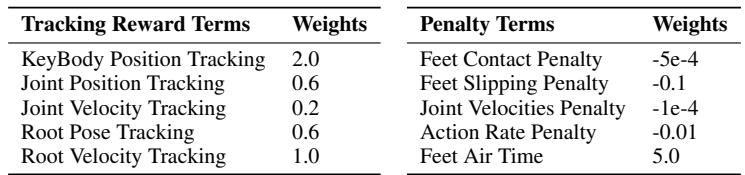
As shown in Table 1, the system heavily rewards tracking accuracy (Root Velocity and KeyBody Position) but applies penalties for dangerous behaviors like feet slipping or erratic joint velocities.
Stage 3: Real-World Deployment
Once the Student policy is trained in simulation, it is deployed “zero-shot” to the real robot. This means no further training is done on the physical hardware—a testament to the quality of the simulation.
The real-world pipeline runs at two frequencies:
- 50Hz: The MoCap system captures the human, retargets the motion, and the neural network infers the target joint angles.
- 1000Hz: A low-level PD (Proportional-Derivative) controller on the robot takes those target angles and drives the motors to execute the movement.
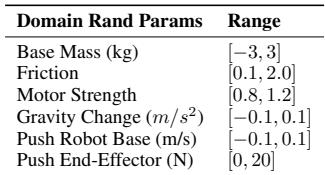
To ensure the simulation matched reality, the team applied extensive Domain Randomization during training, varying parameters like friction, motor strength, and robot mass to make the policy robust to physical inconsistencies.
Experimental Results
The TWIST system was tested on the Unitree G1 (a medium-sized humanoid) and the Booster T1. The results showcased a level of coordination rarely seen in learning-based controllers.
1. Versatility and Coordination
The single controller managed to handle widely different tasks without mode switching.
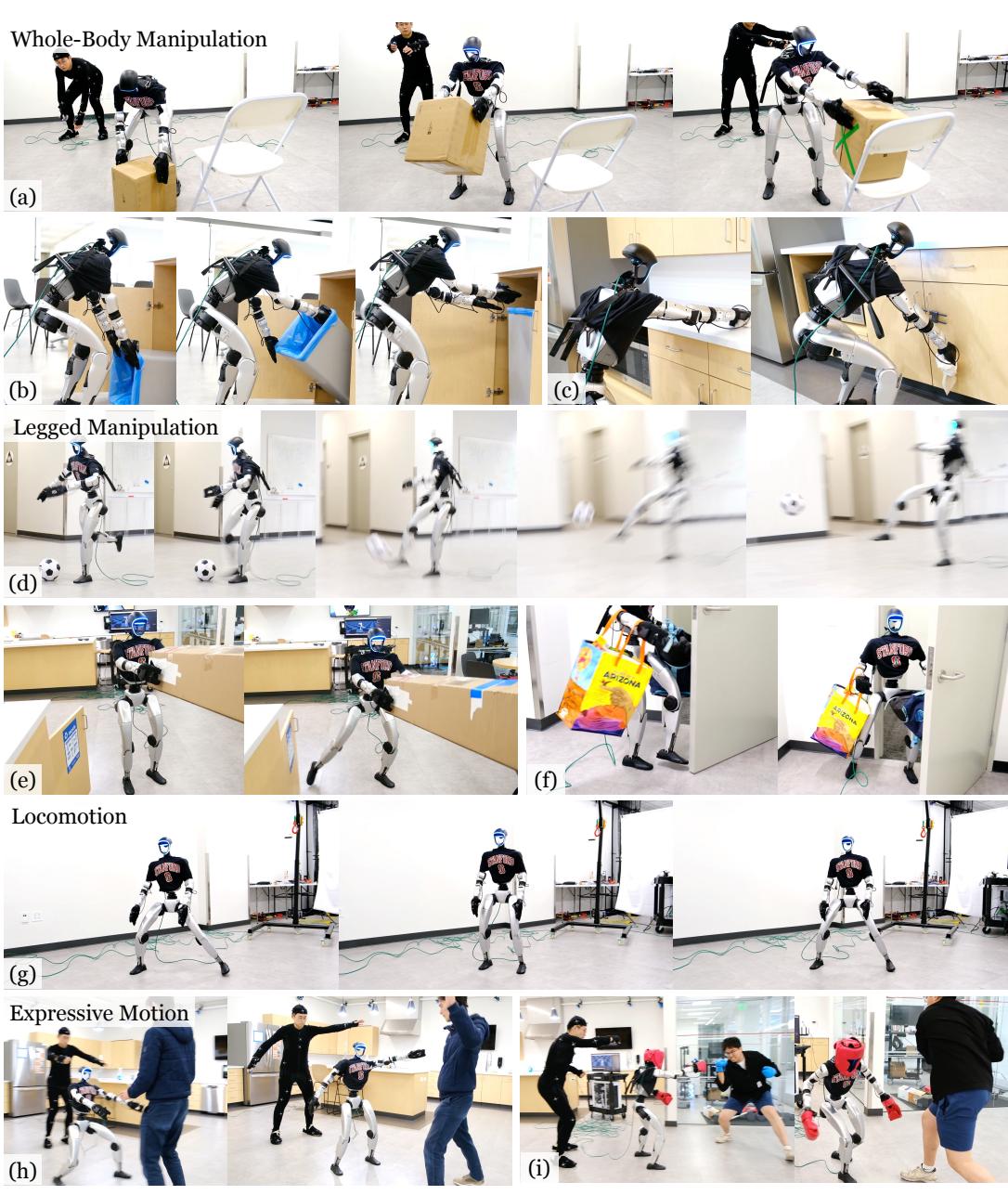
As illustrated in Figure 2, the robot successfully performed:
- Whole-Body Manipulation: Crouching to pick up a box (requires leg balance while arms reach out).
- Legged Manipulation: Kicking a soccer ball (requires balancing on one foot while swinging the other).
- Locomotion: Walking sideways and backward.
- Expressive Motion: Imitating a Waltz dance and boxing motions.
2. Generalization to Different Robots
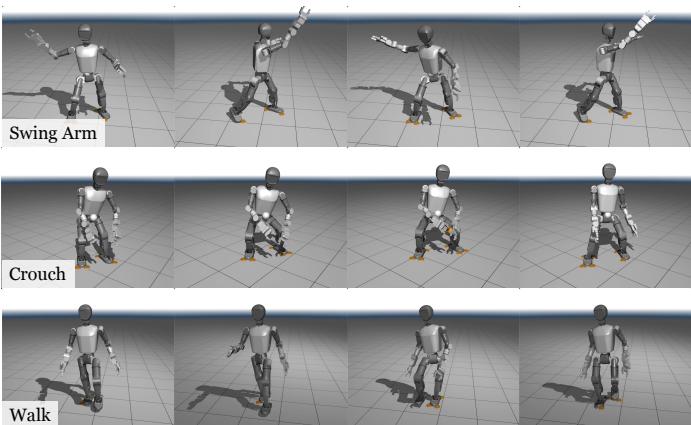
One of the strengths of this learning-based approach is that it isn’t hard-coded to a specific robot’s kinematics. By adjusting the retargeting and retraining the policy, TWIST was successfully applied to the Booster T1 robot in simulation.
3. Why RL + BC? (Ablation Studies)
The researchers compared their method against pure Reinforcement Learning (RL) and pure Behavior Cloning (DAgger).
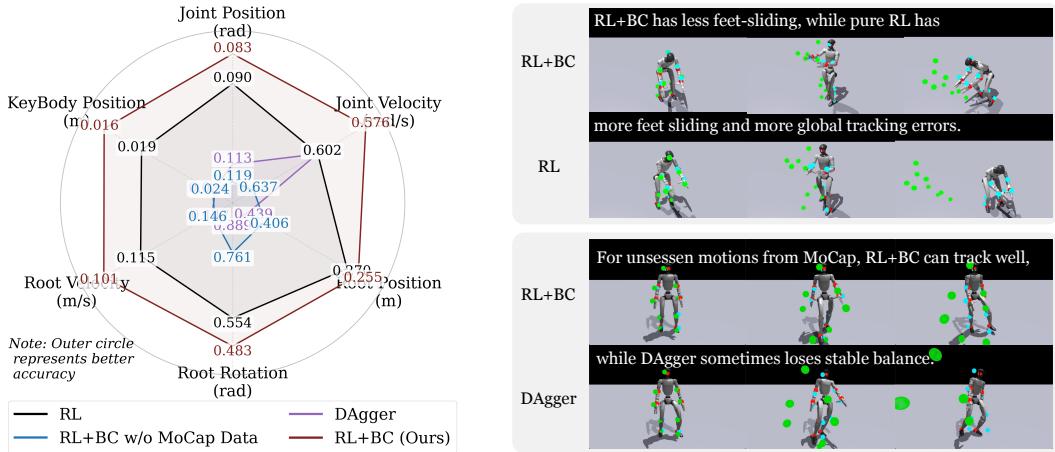
The data in Figure 6 reveals why the hybrid approach is superior. Pure RL (gray line) resulted in significant “foot sliding”—the robot would shuffle unnaturally because it was gaming the physics engine to maintain balance rather than walking properly. Pure DAgger (pink line) struggled with stability on unseen motions. The RL+BC approach (cyan line) offered the best balance of low tracking error and physical stability.
4. Robustness and Perturbations
A fascinating insight from the paper is how the robot learned to apply force. If a robot only learns to mimic position, it might go limp when it touches an object. To counter this, the training included End-Effector Perturbations—essentially pushing the robot’s hands and feet randomly during simulation.
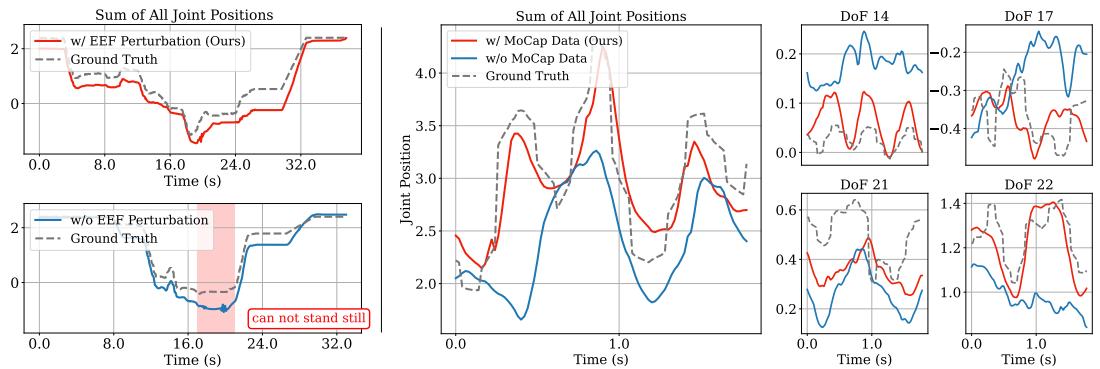
Figure 7 (left) shows that without these perturbations (blue line), the robot becomes unstable when holding a box (a task requiring force). With perturbations (red line), the robot learned to “brace” itself and maintain stability against external loads.
System Analysis and Limitations
While impressive, the system is not without faults. The researchers provided a transparent analysis of where TWIST struggles.
Tracking Errors: The system is most accurate at the torso and head. However, tracking errors increase towards the extremities.

As shown in Figure 8 (right), the feet exhibit the highest tracking error (over 20mm). This is expected, as the feet are constantly making and breaking contact with the ground, creating complex discontinuities that are hard to model perfectly.
Latency: Real-time teleoperation is demanding. The total system delay was measured at approximately 0.9 seconds.
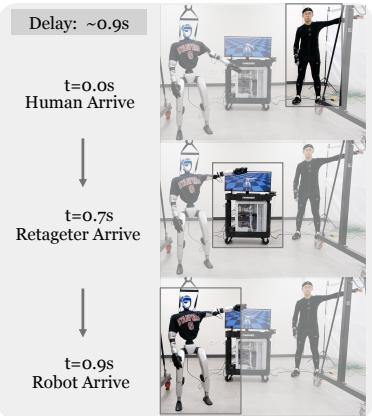
Most of this delay comes from the motion generation and retargeting pipeline (0.7s) rather than the policy inference itself. While 0.9 seconds allows for effective control, it creates a slight “lag” feeling for the operator, requiring them to move somewhat deliberately.
Reachability and Hardware Limits: The system pushes the hardware to its absolute limit. In Figure 9(a), we see the robot achieving extreme poses, utilizing its full range of motion to touch its toes. However, Figure 9(b) highlights the reality of current humanoid hardware: motor overheating.
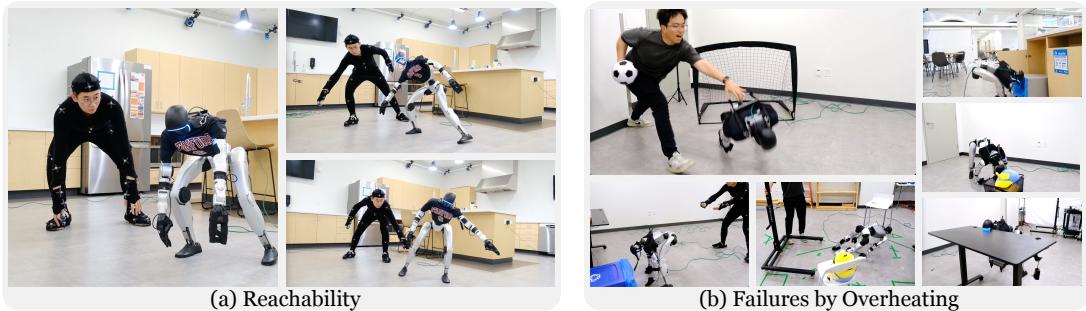
Sustained crouching or holding heavy objects generates significant heat. The researchers noted that the robot often needed cooling breaks after 5-10 minutes of intense operation.
Conclusion
TWIST represents a significant leap forward in humanoid teleoperation. By formulating the problem as whole-body imitation and solving it with a hybrid RL+BC Teacher-Student framework, the researchers have created a system that is both versatile and robust.
The implications are exciting:
- Unified Control: We are moving away from fractured, modular controllers toward unified neural policies that handle the entire body’s dynamics.
- Data-Driven: The success of mixing large offline datasets with small, noisy “in-house” datasets provides a blueprint for future sim-to-real efforts.
- Complex Interaction: Robots are finally beginning to coordinate their upper and lower bodies effectively, a prerequisite for doing actual work in human environments.
While challenges regarding latency and hardware endurance remain, TWIST demonstrates that with the right data and training algorithms, humanoid robots can indeed learn to dance, kick, and work alongside us.