](https://deep-paper.org/en/paper/2505.03233/images/cover.png)
Introduction: The Data Bottleneck in Robotics
We are currently witnessing a golden age of Artificial Intelligence, driven largely by Foundation Models. In Natural Language Processing (NLP) and Computer Vision (CV), models like GPT-4 and Gemini have achieved staggering capabilities. Their secret weapon? The internet. These models are pre-trained on trillions of tokens of text and billions of images scraped from the web.
However, there is one frontier where this formula hasn’t quite worked yet: Robotics.
While the internet is full of images of objects, it is surprisingly devoid of data on how to physically interact with them. A video of a person picking up a mug doesn’t tell a robot the precise joint torques, gripper width, or 3D trajectory required to replicate the action. Consequently, most robotic “Vision-Language-Action” (VLA) models rely on real-world data collected via teleoperation—a human manually controlling a robot arm. This process is slow, expensive, and labor-intensive.
But what if we didn’t need real-world data at all?
This is the question posed by GraspVLA, a new research paper that introduces a radical shift in robotic training. The researchers propose training a foundation model entirely on synthetic action data—simulated environments where physics and rendering are controlled by code.
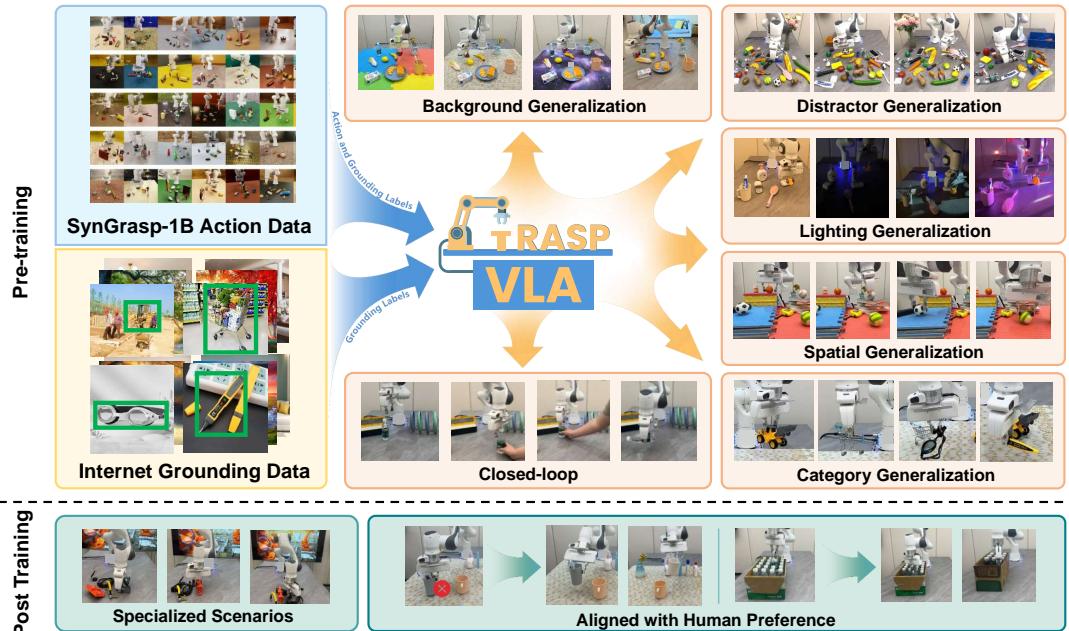
As shown in Figure 1, GraspVLA is a grasping foundation model pre-trained exclusively on a billion-scale synthetic dataset. It demonstrates that with the right architecture and data pipeline, a robot can learn to manipulate objects in the real world without ever having seen it during pre-training.
In this deep dive, we will explore how the researchers constructed a billion-frame dataset, the novel “Progressive Action Generation” architecture they designed, and the surprising results when this simulation-trained brain was put into a physical robot body.
Part 1: SynGrasp-1B — Building a Universe of Data
The first hurdle to synthetic training is the “Sim-to-Real” gap. If a simulation looks like a low-poly video game from the 90s, the robot will fail when it sees high-definition reality. Furthermore, if the physics are slightly off, the robot might crush a real egg thinking it’s a rigid sphere.
To bridge this gap, the authors curated SynGrasp-1B, the largest robotic grasping dataset to date. It contains over 1 billion frames of data.
The Data Generation Pipeline
Creating this dataset wasn’t just about running a simulator; it required a sophisticated pipeline to ensure diversity in object geometry, visual appearance, and grasping mechanics.
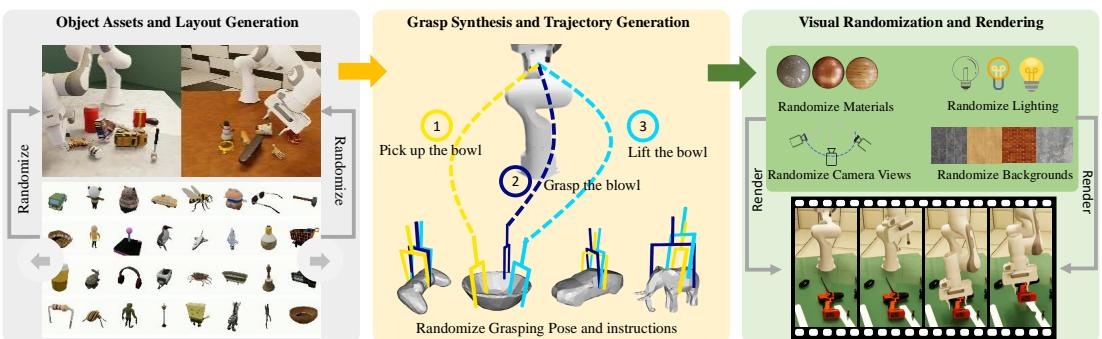
As illustrated in Figure 2, the pipeline consists of three stages:
- Object Assets & Layouts: The team filtered the “Objaverse” dataset (a massive library of 3D models) to find 10,680 objects suitable for grasping, across 240 categories. They then procedurally generated scenes where these objects were dropped onto tables in random clusters.
- Grasp Synthesis & Trajectory Generation: Instead of asking humans to demonstrate grasps, they used algorithms. They employed a grasp synthesis algorithm to find stable ways to hold an object, and then used CuRobo (a GPU-accelerated motion planner) to calculate collision-free paths.
- Crucial Detail: To prevent the “hesitation” often seen in robotic movements, they prioritized smooth, continuous trajectories rather than the stop-and-go motions typical of standard grasp planners.
- Visual Randomization: This is the key to fooling the robot into understanding reality. Using Isaac Sim (a photorealistic simulator), they rendered the scenes while randomizing everything: lighting (point, directional, dome), textures, camera angles, and backgrounds.
A Glimpse into the Synthetic World
The result is a dataset of staggering visual variety. By randomizing textures and lighting, the model learns to ignore irrelevant details (like the color of the table) and focus on the geometry of the target object.
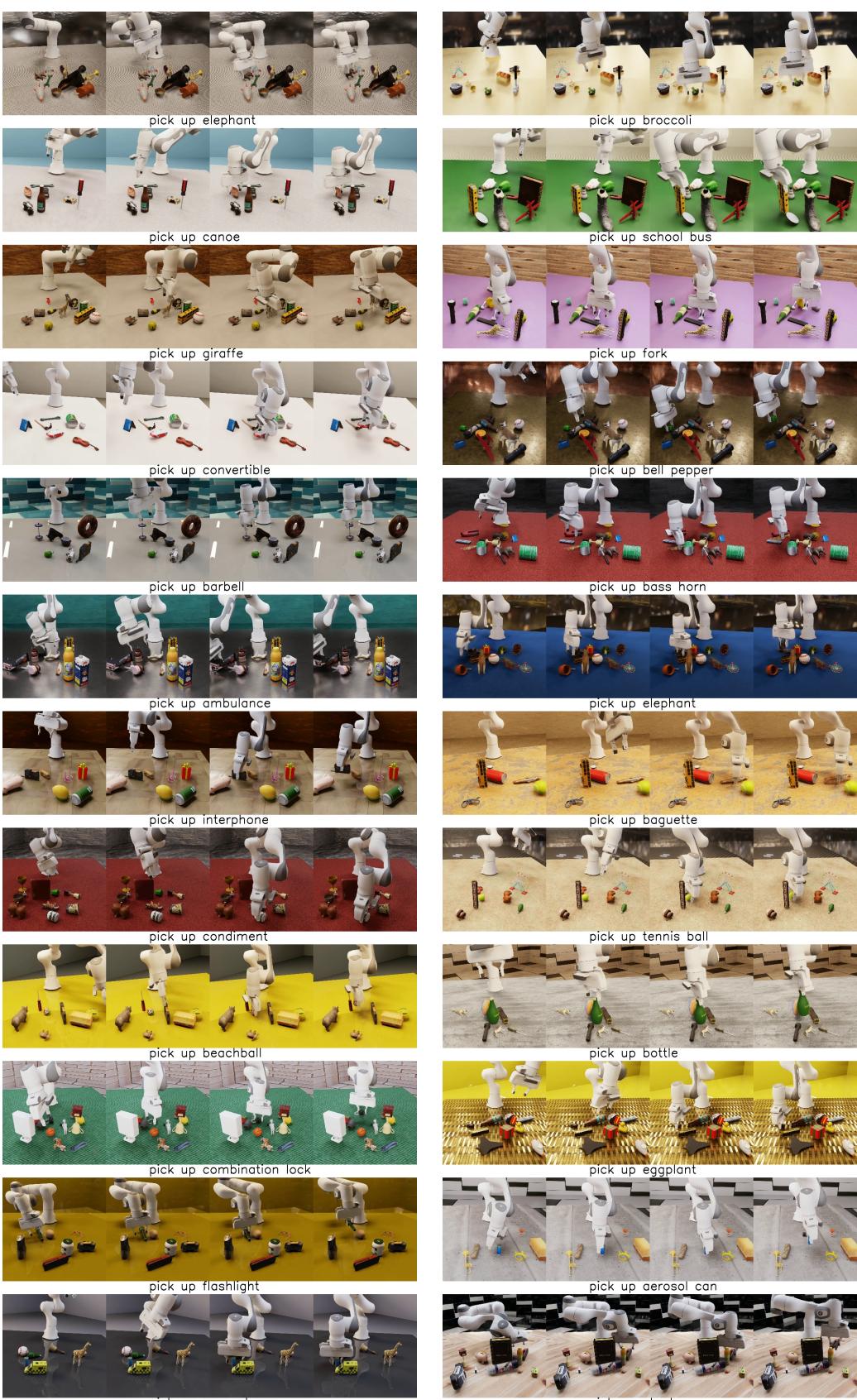
Figure 7 shows 24 random trajectories from the dataset. Notice how the same robot action is practiced against wood grain, green felt, carpet patterns, and harsh lighting conditions. This “domain randomization” forces the neural network to learn robust features that survive the transition to the real world.
Part 2: The GraspVLA Model
Having a billion frames of data is useless without a model intelligent enough to learn from them. The authors introduced GraspVLA, an architecture that combines the reasoning power of Large Language Models (LLMs) with the precision of robotic control.
The Core Problem: Generalization
If you train a robot only on synthetic data, it might learn to grasp a “synthetic apple” perfectly. But if you ask it to “pick up the iPhone”—an object class it never saw in the simulator—it will fail.
To solve this, GraspVLA creates a synergy between two types of data:
- Synthetic Action Data: Provides the geometric knowledge of how to grasp (e.g., “how to position fingers around a flat object”).
- Internet Grounding Data: Provides the semantic knowledge of what objects are (e.g., matching the word “iPhone” to the visual of a phone), sourced from web datasets like GRIT.
Progressive Action Generation (PAG)
The authors propose a mechanism called Progressive Action Generation (PAG). Instead of trying to jump straight from an image to a motor command, PAG forces the model to “think” in steps, similar to the Chain-of-Thought (CoT) reasoning used in advanced LLMs.
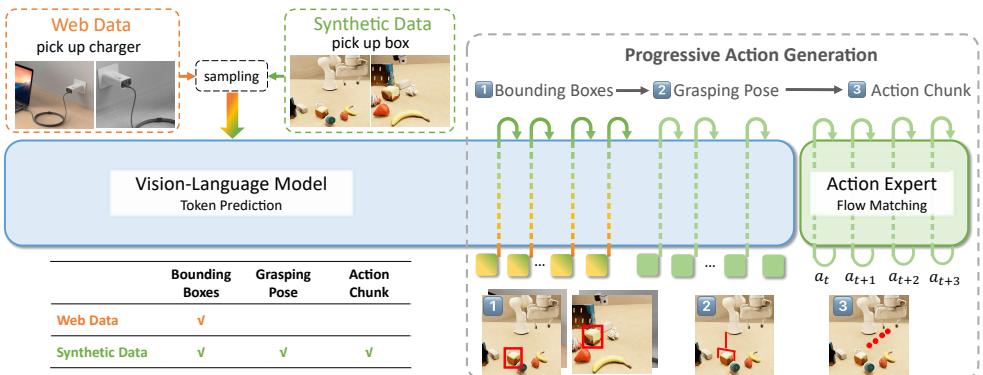
As shown in Figure 3, the process works like this:
- Input: The model receives an image and a text instruction (e.g., “Pick up the charger”).
- Step 1: Visual Grounding (Bounding Box): The Vision-Language Model (VLM) first predicts the 2D bounding box of the target object.
- Why? This step can be supervised by both Synthetic data and Internet data. It bridges the semantic gap.
- Step 2: Grasp Pose Prediction: For synthetic data, the model next predicts the 6-DoF (Degree of Freedom) grasp pose—essentially, where the gripper needs to end up.
- Step 3: Action Generation: Finally, an “Action Expert” module generates the specific arm trajectory (the motor commands) to reach that pose.
This chain—Find it \(\rightarrow\) Plan the Grip \(\rightarrow\) Move—allows the model to transfer its “finding” skills from the web to the “moving” skills learned in simulation.
The Mathematics of Training
The training process is a multi-task learning problem. The loss function combines two main components.
First, the Vision-Language Loss (\(\mathcal{L}_{S2}\)) handles the reasoning steps. It is an auto-regressive loss (predicting the next token) for the bounding boxes and grasp poses:

Second, the Action Loss (\(\mathcal{L}_{S1}\)) trains the motion itself. The authors use a technique called Flow Matching, a modern generative approach superior to simple diffusion for this task, to generate smooth action chunks (\(\mathbf{A}_t\)):

By minimizing the sum of these losses, GraspVLA learns to reason about the scene and execute smooth movements simultaneously.
Part 3: Experimental Results
Can a robot trained only on the matrix (simulation) function in the real world? The authors put GraspVLA to the test against state-of-the-art models like OpenVLA, Octo, and Google’s \(\pi_0\).
Zero-Shot Real-World Transfer
The primary evaluation involved a real Franka Emika Panda robot arm. The researchers set up 5 different test scenarios involving changes in lighting, backgrounds, and object clutter (distractors). They tested objects the model had seen in simulation (“Synthetic Categories”) and novel objects it had only seen on the web (“Web Categories”).
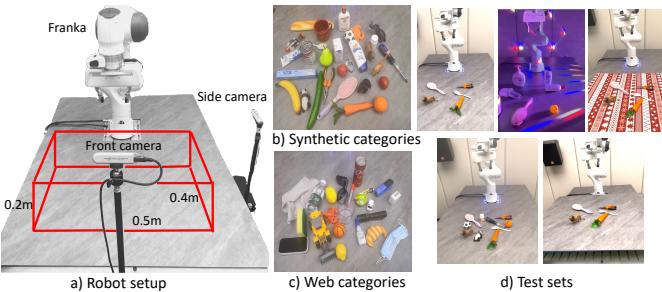
The results, summarized in Table 1 below, were remarkable.

Key Takeaways:
- Outperforming Real-Data Models: GraspVLA achieved a 93.3% success rate on synthetic categories and 93.3% on web categories. This significantly outperformed OpenVLA (20%) and Octo (16.6%), and even beat the fine-tuned \(\pi_0\) model.
- The Power of PAG: The ablation studies showed that without the Progressive Action Generation (the intermediate bounding box and grasp pose steps), performance on web categories dropped significantly. The “Chain of Thought” allows the model to apply its web-learned semantic knowledge to the physical world.
Scaling Laws
A defining characteristic of foundation models is that they get better as you feed them more data. Does this hold for synthetic robotic data?
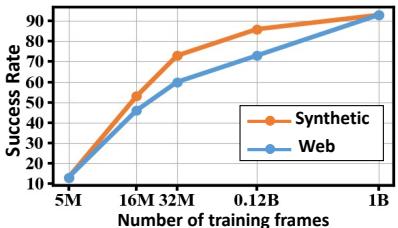
Figure 5 confirms that Scale Matters.
- Synthetic Categories (Orange Line): Performance improves rapidly and saturates near 90%.
- Web Categories (Blue Line): This is the most interesting curve. It scales slower initially but catches up as data volume increases. This proves that large-scale synthetic pre-training is essential for generalizing to novel, real-world objects.
Few-Shot Adaptation
One of the most powerful features of GraspVLA is its ability to adapt. What if you need the robot to perform a specialized task that wasn’t in the training set?
The authors demonstrated this with “Post-Training.” They fine-tuned the model with a tiny amount of real-world data (few-shot learning) for three specific tasks:
- Grasping rare industrial parts.
- Picking up a mug without touching the interior (sanitary grasping).
- Sequentially grasping bottles in a packed box (avoiding collisions).
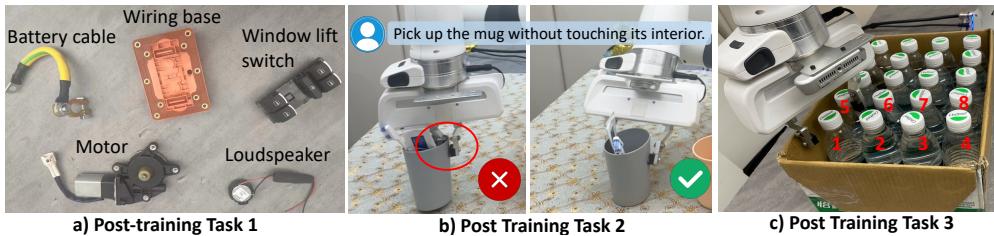
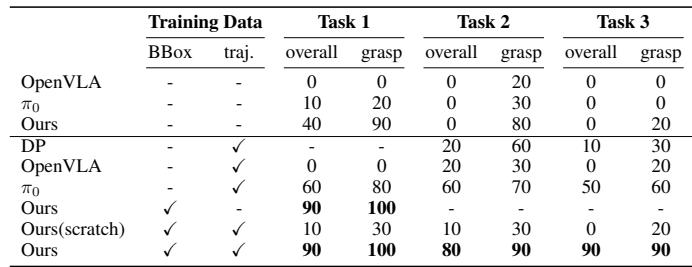
As shown in Table 4, GraspVLA adapted quickly. For the “sanitary mug” task, it learned the preference with just a few demonstrations, whereas baseline models struggled to understand the geometric constraint (touching the rim/handle vs. the inside).
Conclusion & Implications
GraspVLA represents a significant milestone in embodied AI. It challenges the prevailing wisdom that robots must learn from the real world. By generating a billion frames of high-fidelity synthetic data and employing a “Progressive Action Generation” architecture, the authors created a model that is:
- Generalizable: It handles novel objects and lighting conditions zero-shot.
- Scalable: Performance improves linearly with synthetic data volume (which is infinite and cheap).
- Adaptable: It can be fine-tuned for specific, nuanced tasks rapidly.
This suggests a future where robot “brains” are largely pre-trained in the cloud, inside massive simulations, before ever being downloaded into a physical body. The “Sim-to-Real” gap is no longer a canyon—it is a crack that is rapidly being filled by data.
While GraspVLA focuses on grasping, the methodology could likely be extended to more complex manipulation tasks like folding laundry or assembling electronics, paving the way for truly general-purpose robots.