](https://deep-paper.org/en/paper/2505.03238/images/cover.png)
Introduction
We are currently witnessing a massive shift in the capabilities of Large Language Models (LLMs). With the release of models like DeepSeek R1, we’ve seen that LLMs can “learn to reason” by verifying their own answers against mathematical truths. But there is a frontier where this reasoning capability hits a wall: Embodied AI.
In the digital world, a math problem is static. In the physical world, environments are chaotic, dynamic, and unpredictable. A robot cannot simply “think” its way out of a problem; it must act, observe the consequences, and adapt. Furthermore, robots often operate on the “edge”—onboard computers with limited battery and memory—making massive cloud-based models like GPT-4 impractical and insecure for real-time control.
This brings us to a fascinating new paper: RobotxR1. The researchers propose a method to extend the “R1-Zero” training philosophy—Reinforcement Learning (RL) on raw reasoning—into the domain of robotics. By placing a small, manageable LLM into a closed feedback loop with a driving simulator, they achieved something remarkable: a small 3-billion parameter model that outperforms the massive, cloud-based GPT-4o in controlling an autonomous car.
In this post, we will tear down the RobotxR1 architecture, explain how they successfully bridged the gap between language and control, and look at the data proving that “learning by doing” beats “learning by reading.”
Background: The Problem with Mimicry
To understand why this paper is significant, we have to look at how we typically train robots with LLMs. The standard approach is Supervised Fine-Tuning (SFT).
Imagine you want to learn to drive.
- SFT approach: You read a driving manual and memorize 10,000 descriptions of perfect turns. You have “knowledge,” but no “feel.”
- RL approach: You get in a car. You turn the wheel too hard, hit a cone, and correct yourself. You turn too soft, drift out of the lane, and correct yourself. You develop intuition.
Most current “Embodied LLMs” rely on SFT. They distill the reasoning of huge models (like GPT-4) into smaller models. While effective for basic instructions, these distilled models operate in abstraction. They lack the closed-loop perception-action cycle—the “physical intuition”—required for robust robotic intelligence.
The RobotxR1 paper asks: Can we skip the distillation and instead let the LLM learn directly from the environment, just like a human student driver?
The RobotxR1 Architecture
The researchers developed an autonomous driving agent composed of two specialized modules working in tandem. This split architecture allows the system to verify its own behavior and adapt its control strategy simultaneously.
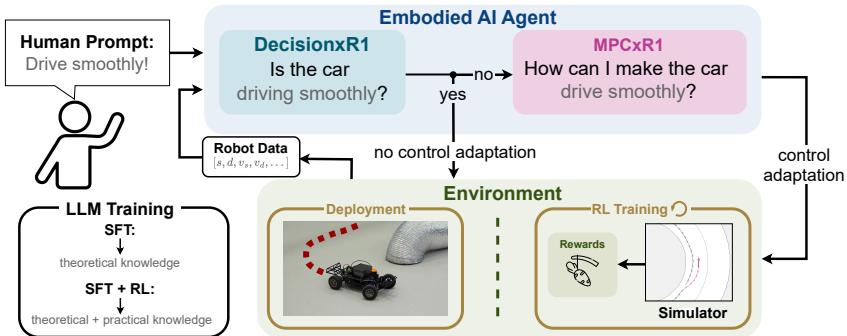
As shown in Figure 1 above, the system takes a human prompt (e.g., “Drive smoothly!”) and processes it through two pathways:
- DecisionxR1: The “Judge.” It looks at the car’s current data and asks, “Is the car driving smoothly?”
- MPCxR1: The “Driver.” It asks, “How do I tune the controller to make the car drive smoothly?”
If the Decision module sees the car is failing the task, the MPC module kicks in to adapt the control parameters.
The Hands and Feet: Model Predictive Control (MPC)
Before diving into the LLM, we need to understand what the LLM is actually controlling. It is not sending voltage directly to the motors. It is talking to a Model Predictive Controller (MPC).
An MPC is a mathematical optimization algorithm. It looks a slightly into the future, predicts where the car will go based on physics, and selects the best steering and acceleration to minimize a “cost function.”

In the equation above, the controller tries to minimize errors in distance to the racing line (\(n\)), velocity differences (\(v - v_{ref}\)), and heading errors (\(\Delta \phi\)).
The innovation here is that the LLM acts as the tuner. The MPC has “weights” (how much it cares about speed vs. safety vs. smoothness). The LLM’s job is to dynamically change these weights based on what the human wants.
DecisionxR1: The Reasoning Judge
The first specialized module is DecisionxR1. Its sole purpose is to reason about the robot’s current state relative to the human’s command.
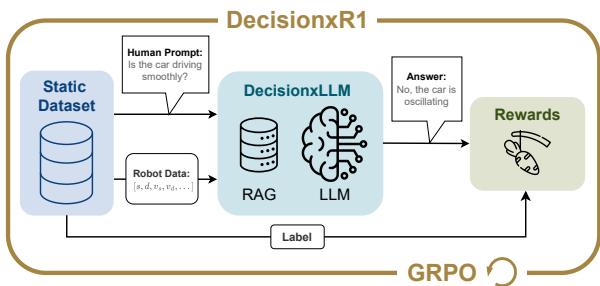
This module uses Retrieval Augmented Generation (RAG) to access a history of robot states. It acts as a binary classifier, outputting a “Yes/No” on whether the car is obeying the prompt.
The training here uses Reinforcement Learning from Verifiable Rewards (RLVR). The researchers created a static dataset of driving scenarios (e.g., reversing, racing, smooth driving) with known ground-truth labels. The model is rewarded based on two factors:

- Accuracy (\(R_{accuracy}\)): Did it correctly identify the behavior?
- Formatting (\(R_{fmt}\)): Did it structure its reasoning thoughts correctly (e.g., using specific XML tags)?
This structure forces the model to “think out loud” before answering, improving its reliability.
MPCxR1: Embodied Learning by Doing
This is the core contribution of the paper. Unlike the Decision module which learns from static data, MPCxR1 learns by interacting with a simulator.
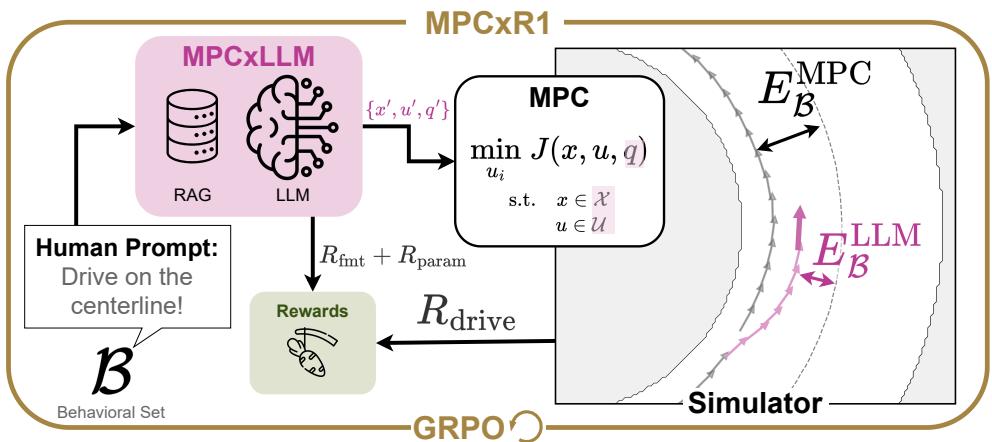
The process illustrated in Figure 3 works as follows:
- Prompt: The system receives a command (e.g., “Drive at 1.83 m/s”).
- LLM Action: The LLM generates a set of MPC parameters (weights, constraints).
- Simulation: The system runs a simulation using those parameters.
- Feedback: The simulator calculates the error (RMSE) between the actual driving behavior and the requested behavior.
This forms a closed loop. The reward function for this module is critical:

The driving reward (\(R_{drive}\)) is calculated by comparing the error of the LLM’s parameters (\(E^{LLM}\)) against the error of the default MPC parameters (\(E^{MPC}\)).
- If the LLM makes the car drive closer to the target than the default controller, it gets a positive reward.
- If it performs worse, it gets a negative reward.
This forces the LLM to develop an “intuition” for how changing a mathematical weight (like q_v for velocity cost) translates to physical motion on the track.
Generalization Strategy
To ensure the LLM isn’t just memorizing one specific track, the researchers used a clever training strategy.
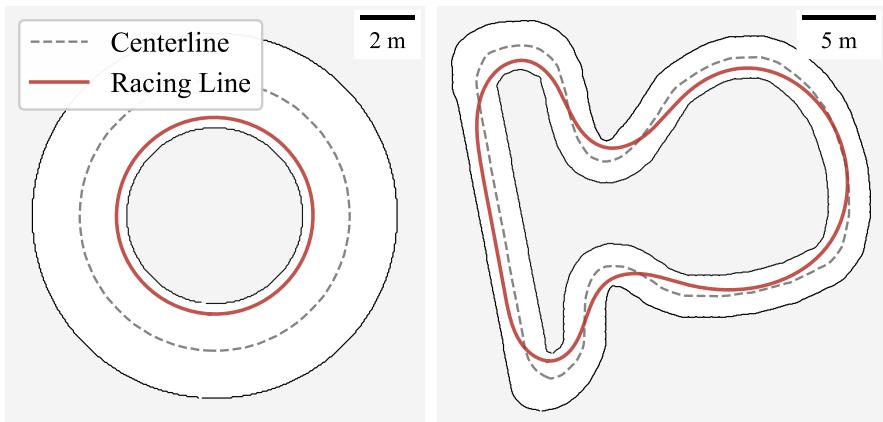
As seen in Figure 7, they trained the model on a simple Circle Map (Left). This allows for fast, consistent feedback. However, they evaluated the model on The Grand Tour Map (Right), a complex track with sharp turns and varying geometry. If the model performs well on the Grand Tour, it proves it has learned generalizable vehicle dynamics, not just map memorization.
Experiments and Results
The authors trained Qwen2.5 models (1.5B and 3B parameters) using this pipeline and compared them against standard SFT models and the industry giant, GPT-4o.
1. Does the model actually learn?
The training curves show a clear success story.
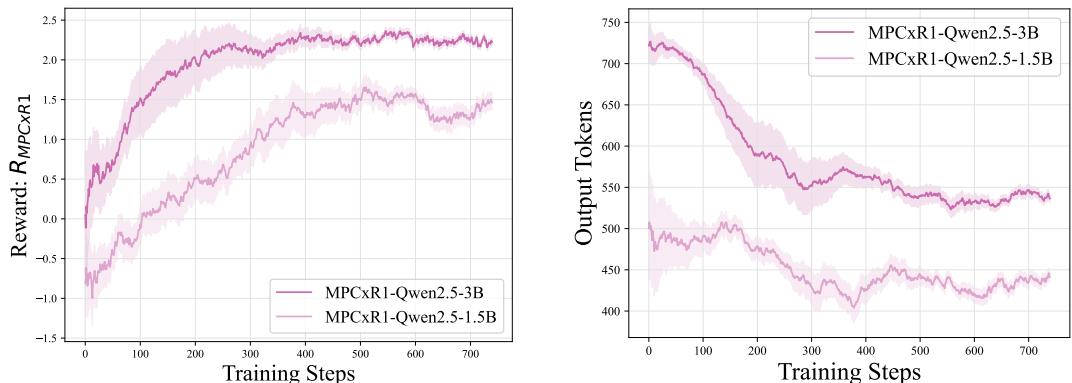
In Figure 5 (Left), we see the reward signal (\(R_{MPCxR1}\)) steadily increasing over training steps. The model is effectively learning to tune the MPC.
A surprising finding: Look at Figure 5 (Right). The average output token length decreases over time. In math-based reasoning models (like DeepSeek R1), chain-of-thought usually gets longer as the model “thinks harder.” In robotics, the model learned to be concise. The authors suggest that for immediate control tasks, brevity and directness might be more optimal than long philosophical reasoning chains.
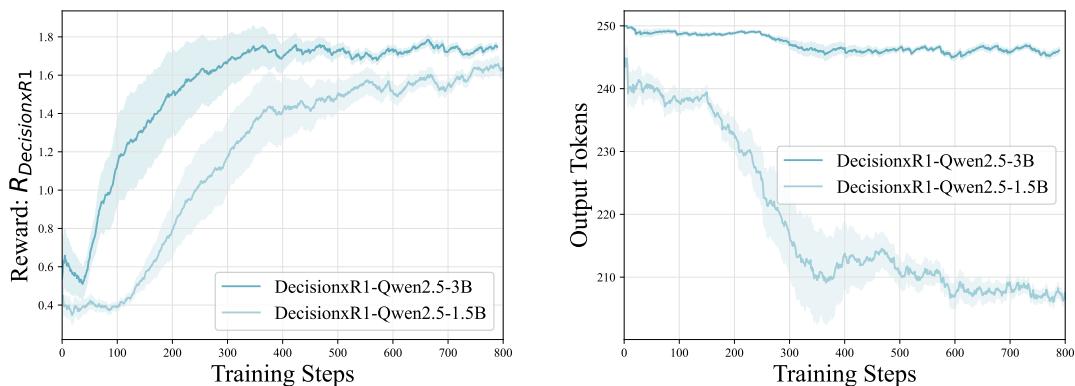
The Decision module showed similar convergence:
2. David vs. Goliath: Qwen-3B vs. GPT-4o
The most striking result is the control adaptability comparison. The researchers measured how well different models could adapt the car’s behavior to match user prompts (e.g., “Reverse,” “Drive smoothly,” “Drive fast”).
- GPT-4o (Cloud): achieved a 58.5% improvement over the baseline.
- Qwen2.5-3B (SFT only): achieved 50.4% improvement (with some failures).
- Qwen2.5-3B (RobotxR1 / SFT + RL): achieved 63.3% improvement.
The small, locally trained model beat GPT-4o.
Why? Because GPT-4o has read every book on driving, but Qwen2.5-3B (RobotxR1) has actually “driven” (in simulation). The RL training grounded the model’s language in physical reality.
3. Real-World Deployment
The researchers didn’t stop at simulation. They deployed the model on a physical 1:10 scale autonomous race car powered by an NVIDIA Jetson Orin AGX.
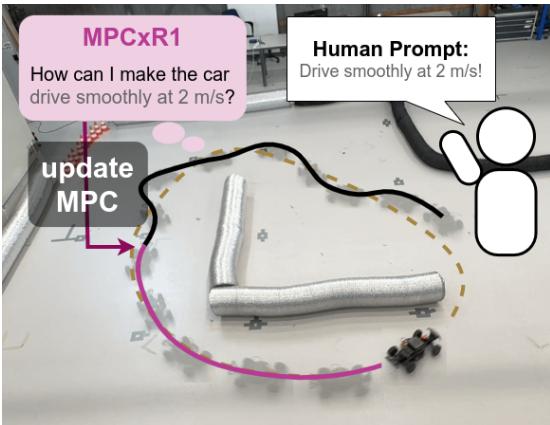
In Figure 4, we see the real-world experiment. The robot was initially set to an unstable, oscillating state. The user prompted: “Drive smoothly at 2 m/s!” The MPCxR1 module successfully diagnosed the oscillation, updated the MPC weights, and the car smoothed out its trajectory immediately.
4. Computational Efficiency
Running LLMs on robots is hard because of power constraints. The authors used Quantization (reducing the precision of the model weights to 5-bit) to make it fit.
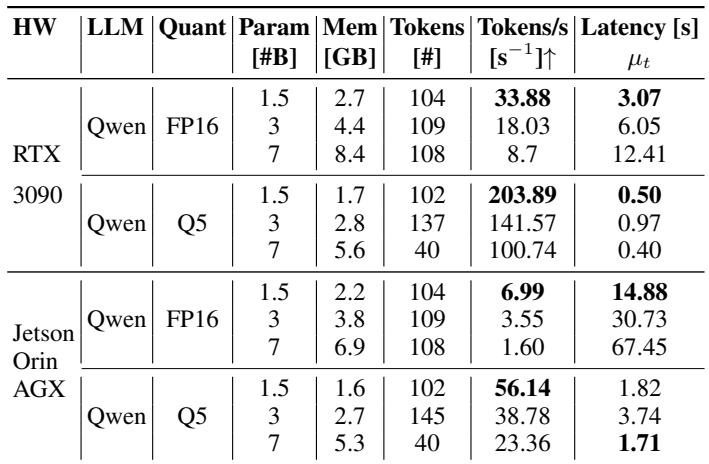
Table 3 shows the performance on the embedded Jetson Orin AGX.
- The Q5 (Quantized) 3B model runs at 38.78 tokens/second.
- The Full Precision (FP16) model runs at only 3.55 tokens/second.
This 10x speedup is the difference between a robot that crashes while “thinking” and a robot that reacts in real-time. Crucially, the experiments showed that quantization had a negligible impact on the model’s reasoning accuracy, proving this approach is viable for edge deployment.
Conclusion
The RobotxR1 paper serves as a proof-of-concept for a new paradigm in robotic learning. Instead of relying on massive, cloud-tethered models or purely supervised imitation, it enables small, efficient models to learn through interaction.
By closing the loop between the LLM and the simulator, the researchers allowed the model to verify its own actions. The result is a system that is:
- More capable: Beating GPT-4o in specific control tasks.
- More efficient: Running locally on embedded hardware.
- More robust: Generalizing from simple circles to complex race tracks.
As we look toward the future of Embodied AI, this “learning by doing” approach—grounded in Reinforcement Learning rather than static datasets—seems to be the key to unlocking robots that truly understand the physical world they operate in.