](https://deep-paper.org/en/paper/2505.03725/images/cover.png)
Introduction
Imagine asking a robot to “draw a perfect star on a tilted whiteboard” or “push these scattered blocks into a neat line.” To a human, these requests are simple. To a robot, they represent a complex interplay of high-level semantic understanding and low-level geometric precision.
For years, roboticists have struggled with the Task and Motion Planning (TAMP) problem. The challenge lies in the divide between discrete decisions (which object to pick up, which tool to use) and continuous control (how to move the joints smoothly without hitting obstacles).
Recently, Foundation Models (FMs) and Large Language Models (LLMs) have promised a revolution. We’ve seen demos where LLMs generate code to control robots. However, there is a catch: LLMs are great at reasoning (“I need to pick up the cup”) but terrible at physics and precise numbers (“I need to apply 2.4N of force at coordinates x, y, z”). Current approaches often result in robots that “hallucinate” feasible actions, leading to collisions or failed tasks.
In this post, we are breaking down a new paper, “Meta-Optimization and Program Search using Language Models for Task and Motion Planning” (MOPS). This research proposes a fascinating solution: instead of asking the LLM to directly control the robot, we ask it to act as a meta-optimizer. It writes a mathematical program, which is then tuned by a numerical optimizer, which is finally solved by a motion planner.
It sounds complex, but it essentially gives the robot a “brain” for strategy, a “calculator” for tuning, and a “reflex system” for movement. Let’s dive into how it works.
Background: The TAMP Problem
To understand why MOPS is significant, we first need to understand the limitations of current approaches.
Classical TAMP
Traditionally, TAMP involves symbolic planning (like PDDL) linked to trajectory optimization. An engineer manually defines “predicates” (rules like IsHolding(BlockA)). A planner searches for a sequence of these rules to reach a goal.
- Pros: precise, guarantees safety.
- Cons: brittle. If the engineer didn’t write a rule for a specific situation, the robot fails. It requires immense manual effort.
The “Code as Policies” Era
With the rise of GPT-4 and other models, researchers started prompting LLMs to write Python code that calls robot primitives (e.g., robot.pick_up(block)).
- Pros: incredibly flexible; handles natural language instructions well.
- Cons: LLMs lack spatial reasoning. They might tell a robot to place a block at coordinates that are mathematically impossible or result in a collision.
The Missing Link
The authors of MOPS identify that prior FM-based methods suffer from two extremes:
- Too much abstraction: Chaining pre-canned skills without adjusting the fine details.
- Lack of abstraction: Trying to predict joint angles directly (which LLMs are notoriously bad at).
MOPS sits in the middle. It uses the LLM to define the structure of an optimization problem but leaves the numerical details to specialized algorithms.
The Core Method: MOPS
MOPS stands for Meta-Optimization and Program Search. The core idea is to treat the planning problem as a search over constraint sequences rather than action sequences.
The framework operates in a three-level loop, as illustrated in the diagram below.
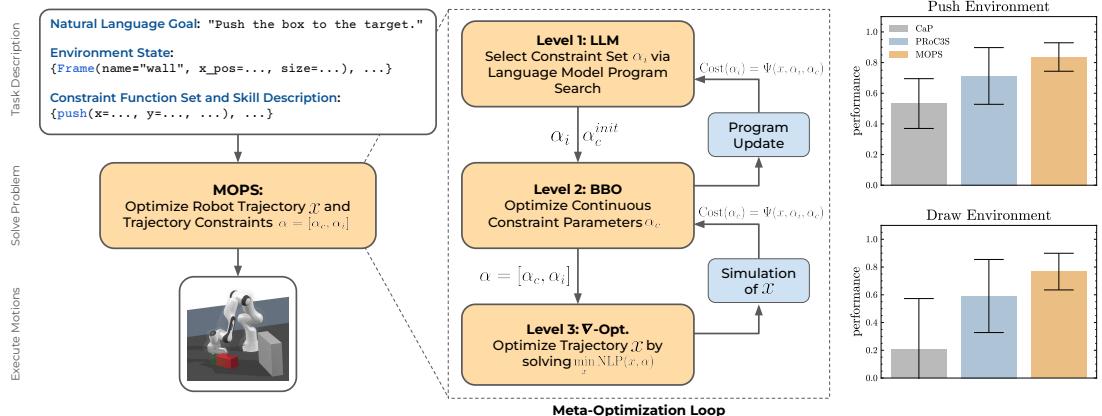
Let’s break down these three levels.
Level 1: Language Model Program Search (The Architect)
At the highest level, we have the Foundation Model (FM). The system feeds the FM a textual description of the scene and the goal.
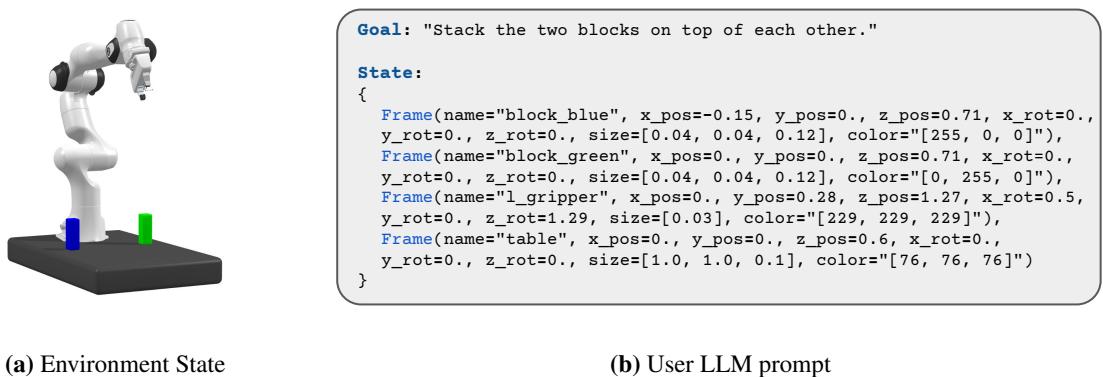
Instead of asking the FM to “move the arm,” MOPS asks the FM to generate a Language Model Program (LMP). Specifically, it asks for a function that defines a Non-Linear Program (NLP).
This code doesn’t specify how to move. It specifies what constraints must be true. For example, if the task is to draw a line, the LLM might output code that mathematically imposes: “The end-effector must be in contact with the surface between time \(t_1\) and \(t_2\).”
The LLM outputs two things:
- The Constraint Structure (\(\alpha_i\)): Which constraints apply? (e.g., “Keep the gripper vertical”).
- Initial Parameter Guesses (\(\alpha_c^{init}\)): Rough guesses for the numbers (e.g., “Start drawing at x=0.2”).
Mathematically, the LLM is trying to minimize the cost over the choice of discrete constraints:

Here, \(\Psi\) represents the extrinsic cost (did we succeed?), which depends on the trajectory \(x\), the active constraints \(\alpha_i\), and the continuous parameters \(\alpha_c\).
Level 2: Black-Box Optimization (The Tuner)
LLMs are notoriously bad at outputting precise floating-point numbers. If the LLM guesses the “start point” of a drawing, it might be 2cm off, causing the pen to miss the paper or stab through it.
Level 2 fixes this. It takes the rough guess from the LLM and uses a Black-Box Optimizer (BBO)—specifically CMA-ES (Covariance Matrix Adaptation Evolution Strategy).
The BBO runs simulations. It takes the constraints provided by the LLM, tweaks the continuous parameters (like the exact tilt of the whiteboard or the precise grasping point), and checks the result in a physics simulator. It iterates to minimize the cost \(\Psi\).
This creates a robust interface. The LLM handles the logic (semantics), while the BBO handles the tuning (numerics).
Level 3: Gradient-Based Trajectory Optimization (The Solver)
Once Level 2 has refined the parameters, we have a fully defined optimization problem. Now, we use a classic gradient-based solver (like Newton’s method) to generate the actual robot motion.
The solver minimizes the physical effort (squared acceleration) while strictly adhering to the constraints defined by the LLM and tuned by the BBO.
The objective function looks like this:

Subject to inequality constraints \(g\) and equality constraints \(h\):
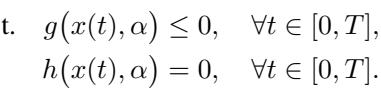
Or, combining the trajectory generation into a single expression:

This step ensures the robot moves smoothly, avoiding jerky motions that could damage hardware or objects, while satisfying the “rules” of the task.
Closing the Loop
Here is the “Meta” part: If the plan fails (high cost), the system feeds feedback back to the LLM. It reports the cost and the failure mode, allowing the LLM to re-write the program (e.g., “Oh, I need to add an obstacle avoidance constraint”) and try again.
Experiments and Results
The researchers tested MOPS in two challenging environments: Pushing and Drawing.
The Tasks
- Pushing: The robot must arrange blocks into specific formations (a line, a circle) or navigate a block around a wall. This requires physics reasoning—pushing one block might displace another.
- Drawing: The robot must draw shapes (star, pentagon, hash) on a tilted whiteboard. This is tricky because the camera view is top-down, but the board is angled. A simple 2D plan would result in distorted, “squashed” drawings.
Qualitative Results: Seeing is Believing
Let’s look at the Pushing task. The goal was to push blocks into a straight line.
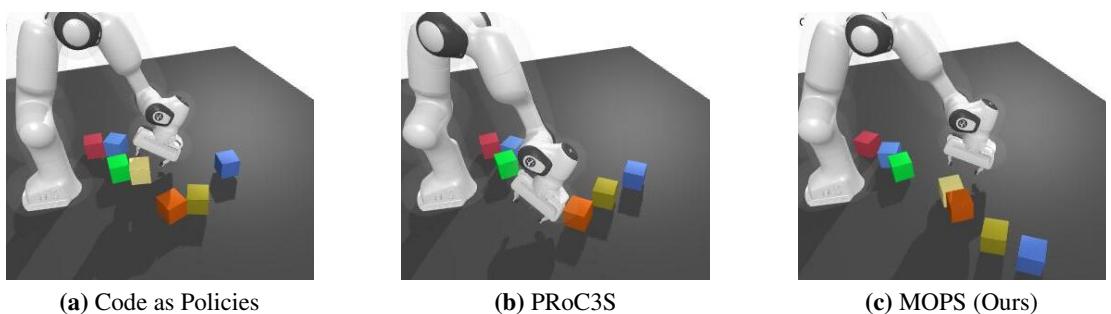
In the image above:
- Code as Policies (CaP) fails to align the gripper properly.
- PRoC3S (a baseline that uses sampling) gets closer but leaves the blocks messy.
- MOPS (Right) achieves a nearly perfect alignment.
The difference is even more stark in the Drawing domain. Because the whiteboard is tilted, the robot must adjust its trajectory in 3D space to make the 2D image look correct (perspective correction).
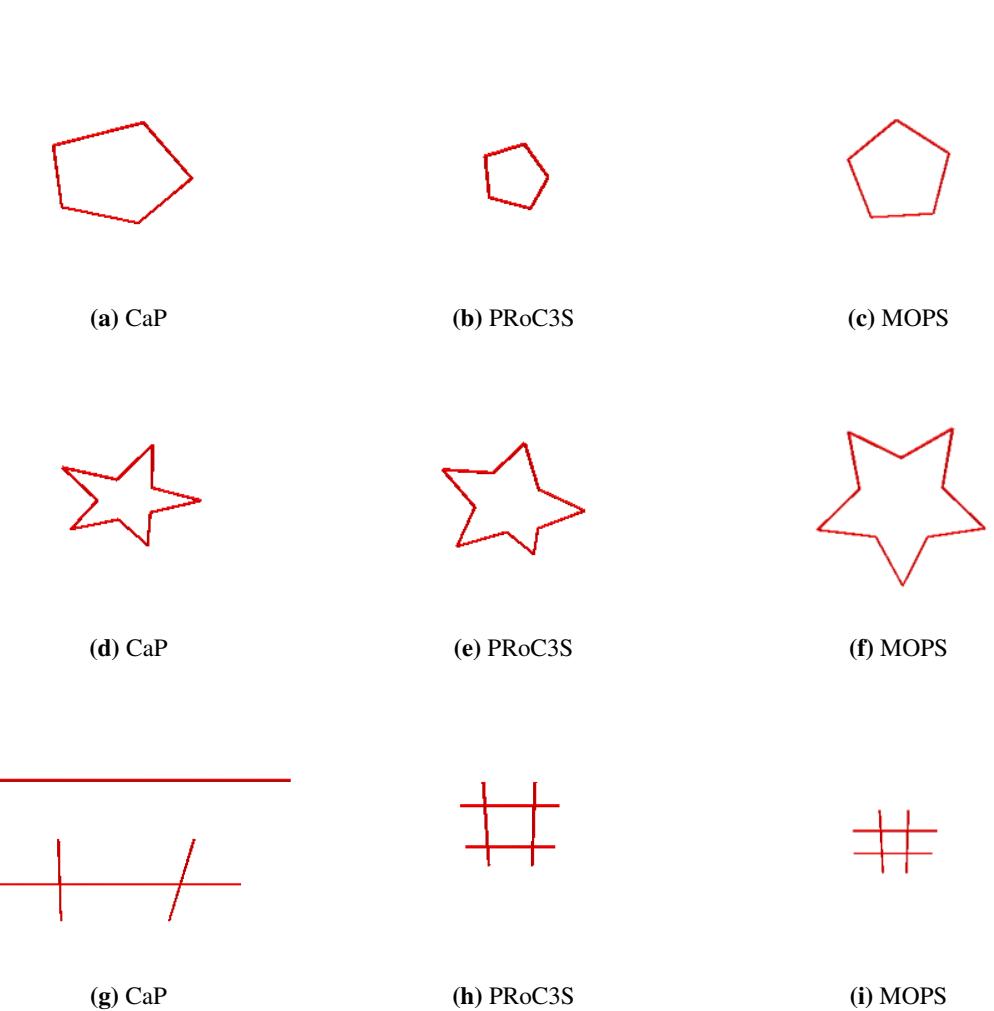
Look at the Star (middle row) and Hash (bottom row) in Figure 8:
- CaP (Left): The shapes are unrecognizable or distorted.
- PRoC3S (Middle): Better, but the “Hash” is disconnected.
- MOPS (Right): Produces clean, connected, geometrically accurate shapes.
Quantitative Analysis
The researchers compared MOPS against Code-as-Policies (CaP) and PRoC3S. The metric is normalized performance (higher is better, max 1.0).
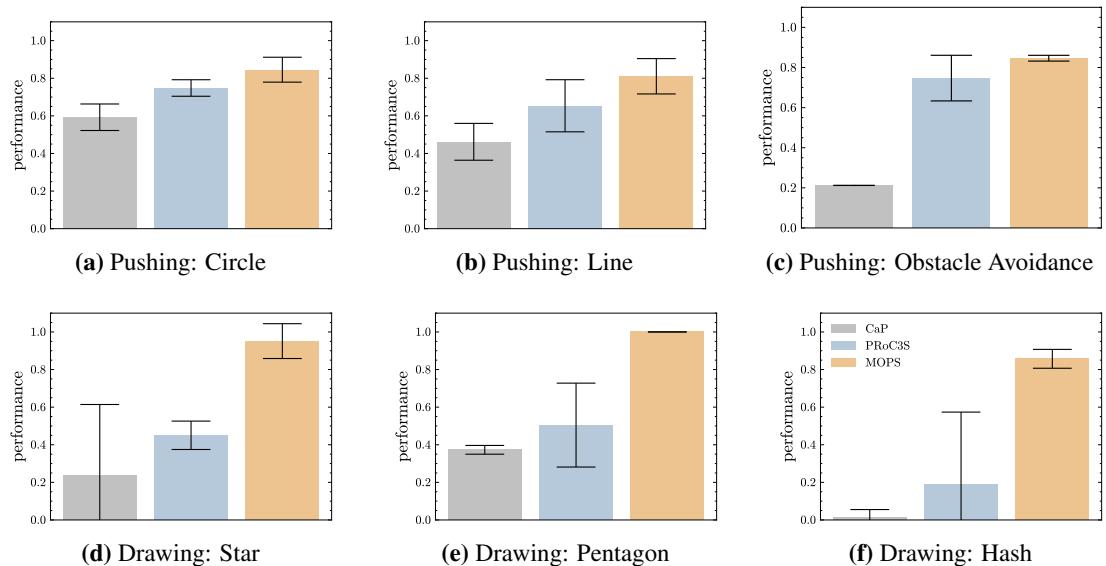
As shown in Figure 4, MOPS (Orange bars) dominates across every task.
- Drawing: The gap is massive. CaP scores near zero because it cannot infer the complex 3D transforms needed for the tilted board.
- Pushing: The “Obstacle Avoidance” task (panel c) shows that without the optimization loop, baselines struggle to navigate complex constraints.
Why does it work? (Ablation Studies)
Is the Black-Box Optimizer (BBO) really necessary? Could we just use random sampling?
The authors tested this by swapping the CMA-ES optimizer for Random Sampling (RS) and Hill Climbing (HC).
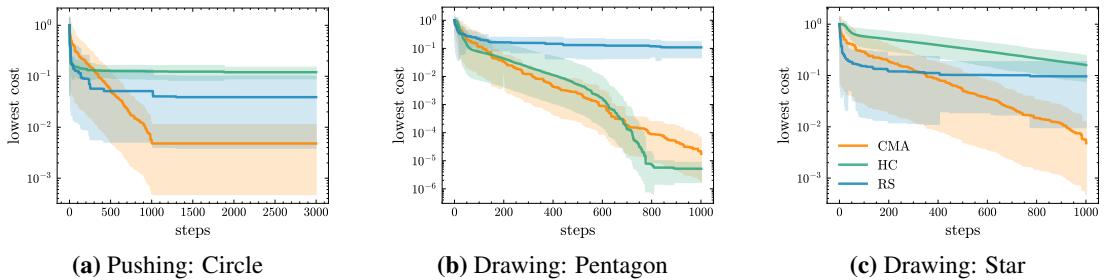
Figure 5 shows the “Lowest Cost” (lower is better) over optimization steps.
- Orange Line (CMA - MOPS): Converges rapidly to a very low cost.
- Blue Line (RS): Improves slowly. Randomly guessing parameters in a high-dimensional space is inefficient.
This proves that the “Level 2” optimization is critical. The LLM gives a good starting point, but the BBO is required to “dial in” the physics.
The Feedback Loop
Finally, does the LLM need to refine its plan? Figure 6 shows the cost dropping as the system iterates through feedback loops (0 to 2 iterations).
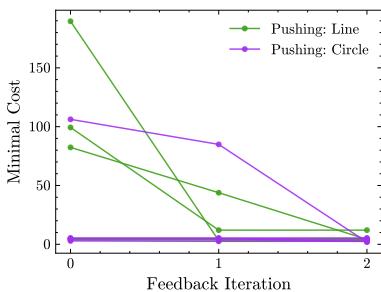
For the “Pushing Line” task, the initial plan (Iteration 0) had a high cost. After receiving feedback, the LLM adjusted the constraints, and by Iteration 2, the cost dropped significantly. This validates the “Meta-Optimization” aspect—the system learns and adapts during the planning phase.
Real World Transfer
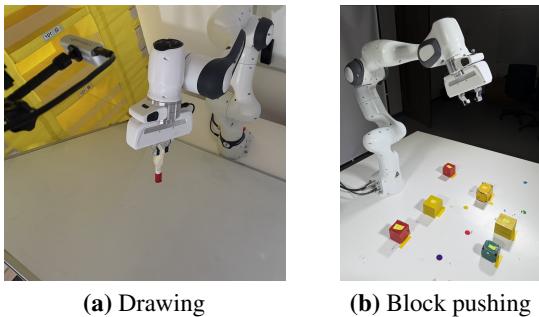
The team also validated this on a real Franka Panda robot, proving that the trajectories generated in simulation transfer to the real world (provided the calibration is accurate).
Conclusion and Implications
The MOPS paper presents a compelling argument: Foundation Models are not ready to be direct controllers, but they are excellent architects.
By treating TAMP as a meta-optimization problem, MOPS leverages the strengths of all available tools:
- LLMs for semantic understanding and program structure.
- Black-Box Optimization for tuning continuous parameters that LLMs cannot intuit.
- Trajectory Optimization for generating smooth, feasible robotic motion.
Key Takeaways for Students
- Hybrid Systems: The future of robotics likely isn’t “End-to-End AI” or “Classical Control,” but a hybrid of both.
- Abstraction Layers: Success in complex tasks comes from finding the right level of abstraction. MOPS abstracts constraints, not just actions.
- Optimization is Key: Generating a plan is only half the battle; tuning that plan against physical reality is where the robustness comes from.
This approach opens the door for robots that can understand vague human instructions (“Clean up this mess”) and translate them into mathematically rigorous, safe, and precise movements.