](https://deep-paper.org/en/paper/2505.03729/images/cover.png)
Introduction
Imagine trying to learn how to parkour just by reading a textbook on physics. You would have to calculate friction coefficients, angular momentum, and trajectory arcs in real-time. It sounds impossible, right? Instead, humans learn by watching. We observe someone climb a set of stairs or sit on a chair, we internalize that motion, and then we try to replicate it, adjusting our balance as we go.
For years, roboticists have been trying to teach humanoid robots to navigate complex environments—like climbing stairs or traversing rough terrain—using the “physics textbook” approach. This usually involves hand-tuning complex reward functions or setting up expensive motion capture (MoCap) studios to record data. But what if a robot could learn like we do? What if it could just watch a video of a person walking up stairs and figure it out?
This is the premise behind VIDEOMIMIC, a groundbreaking research paper from UC Berkeley.
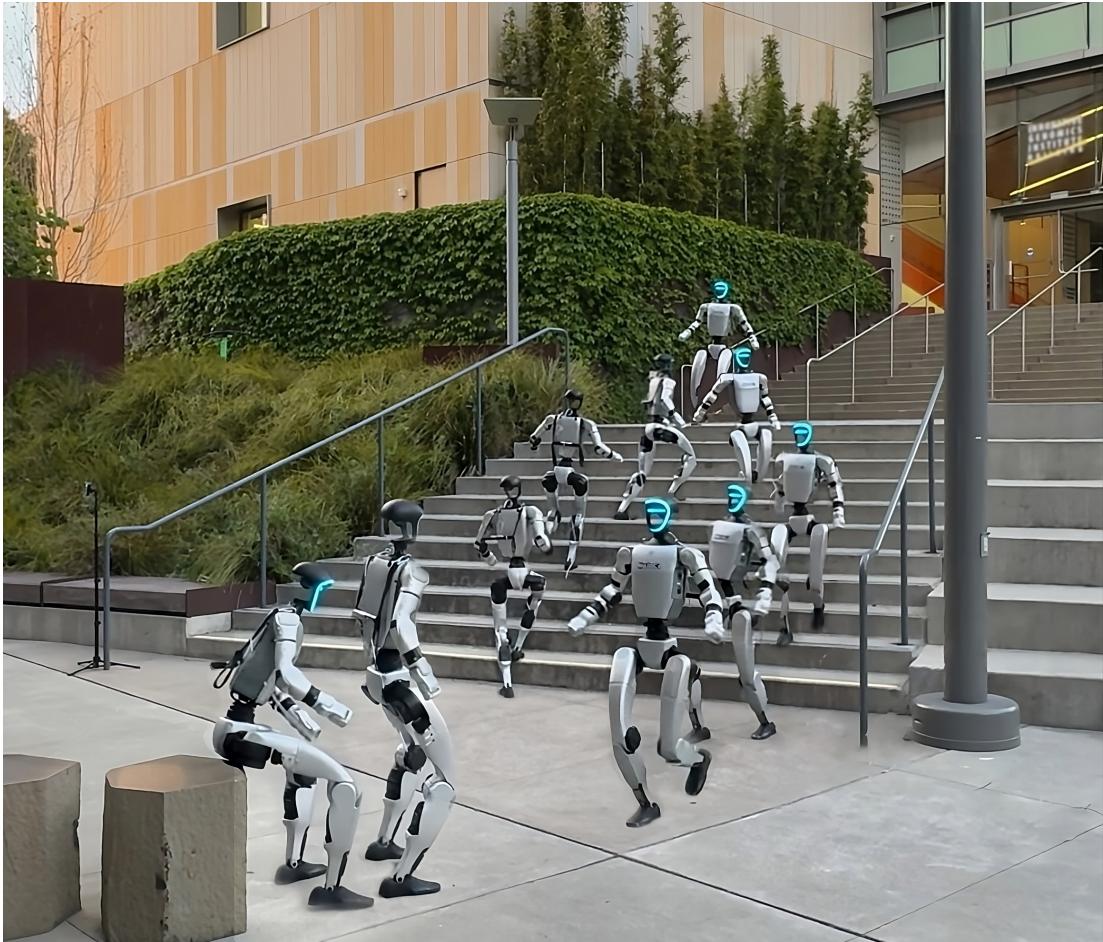
As shown in Figure 1, the researchers have developed a pipeline that converts casual, monocular videos (like those taken on a smartphone) into transferable skills for humanoid robots. By “watching” a video, the robot learns not just the motion, but how that motion interacts with the environment—enabling it to climb stairs, step over obstacles, and sit on chairs, all without a single line of manual reward engineering for those specific tasks.
In this post, we will tear down the VIDEOMIMIC pipeline, exploring how it turns 2D pixels into 4D control policies that work in the real world.
The Context: Why is this Hard?
To understand why VIDEOMIMIC is significant, we need to understand the current bottleneck in humanoid robotics: Data.
There are two main ways we currently teach legged robots to move:
- Reward Engineering: We place a robot in a simulation and tell it, “I will give you points if you move forward, but I will take away points if you fall or use too much energy.” This works for walking on flat ground, but defining the mathematical reward for “sit on that specific chair naturally” is incredibly difficult.
- Imitation Learning: We use Motion Capture (MoCap) data where a human wears a suit with markers. This provides high-quality data, but it is restricted to a studio. You cannot easily capture MoCap data of a person hiking a steep trail or navigating a cluttered office.
The “Holy Grail” is learning from raw video—the billions of hours of footage available on the internet. However, video lacks depth information (it’s 2D), and humans have different body proportions than robots (the “embodiment gap”). VIDEOMIMIC bridges this gap.
The Core Method: Real-to-Sim-to-Real
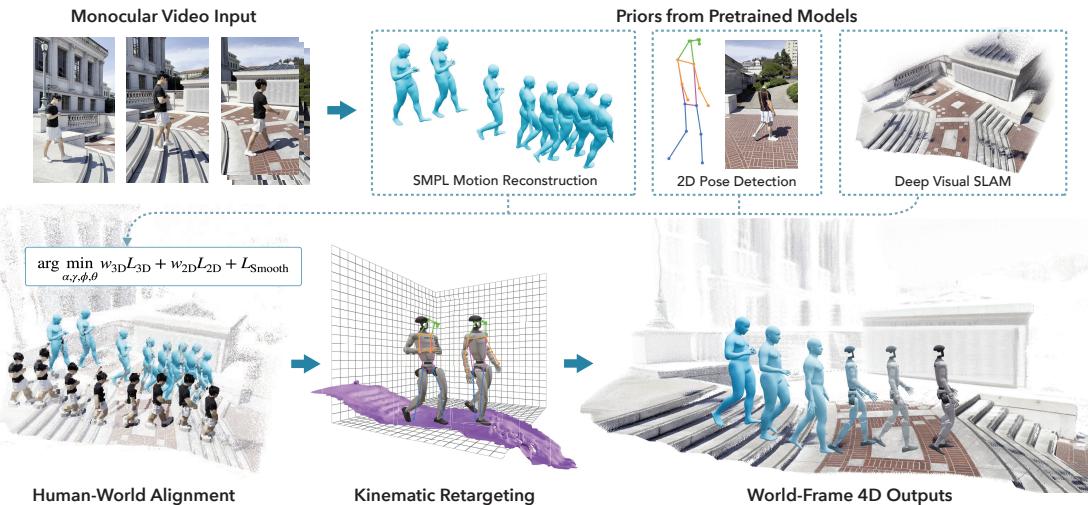
The VIDEOMIMIC pipeline is a masterclass in combining computer vision with reinforcement learning. The process can be broken down into a “Real-to-Sim” phase (processing the video) and a “Sim-to-Real” phase (training the policy).
Let’s look at the high-level workflow:
Step 1: 4D Human-Scene Reconstruction
The input is a simple RGB video. The goal is to extract two things: the 3D motion of the human and the 3D geometry of the environment.
The researchers use off-the-shelf tools to get a rough starting point. They use SAM2 to track people and ViTPose to detect body joints. For the environment, they use MegaSaM or MonST3R to generate a point cloud of the scene.
However, these tools have a major flaw when used separately: Scale Ambiguity. From a single camera, it’s hard to tell if you are looking at a giant human in a giant room or a small human in a small room. The camera trajectory is also often shaky.
To solve this, the authors introduce a Joint Human-Scene Optimization. They treat the human’s height (using standard biological priors) as a “ruler” to scale the environment correctly. They effectively say, “If we assume this person is roughly 1.7 meters tall, how big must the stairs be?”
They minimize a complex objective function to align everything:

This equation optimizes for:
- \(L_{3D}\): The 3D joints must make sense physically.
- \(L_{2D}\): When projected back onto the video, the 3D model must match the pixels.
- \(L_{Smooth}\): The motion shouldn’t jitter; humans move smoothly.
The result is a transformation from a messy, disjointed projection into a coherent, gravity-aligned world.
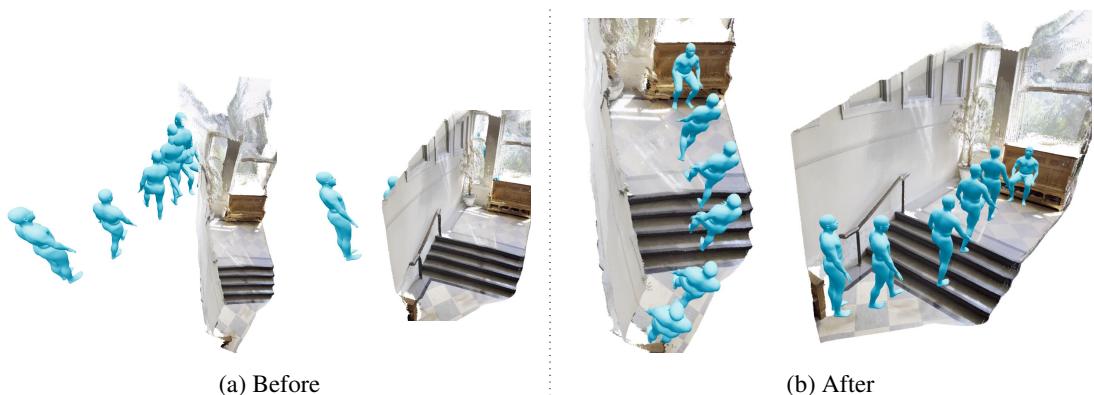
As you can see in Figure 7 above, the “Before” state (a) often has the human floating or the floor tilted at impossible angles. The “After” state (b) locks the human feet to the stairs and aligns the floor with gravity.
Step 2: Meshification and Retargeting
Once the system has a 3D point cloud of the scene and the human motion, it needs to prepare this for a physics simulator (Isaac Gym).
- Meshification: The point cloud is noisy. The system filters it and converts it into a solid mesh (using a method called NKSR). This gives the robot a solid floor to step on in simulation.
- Retargeting: A human has different joints than a Unitree G1 robot. The system uses kinematic optimization to map the human’s pose to the robot. It ensures that if the human’s foot is planted on a step, the robot’s foot is also planted on that step.
Step 3: Policy Learning
Now that we have a “Digital Twin” of the video—a robot character standing in front of a reconstructed staircase—we need to teach its brain (the neural network) how to execute the move.
The training process is a four-stage pipeline designed to gradually increase the robot’s independence.
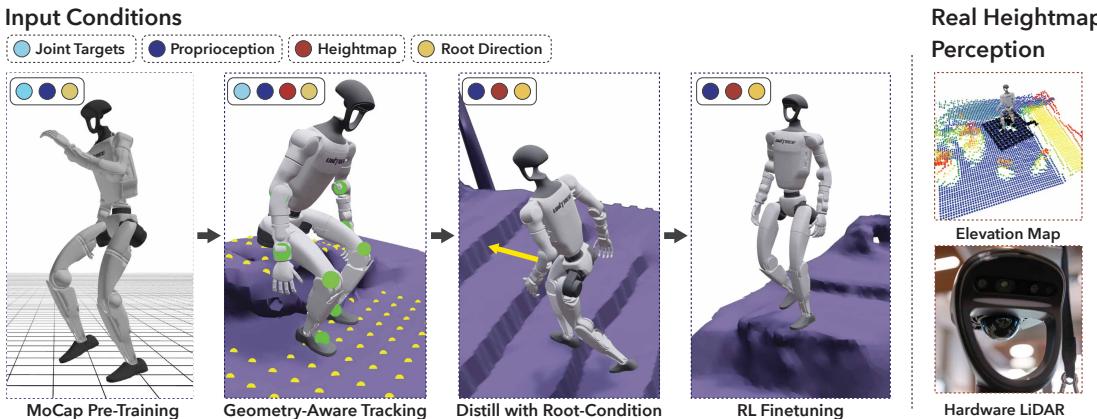
Stage 1: MoCap Pre-Training (MPT)
Learning from video reconstruction is hard because the data can be noisy. To give the robot a head start, the researchers first train it on high-quality Motion Capture (MoCap) data. This teaches the robot the basics of balance and walking without the confusion of complex terrain.
Stage 2: Scene-Conditioned Tracking
The robot is then placed into the reconstructed video scenes. It is given a “Heightmap” (a scan of the terrain around its feet) and told to track the retargeted video motion. At this stage, the robot is still being “spoon-fed” the target joint angles. It knows exactly where its knees should be at every millisecond.
Stage 3: Distillation
This is the critical step for generalization. In the real world, you can’t tell a robot “move your knee to 45 degrees” to climb a stair it has never seen. You want to tell it “move forward” and have it figure out where to put its feet based on what it sees.
The researchers use DAgger (Dataset Aggregation) to distill the policy. They train a “Student” policy that does not see the specific joint targets. Instead, the Student only sees:
- Proprioception: Its own body state.
- Heightmap: The terrain geometry.
- Root Direction: “Go that way.”
The Student tries to copy the Teacher (from Stage 2) using only these limited inputs.
Stage 4: RL Finetuning
Finally, the Student policy is allowed to practice on its own using Reinforcement Learning. This helps it smooth out behaviors and recover from mistakes. The result is a generalist controller that can walk, climb, or sit based purely on the environment and a directional command.
Experiments and Results
The researchers validated their approach through rigorous testing in simulation and, most importantly, on physical hardware.
Robustness of Reconstruction
How well does that joint optimization actually work? The team compared their reconstruction accuracy against state-of-the-art methods like WHAM and TRAM.
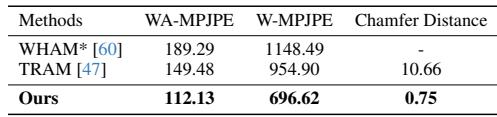
Table 2 shows that VIDEOMIMIC achieves significantly lower error (MPJPE is “Mean Per Joint Position Error”) and better geometric reconstruction (Chamfer Distance) than the baselines. This accuracy is vital—if the stairs are reconstructed 10cm too low, the robot will trip.
The Importance of Pre-Training
Is it necessary to start with MoCap data? The authors performed an ablation study to find out.
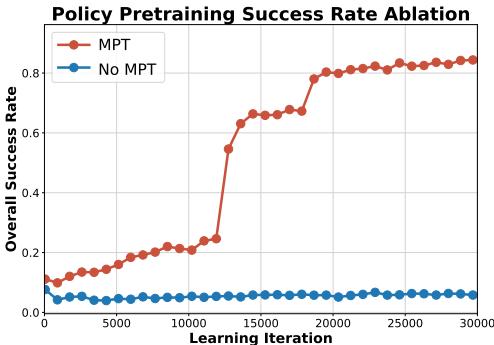
Figure 6 illustrates a stark difference. The blue line (No MPT) barely learns anything. The red line (With MPT) shoots up to high success rates. This confirms that “warm-starting” the robot with clean motion data is essential for it to handle the noise of video data later.
Real-World Deployment
The ultimate test is putting the code on a Unitree G1 robot. The robot relies on a LiDAR sensor to generate the local heightmap in real-time.
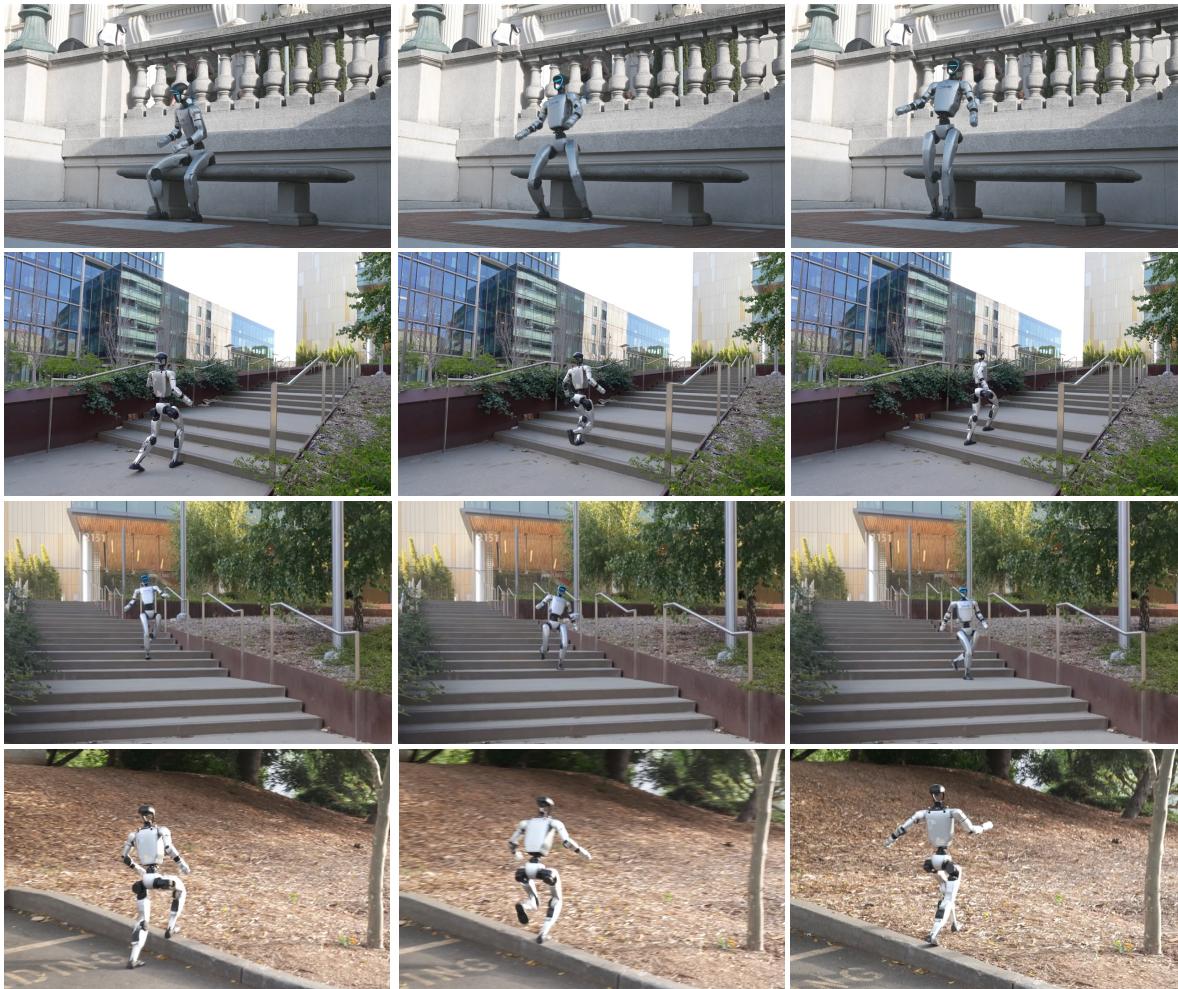
The results, shown in Figure 5, are impressive. The same single policy enables the robot to:
- Sit and Stand: (Top row) The robot approaches a bench, detects the geometry, and sits down.
- Climb Stairs: (Middle rows) It handles both ascending and descending flights of stairs.
- Traverse Rough Terrain: (Bottom row) It navigates over curbs and uneven ground.
Crucially, the robot is context-aware. It isn’t explicitly told “switch to stair-climbing mode.” It simply sees the stairs via its heightmap, receives a “move forward” command from the joystick, and the policy infers that it needs to lift its legs higher to climb.
Evaluation at Different Stages
The team also visualized the performance difference between the initial MoCap policy and the final generalist policy.
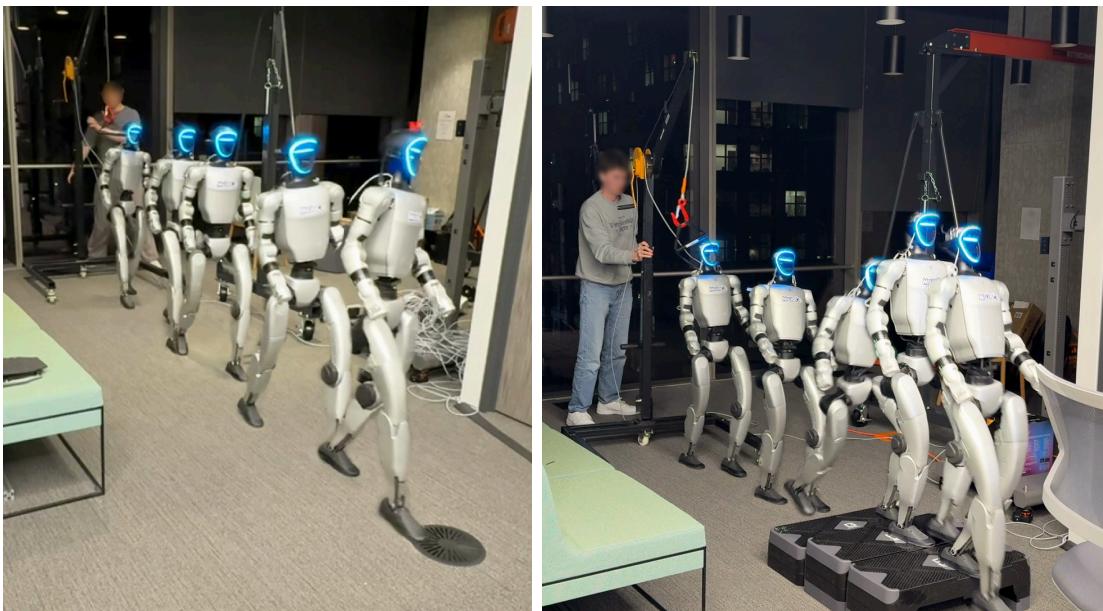
While the MoCap policy (Left) is stable, the final generalist policy (Right) demonstrates the ability to track trajectories flexibly in a lab environment, proving the effectiveness of the distillation process.
Future Implications: Seeing Through the Robot’s Eyes
One of the most exciting potential expansions of this work is Ego-view Rendering. Because the pipeline reconstructs the full 3D scene, the researchers can generate what the robot would see from its own camera during the motion.
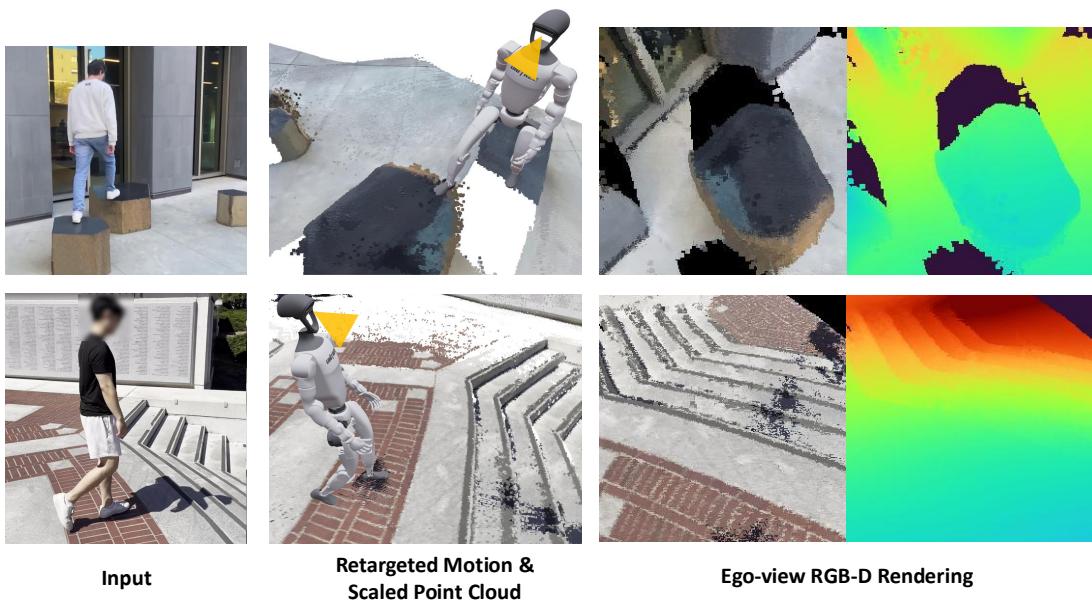
As shown in Figure 8, this allows for generating synthetic RGB and depth data from the robot’s perspective. While the current policy relies on a heightmap (geometry), future versions could use this visual data to train robots to understand semantics—for example, avoiding a wet floor sign or distinguishing between a sidewalk and a flowerbed.
Conclusion
VIDEOMIMIC represents a significant step away from manual robot programming and toward robots that learn like we do: by observing the world.
By successfully recovering 4D human-scene interactions from casual videos and distilling them into a robust control policy, the authors have provided a scalable path for teaching humanoids. We are moving toward a future where, instead of writing code to teach a robot to fix a sink or load a dishwasher, we might simply show it a YouTube video and say, “Do it like that.”
The paper demonstrates that with the right pipeline, the noisy, chaotic data of the real world isn’t a hindrance—it’s the best training manual we have.