](https://deep-paper.org/en/paper/2505.04656/images/cover.png)
Introduction
The race to bridge the gap between 2D images and 3D content creation is moving at breakneck speed. We have seen massive leaps in diffusion models that can conjure images from thin air, and naturally, researchers are applying these principles to the third dimension. However, generating a high-quality, production-ready 3D asset from a single image remains a formidable challenge.
Current state-of-the-art methods generally fall into two camps: optimization-based methods (which are slow) and Large Reconstruction Models (LRMs) that predict 3D representations like NeRFs or Gaussians directly. While LRMs are fast, they often struggle when converting those volumetric representations into clean, editable meshes. Furthermore, “native” 3D diffusion models—which attempt to learn the distribution of 3D shapes directly—often produce overly simple, symmetric blobs that lack the sharp geometric details of the input image.
Perhaps the biggest bottleneck for practical use is texture. Most current AI 3D generators produce “baked-in” lighting. If you generate a 3D model of a car, the reflection of the sun is painted onto the car’s surface. If you put that car in a night scene in a video game, it will still look like it’s noon. For professional workflows, we need Physically Based Rendering (PBR) materials—maps for Albedo (base color), Roughness, and Metallic properties—that react to light dynamically.
Enter MeshGen.
In this post, we will dive deep into a new research paper that proposes a comprehensive pipeline for generating high-fidelity meshes with PBR textures. MeshGen introduces a “render-enhanced” auto-encoder to capture geometric details and uses clever generative data augmentation to teach the model how to handle complex real-world images.
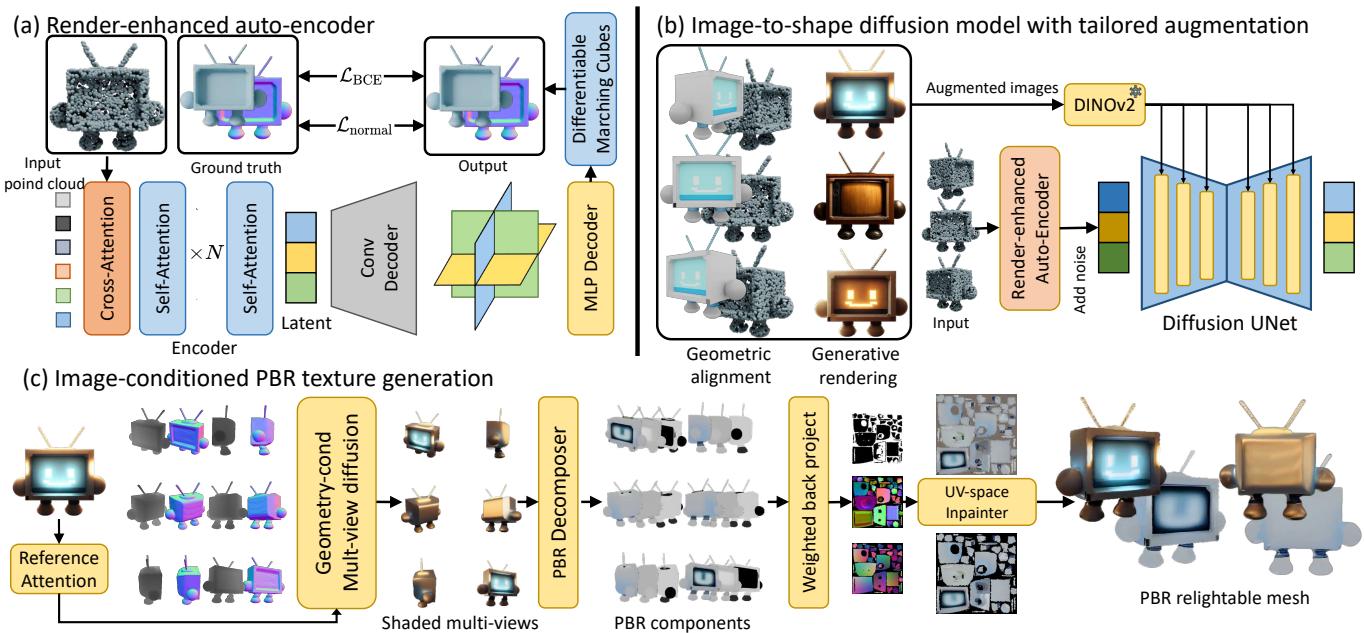
As illustrated in Figure 1 above, MeshGen isn’t just one model; it is a pipeline composed of three distinct stages: compression (auto-encoder), generation (diffusion), and texturing. Let’s explore how it works.
Background: The Native 3D Generation Problem
To understand why MeshGen is necessary, we must understand the limitations of “Native 3D Diffusion.”
In this paradigm, researchers train an Auto-Encoder (VAE) to compress complex 3D meshes into a compact “latent space” (often represented as Triplanes). A diffusion model (like Stable Diffusion, but for 3D) is then trained to generate these latents from an input image.
The problems with current approaches are threefold:
- The “Blob” Problem: Standard 3D auto-encoders rely on occupancy loss (is there matter at this point in space?). They lack perceptual feedback, meaning they struggle to encode sharp edges or thin structures, resulting in smooth, simplified shapes.
- Data Scarcity: We have billions of images but relatively few high-quality 3D models. Models trained on datasets like Objaverse tend to overfit to simple, symmetric objects.
- Texture Inconsistency: Generating a texture map that wraps perfectly around a 3D object without seams or “baked” lighting is notoriously difficult.
MeshGen tackles these by improving the auto-encoder’s vision, augmenting the training data synthetically, and explicitly decomposing textures into PBR components.
Core Method
1. The Render-Enhanced Auto-Encoder
The foundation of any latent diffusion model is the quality of its auto-encoder. If the auto-encoder cannot reconstruct a mesh accurately, the diffusion model typically fails to generate high-quality results.
MeshGen uses a point-to-shape encoder. It takes a point cloud sampled from a mesh, processes it through Transformer blocks, and decodes it into a Triplane representation. This triplane is then upsampled to query occupancy (whether a point in space is inside or outside the object).
The architecture is defined mathematically as:

Followed by the occupancy decoder:

The Innovation: Ray-Based Regularization
Previous methods trained these networks using Binary Cross Entropy (BCE) on occupancy values. MeshGen argues this isn’t enough. They introduce a Render-Based Perceptual Loss. During training, they actually render the predicted mesh into normal maps and compare those renderings to the ground truth. This forces the model to care about surface details, not just volume.
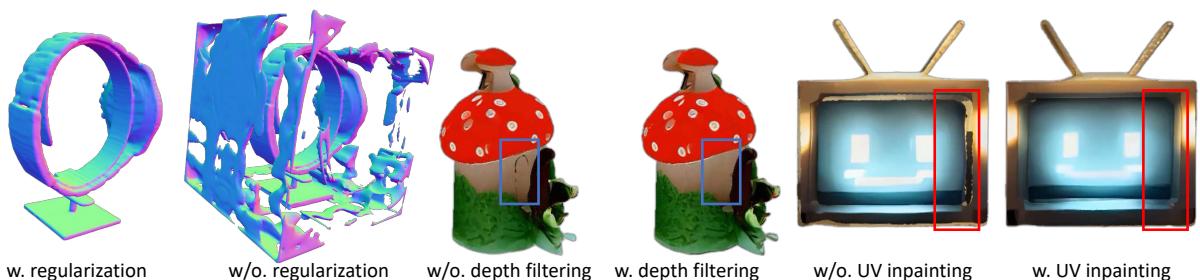
However, simply adding render loss introduces a new problem: Floaters. The model tries to “cheat” the rendering loss by placing random density in empty space near the camera.
To fix this, the authors propose Ray-Based Regularization.
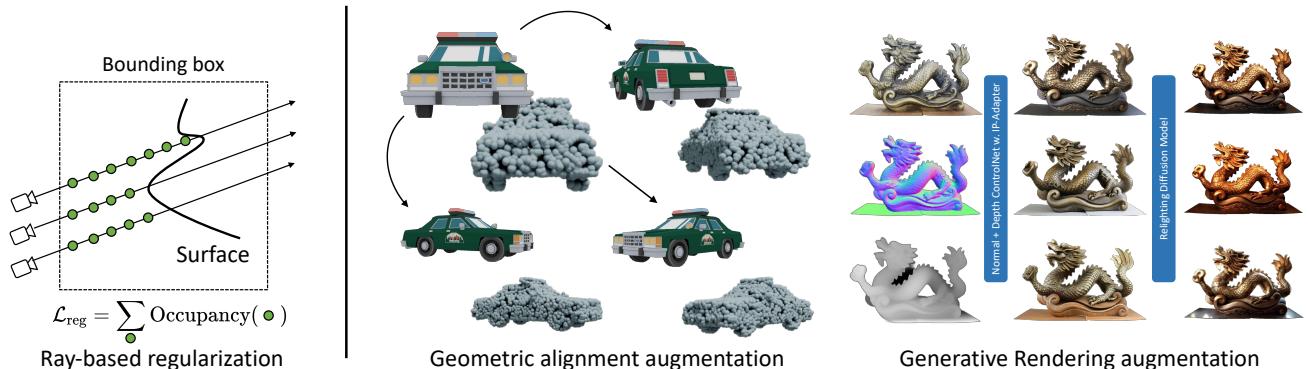
As shown in the left panel of Figure 2, the system casts rays into the scene. For points along the ray that are in empty space (between the camera and the object), the model strictly penalizes any non-zero occupancy.
The training is done in a coarse-to-fine manner. First, the model learns the rough shape using standard losses:

Then, it refines the model using the render-enhanced objectives, including MSE and LPIPS (perceptual) loss on the normal maps, plus the ray-based regularization:

This strategy allows MeshGen to reconstruct sharp features—like the thin straps of a watch or the tentacles of an octopus—that previous auto-encoders would blur out.
2. Image-to-Shape Diffusion with Data Augmentation
Once the auto-encoder is trained, the next step is training the Diffusion U-Net to generate the triplane latents from a single input image.
The researchers identified a critical flaw in previous training pipelines: Data Bias. Most 3D datasets contain perfectly centered, upright objects with simple lighting. When a user inputs a real-world photo (with complex lighting or a weird camera angle), standard models fail.
MeshGen introduces two specific augmentations (visualized in Figure 2 above) to make the model robust.
Geometric Alignment Augmentation
Standard native 3D models are often “appearance-entangled.” If you feed them a side-view image of a car, they might generate a front-facing car because that’s the “canonical” pose in the dataset.
MeshGen exploits the fact that their point-cloud encoder is geometrically covariant. During training, they randomly rotate the 3D point cloud to match the specific viewpoint of the input image. This aligns the coordinate system of the image with the coordinate system of the mesh.
- Result: The model learns that if the input image is a side view, the generated 3D mesh should be oriented sideways. This significantly improves controllability.
Generative Rendering Augmentation
To handle “in-the-wild” images, the model needs to understand complex lighting. The researchers synthetically expand their dataset using 2D generative models.
- They render the 3D objects to get normal and depth maps.
- They feed these maps into ControlNet and IC-Light (a relighting tool).
- This generates photorealistic 2D images of the object with varied textures and dramatic lighting conditions.
By training on these synthetic images, the diffusion model learns to ignore lighting artifacts and focus on the underlying geometry.
3. PBR Texture Generation
The final piece of the puzzle is appearance. MeshGen aims for physically based rendering (PBR), specifically separating Albedo (color), Roughness, and Metallic maps.
The texturing pipeline follows three steps:
Step A: Geometry-Conditioned Multi-View Generation
First, the system needs to “imagine” what the object looks like from all angles. It uses a multi-view diffusion model (based on Zero123++).
A key challenge here is maintaining consistency with the input image. Standard methods (like IP-Adapter) often capture the style but lose the specific identity of the reference object. MeshGen introduces Reference Attention.
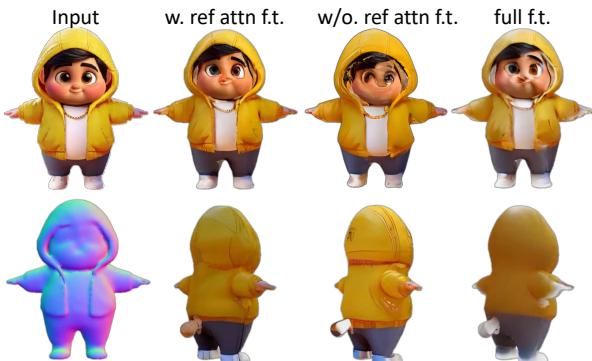
As seen in Figure 3, without Reference Attention (middle column), the model generates a character that looks similar to the input but loses specific facial details. With Reference Attention (left column), the generated views tightly adhere to the input image’s identity.
Step B: PBR Decomposition
The multi-view generator produces “shaded” images (images with light and shadow). To get PBR textures, we need to remove that light.
MeshGen uses a specialized PBR Decomposer. This is a diffusion model trained to take a shaded image and split it into its components.

The decomposer essentially performs an image-to-image translation, outputting the Albedo, Metallic, and Roughness channels simultaneously.
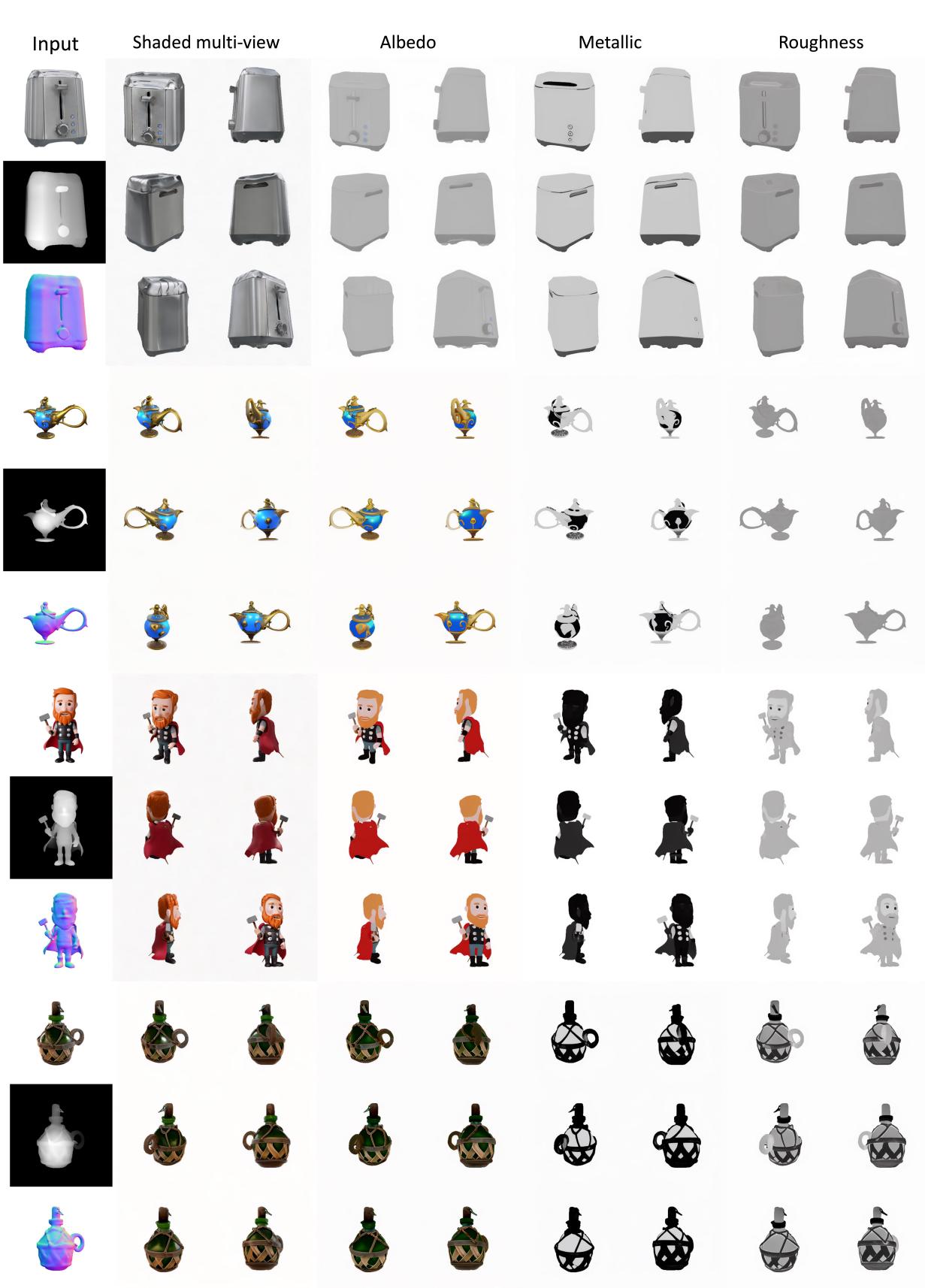
Figure 17 shows this decomposer in action. Notice how it successfully isolates the “Metallic” map for the Thor figure and the “Roughness” map for the bottle, separating them from the base color.
Step C: UV Inpainting
Finally, these multi-view maps are projected onto the 3D mesh’s UV space. Because some parts of the mesh (like the underarms or between legs) might not be visible in any of the generated views, the system uses a UV Inpainter.
This inpainter looks at the incomplete texture map and fills in the blanks, ensuring a seamless 360-degree texture.
Experiments & Results
The researchers compared MeshGen against two categories of competitors:
- Large Reconstruction Models (LRMs): InstantMesh, TripoSR, MeshFormer.
- Native 3D Diffusion Models: CraftsMan, 3DTopia-XL, LN3Diff.
Geometry Quality
The visual results are compelling. In Figure 4 below, look at the “File Sorter” (top right) or the character with the large mouth.
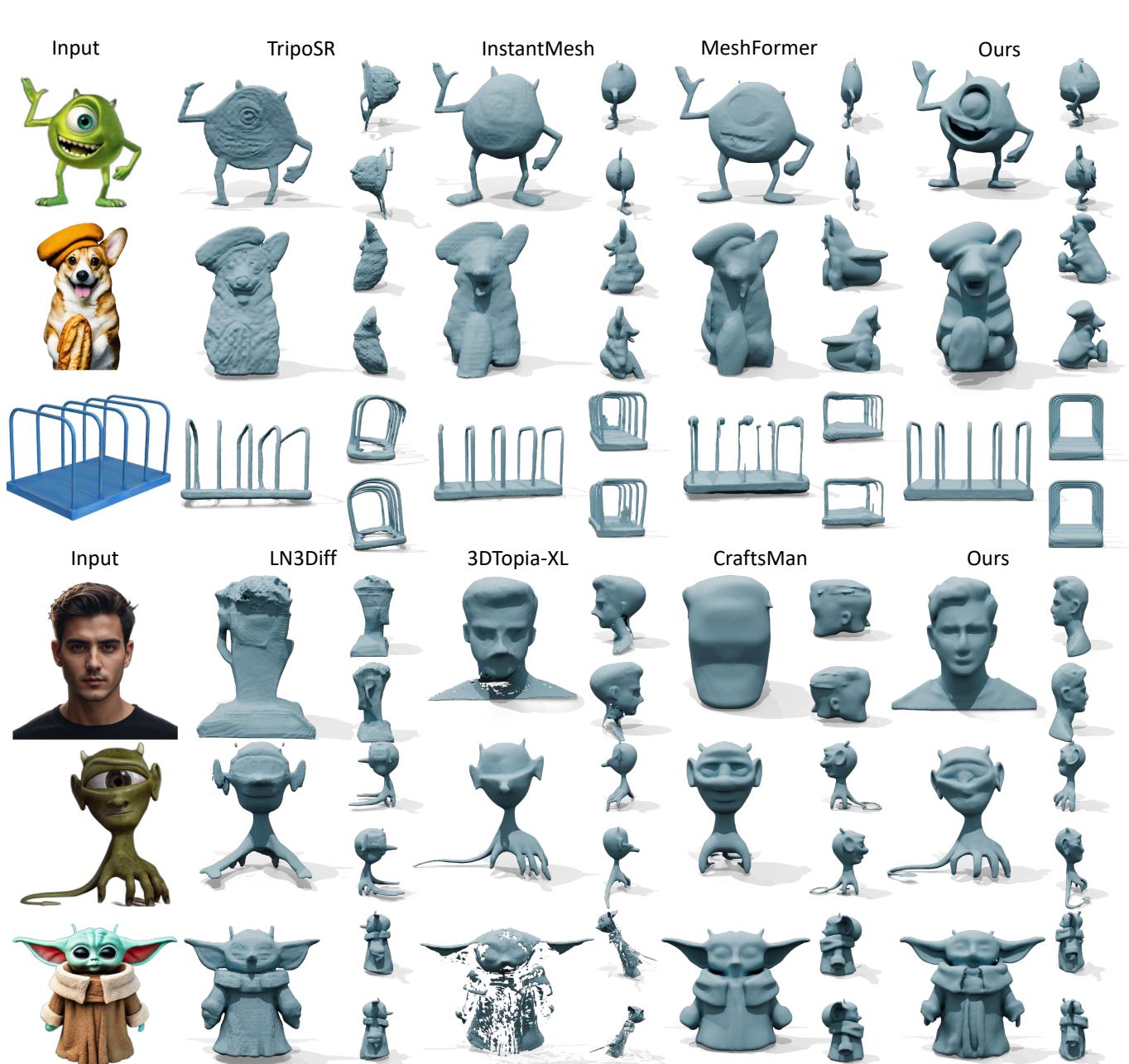
Large Reconstruction Models (InstantMesh, TripoSR) often struggle with thin structures or complex topologies, sometimes producing noisy surfaces. Other Native 3D models (CraftsMan) frequently fail to capture the correct pose or shape, reverting to generic symmetric forms. MeshGen (far right) consistently captures the specific geometric nuances of the input.
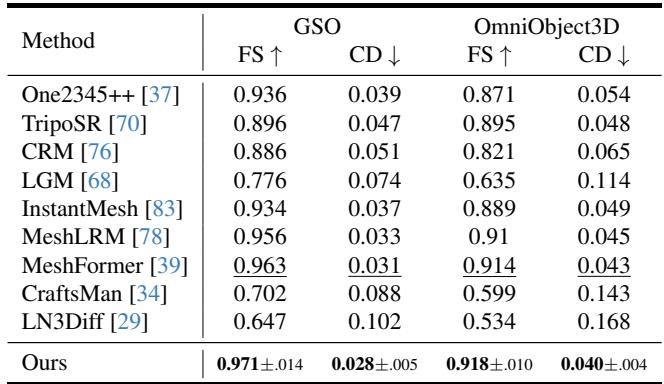
Quantitative metrics confirm this. MeshGen achieves higher F-Scores and lower Chamfer Distances (error rates) on benchmark datasets like Google Scanned Objects (GSO).
Texture Quality
For texture, the comparison is even more stark. Figure 5 compares MeshGen against texture-specific pipelines like Paint3D.
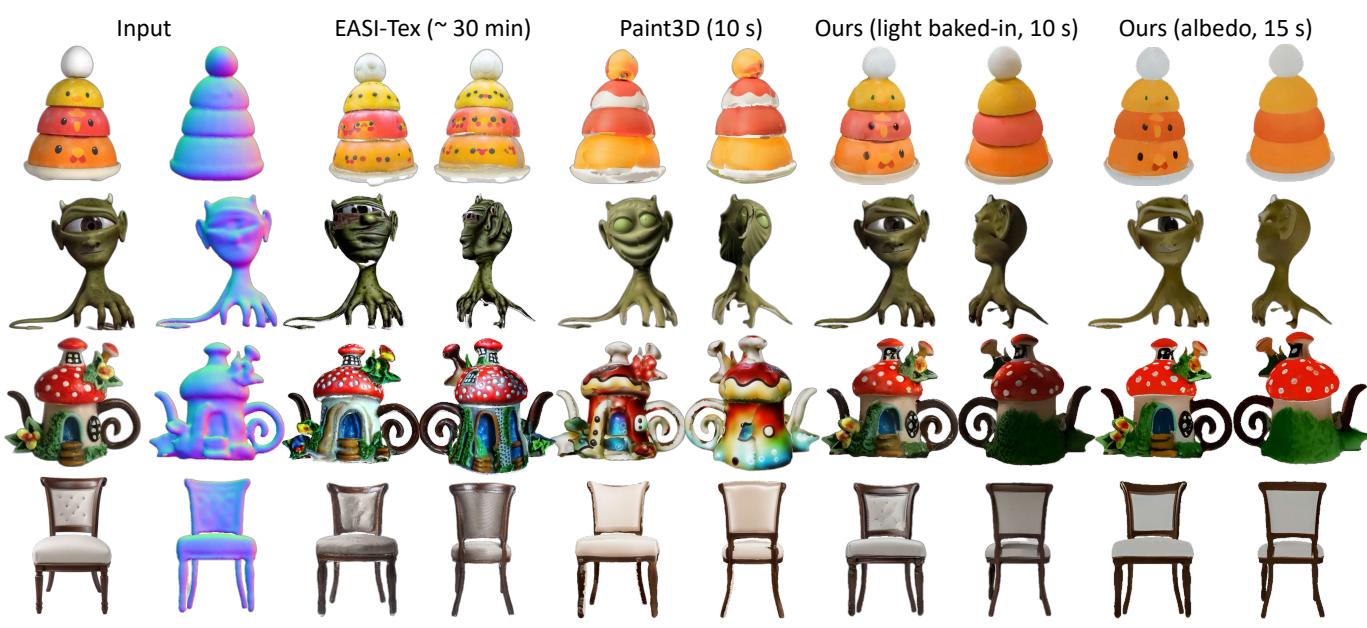
Paint3D (center) often produces seams or low-resolution textures. MeshGen (right) produces sharp, consistent textures. Crucially, MeshGen offers both a “Light Baked-in” mode and an “Albedo” mode (PBR), giving artists flexibility.
The user study results (Table 2) show an overwhelming preference for MeshGen’s output, with over 90% of users preferring its image alignment.

Ablation Studies
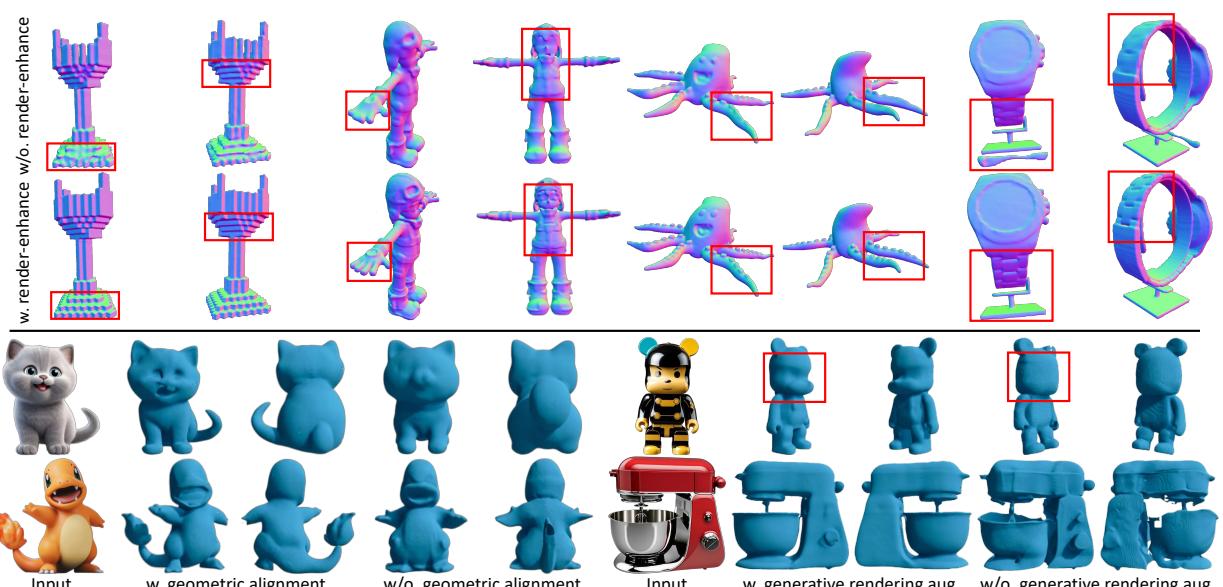
To prove that their specific contributions (Regularization and Augmentation) actually matter, the authors performed ablation studies.
In Figure 6:
- Without Geometric Alignment (left): The cat model becomes blocky and loses the specific pose of the input.
- Without Generative Rendering Augmentation (right): The model fails to interpret the shape of the stand mixer correctly, likely confused by the metallic reflections in the source image.
Furthermore, the impact of the Ray-Based Regularization is visually proven in Figure 8. Without it, the mesh is surrounded by “floaters”—disconnected artifacts that ruin the model.
Conclusion and Implications
MeshGen represents a significant step forward in the quest for “Image-to-Ready-to-Use-3D.” By moving away from simple occupancy losses and incorporating render-based supervision, the authors have created an auto-encoder that respects the fine details of a mesh.
Perhaps more importantly, the paper demonstrates that data augmentation is just as critical as model architecture. By synthetically expanding the training data to include rotated poses and complex lighting, MeshGen overcomes the biases inherent in current 3D datasets.
Key Takeaways:
- Native 3D is maturing: We are moving past “blobby” shapes into sharp, detailed meshes.
- PBR is possible: Decomposing lighting from texture using diffusion allows for the creation of assets that are actually useful in game engines, not just for viewing.
- Perceptual Loss matters: Training 3D models using 2D rendering losses (comparing normals/images) creates better 3D geometry than 3D losses alone.
Limitations: The authors note that the method still struggles with transparent objects (glass) and extremely high-frequency details (like small text on a box), largely due to resolution limits in the multi-view generation stage.
However, for students and researchers in Computer Vision, MeshGen provides a blueprint for the future of 3D generation: a hybrid approach that combines strong 3D priors with the generative power of 2D diffusion models.