](https://deep-paper.org/en/paper/2505.04788/images/cover.png)
If you look down a long, straight hallway or stare at a skyscraper from the street, you intuitively understand perspective. Parallel lines in the real world—like the edges of a ceiling or the sides of a building—appear to converge at a specific spot in the distance. In Computer Vision, these are called Vanishing Points (VPs).
Locating these points is crucial for tasks like camera calibration, 3D reconstruction, and autonomous navigation. In structured environments (like cities or indoors), we often rely on the Manhattan World assumption, which posits that the world is built on three mutually orthogonal axes (up-down, left-right, forward-backward).
However, estimating these points accurately is surprisingly difficult. It is a classic “chicken-and-egg” problem: to find the vanishing point, you need to know which lines belong to it; but to classify the lines, you need to know where the vanishing point is.
In this post, we are breaking down a fascinating paper, “Convex Relaxation for Robust Vanishing Point Estimation in Manhattan World,” which proposes a mathematically elegant solution to this problem using Convex Relaxation.
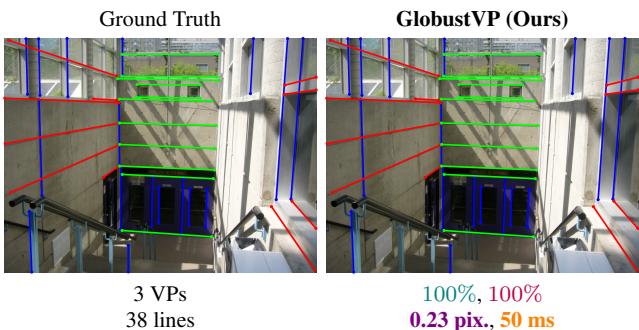
The Problem: Speed vs. Optimality
Historically, algorithms for finding VPs fell into two camps, neither of which was perfect:
- Local Methods (e.g., RANSAC, Hough Transform): These are fast and popular. They guess and check, or vote for the best fit. However, they are non-deterministic. If your image is noisy or has many “outlier” lines (lines that don’t fit the Manhattan structure), these methods might get stuck in a “local minimum”—a solution that looks good nearby but is wrong globally.
- Global Methods (e.g., Branch-and-Bound): These guarantee the mathematically perfect solution. The downside? They can be excruciatingly slow. In the worst-case scenario, their runtime grows exponentially, making them impractical for real-time applications.
The researchers behind this paper asked: Can we create a solver that guarantees global optimality (like Branch-and-Bound) but runs efficiently (like RANSAC), even in the presence of heavy noise?
Their answer is GlobustVP.
The Core Method: From Hard Choices to Soft Mathematics
The heart of the paper is how the authors reframe the problem. Instead of making hard, discrete choices immediately (e.g., “Line A belongs to VP 1”), they formulate the problem mathematically and then apply convex relaxation.
1. The Primal Problem: A “Soft” Association
First, let’s look at the data. We have a set of lines extracted from an image. We want to assign each line to one of three Vanishing Points (VP1, VP2, VP3) or mark it as an outlier.
The authors introduce a “Truncated Multi-Selection Error.” This is a fancy way of creating a cost function that penalizes lines based on how far they are from a vanishing point. If a line is too far from all VPs, it is capped at a maximum cost (the outlier threshold).
To visualize this, imagine a matrix where we calculate the “cost” of assigning every line to every possible VP.
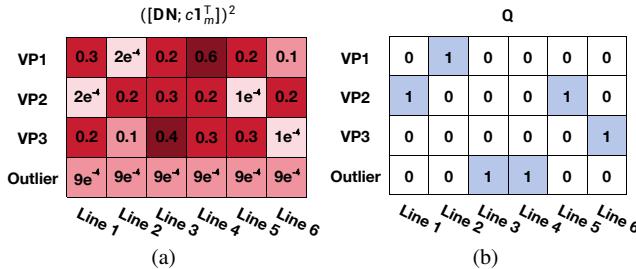
In the figure above:
- Matrix (a) shows the costs (distances).
- Matrix (b) is a Permutation Matrix (Q). This is a binary matrix (0s and 1s) that selects exactly one label for each line (VP1, VP2, VP3, or Outlier).
The goal is to find the Vanishing Points (D) and the Permutation Matrix (Q) that minimize the total error. Mathematically, the “Primal Problem” looks like this:
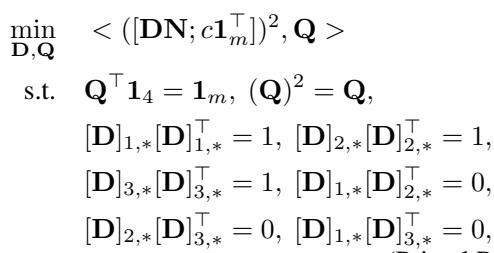
This equation is trying to minimize the distance between lines and VPs, subject to constraints that ensure Q is a valid selection matrix (only one choice per line) and D contains orthogonal vectors (the Manhattan assumption).
2. The “Magic” Trick: Convex Relaxation
The Primal Problem above is non-convex. In simple terms, the “landscape” of the solution is rugged, full of hills and valleys. Standard optimization algorithms might get trapped in a small valley (local minimum) instead of finding the deepest valley (global minimum).
To fix this, the authors transform the problem.
- QCQP: They rewrite the problem as a Quadratically Constrained Quadratic Programming (QCQP) problem.
- SDP: They apply Convex Relaxation. They relax the strict constraints to turn the rugged landscape into a smooth bowl (a convex shape). This transforms the difficult problem into a Semidefinite Programming (SDP) problem.
Why does this matter? Convex problems are easy to solve. We have efficient, off-the-shelf solvers that can find the absolute global minimum of a convex problem in polynomial time.
The relaxed SDP formulation looks like this:
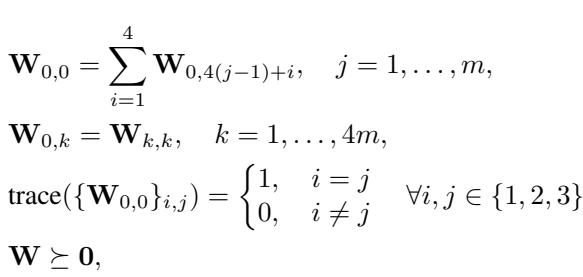
By solving this SDP, the researchers can find a globally optimal solution that accounts for all lines and potential VPs simultaneously.
3. GlobustVP: The Iterative Solver
While the “Full SDP” formulation is powerful, solving it for three VPs and thousands of lines simultaneously is computationally heavy. To make it faster without losing robustness, the authors propose an iterative solver called GlobustVP.
Instead of finding all three VPs at once, the algorithm:
- Searches for ONE VP: It treats the other two VPs and background noise as “outliers.”
- Identifies Inliers: It finds the optimal set of lines for that single VP.
- Removes & Repeats: It removes those lines from the dataset and repeats the process for the second and third VPs.
- Refines: Once all three are found, a final “Manhattan Post-Refinement” step adjusts them slightly to ensure they are perfectly orthogonal (\(90^{\circ}\) to each other).
This approach drastically reduces the size of the matrices the computer has to process, making the algorithm significantly faster while maintaining high accuracy.
Experiments and Results
Does it actually work? The authors tested GlobustVP against state-of-the-art methods, including RANSAC, J-Linkage, and Branch-and-Bound (BnB).
1. Robustness to Outliers (Synthetic Data)
In a Manhattan World, “outliers” are lines that don’t align with the main building axes (e.g., a diagonal shadow, a tree branch, or a person). A good algorithm needs to ignore these.
The graph below shows the \(F_1\)-score (a measure of accuracy) as the percentage of outliers increases.
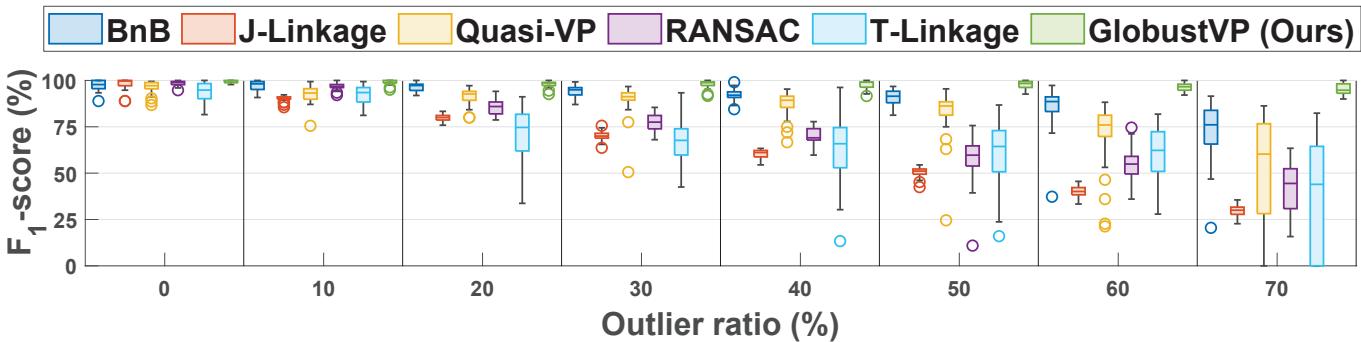
- Observation: Look at how most methods (blue, orange, purple) crash when the outlier ratio gets high (50-70%).
- GlobustVP (Green/Ours): It stays remarkably stable, maintaining high accuracy even when 70% of the lines are noise. This confirms that the global convex approach effectively separates signal from noise.
2. Efficiency (Speed)
Can a global method be fast?
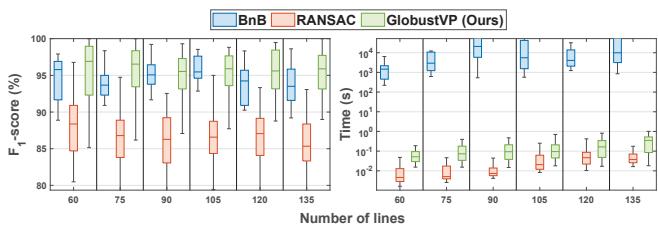
The plot above compares accuracy (Left) and Time (Right).
- BnB (Blue) is accurate but slow (note the log scale on the time axis—it is much higher up).
- RANSAC (Orange) is fast but less accurate.
- GlobustVP (Green) sits in the “sweet spot”—it is orders of magnitude faster than the traditional global method (BnB) while matching its accuracy.
3. Real-World Performance
Synthetic lines are one thing, but real photos are messy. The authors tested on the York Urban Database (YUD).
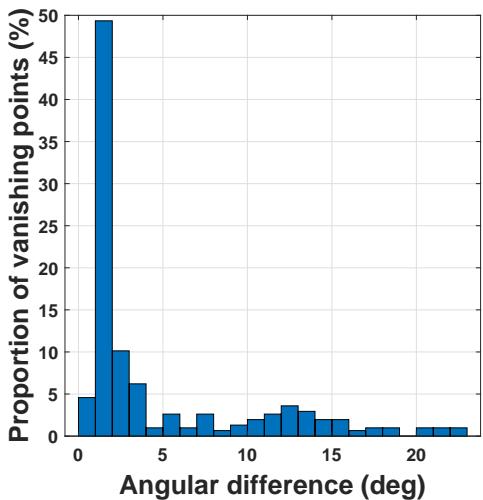
The histogram below shows the angular error. The vast majority of VPs estimated by GlobustVP are within a tiny fraction of a degree of the ground truth.
To see this visually, look at the comparison below on a complex building facade.
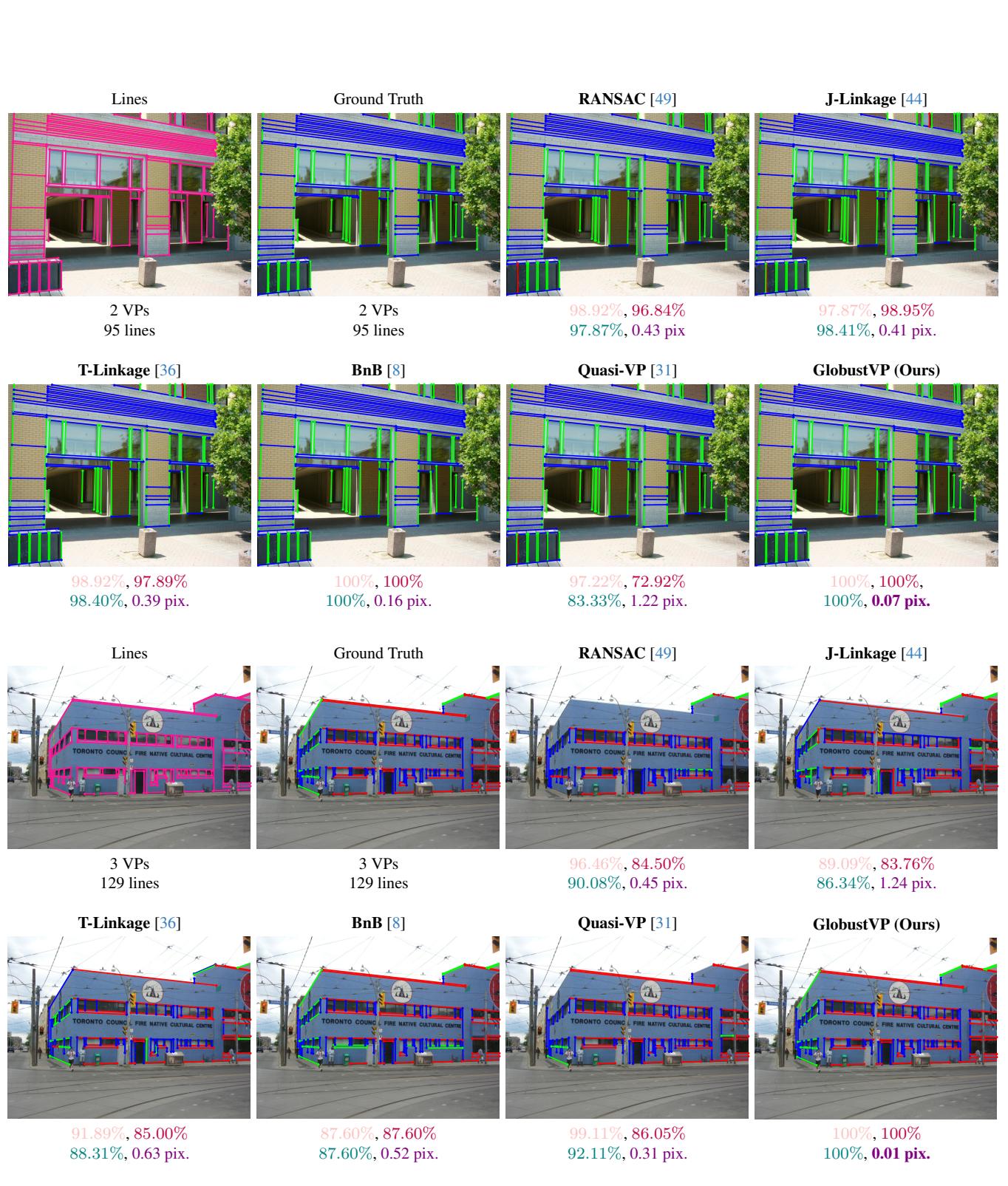
- RANSAC (top middle) gets confused, detecting only 60% precision.
- BnB (top right) does better but misses some lines.
- GlobustVP (bottom right) achieves 92.31% precision and high recall, producing a result that looks almost identical to the ground truth. The colored lines clearly map to the three distinct axes of the room.
Conclusion
The paper “Convex Relaxation for Robust Vanishing Point Estimation in Manhattan World” bridges a long-standing gap in computer vision. By translating a geometric problem into a convex optimization one, the authors achieved the “holy grail” of estimation: Global Optimality and Robustness, without the crippling computational cost usually associated with global solvers.
Key Takeaways for Students:
- Formulation Matters: How you write down the error function determines how you can solve it. The “soft” assignment was key here.
- Convexity is Powerful: If you can turn a non-convex problem into a convex one (via relaxation), you unlock powerful solvers that guarantee optimal results.
- Iterative Approaches: Sometimes, breaking a massive problem into smaller, sequential sub-problems (finding one VP at a time) is the key to efficiency.
This work paves the way for more reliable 3D understanding of our built environments, ensuring that whether a robot is navigating a hallway or a drone is inspecting a building, they know exactly where “forward” really is.