](https://deep-paper.org/en/paper/2505.05287/images/cover.png)
Introduction
If you have ever tried to write with your non-dominant hand, you know the struggle. Despite your left and right hands being nearly identical mirror images of each other—structurally and mechanically—your brain has specialized to favor one side for fine motor skills. This phenomenon, known as handedness, is efficient for humans but represents a significant limitation for robots.
Bimanual robots (robots with two arms) are typically built with perfect bilateral symmetry. The left arm is a precise reflection of the right. Yet, when we teach these robots to perform tasks using Reinforcement Learning (RL), we often treat them like humans with a strong dominant hand. We might train the right arm to use a screwdriver while the left arm just holds the object. If the workspace is flipped, the robot fails or awkwardly reaches across its body, unable to transfer the skill to the other arm.
Why don’t we exploit the fact that the robot is physically symmetric?
This is the core question behind SYMDEX (SYMmetric DEXterity), a new framework presented at CoRL 2025. The researchers propose that by explicitly baking “morphological symmetry” into the learning process, we can create robots that are truly ambidextrous. These robots can learn faster, generalize better, and seamlessly switch hands depending on which is more efficient for the task—just like a master pianist using both hands with equal proficiency.
In this post, we will tear down the SYMDEX architecture, exploring how Group Theory, Equivariant Neural Networks, and clever task decomposition come together to solve complex manipulation problems.
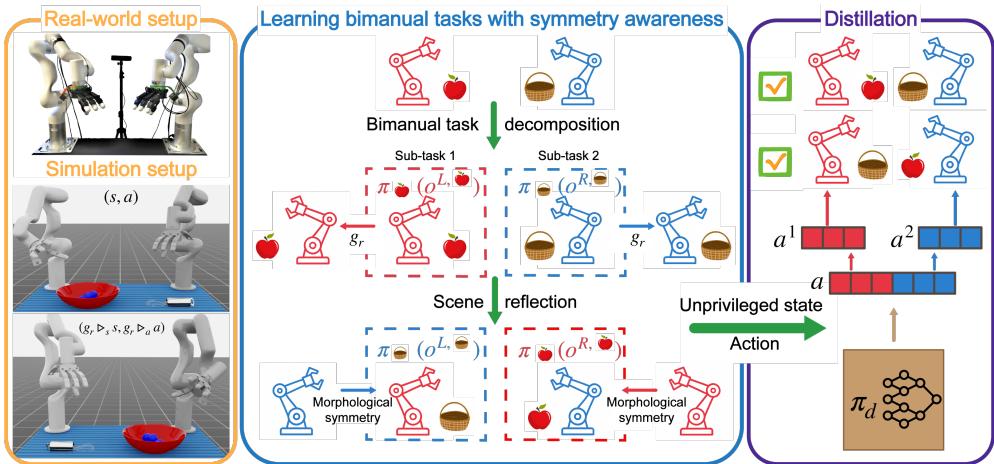
The Challenge of Bimanual Learning
Before diving into the solution, we need to understand why bimanual manipulation is so difficult in the first place.
The Curse of Dimensionality
Reinforcement Learning works by exploring an environment and learning which actions yield rewards. For a single robot arm, the “search space” (all possible configurations of joints) is already large. When you add a second arm and dexterous hands, the number of joints—and therefore the complexity—doubles. The exploration space doesn’t just double; it grows exponentially.
The Credit Assignment Problem
Imagine you are teaching a robot to stir a bowl of eggs. The left hand must hold the bowl steady, while the right hand whisks. If the robot fails (e.g., the bowl spills), the learning algorithm has to figure out who messed up. Did the left hand slip? Did the right hand whisk too aggressively? This is the credit assignment problem. In a dual-arm setup, the reward signal is often sparse and mixed, making it incredibly hard for the algorithm to pinpoint which arm needs to adjust its behavior.
The Waste of Experience
In standard RL, if a robot learns to lift a cup with its right hand, that experience serves no purpose for the left hand. The policy views the left hand as a completely different entity. To teach the left hand, the robot must start from scratch. This ignores the obvious physical reality: the left hand is just a mirror of the right.
Background: Symmetry as a Mathematical Prior
To solve these problems, SYMDEX relies on the mathematics of symmetry, specifically Group Theory.
In this context, a “Group” is a set of transformations. For a bimanual robot, the most relevant group is the reflection group, often denoted as \(\mathbb{C}_2\). This group contains two elements:
- Identity (\(e\)): Doing nothing.
- Reflection (\(g_r\)): Mirroring the state across the robot’s center plane.
The researchers treat the learning problem as a Symmetric POMDP (Partially Observable Markov Decision Process). This is a fancy way of saying that the physics of the world and the robot obey symmetry rules.
If you rotate or reflect the world, the optimal action should rotate or reflect accordingly. This property is formalized as Equivariance.

The equation above essentially states that if you transform the input state (\(s\)) and the action (\(a\)) by a symmetry group element (\(g\)), the expected outcome in the physical world transforms the same way.
When a system is symmetric, the optimal policy (\(\pi^*\)) and the value function (\(V^*\)) must satisfy specific constraints:

- Policy Equivariance: If I show the robot a mirror image of a situation, the robot should output the mirror image of the action.
- Value Function Invariance: The “value” (how good a state is) doesn’t change if the state is mirrored. A successfully grasped cup is worth the same points whether it’s held by the left or right hand.
The SYMDEX Method
SYMDEX is not just a single network; it is a full learning pipeline designed to exploit these symmetries. The method operates in three distinct phases: Decomposition, Symmetric Learning, and Distillation.
Phase 1: Task Decomposition
Instead of trying to learn a massive, monolithic policy that controls 44 joints (two arms + two hands) simultaneously, SYMDEX breaks the problem down.
The authors formulate the environment as a Multi-Task Multi-Agent (MTMA) system.
- Agents: Each robot arm is treated as a separate agent.
- Subtasks: A complex task (like “Stir Bowl”) is split into subtasks (e.g., “Hold Bowl” and “Operate Whisk”).
Crucially, these subtasks are not permanently assigned. In one scenario, the Left Arm might do Subtask A while the Right Arm does Subtask B. In a mirrored scenario, they swap roles.
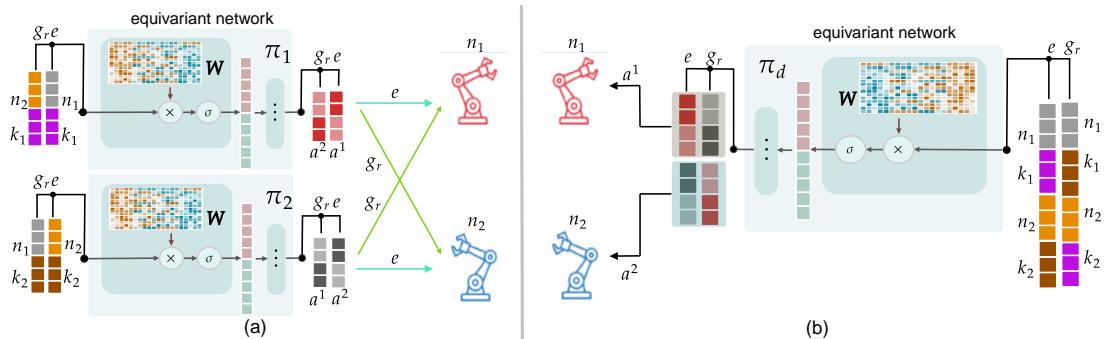
As shown in Figure 2(a) above, the system learns specific policies for specific subtasks. The inputs (\(n\) for agent, \(k\) for task) determine how the network processes the visual data.
Phase 2: Symmetry-Aware Subtask Learning
This is where the magic happens. The researchers train a policy for each subtask (e.g., a “Grasping Policy”). However, instead of training it normally, they use an Equivariant Neural Network.
In a standard neural network, you might try to teach symmetry by showing the robot millions of mirrored images (Data Augmentation). The network might eventually learn that the left hand works like the right hand, but it has to spend valuable training time figuring that out.
An Equivariant Network has symmetry hard-coded into its architecture. It forces the weights of the network to respect the symmetry group.
The Reflection Group in Action
Let’s look at the math that drives this. If we have a reflection transformation \(g_r\), it swaps the roles of the arms and the subtasks.

This equation shows that applying the reflection \(g_r\) swaps the Left/Bowl assignment to Left/Egg-beater.
Because the policy is equivariant, knowledge is shared instantly. Every time the right arm learns something about grasping, the network mathematics automatically update the policy so the left arm improves too. They are effectively sharing the same “brain” parameters, just transformed geometrically.
The subtask policy is defined mathematically as:

Here, \(\pi_k\) is the policy for subtask \(k\). The equation guarantees that if you input a transformed observation, you get a transformed action. This cuts the exploration space drastically because the robot doesn’t need to relearn physics for the left side of the workspace.
Similarly, the Value Function (the critic in RL) is Invariant:

This means the critic recognizes that a good state is “good” regardless of which side of the table it’s happening on.
Phase 3: Global Policy Distillation
At this point, we have highly competent independent agents. The left arm knows how to hold a bowl, and the right arm knows how to whisk. But who tells them what to do?
If we just deployed them as independent agents, we might end up with both arms trying to hold the bowl, or both trying to whisk. We need a conductor.
The final phase of SYMDEX is Distillation. The researchers train a single “Global Policy” that acts as a supervisor.
- Teacher-Student Setup: The independent subtask policies act as “Teachers.” They generate high-quality data.
- The Student (Global Policy): A new Equivariant Policy is trained to mimic the teachers.

This global policy takes in the raw state of the world and outputs actions for both arms simultaneously. Crucially, it learns to infer the task assignment. It looks at the scene and decides: " The bowl is closer to the left, so the Left Arm grasps, and the Right Arm whisks."
Because this global policy is also equivariant, the resulting behavior is perfectly ambidextrous. If you slide the bowl to the other side of the table, the robot seamlessly swaps hands without needing to be explicitly programmed to do so.
Experiments and Results
The team evaluated SYMDEX on six highly challenging simulated tasks that require coordination, precision, and contact-rich manipulation.
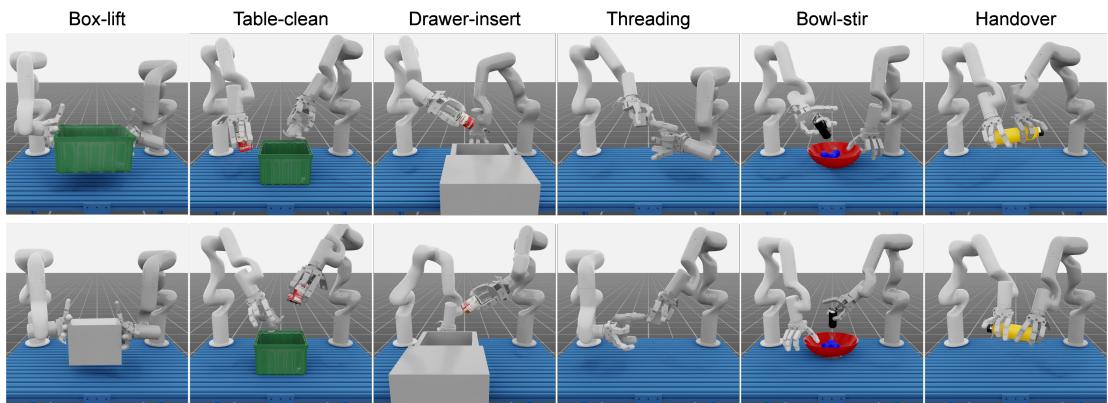
The Tasks
- Box-lift: Both arms must coordinate to lift a heavy box.
- Table-clean: One arm picks up trash, the other holds a bin.
- Drawer-insert: One arm opens a drawer, the other places an object inside.
- Threading: Extremely high precision—threading a needle/drill into a hole held by the other hand.
- Bowl-stir: The classic holding and stirring task.
- Handover: Passing an object from one hand to the other.
Simulation Performance
The results were compared against several baselines, including standard PPO (a popular RL algorithm) and other symmetry-based approaches that rely on data augmentation rather than equivariant architecture.
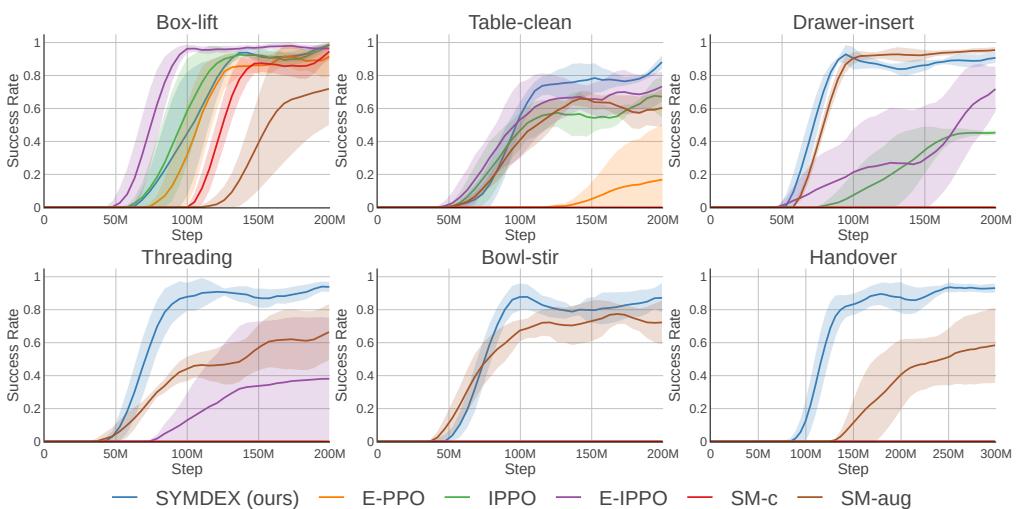
As seen in Figure 4, SYMDEX (the blue line) dominates.
- Sample Efficiency: It learns much faster. In tasks like “Box-lift,” it reaches near-perfect success rates while standard methods are still struggling.
- Generalization: The separation of subtasks combined with symmetry means the robot rarely gets confused by complex geometries.
- Failure of Baselines: Notice that “E-PPO” (Equivariant PPO without decomposition) fails on complex tasks like Bowl-stir. This proves that symmetry alone isn’t enough; you need the task decomposition to solve the credit assignment problem.
Sim-to-Real Transfer
One of the biggest hurdles in robotics is the “Sim-to-Real Gap.” Physics simulators are never perfect. To make SYMDEX work on physical robots (two xArm manipulators with Allegro hands), the authors used Curriculum Learning.
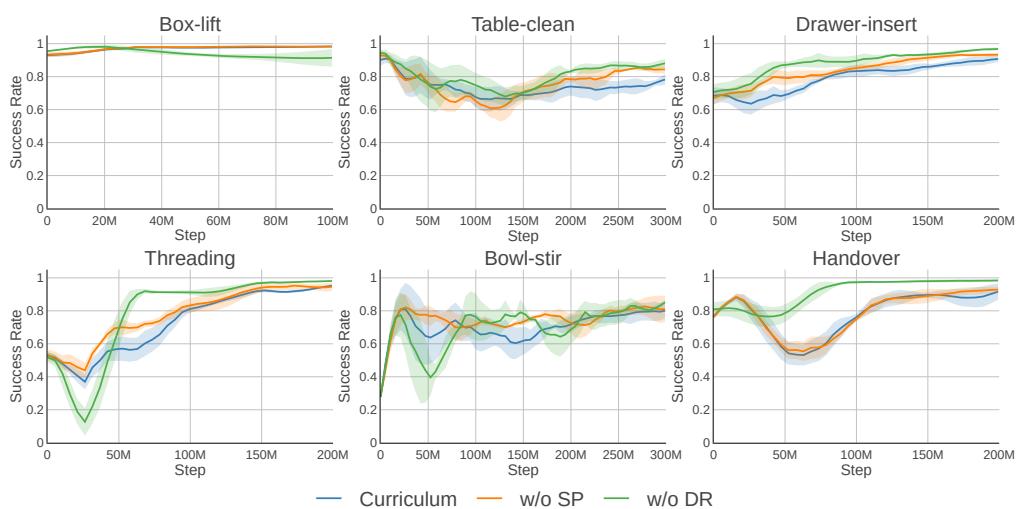
They didn’t just dump the robot into the real world. They created a curriculum in simulation that progressively made things harder:
- Randomization: Varying object weights, friction, and visual appearance.
- Safety Penalties: Gradually introducing penalties for collisions or jerky movements.
As the graph above shows, using the full curriculum (blue line) ensures high success rates. Without the safety penalties (orange) or domain randomization (green), the policy might perform okay in sim but would likely be dangerous or erratic in reality.
The Real World in Action
The distillation process produced a policy robust enough to work with real cameras and noisy sensors.
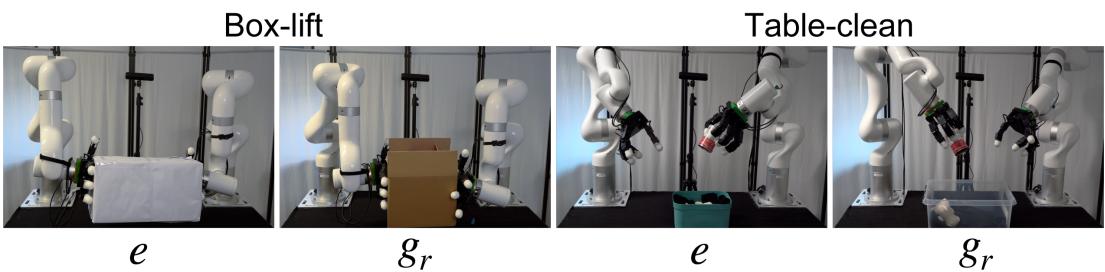
The image above demonstrates the system in action. Note the labels “\(e\)” and “\(g_r\)”.
- In \(e\) (Identity), the robot performs the task in a standard configuration.
- In \(g_r\) (Reflection), the physical setup is mirrored. The robot successfully identifies the change and swaps the roles of its arms to complete the task, validating the ambidextrous nature of the policy.
Scaling Up: The 4-Arm Monster
Perhaps the most visually impressive result is the extension of SYMDEX to a four-arm system.
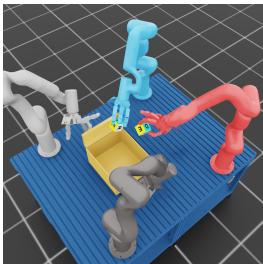
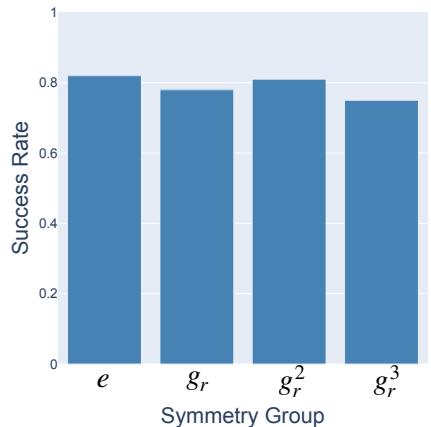
In this setup, two arms hold a box open while two other arms place objects inside. The symmetry group here is more complex—it’s not just reflection, but rotational symmetry (\(\mathbb{C}_4\)).
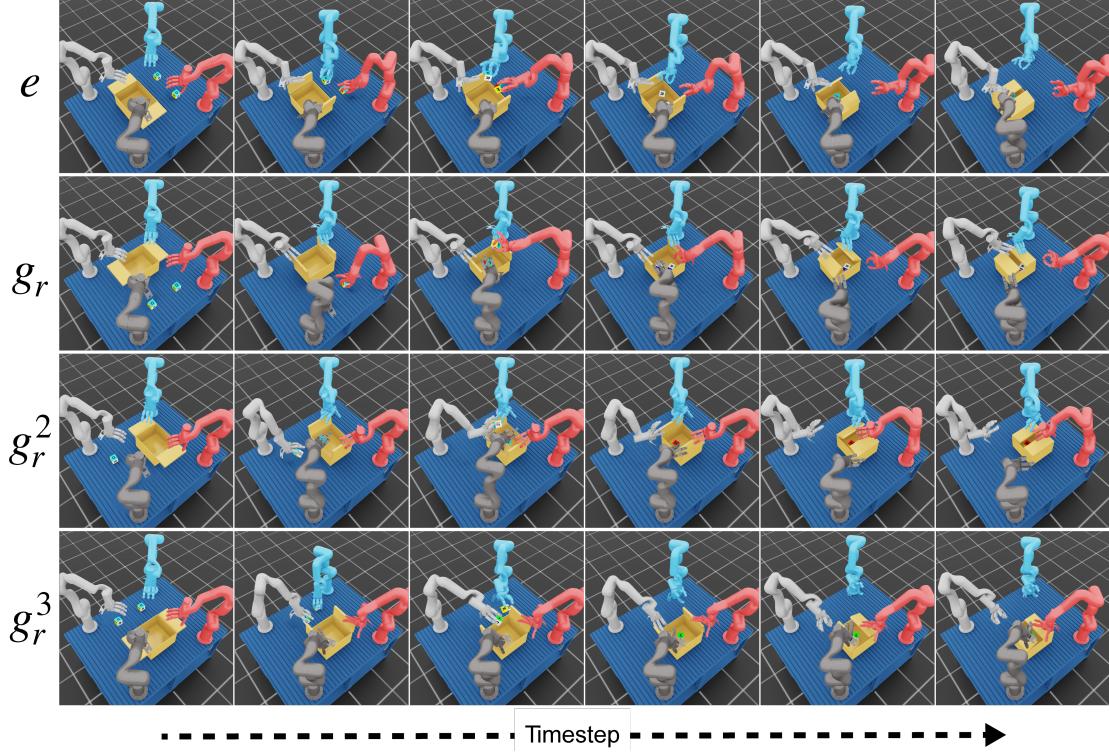
Figure 8 shows the policy handling the task from four different rotational angles (\(e, g_r, g_r^2, g_r^3\)). The equivariant network handles this naturally. The success rates (Figure 9 below) remain consistent across all rotations, proving that the math holds up even as the system complexity scales.
Conclusion
SYMDEX represents a significant step forward in robotic manipulation. By stopping to ask “What properties does this robot inherently possess?”, the researchers identified bilateral symmetry as a massive, underutilized resource.
Instead of forcing a robot to learn “left-handedness” and “right-handedness” separately, SYMDEX teaches the robot the concept of “manipulation” and allows the geometry of the body to dictate the specifics.
Key Takeaways:
- Geometry is powerful: Inductive biases like symmetry can drastically reduce the amount of data needed to train robots.
- Decomposition helps: Breaking bimanual tasks into per-hand subtasks solves the credit assignment problem.
- Distillation unifies: You can train specialized experts and then distill their knowledge into a single, generalist agent that is robust and ambidextrous.
As we move toward humanoid robots that look more like us, approaches like SYMDEX will be essential. They allow robots to interact with the world with the same fluid, adaptable dexterity that we often take for granted.