](https://deep-paper.org/en/paper/2505.05753/images/cover.png)
Introduction
Two millennia ago, the philosopher Heraclitus famously wrote that “no man steps in the same river twice.” In the field of robotics, we face a similar, strictly physical reality: no agent acts with exactly the same body twice.
Consider a robot deployed in the real world. Over time, its motors degrade, its joints loosen, and it might even suffer damage to a limb. Even newly manufactured robots of the same model have subtle manufacturing variations. If we want to build truly generalist robots—agents that can operate not just one specific machine, but adapt to any physical form—we face a massive hurdle. Current deep learning success stories, like Large Language Models (LLMs), have thrived by scaling up data and model size. But in robotics, we have a third, largely unexplored dimension: embodiment.
The research paper Towards Embodiment Scaling Laws in Robot Locomotion tackles this frontier. The researchers hypothesize that just as reading more text makes an LLM smarter, training on a larger variety of physical bodies (embodiments) makes a robot controller more robust and capable of generalizing to completely unseen robots.
They tested this by procedurally generating over 1,000 different robot “blueprints” and training a single neural network to control them all. The result? A single “brain” that can control simulated humanoids, quadrupeds, and hexapods, and—remarkably—can control real-world robots it has never seen before, right out of the box.
Background: The Challenge of Cross-Embodiment
To understand why this paper is significant, we have to look at how robots are typically trained today. Usually, if you have a Unitree Go2 quadruped, you train a specific policy for that robot’s specific skeleton, mass distribution, and motor limits. If you try to run that software on a humanoid robot, it will fail immediately. The inputs (state space) and outputs (action space) are completely different.
Cross-embodiment learning aims to solve this. The goal is to create a single policy that can look at a robot’s description and figure out how to move it.
Scaling Laws
In Computer Vision and Natural Language Processing (NLP), we observe “scaling laws”: performance improves predictably as you increase the amount of training data and the size of the neural network. This paper asks: Is there an Embodiment Scaling Law?
The hypothesis is straightforward: increasing the number of training embodiments (morphologies) should improve the policy’s ability to generalize to unseen embodiments. If true, this suggests a path toward a “Universal Robot Controller.”
The Method: One Policy, Many Robots
Testing this hypothesis requires a massive amount of data. You cannot simply go out and buy 1,000 different types of robots; they don’t exist in those quantities, and the cost would be astronomical. The authors solved this by turning to simulation.
1. GENBOT-1K: A Procedural Robot Army
The researchers created a dataset called GENBOT-1K. This is a collection of approximately 1,000 procedurally generated robot “blueprints.”
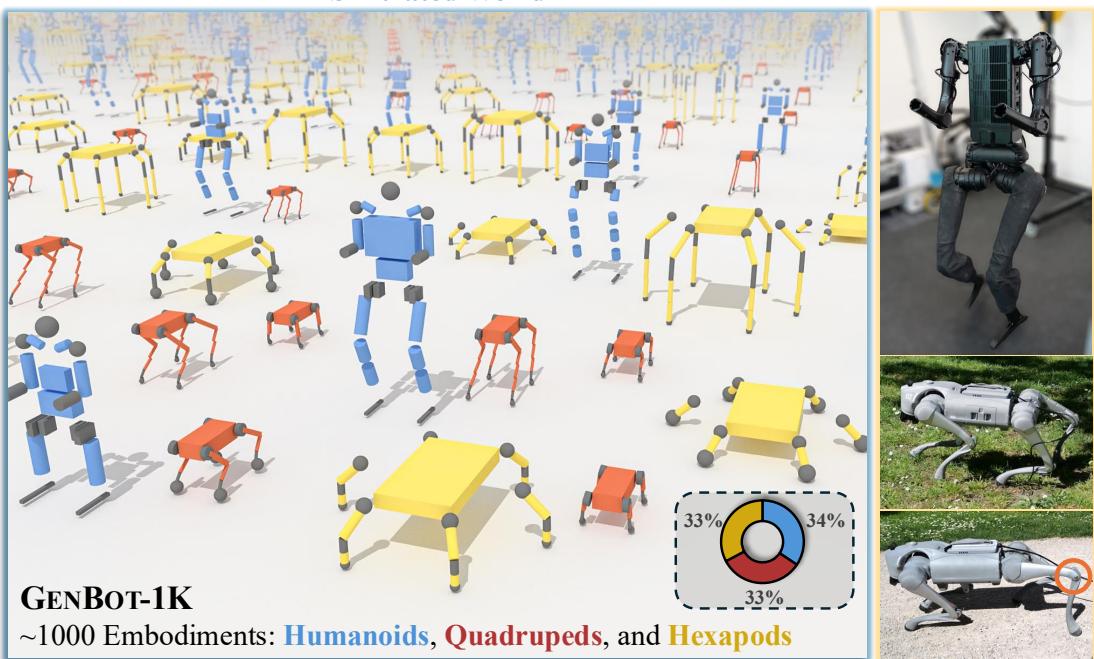
As shown in Figure 1 above, the dataset isn’t just copies of the same robot. It spans three distinct morphology classes:
- Humanoids: Bipedal robots (unstable, hard to control).
- Quadrupeds: Four-legged robots (stable, standard in research).
- Hexapods: Six-legged robots (highly stable, complex coordination).
Within these classes, the procedural generation engine varies three critical aspects:
- Topology: The skeletal structure (e.g., adding or removing knee joints).
- Geometry: The physical dimensions (e.g., length of thighs, size of feet).
- Kinematics: The movement constraints (e.g., motor strength, joint angle limits).

Figure 3 illustrates the diversity of this dataset. You can see the distribution of robot heights, joint counts (ranging from simple to complex), and motion ranges. This diversity is crucial; if the robots were too similar, the network wouldn’t learn to generalize.
2. The Architecture: URMA
How do you build a neural network that can control a robot with 12 joints and also a robot with 24 joints? Standard neural networks require fixed input and output sizes.
The authors utilized and extended an architecture called URMA (Unified Robot Morphology Architecture).
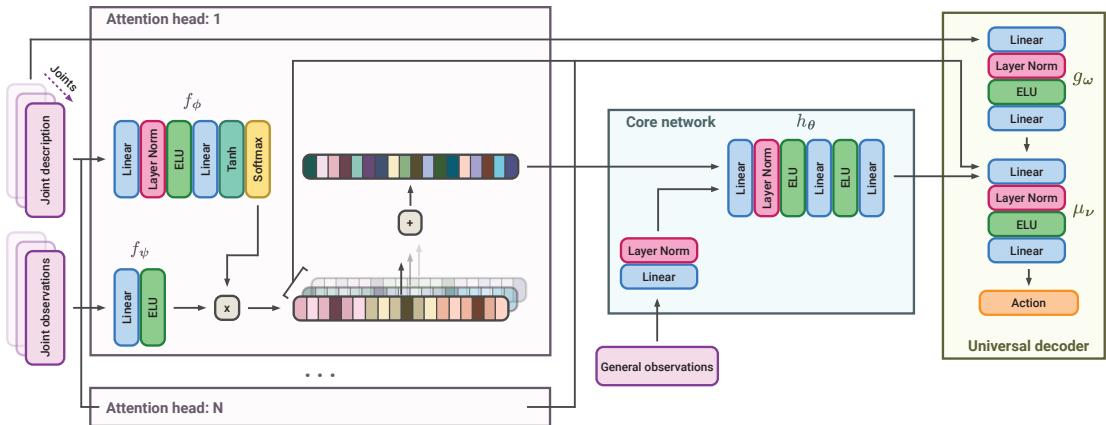
The key innovation in URMA is the use of Attention mechanisms, similar to those in Transformers (like GPT). Here is how it processes a robot:
- Input Separation: The state is split into General Observations (gravity, velocity commands, trunk orientation) and Joint-Specific Observations (angle, velocity, and properties of each specific joint).
- Attention Encoder: Instead of a fixed list of joints, the network treats joints as a set. It uses attention to look at each joint’s properties and its current state to create a “joint embedding.”
- Core Network: These embeddings are aggregated and combined with the general observations.
- Action Decoder: The network outputs actions for each joint individually by querying the core network with that joint’s specific description.
This design allows the policy to handle any robot, regardless of how many legs or joints it has, as long as the robot fits the general format.
3. Two-Stage Training Pipeline
Training a single policy to master 1,000 different bodies from scratch using Reinforcement Learning (RL) is notoriously unstable. To manage this, the authors used a two-stage approach (Figure 2).
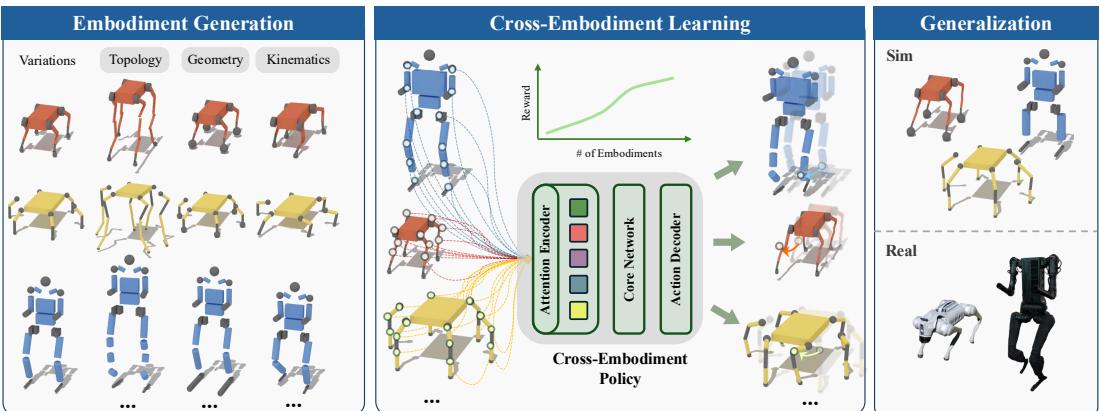
Stage 1: Expert Training (The Teachers) They first trained an individual “expert” policy for each of the ~1,000 robots using PPO (Proximal Policy Optimization). These experts are specialists—they only know how to walk their specific body. They trained these experts for a combined total of 2 trillion simulation steps.
Stage 2: Distillation (The Student) They then collected data (demonstrations) from all these experts. The single URMA policy (the student) was trained using Behavior Cloning (BC) to mimic the experts. The student policy takes the robot’s description as input and tries to replicate the expert’s action.
This “distillation” method effectively compresses the wisdom of 1,000 specialists into one generalist brain.
Experiments & Results
The primary goal was to validate the Embodiment Scaling Law. Does adding more robot types to the training set actually help?
Q1: Does Scaling Embodiments Work?
The results provide strong evidence for the hypothesis.
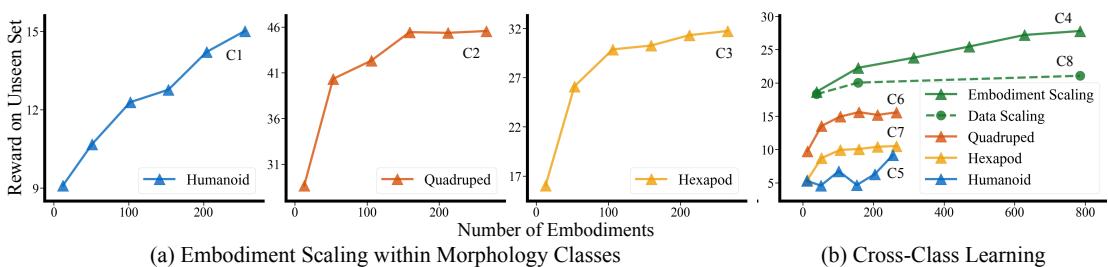
Looking at the charts in Figure 4:
- In-Class Scaling (a): When trained only on quadrupeds (orange), performance on unseen quadrupeds improves as you add more quadruped variations. The same applies to hexapods. Interestingly, humanoids (blue) show a steep upward trend without saturating, suggesting that for difficult morphologies, we are far from hitting the ceiling—we need even more data.
- Cross-Class Scaling (b): The green line (C8/Embodiment Scaling) represents the policy trained on all classes. It consistently outperforms policies trained on single classes (C5, C6, C7), even when tested on a mixed bag of robots.
Crucially, the researchers compared Embodiment Scaling vs. Data Scaling. They took a fixed set of 5% of the robots and just added more trajectory data (Curve C8 vs the dashed circle point). The performance plateaued almost immediately. This proves that simply having more data isn’t enough; you need more diverse bodies.
Q2: Zero-Shot Real-World Transfer
Simulation results are promising, but the real test is hardware. The authors deployed their best policy (trained on 817 simulated robots) onto two real robots: the Unitree Go2 (quadruped) and the Unitree H1 (humanoid).
Neither of these robots was in the training set.
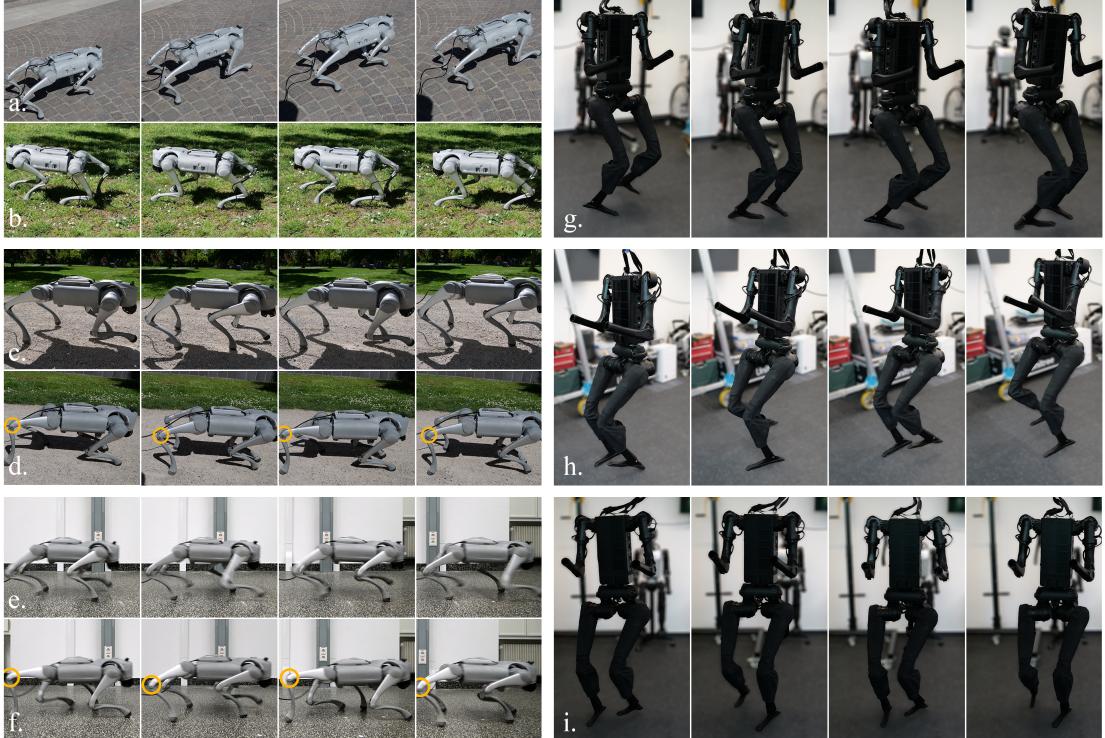
As shown in Figure 5:
- Go2 (a-b): The robot walks stably on grass and cobblestone.
- H1 (g-i): The humanoid walks forward, backward, and sideways in a lab setting.
- Robustness (c-f): The researchers artificially restricted the knee joint of the Go2 by 20% to simulate damage. Because the policy understands kinematics (it knows the joint limits are now smaller), it adapted zero-shot to a stable limping gait.
This confirms that the policy didn’t just memorize motion patterns; it learned an adaptable control strategy based on the robot’s physical description.
Q3: What Did the Brain Learn?
To understand how the neural network organizes its knowledge, the researchers visualized the “latent space” (the internal representation) of the policy using t-SNE.
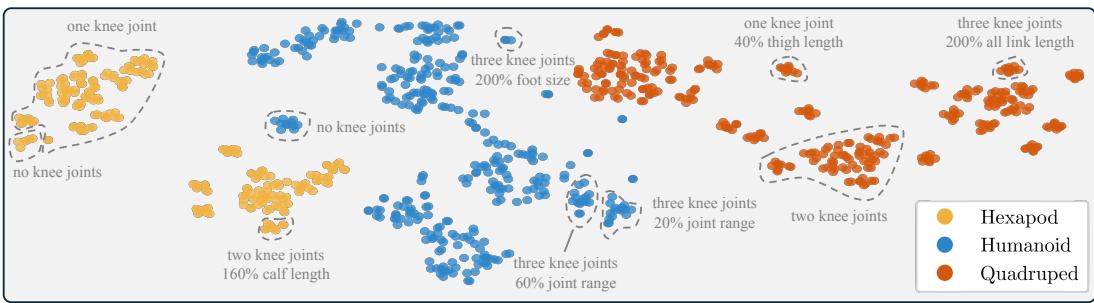
Figure 6 reveals a beautiful structure. The network naturally separated the robots into clusters of Humanoids (blue), Quadrupeds (orange), and Hexapods (yellow). Inside those clusters, it further organized them by the number of joints. This structure wasn’t hard-coded; the network learned that these physical forms require distinct control strategies, yet share underlying principles.
Conclusion and Implications
This paper presents the first large-scale empirical validation of Embodiment Scaling Laws in robot locomotion. The takeaways are significant for the future of robotics:
- Diversity > Quantity: To build generalist robots, we don’t just need more data from one robot; we need data from many different robots.
- Cross-Morphology Transfer: Learning to walk on six legs helps you learn to walk on two. The shared physics of locomotion transfers across varied bodies.
- Foundation Models for Robotics: Just as GPT-4 serves as a foundation for text, we are moving toward “Foundation Policies” for physical control. A single pre-trained network could one day serve as the “brain stem” for any new robot we build, drastically reducing the time required to program new hardware.
By procedurally generating a diverse army of robots, these researchers have shown that the path to general embodied intelligence lies in embracing physical variation, not avoiding it. As we scale up to tens of thousands of embodiments, we may soon see robots that can adapt to new bodies as easily as we put on a new pair of shoes.