](https://deep-paper.org/en/paper/2505.06699/images/cover.png)
Introduction
In the current landscape of deep learning, we are witnessing an arms race of foundation models. Companies and research labs are training massive models on equally massive datasets, often requiring computational resources that are out of reach for most academic researchers or smaller organizations. However, a byproduct of this race is the availability of powerful, open-weight models like OpenAI’s CLIP or Meta’s Llama.
This leads to a compelling question: How can we leverage these existing “reference” models to improve the training of our own “target” models on custom datasets?
Standard approaches usually involve fine-tuning (starting from the reference weights) or knowledge distillation (trying to mimic the reference). But what if you want to train a model from scratch that might eventually surpass the reference model? What if you want to use the reference model not as a teacher to be copied, but as a guide to tell you which data points matter most?
This emerging paradigm is called Model Steering.
In this post, we will dive deep into a paper titled “Model Steering: Learning with a Reference Model Improves Generalization Bounds and Scaling Laws.” The authors propose a theoretically grounded framework called DRRho (Distributionally Robust RHO optimization). Unlike heuristic methods that rely on gut feeling, DRRho is rooted in robust optimization theory.
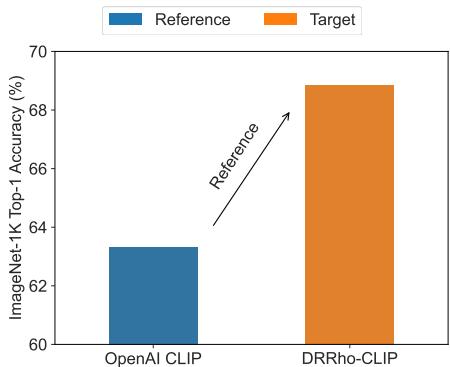
As we will see, this method allows a target model to achieve state-of-the-art performance with significantly less data and compute. As shown below in Figure 1, a target model trained with this method (DRRho-CLIP) significantly outperforms the very reference model it used for guidance.
Background: The Intuition of Model Steering
Before diving into the math, let’s establish the intuition. When you train a deep learning model on a massive dataset, not all data points are created equal. Some samples are “easy” (redundant), some are “hard” (informative), and some might be noisy outliers.
If you have access to a reference model that has already seen a lot of the world, you can use it to evaluate your training data. A popular heuristic in recent years involves the RHO Loss (\(\rho\)-loss). The idea is simple: for a given data point \(z\), we look at the difference between the loss of our model (\(\theta\)) and the reference model (\(\theta_{ref}\)):
\[ \text{RHO Loss} = \ell(\theta, z) - \ell(\theta_{ref}, z) \]If the reference model has a low loss on a sample but your model has a high loss, that sample is highly informative—it’s something you should know but don’t yet. This concept has been used to select data for training, but until now, the theoretical understanding of why it works—and specifically how it helps generalization—has been limited.
The authors of this paper take this heuristic and formalize it using Distributionally Robust Optimization (DRO).
What is Distributionally Robust Optimization (DRO)?
Standard machine learning minimizes the average loss over your training data (Empirical Risk Minimization). DRO, on the other hand, is pessimistic. It tries to minimize the worst-case risk over a set of possible data distributions that are close to your training distribution.
Imagine playing a game against an adversary who can slightly re-weight your training data to make your model look as bad as possible. DRO attempts to find model parameters that perform well even against this adversary. Mathematically, this often results in the model paying more attention (higher weights) to “hard” examples.
The Core Method: DRRho Risk Minimization
The authors introduce a new framework called DRRho Risk Minimization. This framework combines the benefits of DRO with the guidance of a reference model.
1. Defining the Risk
The core innovation is applying DRO not just to the standard loss, but to the difference in loss between the target and the reference model.
The objective function, which they call the DRRho risk, is defined as follows:

Here is what is happening in this equation:
- \(\mathbf{p}\) represents a probability vector (weights) assigned to the training samples.
- The term inside the sum is the RHO loss: \(\ell(\theta, z_i) - \ell(\theta_{ref}, z_i)\).
- The \(\sup\) (supremum) means we are finding the worst-case weighting of our data.
- The constraint \(D_{\phi}(\mathbf{p}, 1/n) \leq \rho/n\) ensures that these weights don’t deviate too much from a uniform distribution (where every sample has weight \(1/n\)).
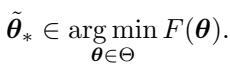
The goal of the training process is to find the model parameters \(\tilde{\theta}_*\) that minimize this risk:
2. Why Does This Improve Generalization?
This is the most critical theoretical contribution of the paper. Standard DRO is known to improve generalization bounds, but usually, these bounds depend on the variance of the loss function. If the loss function varies wildly across the dataset, the bound is loose (meaning we can’t guarantee good performance).
By introducing the reference model, the authors change the game. They derive a generalization bound for DRRho that depends on the variance of the difference between the models.
Let’s look at the generalization bound for the DRRho minimizer:

And, more specifically, comparing the excess risk of the learned model versus the optimal model:

The Key Insight: The term \(\text{Var}(\ell(\theta, \cdot) - \ell(\theta_{ref}, \cdot))\) is likely much smaller than \(\text{Var}(\ell(\theta, \cdot))\).
Why? Because the target model and the reference model are likely correlated. They will both find easy images easy and hard images hard. By subtracting the reference loss, we “cancel out” much of the inherent variance in the difficulty of the dataset.
This reduced variance leads to a tighter generalization bound. In practical terms, this means the model can learn to generalize well with fewer training samples.
3. Data Efficiency vs. The Reference
The theory goes a step further. It suggests that training with DRRho allows the target model to reach the performance level of the reference model with significantly less data than if the reference model were trained from scratch.

If the reference model was trained on millions of samples to achieve a certain variance, the target model needs far fewer samples (proportional to the reduced variance) to match it.
4. From Theory to Algorithms
How do we actually optimize this? The authors show that depending on how you define the “divergence” (\(D_{\phi}\)) in the DRO formulation, you recover different practical algorithms.
Case A: Hard Selection (Top-k) If we use Conditional Value-at-Risk (CVaR) as our divergence, the DRRho risk simplifies to minimizing the average RHO loss of the “hardest” \(k\) samples:
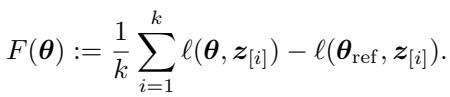
This explains why heuristics that simply select the top-k samples with the highest RHO loss work well—they are a specific instance of this broader framework.
Case B: Soft Weighting (KL Divergence) If we use KL-divergence, we get a “soft” weighting scheme. The objective becomes a smooth, log-sum-exp function involving a temperature parameter \(\tau\):
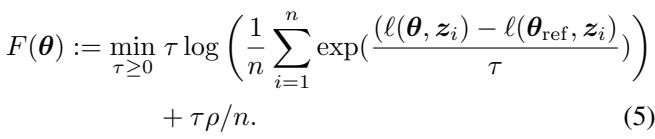
This effectively assigns a weight \(p_i\) to each sample based on how high its RHO loss is:
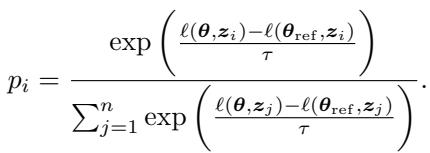
This effectively tells the optimizer: “Focus on samples where our model is doing worse than the reference model, but do it smoothly.”
Application: DRRho-CLIP
The authors apply this framework to CLIP (Contrastive Language-Image Pretraining). CLIP models are notoriously expensive to train, making them perfect candidates for efficiency improvements via model steering.
Standard CLIP training uses a contrastive loss that pulls paired images and texts together while pushing unpaired ones apart. The authors propose DRRho-CLIP, which integrates the reference model into this contrastive setup.
For a given image \(x_i\), the loss considers all negative text samples \(y_j\). The standard DRO-based contrastive loss looks like this:
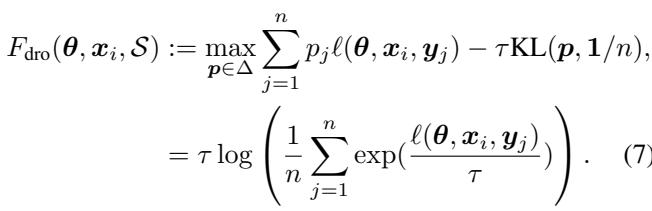
To create DRRho-CLIP, they simply replace the standard pairwise loss \(\ell\) with the shifted RHO loss \(\hat{\ell}\):

This results in the final DRRho contrastive loss for the image side:

A similar loss is defined for the text side (\(F(\theta, y_i, S)\)).
Optimization with SogCLR
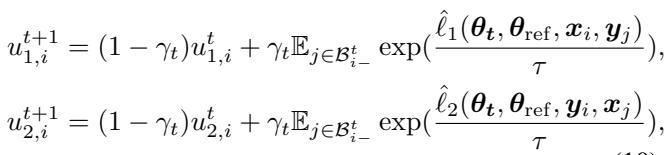
Optimizing contrastive losses on massive datasets is tricky because computing the denominator (the sum over all negatives) is expensive. The authors utilize an algorithm called SogCLR, which allows for efficient stochastic optimization with large effective batch sizes without needing massive GPU memory.
The update rules track a moving average of the exponential terms (\(u\)):
And the gradients are computed using these estimators:
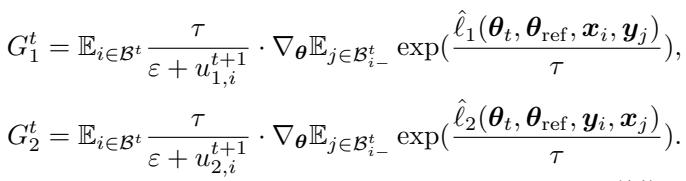
This ensures the method is scalable to the massive datasets required for foundation models.
Experiments and Results
The researchers conducted extensive experiments to validate their theory, primarily focusing on CLIP training using datasets like CC12M (12M samples) and DFN-192M (192M samples).
1. Data Efficiency
One of the boldest claims of the theory is that DRRho allows for training with significantly less data. The experimental results in Figure 3 strongly support this.
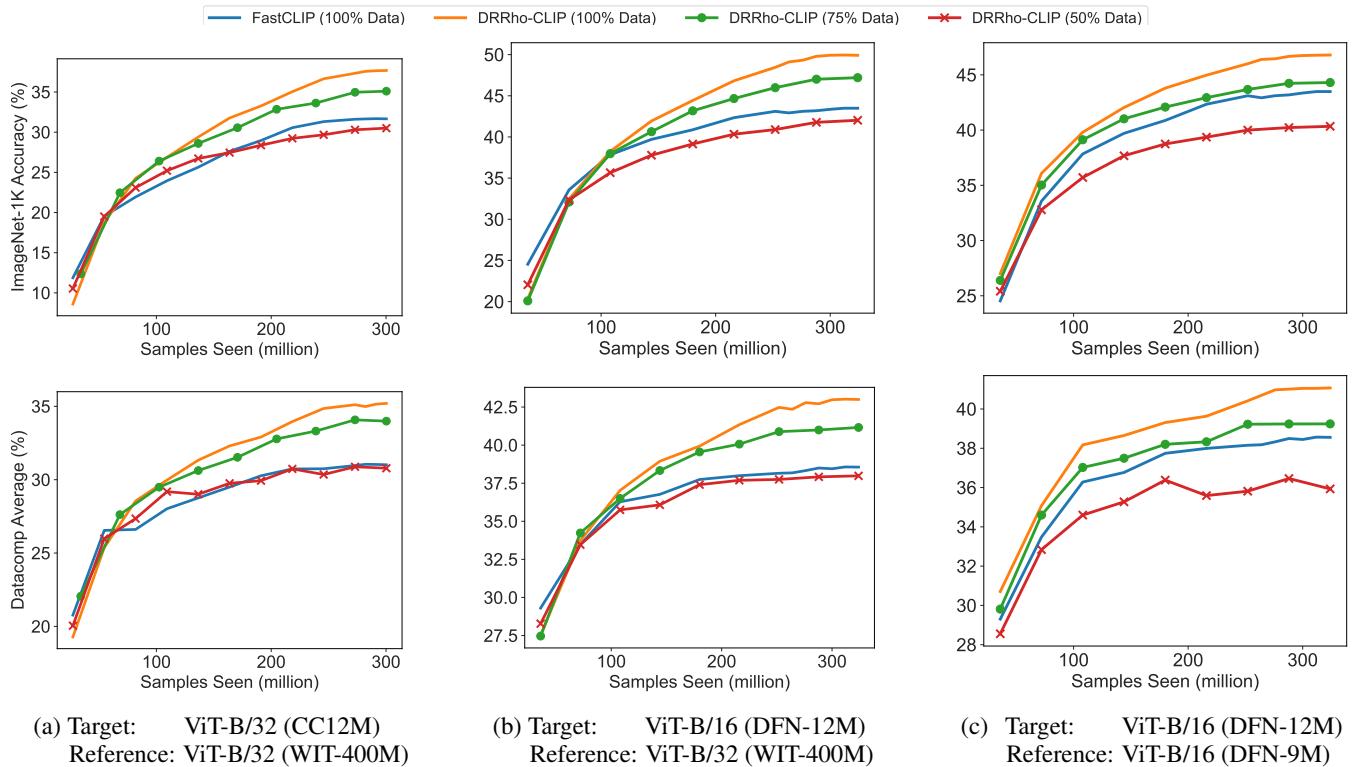
Look closely at the plots (specifically the bottom row, showing Datacomp average performance). The red line with crosses represents DRRho-CLIP trained on only 50% of the data. In many cases, it performs comparably to the baseline FastCLIP trained on 100% of the data (blue line). This empirical evidence validates the theoretical claim regarding reduced sample complexity.
2. Comparison with Heuristics
The authors compared DRRho-CLIP against JEST, a state-of-the-art heuristic method for data selection using reference models.
As shown in Table 1, DRRho-CLIP consistently outperforms JEST and standard training methods.
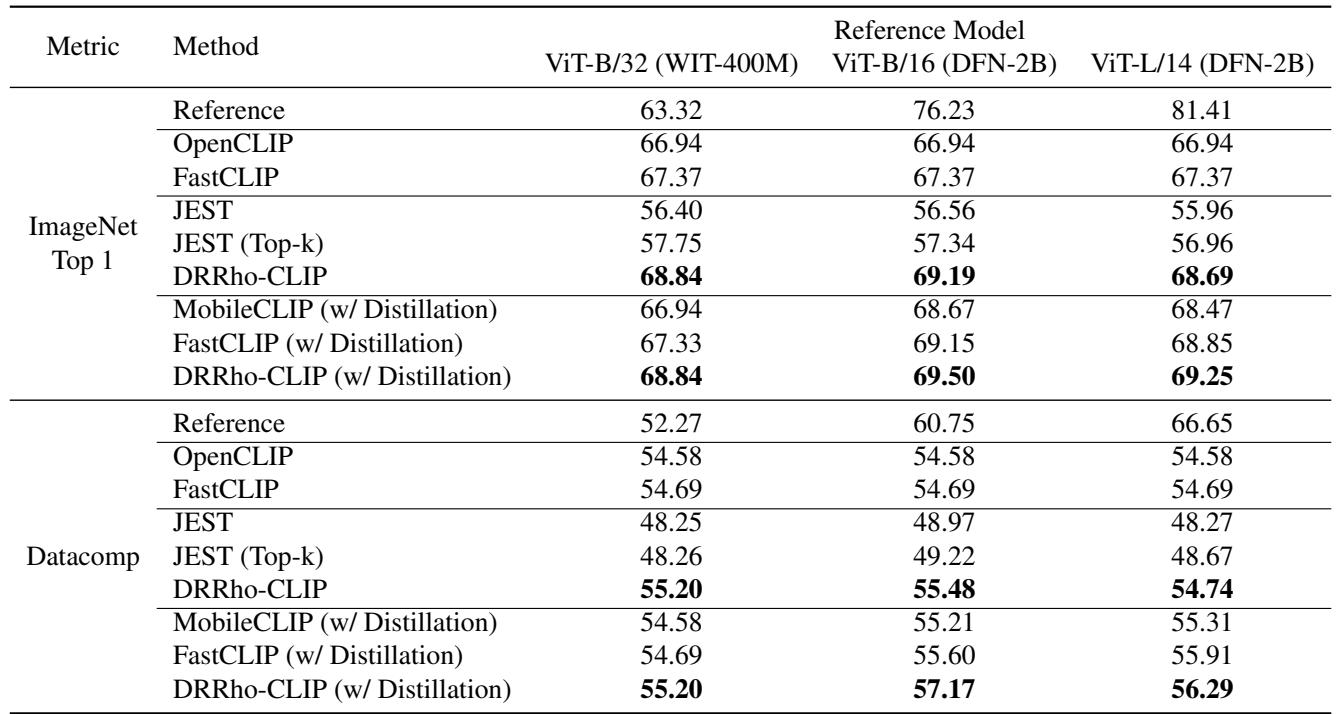
On the DFN-192M dataset, using OpenAI’s CLIP as a reference (which achieves 63.3% on ImageNet), DRRho-CLIP achieves 68.8%, beating both the reference model and the standard training baseline (67.3%).
3. Scaling Laws
Perhaps the most exciting result for the future of large model training is the impact on scaling laws. Scaling laws typically describe how the error rate of a model decreases as we increase compute (FLOPs). A steeper slope (lower beta) is better—it means you get “smarter” faster for every dollar spent on compute.
The authors plotted the scaling performance of DRRho-CLIP against OpenCLIP.
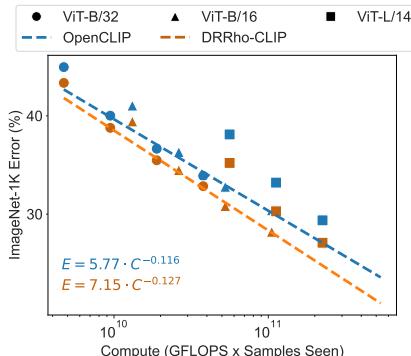
Figure 2 shows that DRRho-CLIP (the orange line) sits below the OpenCLIP baseline (blue line) and follows a more favorable power law. This suggests that as we scale up to even larger models and datasets, the advantage of using DRRho will likely grow, not shrink.
4. Does the Variance Actually Decrease?
Recall the theoretical crux: the method works because \(\text{Var}(\ell - \ell_{ref})\) is lower than \(\text{Var}(\ell)\). The authors actually measured this during training.
They found that for a ViT-B/32 reference model, the variance of the RHO loss was significantly lower than the standard loss (e.g., \(4.49 \times 10^{-3}\) vs \(7.26 \times 10^{-3}\) for images). This empirical check confirms that the theoretical foundation of the work is sound.
Conclusion & Implications
The paper “Model Steering: Learning with a Reference Model Improves Generalization Bounds and Scaling Laws” offers a significant step forward in how we train foundation models. It moves us away from viewing pre-trained models solely as checkpoints for fine-tuning or teachers for distillation. Instead, it frames them as robust guides that steer the optimization landscape itself.
Key Takeaways:
- Theoretical Grounding: Data selection using reference models isn’t just a hack; it’s a form of Distributionally Robust Optimization that reduces variance.
- Weak-to-Strong Generalization: You can use a weaker reference model to train a stronger target model.
- Efficiency: You can achieve comparable performance with half the training data.
- Better Scaling: The method exhibits superior scaling laws compared to standard training.
For students and practitioners, this implies that utilizing the open-source ecosystem of models is more valuable than ever. Even if you are training a model from scratch, having a “friend” (reference model) to help you navigate the data can make your journey significantly faster and more successful.