](https://deep-paper.org/en/paper/2505.06771/images/cover.png)
Introduction
Imagine trying to teach a swarm of drones to fly in formation or a fleet of warehouse robots to sort packages without colliding. In the world of robotics, we are moving away from hard-coding these behaviors toward Multi-Agent Reinforcement Learning (MARL). The promise of MARL is enticing: let the robots learn to coordinate by themselves through trial and error.
However, researchers in this field face a frustrating dilemma. On one hand, you have high-speed simulators (like those used for video games such as StarCraft) that allow for rapid training but ignore the laws of physics. On the other hand, you have realistic robotics testbeds that respect physics and safety but are agonizingly slow to train on because they cannot be easily parallelized.
This creates a significant “Sim2Real” gap. You either train a smart policy that fails in the real world because it doesn’t understand momentum, or you spend weeks training a realistic policy that takes too long to iterate on.
Enter JaxRobotarium.
In a new paper from the Georgia Institute of Technology, researchers have introduced a platform that bridges this divide. JaxRobotarium combines the lightning-fast computational power of JAX with the realistic dynamics of the Robotarium (a remote-access multi-robot testbed). The result? A system that can train multi-robot policies up to 20 times faster than previous methods and simulate trajectories 150 times faster, all while maintaining the fidelity needed to deploy those policies onto physical hardware.
In this post, we will tear down how JaxRobotarium works, why JAX makes such a difference for robotics, and look at the results of deploying these policies on real robots.
The Background: The Dilemma of Multi-Robot Learning
To understand why JaxRobotarium is significant, we first need to look at the existing landscape of MARL tools.
Currently, if you want to study multi-agent systems, you generally have to pick a lane:
- The “Gamer” Lane: You use platforms like the Multi-Agent Particle Environment (MPE) or the StarCraft Multi-Agent Challenge (SMAC). These are compatible with modern GPU acceleration. You can run thousands of agents at once. However, the “robots” are often just dots with no mass, inertia, or collision constraints. A policy learned here rarely works on a physical robot.
- The “Roboticist” Lane: You use high-fidelity simulators like IsaacGym or physical testbeds like the Robotarium. The Robotarium is a fantastic facility at Georgia Tech that allows anyone to upload code to run on physical robots remotely. However, the software infrastructure linking MARL to the Robotarium (specifically a platform called MARBLER) has historically been CPU-bound. It processes environments sequentially, making training deep learning models prohibitively slow.
The researchers summarize this landscape in the comparison table below. Note how most platforms force you to choose between GPU training speeds and realistic robot dynamics/safety.
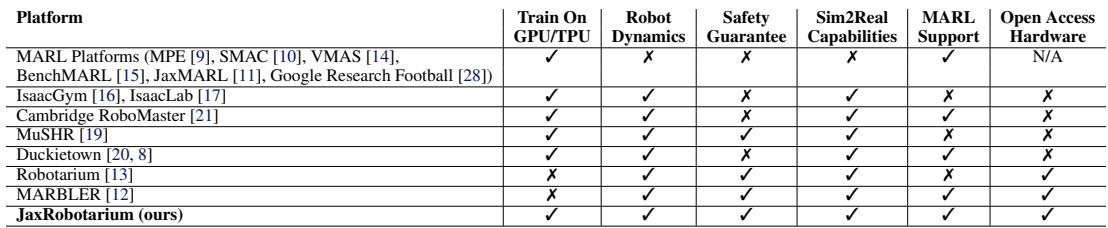
The goal of JaxRobotarium is to check every box in that right-hand column: GPU training, realistic dynamics, safety guarantees, and open-access hardware deployment.
The Core Method: Inside JaxRobotarium
The magic of JaxRobotarium lies in its architecture, which replaces standard Python loops with JAX-based operations. JAX is a library designed for high-performance machine learning research. It allows for JIT (Just-In-Time) compilation and vectorization, which are critical for speed.
Let’s break down the three main pillars of the platform: the Simulator, the Interface, and the Benchmark.
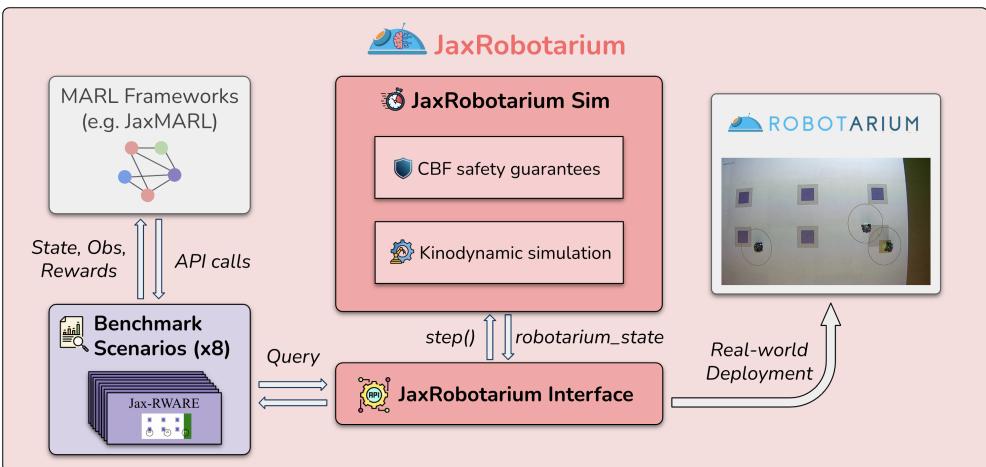
1. Jax-RPS: The High-Speed Simulator
The heart of the project is Jax-RPS, a simulator built from the ground up to mimic the physical Robotarium testbed.
In a standard simulator, if you want to train 100 robots, your computer might calculate the physics for Robot #1, then Robot #2, and so on. Even if you run multiple simulations, they are often handled as separate CPU processes, which creates significant overhead.
JaxRobotarium uses vmap (vectorization map) to handle these calculations. Instead of a “for loop,” JAX processes the physics for thousands of environments simultaneously on the GPU as a single matrix operation.
Realistic Dynamics and Safety
Speed is useless if the simulation is wrong. Jax-RPS implements Unicycle Dynamics. Unlike a simple particle that can move instantaneously in any direction, a unicycle model (like a differential drive robot) has constraints—it must rotate to change direction.
Furthermore, the simulator incorporates Control Barrier Functions (CBFs). Think of CBFs as invisible force fields. In reinforcement learning, agents explore by trying random actions. In the real world, a random action might smash a robot into a wall. The CBF layer in the simulator acts as a safety filter: it takes the agent’s desired action, checks if it creates an imminent collision, and if so, minimally alters the action to guarantee safety. This is computationally expensive, but by implementing the Quadratic Program solver (required for CBFs) directly in JAX, the researchers maintained high speeds.
2. The Learning Interface
The simulator needs to talk to the brain—the neural network. The authors built an interface that integrates natively with JaxMARL, a library of state-of-the-art multi-agent algorithms.
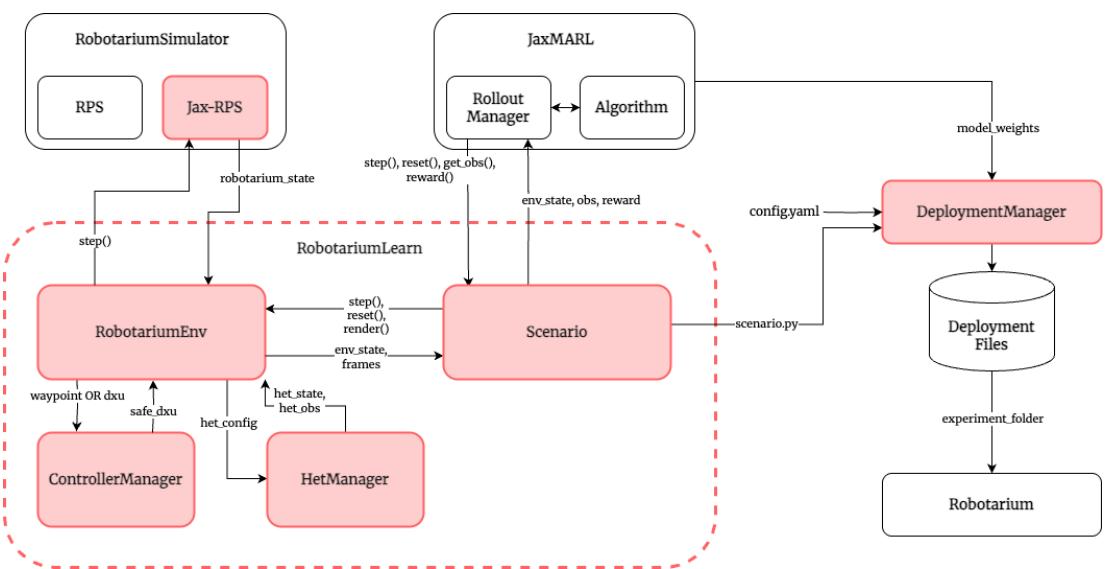
As shown in the detailed architecture diagram above, the system is modular.
- JaxMARL handles the algorithms (like PPO or QMIX).
- RobotariumEnv manages the state and observations.
- ControllerManager translates the high-level decisions from the AI into low-level motor commands (velocities), applying the safety barrier certificates along the way.
This end-to-end pipeline allows a user to write code in high-level Python, have it compiled down to highly efficient machine code via XLA (Accelerated Linear Algebra), and run the entire training loop on a GPU.
3. The Benchmark Scenarios
To prove the system works, the researchers implemented eight distinct coordination scenarios. These range from simple navigation tasks to complex warehouse logistics. Crucially, every scenario exists in three forms:
- The JAX simulation (for training).
- The standard Python simulation (for verification).
- The physical Robotarium setup (for deployment).

The scenarios include:
- Arctic Transport: A heterogeneous team (slow on ice/fast on water vs. fast on ice/slow on water) must cross a map.
- Discovery: Sensing robots must find hidden landmarks for tagging robots to collect.
- Foraging: Robots with different “strength levels” must team up to collect heavy resources.
- Material Transport: A logistics task involving moving goods from loading zones to drop-off zones.
- RWARE (Robot Warehouse): A realistic warehouse simulation where robots move shelves to packing stations.
Experiments and Results
The paper claims “Training in 10 Minutes.” Let’s look at the data to see if that holds up.
Computational Speed Comparison
The researchers pitted Jax-RPS against the standard Robotarium Python Simulator (RPS). They measured how long it takes to simulate steps as you increase the number of parallel environments.
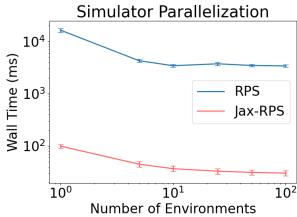
The graph above is striking. The blue line (standard RPS) stays flat or gets worse; it takes about 10 seconds to simulate a batch regardless of parallelization because of CPU overhead. The red line (Jax-RPS) plummets. As you add more parallel environments (moving right on the X-axis), the time per step drops drastically.
The Result: JaxRobotarium achieves a 150x speedup in trajectory simulation compared to the baseline.
Training Efficiency
Speeding up the simulator is only half the battle. Does this translate to faster learning? The researchers compared training times against MARBLER (the CPU-based framework).
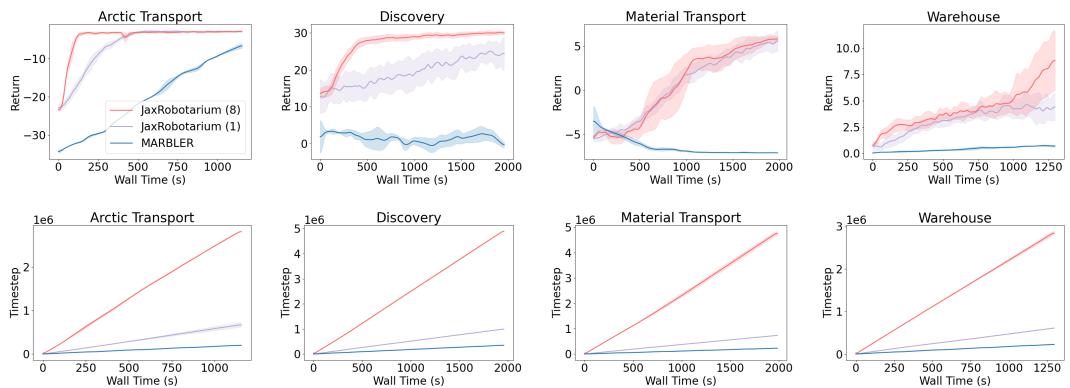
In the charts above, look at the top row (Returns vs. Time). The red lines (JaxRobotarium) shoot up almost immediately, reaching high rewards in a fraction of the time it takes the blue line (MARBLER) to even get started.
- Metric: JaxRobotarium trains policies up to 20 times faster.
- Implication: A training run that used to take 3 hours now takes less than 10 minutes. This tightens the feedback loop for researchers, allowing them to test new ideas rapidly.
Benchmarking Algorithms
The researchers benchmarked four major MARL algorithms: PQN, QMIX, MAPPO, and IPPO.
Interestingly, they found that Independent PPO (IPPO), a simpler algorithm that doesn’t use a centralized critic, performed surprisingly well, often beating more complex methods like MAPPO. This suggests that in scenarios where robots can see their neighbors (limited partial observability), simpler independent learning might be sufficient.
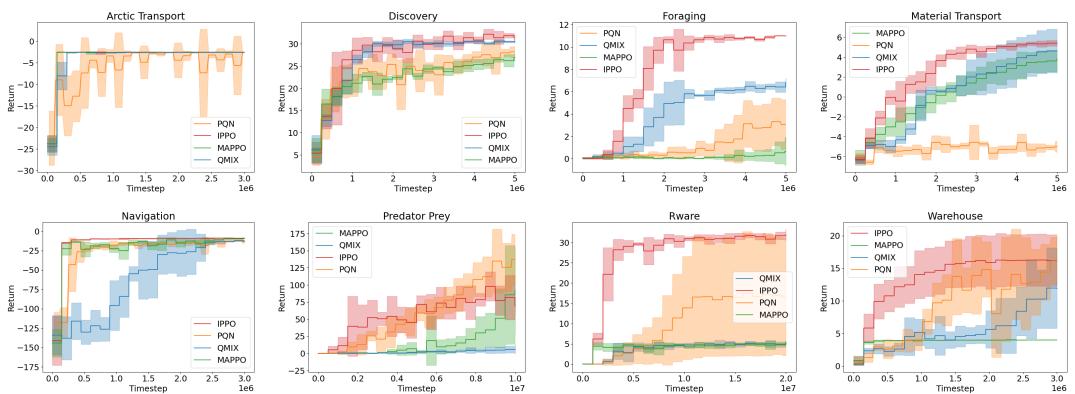
The training curves (Figure 6) show that while performance varies by task, the platform is stable enough to train diverse algorithms to convergence.
Sim2Real: The Moment of Truth
The ultimate test for any robotics paper is “Sim2Real”—taking the brain trained in the matrix and putting it into a physical body.
The authors deployed their trained policies on the physical Robotarium testbed in over 200 experiments. The results were largely positive, but with important nuances.
Where it worked well
In “static” environments like Arctic Transport or Material Transport, the transfer was nearly seamless. The robots acted in the real world almost exactly as they did in the simulation. The barrier functions successfully prevented collisions, and the tasks were completed efficiently.
Where it struggled (and how they fixed it)
In highly interactive environments, specifically Predator-Prey, they observed a larger performance gap. In simulation, the robots caught the prey easily. In the real world, small sensor noises or tiny delays caused the robots to miss, and the “prey” (programmed to run away) would escape.
This highlighted a classic problem: overfitting to the simulator. The agents had learned to rely on the perfect precision of the JAX simulation.
To fix this, the researchers used Domain Randomization. They simply added noise to the robots’ actions during training. By forcing the agents to learn in a “noisy” simulator, they became robust enough to handle the “noisy” real world.
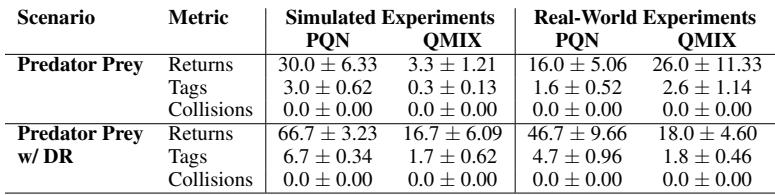
As the table above shows, adding domain randomization (DR) recovered a significant amount of the lost performance, proving that JaxRobotarium is a viable tool for Sim2Real research—provided you treat the simulation as an approximation, not a perfect replica.
Conclusion and Implications
JaxRobotarium represents a significant step forward for the democratization of multi-robot research.
- Accessibility: It removes the need for expensive local compute clusters. A student with a standard GPU (or even using Google Colab) can train meaningful policies in minutes.
- Standardization: By providing 8 diverse scenarios, it allows researchers to benchmark their algorithms fairly.
- Reality Check: By linking directly to the Robotarium, it prevents the field from getting stuck in “video game physics.” It forces policies to confront the reality of dynamics and safety.
While it’s not a replacement for photorealistic simulators (it doesn’t simulate camera images or LiDAR point clouds), it fills a critical niche for coordination and control logic. For students and researchers looking to test multi-agent theories on real hardware without waiting days for results, JaxRobotarium is a game-changer.