](https://deep-paper.org/en/paper/2505.07096/images/cover.png)
Introduction: The Data Bottleneck in Robotics
Imagine you want to teach a robot how to make a cup of coffee. The traditional way to do this is through imitation learning. You, the human expert, have to grab a controller or physically guide the robot arm through the motion dozens, perhaps hundreds of times. This process, known as teleoperation, provides the robot with exact pairs of “what the robot sees” (images) and “what the robot did” (motor actions).
This works well, but it is incredibly slow and expensive. It is the primary reason we don’t yet have “ChatGPT for robots.” While Large Language Models (LLMs) learned from the entire internet, robots are starving for data because there simply isn’t a massive internet-scale dataset of robot arm movements.
But wait—there is a massive dataset of tasks being performed: YouTube. There are millions of videos of humans cooking, cleaning, and fixing things. Why can’t robots just watch those?
The problem is the embodiment gap. A human hand is not a robot gripper. We have five fingers; a robot might have two parallel jaws. We move with different kinematics and dynamics. Most importantly, a video of a human provides visuals, but it contains zero robot action labels. The robot can see the coffee being poured, but it has no idea what motor currents or joint velocities are required to replicate that motion with its own body.
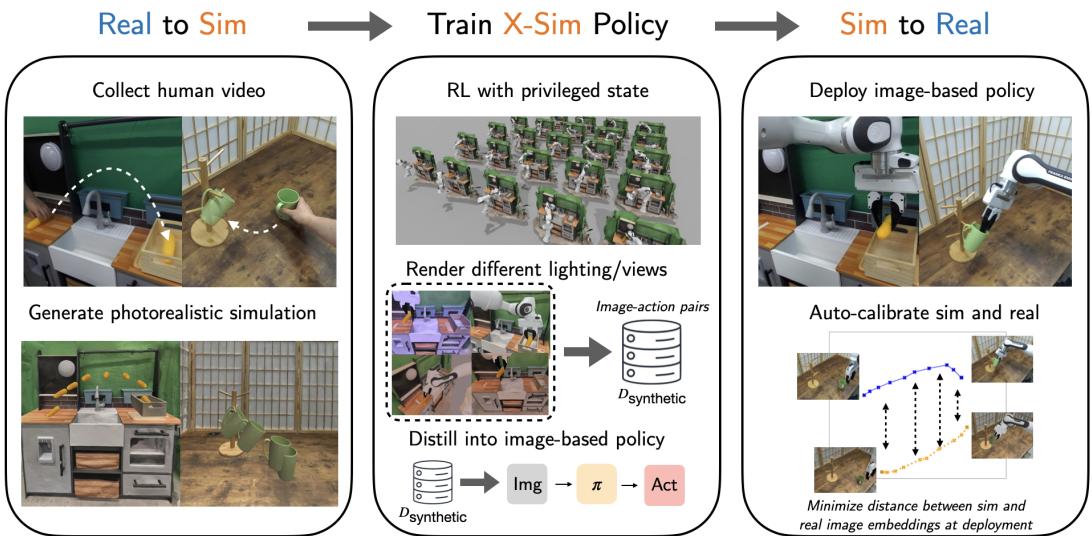
In this post, we are diving deep into X-SIM, a fascinating paper presented at CoRL 2025. The researchers propose a pipeline that bypasses the need for expensive robot teleoperation entirely. Their method allows a robot to watch a human video, simulate it, learn from it, and then execute the task in the real world—often performing better than methods that try to mimic human hand motions directly.
Background: The Trouble with Mimicry
To understand why X-SIM is innovative, we first need to look at how others have tried to solve the “learning from human video” problem.
Most existing approaches rely on retargeting. They use computer vision to track the human hand and then try to mathematically map the hand’s position to the robot’s end-effector. For example, if the human hand moves 10cm forward, tell the robot to move 10cm forward.
This sounds logical, but it fails in practice for two main reasons:
- Kinematic Infeasibility: A human might twist their wrist in a way that a robotic arm simply cannot mechanically replicate without colliding with itself or the table.
- Visual Mismatch: A robot looking at a human hand sees a very different scene than a robot looking at its own metal gripper. Policies trained on human hands often get confused when they see a robot gripper during deployment.
The authors of X-SIM realized that trying to copy the motion of the hand is a trap. Instead, they asked: what actually matters in a task?
The Core Insight: Object-Centric Learning
When you pour coffee, it doesn’t really matter where your elbow is or how your fingers are curled. What matters is that the cup tilts and the liquid goes into the mug.
X-SIM is built on the insight that object motion is the universal language between embodiments. If a human moves a mustard bottle from point A to point B, that object trajectory is the “ground truth” of the task. If a robot can figure out how to make the mustard bottle follow that same trajectory, it has succeeded, regardless of how its arm moved to make it happen.
X-SIM leverages this by using a Real-to-Sim-to-Real pipeline. Instead of mapping actions directly, it uses the human video to create a simulation, trains the robot in that simulation (where trial and error is safe), and then transfers that knowledge back to the real world.
The X-SIM Method
The framework is divided into three distinct stages. Let’s break them down.
Stage 1: Real-to-Sim Transfer
The first step is to turn a passive video into an interactive environment. The system needs to reconstruct the physical world digitally so the robot can practice in it.
The process begins with two inputs: a scan of the objects (using a phone app like Polycam) and a scan of the environment. The researchers use 2D Gaussian Splatting, a modern rendering technique that creates highly photorealistic 3D scenes from a short video scan.
Once the static scene is built, they need to extract the motion. They use a computer vision model called FoundationPose to track the position and rotation (6D pose) of the objects in the human video.
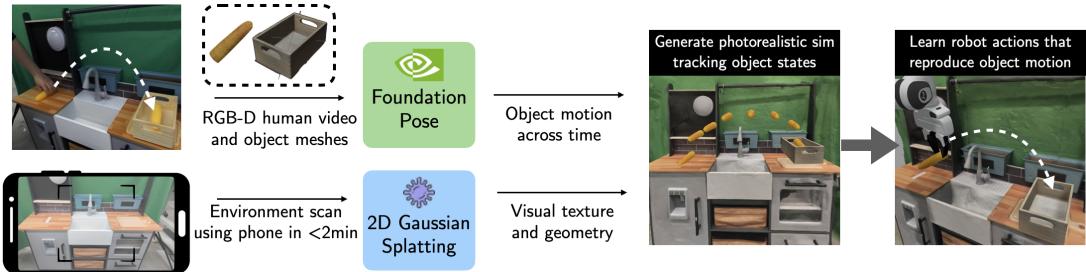
As shown in Figure 2 above, the result is a digital twin of the scene where the system knows exactly where the objects moved at every timestamp of the human demonstration.
Stage 2: Learning in Simulation (The Teacher)
Now that we have a simulation, we need to teach the robot how to manipulate the objects to match the human’s demonstration. Since we are in a simulation, we have access to the privileged state—meaning the robot knows the exact X,Y,Z coordinates of every object. This makes learning much easier than trying to learn from raw pixels immediately.
The Object-Centric Reward
The robot is trained using Reinforcement Learning (RL), specifically the PPO algorithm. In RL, an agent learns by trying to maximize a reward. X-SIM defines the reward based on the object trajectory.
The reward function essentially asks: “Is the object currently in the same position and orientation as it was in the human video?”
The mathematical formulation for the goal reward is:

Here, \(d_{pos}\) is the distance between the object’s current position and the target goal from the video, and \(d_{rot}\) is the rotational difference.
By optimizing this reward, the robot figures out its own way to grasp and move the object. It doesn’t care how the human held it; it only cares about getting the object to the right place.
Generating Synthetic Data
Once the RL policy is trained, it can perform the task perfectly in simulation. But we can’t deploy this RL policy directly to the real world because real robots don’t have magical access to exact object coordinates (privileged state). Real robots see the world through cameras.
To bridge this gap, X-SIM uses the trained RL policy to generate a massive dataset of Synthetic Image-Action Pairs. They run the simulation thousands of times, randomizing the lighting, camera angles, and object starting positions.
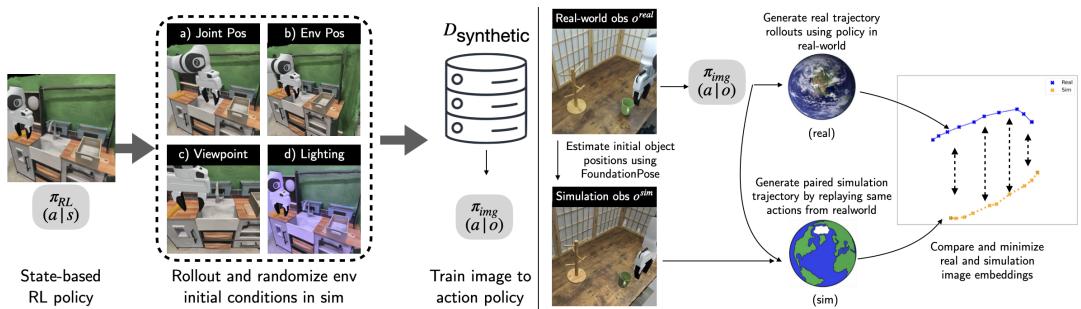
As illustrated in the left side of Figure 3, this results in a dataset \(D_{synthetic}\) where the inputs are rendered images (that look very realistic thanks to Gaussian Splatting) and the outputs are the correct robot actions derived from the RL expert.
Stage 3: Sim-to-Real Distillation (The Student)
Using the synthetic dataset, the team trains a Diffusion Policy. This is a powerful type of behavior cloning model that takes an image as input and predicts the robot’s action.
Because the simulation is photorealistic, this policy can often work “zero-shot” in the real world. However, no simulation is perfect. There are always subtle differences in lighting, texture, or color between the digital render and the physical camera feed. This is known as the Sim-to-Real Gap.
Auto-Calibration: Closing the Gap
X-SIM introduces a clever online domain adaptation technique to fix this.
- Deploy the policy on the real robot. It might fail or be slightly jittery.
- Record the video of the real robot’s attempt.
- Go back to the simulation and replay the exact same robot motions that happened in the real world.
- Now you have pairs of images: “What the real robot saw” and “What the simulated robot saw” for the exact same moment in time.
The system then fine-tunes the policy’s visual encoder using a Calibration Loss:

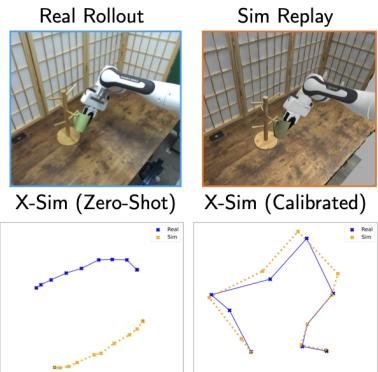
This contrastive loss forces the neural network to map the real image and the simulated image to the same feature embedding. It teaches the robot to ignore the “fake” look of the simulation and focus on the semantic content (e.g., “the cup is near the edge”).
The result, as seen in the t-SNE plot below (Figure 7), is that the feature representations of real and sim data align closely after calibration.
Experiments and Results
The researchers evaluated X-SIM on 5 real-world tasks using a Franka Emika robot arm. The tasks ranged from pick-and-place (Putting corn in a basket) to precise insertion (Putting a mug on a holder).
They compared X-SIM against two baselines that use hand-tracking:
- Hand Mask: Masks out the human hand and tries to clone the behavior.
- Object-Aware IK: Tracks the hand relative to the object and uses Inverse Kinematics to force the robot to follow the hand’s path.
Performance Comparison
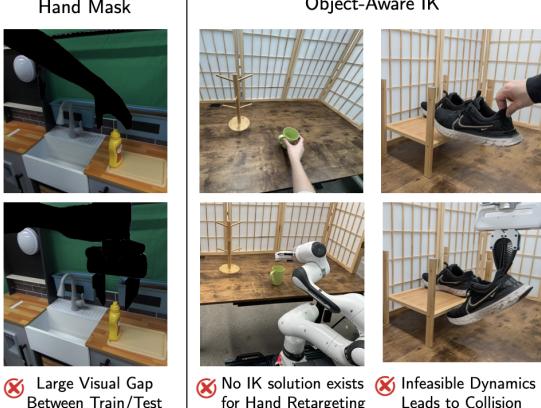
The results were stark. The hand-tracking baselines struggled significantly. The “Hand Mask” method failed because the visual gap was too large. The “Object-Aware IK” failed because the human motions were often impossible for the robot to execute physically (e.g., weird wrist angles).
X-SIM, however, consistently achieved high success rates.
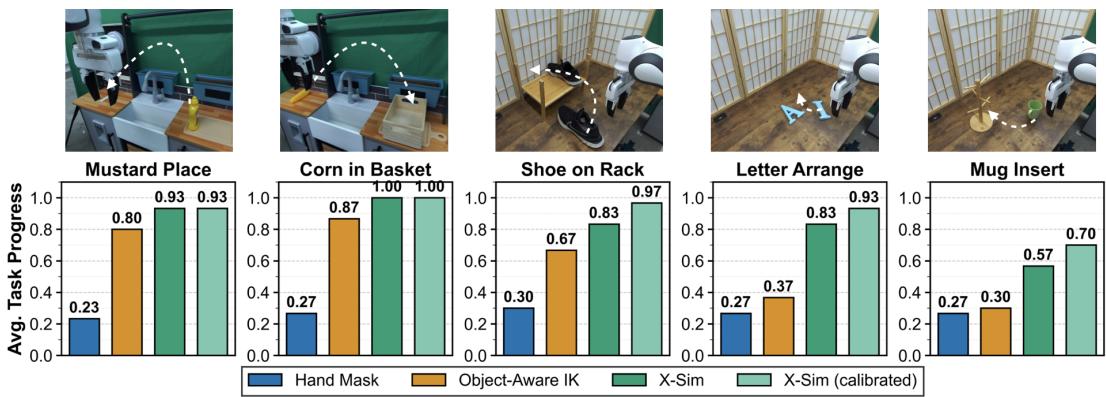
Figure 4 shows that X-SIM (especially the calibrated version) achieves nearly 100% progress on tasks like “Corn in Basket,” while baselines hover around 30%.
The failures of the baselines are visualized below. Hand retargeting is brittle; if the robot can’t physically reach a pose the human did, the whole system breaks. X-SIM avoids this because the RL agent discovers feasible robot actions from scratch.
Data Efficiency: The “Killer Feature”
Perhaps the most impressive result is data efficiency. Collecting robot data (teleoperation) is hard. Collecting human videos is easy.
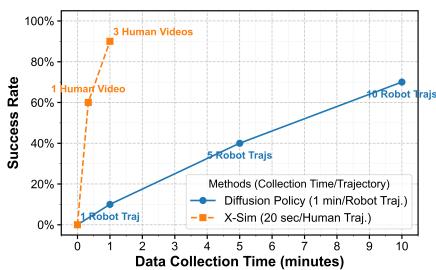
The researchers tested how much “human time” was needed to achieve good performance.
- Robot Teleoperation (Behavior Cloning): Required 10 minutes of tedious data collection to hit 70% success.
- X-SIM: Required only 1 minute of human video (just a few demos) to hit 90% success.
Because X-SIM can randomize the simulation (perturbing object positions slightly), a single minute of human video can be expanded into hours of diverse synthetic training data.
Robustness to Viewpoint Changes
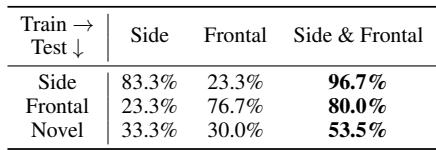
Finally, X-SIM solves another common headache in robotics: camera angles. If you train a robot with a front-facing camera, it usually fails if you move the camera 20 degrees to the side.
With X-SIM, you can simply render the synthetic data from multiple viewpoints. The researchers showed that by training on synthetic views from the side and front, the real robot could generalize to novel viewpoints it had never seen before—neither in the human video nor in the real world setup.
Conclusion
X-SIM presents a compelling path forward for robotic learning. By shifting the focus from imitating the body to imitating the effect on the world, it bypasses the difficult problems of retargeting and kinematic mismatch.
The key takeaways are:
- Object Motion is Universal: It is the robust link between human and robot domains.
- Simulation is a Multiplier: A small amount of real-world data (1 minute of video) can become a massive amount of training data through synthetic randomization.
- Real-to-Sim-to-Real works: With high-fidelity rendering (Gaussian Splatting) and smart domain adaptation (Auto-Calibration), we can train agents in the Matrix and have them work in the real world.
This approach hints at a future where robots might learn to cook, clean, or repair simply by “watching” standard instructional videos, generating their own internal simulations to practice, and then executing the task with their own unique bodies. We aren’t quite at the “downloading Kung Fu” stage, but X-SIM brings us one step closer.