](https://deep-paper.org/en/paper/2505.08243/images/cover.png)
Introduction
In the quest to build general-purpose robots, we often look to the success of Large Language Models (LLMs). If an AI can plan a vacation or debug code by “thinking through” the problem step-by-step, shouldn’t a robot be able to plan how to tidy a kitchen using the same mechanism?
This concept is known as Embodied Chain-of-Thought (CoT) reasoning. By training Vision-Language-Action (VLA) models to predict intermediate reasoning steps—like “identify the apple,” “plan to move the arm,” and “calculate gripper width”—before outputting a final movement command, researchers have achieved impressive gains in generalization. Robots trained this way are smarter; they handle new objects and instructions much better than those that just map pixels directly to actions.
But there is a catch, and it is a big one: Latency.
Generating a paragraph of text reasoning before every single motor movement takes time. In some cases, it slows the robot down to a control frequency of 1 Hz (one action per second). In dynamic real-world environments, a robot that pauses to “think” for a second before every twitch is often impractical.
This brings us to a fascinating paper titled “Training Strategies for Efficient Embodied Reasoning.” The researchers pose a critical question: Do we actually need the robot to produce these reasoning steps during deployment, or does the magic happen during training?
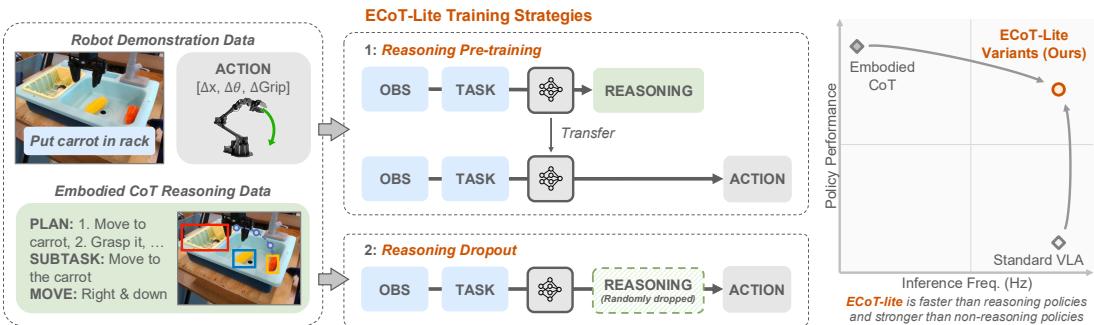
In this post, we will deconstruct their work. We will explore why reasoning helps robots, and look at their proposed solution, ECoT-Lite—a set of training strategies that boosts robot performance to state-of-the-art levels while maintaining the lightning-fast inference speeds of standard policies.
Background: The State of Robot Reasoning
To understand the innovation here, we first need to look at the baseline: Vision-Language-Action Models (VLAs).
A standard VLA (like OpenVLA or RT-2) is essentially a VLM fine-tuned for robotics. It takes an image and a text instruction (e.g., “Put the carrot on the plate”) and outputs a sequence of “action tokens.” These tokens are decoded into physical robot commands (changes in x, y, z coordinates, gripper rotation, etc.).
The “Full ECoT” Approach
Recent work introduced Embodied Chain-of-Thought (ECoT). Instead of jumping straight from image to action, the model is trained to generate a sequence of reasoning steps first.
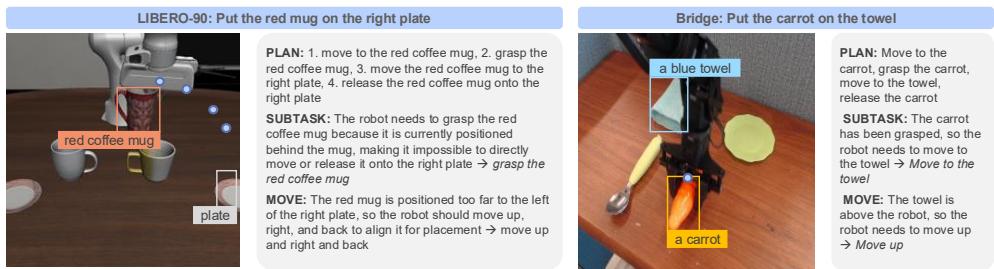
As shown in the image below, these steps are granular. They might include:
- A high-level plan: “Pick up the corn.”
- Visual grounding: Bounding boxes coordinates for the corn.
- Subtask logic: “The corn is not grasped yet -> Move to corn.”
- Movement rationale: “Corn is below the arm -> move down.”
![Figure 2: Example intermediate reasoning steps. We use Embodied Chain-of-Thought Reasoning (ECoT [14]) as a representative robot reasoning approach for this work, and thus indicate which steps it does not use with dashed borders (but they are used in other similar works [45, 46]).](/en/paper/2505.08243/images/002.jpg#center)
While effective, this pipeline is computationally expensive. If your robot arm needs to react quickly to a slipping object, it cannot afford to write a short essay about it first. The authors of this paper wanted to keep the intelligence of ECoT without the computational tax.
Deconstructing the “Why”: Three Hypotheses
To fix the speed problem, the researchers first had to understand the mechanism of improvement. Why exactly does training on reasoning data make the robot better at grabbing the corn? They proposed three hypotheses:
- Representation Learning: The reasoning data forces the model to learn better internal features. For example, by forcing the model to predict the bounding box of a “red mug,” the model’s internal layers get much better at recognizing “red mugs” generally. If this is true, we might not need to output the text at test time—the internal features are already learned.
- Learning Curriculum: Reasoning acts as “scaffolding.” It’s easier for a model to learn “Image \(\to\) Plan \(\to\) Action” than the massive leap of “Image \(\to\) Action.” Once the bridge is built during training, perhaps we can remove the scaffolding.
- Expressivity (Compute): This is the skeptic’s hypothesis. Maybe the semantic content doesn’t matter. Maybe the model just works better because generating reasoning tokens gives the Transformer more “thinking time” (more layers of computation) before it commits to an action.
The Core Method: ECoT-Lite
Based on these hypotheses, the authors developed ECoT-Lite, a suite of training recipes designed to isolate these factors and find a faster alternative.
The diagram below outlines the five specific architectures they compared.
![Figure 3: ECoT-Lite training recipes. Blue indicates inputs, orange indicates outputs/generations, dashed border represents absence during test-time (and random drop-out during training). (a): Standard VLA [5, 6] and embodied CoT [14] training. (b) Pre-train or co-train VLA models with embodied reasoning data. (c): Provide reasoning data as a “scaffolding” in context during training. (d): Train with reasoning dropout, remove reasoning during inference. (e): Introduce non-semantic “thinking tokens” to increase effective model expressivity.](/en/paper/2505.08243/images/003.jpg#center)
Let’s break down the new proposed recipes (b, c, d, and e) and how they relate to the hypotheses.
1. Reasoning Pre-training (The Representation Approach)
Corresponds to Recipe (b) Here, the model is first trained exclusively to generate reasoning (plans, bounding boxes, etc.) from images. Then, that objective is turned off, and the model is fine-tuned to predict actions.
- The Logic: If Hypothesis 1 is true, pre-training should shape the model’s visual representations to be “robot-relevant” before it ever sees a motor command. At test time, it acts like a standard VLA—no reasoning output, maximum speed.
2. Reasoning Dropout (The Hybrid Approach)
Corresponds to Recipe (d) This is a clever twist on standard ECoT. The model is trained to produce reasoning, but with a dropout mechanism. During training, the reasoning section is randomly removed for some examples.
- The Logic: This forces the model to be flexible. It learns the deep representations from the examples with reasoning, but because it sometimes has to predict actions directly, it learns a direct pathway from image to action.
- The Benefit: At test time, you simply turn off the reasoning generation. You get the benefits of the “reasoning-informed” weights, but the inference speed of a standard VLA.
3. Reasoning Scaffolding (The Curriculum Approach)
Corresponds to Recipe (c) Here, the reasoning is provided as input (context) during training, but the model isn’t penalized for generating it. It’s treated like a hint.
- The Logic: This tests Hypothesis 2. Does seeing the reasoning help the model learn the mapping, even if it doesn’t have to generate it?
4. Thinking Tokens (The Expressivity Approach)
Corresponds to Recipe (e)
This tests the “compute” hypothesis. The model generates meaningless “thinking tokens” (like a repeated period .) before the action.
- The Logic: If Hypothesis 3 is true, simply forcing the model to churn through dummy tokens should improve performance by increasing effective depth.
Experiments & Results
The researchers evaluated these strategies on two major benchmarks: LIBERO-90 (a simulation benchmark with 90 diverse tasks) and BridgeData V2 (real-world robot manipulation).
Below is an example of the kind of reasoning data used in these experiments. Notice how detailed the reasoning is, covering everything from task planning to spatial relationships.
Key Finding 1: You Don’t Need to “Think” Out Loud to Be Smart
The results were stark. The Reasoning Dropout and Reasoning Pre-training methods (which do not generate text at test time) significantly outperformed standard VLAs and rivaled the performance of full ECoT.
Take a look at the performance charts below:
![Figure 5: Top: Performance of all methods on LIBERO-90 benchmarks. The most performant approaches are ECoT and the ECoT-Lite reasoning dropout policy, both of which beat past state-of-the-art on the standard LIBERO-90 evaluations (90.8% and 89.4% vs. 88.6% by Mete et al. [69]). Reasoning pre-training also improves performance significantly. See Table 1 for numerical values and standard errors. Bottom: We replicate the reasoning dropout and pre-training policies in Bridge to validate their real-world effectiveness. Both ECoT-Lite approaches improve on the standard VLA’s performance. While full ECoT is the most performant, the ECoT-Lite policies do not generate test-time reasonings, making their inference speeds much faster. See Table 2 for per-task numerical values and standard errors. Asterisks in legend indicate method appears in top and bottom.](/en/paper/2505.08243/images/005.jpg#center)
In the LIBERO-90 benchmark (top chart):
- Standard VLA: ~67% success rate.
- Reasoning Dropout (Ours): ~76% success rate.
- Full ECoT: ~77% success rate.
The Reasoning Dropout policy achieved almost the exact same performance as the heavy, slow Full ECoT model, but runs 3x faster (jumping from ~1 Hz to ~3.5 Hz).
Key Finding 2: “Thinking Tokens” Don’t Work
The “Thinking Tokens” strategy (just adding filler tokens) actually degraded performance slightly. This strongly suggests that the content of the reasoning matters. It’s not just about compute; the model needs to learn semantic concepts like “object location” and “planning logic” to improve.
Key Finding 3: Pre-training vs. Co-training
An interesting nuance appeared between Pre-training (training reasoning then actions) and Co-training (training both simultaneously).
You might assume Co-training is better because the model learns everything at once. However, the results showed Pre-training was superior.
The authors propose a “Loss Landscape” theory to explain this (visualized below).
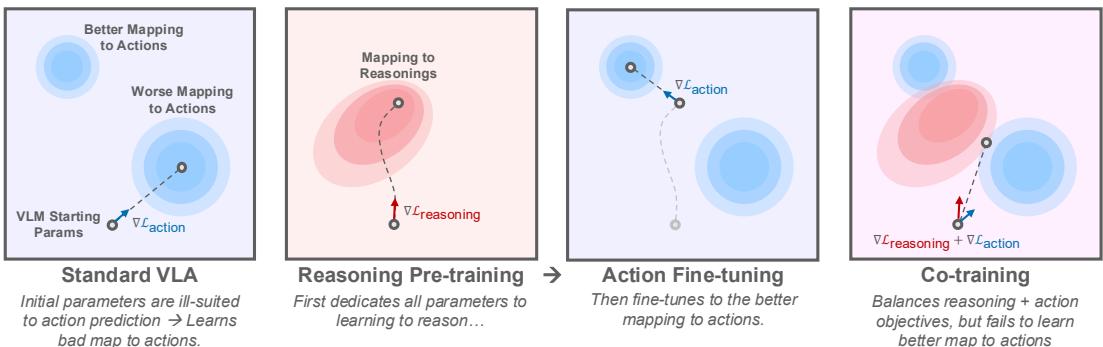
In Co-training, the model might split its capacity: some parameters learn reasoning, others learn actions, and they don’t help each other much. In Pre-training, the model is forced to dedicate all its capacity to understanding the environment (reasoning) first. When it switches to action learning, it’s already “smart,” allowing it to find a better solution for motor control.
When Do We Actually Need Full Reasoning?
While ECoT-Lite (Dropout) is fantastic, are there times when we must use the slow, full ECoT approach?
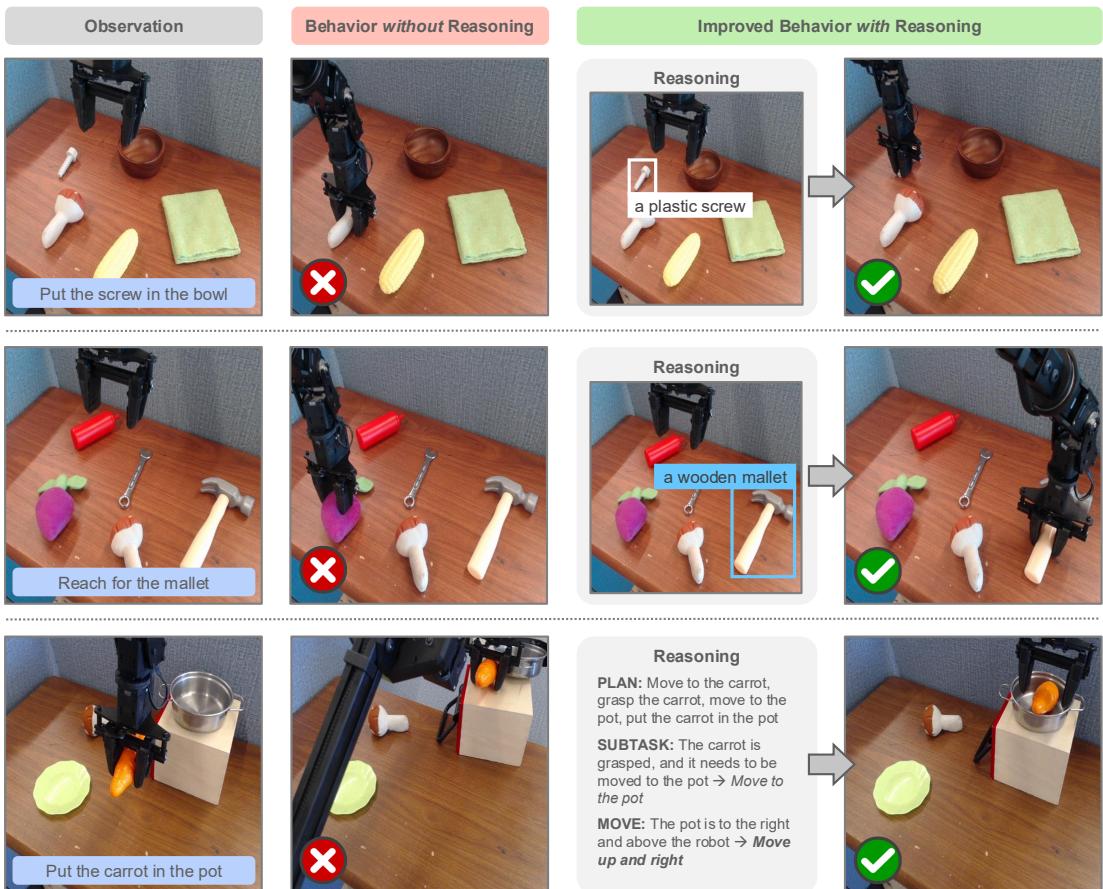
The BridgeData experiments (real robot) suggested yes. For “In-Distribution” tasks, the fast Dropout model worked perfectly. However, for Out-of-Distribution (OOD) scenarios—like handling unseen objects or new spatial relationships—enabling the reasoning at test time helped prevent failures.
The image below illustrates this beautifully. In the “Put carrot on plate” task (where the target location is high up, a new scenario), the Reasoning Dropout model fails because it crashes into the platform. The Full ECoT model explicitly reasons “The carrot is below the arm -> move down,” allowing it to correct its trajectory and succeed.
Conclusion & Implications
This paper provides a significant leap forward for practical robot learning. It proves that the main benefit of “Chain-of-Thought” in robotics isn’t necessarily the real-time generation of text, but the representation learning that happens during training.
The Takeaways:
- Reasoning improves representations: Teaching a robot to explain itself makes it better at seeing and understanding the world.
- Speed doesn’t have to suffer: By using Reasoning Dropout or Pre-training, we can “bake in” this intelligence. We can deploy policies that are as fast as standard VLAs but significantly more robust.
- Flexibility is key: The Reasoning Dropout method is particularly powerful because it gives you a choice. You can run it in “fast mode” (no reasoning) for 99% of tasks, and switch on “slow/smart mode” (full reasoning) when the robot detects it is confused or in a novel situation.
For students and researchers in embodied AI, ECoT-Lite offers a new standard recipe: Train with reasoning, deploy without it. This brings us one step closer to robots that are both smart enough to handle the real world and fast enough to be useful in it.