](https://deep-paper.org/en/paper/2505.09144/images/cover.png)
Imagine two people trying to move a large, heavy couch up a winding staircase. One is at the top, pulling; the other is at the bottom, pushing. They can’t see each other’s faces, and the noise of the city drowns out their voices. Yet, they manage to pivot, lift, and tilt the couch in perfect unison. How?
They rely on implicit cues—the tension in the couch, the speed of movement, and an internal mental model of what the other person is likely doing. In psychology, the ability to attribute mental states—beliefs, intents, desires—to oneself and others is known as Theory of Mind (ToM).
In robotics, this kind of intuitive collaboration is notoriously difficult. Standard approaches usually involve a “central brain” that controls both sets of arms, but that is fragile and hard to scale. Alternatively, if robots act independently, they often end up fighting each other or dropping the object.
Today, we are diving deep into a fascinating paper titled “Latent Theory of Mind: A Decentralized Diffusion Architecture for Cooperative Manipulation.” The researchers propose a novel architecture that allows robots to collaborate in a decentralized way by learning a “consensus” representation of the world and using it to predict their partner’s internal state—effectively giving robots a latent Theory of Mind.
The Problem: The Centralized vs. Decentralized Dilemma
Before we get into the solution, we need to understand why multi-robot manipulation is so hard.
Currently, if you want two robotic arms to pour coffee or fold a shirt together, you typically use a Centralized Policy. This means you train a single neural network that takes input from all cameras and sensors and outputs actions for both arms simultaneously.
While effective, centralized systems have major drawbacks:
- Fragility: If one sensor fails or communication lags, the whole system crashes.
- Scalability: As you add more robots, the input space explodes, making the model massive and hard to train.
- Data Scarcity: It is hard to collect data for every possible combination of robot actions.
The alternative is a Decentralized Policy, where each robot has its own brain. This is robust and scalable. However, decentralized agents struggle to coordinate. Without a shared brain, Robot A might decide to push left while Robot B pushes right, resulting in a stalemate or a broken object.
The challenge this paper tackles is: How do we enable independent robots to reach a consensus on their actions without necessarily needing explicit, constant communication?
The Solution: Latent Theory of Mind (LatentToM)
The researchers introduce LatentToM, a decentralized architecture based on Diffusion Policies. The core innovation is how the robots process information. Instead of treating all observations as a single block of data, the system forces each robot to split its internal representation into two distinct parts:
- Ego Embedding: Information specific to the robot itself (e.g., the position of its own gripper).
- Consensus Embedding: Information that should be shared or common across all agents (e.g., the state of the object being manipulated).
By structuring the brain of the robot this way, the researchers can apply mathematical rules—derived from Sheaf Theory—to force the “Consensus” parts of different robots to align, even if they are looking at the scene from different angles.
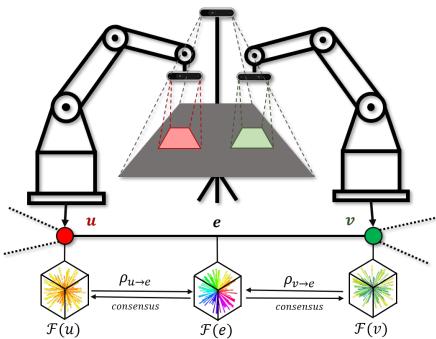
As shown in Figure 1 above, each robot (u and v) has its own local view (red and green cones) and shares a global view (gray cone). The system tries to learn a mapping where their understanding of the shared task (the consensus) overlaps perfectly.
Deep Dive: The Method
This is the heart of the innovation. Let’s break down the architecture and the mathematical constraints that make it work.
1. The Architecture: Splitting the Brain
The system treats the multi-robot setup as a graph where each robot is a node. Each robot receives an observation \(o_u\). The network splits this observation into two streams:
- \(o_u^{ego}\): The robot’s private data (end-effector image, pose).
- \(o_u^{con}\): The shared context (third-person view).
These are encoded into latent vectors \(h_u^{ego}\) and \(h_u^{con}\). The goal is to ensure that \(h_u^{con}\) (Robot A’s view of the world) is consistent with \(h_v^{con}\) (Robot B’s view of the world).
2. Sheaf Theory and Restriction Maps
To align these representations mathematically, the authors use Cellular Sheaf Theory. In simple terms, Sheaf Theory is a topological tool used to stitch local data into global consistency.
Imagine two people looking at a map. One sees the top half, one sees the bottom half, and there is an overlapping strip in the middle. For them to agree on where they are, the features in that overlapping strip must match in both of their minds.
In the LatentToM architecture, this “overlapping strip” is modeled using Restriction Maps. A restriction map \(\rho_{u \to e}\) takes the information from Robot U and projects it into the shared “edge” space (the consensus space).

Ideally, if both robots understand the shared reality correctly, their projected consensus embeddings should be identical.
3. Loss I: Numerical Consistency (Sheaf 1-Cohomology)
The first step to coordination is making sure the robots agree on the numbers. During training, the system minimizes the distance between the consensus embeddings of the two robots. In Sheaf Theory, this is minimizing the 1-cohomology (a fancy way of saying “measuring the disagreement”).

By minimizing this loss (\(\mathcal{L}_{nc}\)), the network forces the two independent robots to generate numerically similar vectors for the shared context.
4. Loss II: The “Theory of Mind” Constraint
Here is the catch: You can minimize the difference between two vectors by simply making both vectors zero. If Robot A says “0” and Robot B says “0”, the error is zero, but they haven’t learned anything useful. This is called representation collapse.
To prevent this and to make the consensus embedding meaningful, the authors draw inspiration from Theory of Mind. They argue that if Robot A truly understands the shared context, it should be able to deduce what Robot B is doing.
They introduce a ToM Predictor network. Robot U uses its Consensus embedding (\(h_u^{con}\)) to predict Robot V’s Ego embedding (\(h_v^{ego}\)).
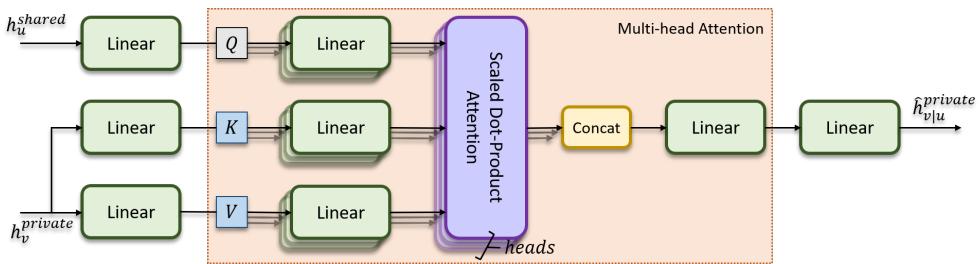
As visualized above, this module uses an attention mechanism where the shared consensus acts as a query to extract information about the partner’s private state.
The loss function for this looks like this:

This constraint (\(\mathcal{L}_{tom}\)) is crucial. It ensures that the consensus embedding is rich enough to contain information about the entire system, effectively forcing each robot to “empathize” with the other’s position.
5. Loss III: Directional Consensus
Not all robots are created equal. At any given moment, one robot might have a better view of the object than the other. If Robot A is blindfolded (occluded) and Robot B has a clear view, Robot A should align its beliefs to Robot B, not the other way around.
To handle this, the network learns a Confidence Score (\(c\)) for each robot. The alignment isn’t just a simple average; it is directional. The robot with lower confidence is penalized more heavily if it deviates from the robot with higher confidence.

The equation above (\(\mathcal{L}_{conf}\)) weights the error based on the difference in confidence. To prevent the system from cheating (e.g., by always setting confidence to 1 or 0), they add an entropy regularization term that encourages the confidence scores to stay somewhat balanced unless there is a strong reason not to be.

6. Inference: The Sheaf Laplacian
Everything discussed so far happens during training. Once trained, the robots can act in a fully decentralized way using only their own sensors.
However, if the robots can communicate during execution, the authors propose an optional “repair” step called the Sheaf Laplacian. Before executing an action, the robots can exchange their consensus embeddings and perform a quick mathematical update to bring them closer together.
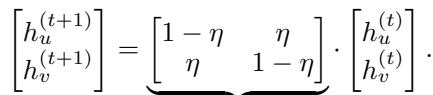
This update (Equation 5 in the paper) smooths out disagreements in real-time, preventing the “livelock” scenario where robots get stuck in a loop of indecision because they are reacting to slightly different versions of reality.
Experiments and Results
The researchers validated LatentToM on two challenging cooperative tasks that require precise coordination.
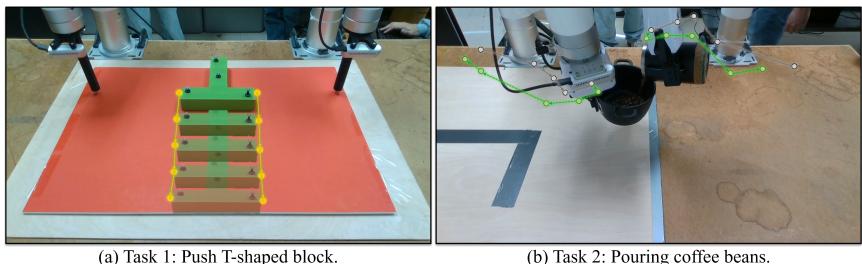
Task 1: The Cooperative Push-T
In this task, two robots must push a T-shaped block to a target. The catch? They must keep the block strictly oriented (no rotating) while pushing.
To make it harder, the researchers introduced an Out-Of-Distribution (OOD) challenge: they changed the friction on the bottom of the block (making it asymmetric) without telling the robots. The robots had to adapt based on visual feedback alone.
The Results: The results were striking. The naive decentralized policies (NDDP) failed miserably because the robots couldn’t agree on how to compensate for the friction, causing the block to rotate wildly.
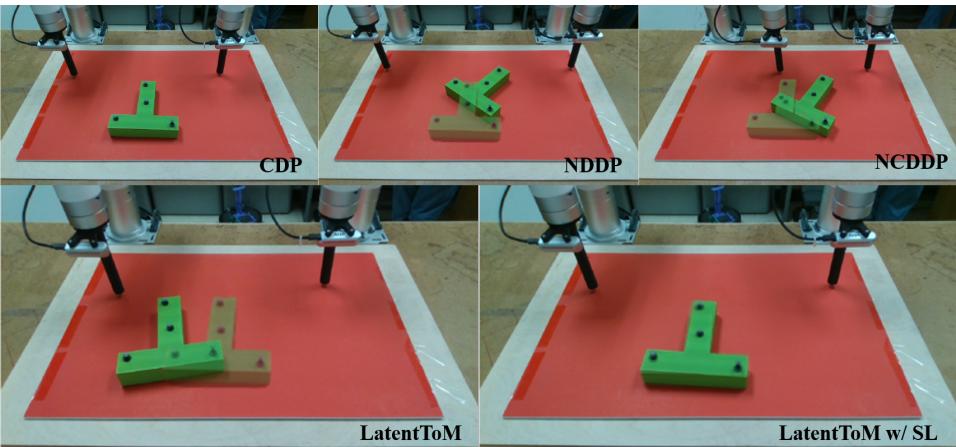
In Figure 4, look at the difference between NDDP (Naive Decentralized) and LatentToM. The NDDP agent loses control of the orientation. LatentToM, however, manages to complete the task, showing that the “Theory of Mind” component allowed the agents to implicitly agree on the dynamics of the heavy block.
Task 2: Pouring Coffee Beans
This task is high-stakes. One robot holds a cup, the other a pot. They must meet in the middle, pour the beans, and return to safety. A mismatch in timing or position results in spilled beans or a collision.
The Results: The authors categorized the outcomes into “Fully Successful,” “Clear Failure,” and various partial failure modes like “No Return” (where the robot freezes).
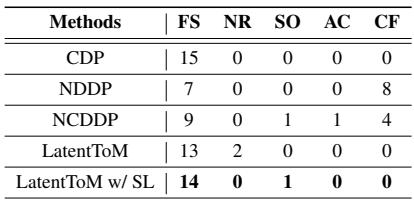
As seen in Table 1, the Centralized Policy (CDP) is perfect (15/15), which is expected since it controls both arms as one body. However, LatentToM comes incredibly close (13/15 without communication, 14/15 with Sheaf Laplacian communication).
Compare this to the naive decentralized approach (NDDP), which failed more than half the time (7/15).
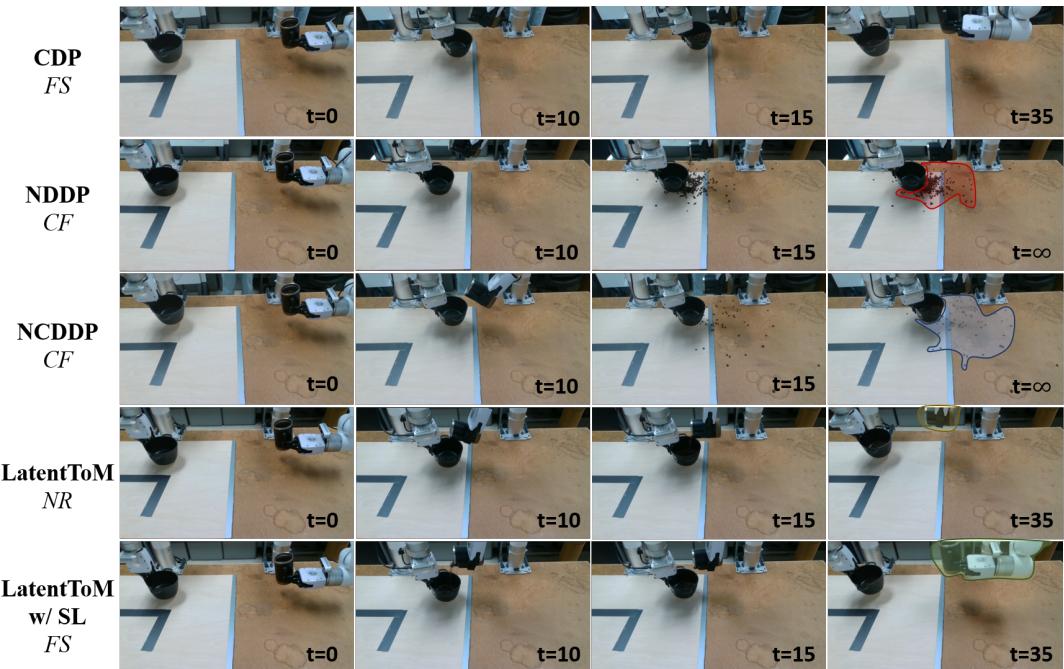
Figure 5 visualizes these failures. The naive policies (NDDP, NCDDP) result in red and blue zones of spilled beans. LatentToM (bottom rows) keeps the beans in the pot. Notably, the version with the Sheaf Laplacian (LatentToM w/ SL) ensures the robots return to a safe resting position, whereas the version without it sometimes hesitated at the end.
Conclusion: Why This Matters
The “Latent Theory of Mind” paper presents a significant step forward for robotic collaboration. By using Sheaf Theory, the authors provided a rigorous mathematical framework for what “consensus” actually means in a neural network.
The key takeaways are:
- Structure Matters: Simply training two robots separately doesn’t work for complex tasks. You must explicitly structure their latent spaces to encourage shared understanding.
- Theory of Mind is Computable: Forcing a robot to predict its partner’s state is a powerful regularizer that prevents the “shared reality” from becoming meaningless noise.
- Flexibility: The architecture allows for fully decentralized execution but can gracefully accept communication (via the Sheaf Laplacian) to boost performance when available.
This approach paves the way for swarms of robots—whether in warehouses, construction sites, or search-and-rescue—to work together intuitively, much like two humans maneuvering a couch up a flight of stairs. They don’t need a central commander; they just need a little Theory of Mind.