](https://deep-paper.org/en/paper/2505.09393/images/cover.png)
Introduction
For decades, accurate 3D human motion capture (MoCap) was restricted to Hollywood studios and high-end research labs. It required a controlled environment, dozens of cameras, and actors wearing suits covered in reflective markers.
In recent years, the focus has shifted to “in-the-wild” motion capture—tracking movement anywhere, from a living room to a hiking trail, using wearable sensors. The most common solution involves Inertial Measurement Units (IMUs)—the same sensors found in your smartphone or smartwatch that track acceleration and rotation.
However, IMU-based motion capture faces a massive hurdle: Drift. Without an external camera to “reset” the position, small errors in acceleration integration accumulate rapidly. A person standing still might appear to be gliding across the room in the digital reconstruction. Furthermore, when using only a sparse set of sensors (e.g., just 6 sensors on the whole body), the system faces pose ambiguity—multiple body postures can result in the exact same sensor readings.
Enter UMotion, a new framework proposed by researchers at the Nara Institute of Science and Technology. UMotion tackles these problems by combining IMUs with Ultra-wideband (UWB) ranging sensors and, crucially, treating uncertainty as a first-class citizen. Instead of just guessing a pose, UMotion calculates how confident it is in every measurement and uses that confidence to filter out noise and drift in real-time.
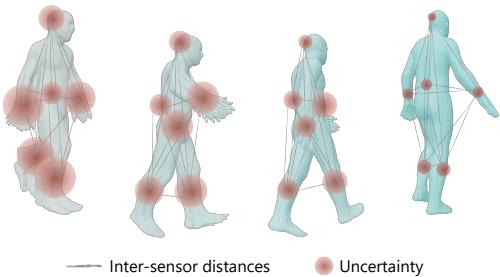
In this post, we will deconstruct how UMotion works, exploring how it fuses deep learning with classical state estimation to achieve state-of-the-art results in sparse sensor motion tracking.
The Hardware: Sparse Sensors and The “Invisible” Ruler
To understand UMotion, we first need to understand the hardware setup. The system uses a sparse sensor configuration. Instead of placing a sensor on every single bone, the researchers place just six units on the body:
- Head
- Pelvis
- Left Forearm
- Right Forearm
- Left Lower Leg
- Right Lower Leg
Each of these units is a hybrid. It contains:
- An IMU: Provides local orientation and acceleration.
- A UWB Sensor: Acts as a radar, measuring the distance (Time of Flight) between itself and the other five sensors.
The Challenge of Hybrid Sensors
While adding UWB sensors provides an “invisible ruler” measuring distances between limbs (e.g., the distance from your wrist to your hip), it introduces new problems.
- Occlusion: The human body is mostly water, which blocks radio signals. If you cross your arms or squat, your body might block the UWB signal between sensors, leading to missing or noisy data.
- IMU Noise: Low-cost IMUs are inherently noisy and prone to bias errors.
The core contribution of UMotion is not just using these sensors, but how it combines them. It uses a tightly coupled framework where the output of the pose estimation (what the AI thinks the body is doing) feeds back into the sensor processing (refining the raw data).
The UMotion Framework
The architecture of UMotion is cyclical. It doesn’t just process data in a straight line; it creates a feedback loop where estimated poses help clean up noisy sensor data, and cleaned sensor data helps estimate better poses.
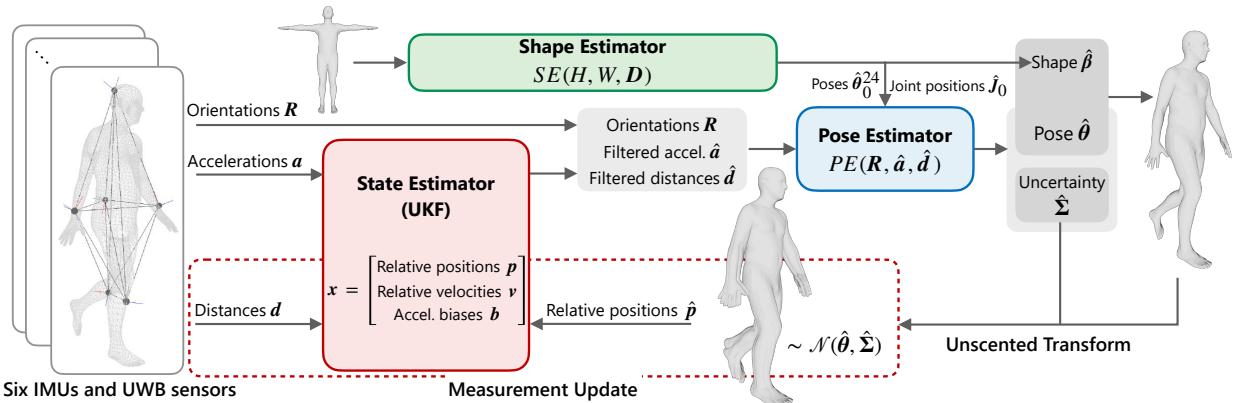
As shown in the overview above, the system consists of three main engines:
- Shape Estimator: Determines the physical dimensions of the user (bone lengths).
- State Estimator (UKF): Tracks the position, velocity, and sensor biases using a Kalman Filter.
- Pose Estimator: A Neural Network that predicts the 3D rotation of joints.
Let’s break down each component.
1. The Shape Estimator: Calibrating the Skeleton
Before tracking motion, the system must understand the body it is tracking. A tall person’s wrist-to-pelvis distance is very different from a child’s. Standard methods often assume a mean body shape, which leads to inaccuracy.
UMotion uses an ensemble learning approach. It takes simple anthropometric measurements—Height (\(H\)) and Weight (\(W\))—along with specific inter-sensor distances (\(D\)) captured while the user stands in a “T-pose.”

Why these inputs? Height and weight give a general sense of volume, while the UWB distances provide specific skeletal constraints. The researchers analyzed which distances were most reliable and selected 7 key measurements (shown below) to train their model.
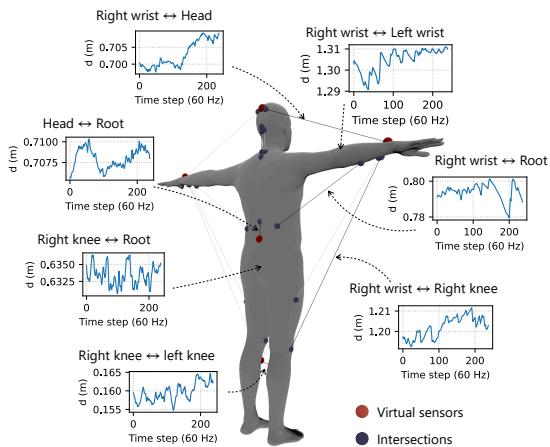
The output is the SMPL body shape parameters (\(\beta\)). This creates a digital skeleton that matches the user, ensuring that when the algorithm calculates motion, it respects the physical constraints of that specific person’s body.

In this equation, \(M\) represents the final mesh, which is a function of shape (\(\beta\)) and pose (\(\theta\)). By fixing \(\beta\) first, the rest of the system only needs to solve for pose (\(\theta\)).
2. The Pose Estimator: A Deep Learning “Oracle”
With the body shape known, the system needs to figure out how the limbs are moving. This is handled by a Bidirectional Recurrent Neural Network (RNN) using LSTM cells.
The Pose Estimator takes three inputs:
- Accelerations (\(\hat{a}\)): Filtered by the state estimator.
- Orientations (\(R\)): From the IMUs.
- Distances (\(\hat{d}\)): Filtered UWB measurements.
Here is the critical innovation: The neural network doesn’t just output the joint rotations (\(\hat{\theta}_{6D}\)). It also outputs the uncertainty (\(\hat{\Sigma}\)) of its own prediction.

The network effectively says, “I think the elbow is bent at 90 degrees, but I’m only 60% sure because the sensor data is noisy right now.”
To train this network to understand uncertainty, the researchers utilize a Gaussian Negative Log Likelihood (GNLL) loss function.

This loss function penalizes the model heavily if it makes a wrong prediction with high confidence. It encourages the model to be “honest”—if the pose is ambiguous, the model learns to output a higher uncertainty (\(\Sigma\)).
3. The State Estimator: The Unscented Kalman Filter
The heart of UMotion is the State Estimator. It uses an Unscented Kalman Filter (UKF). If you aren’t familiar with Kalman Filters, think of them as the ultimate data fusion algorithm. They maintain a “belief” about the state of the system (position, velocity) and update that belief based on:
- Prediction: Using physics (e.g., “if velocity is \(x\), position should be \(y\) in the next second”).
- Measurement: Using sensors to correct the prediction.
The State Vector
The state (\(\mathbf{x}\)) tracked by UMotion includes relative positions (\(p\)), velocities (\(v\)), and accelerometer biases (\(b\)) for all sensor pairs.

Step A: Prediction (Physics)
The system predicts the next state using standard Newtonian physics (kinematics). It uses the accelerations measured by the IMUs (\(\mathbf{u}\)) as the control input.

It updates velocity and position based on the previous state and the current acceleration, accounting for the estimated bias drift (\(\mathbf{b}\)).


This prediction step gives us a “rough draft” of where the sensors are, but it’s prone to drift.
Step B: Measurement Update (Fusion)
Now, the UKF corrects the “rough draft” using observations. UMotion uses a clever mix of observations:
- UWB Distances: Direct measurements from the hardware.
- Pose Constraints: The output from the Neural Network Pose Estimator.
This is where the Uncertainty-driven aspect shines. The UKF fuses these inputs based on their variances (trustworthiness).
For the Neural Network output, UMotion uses the Unscented Transform. Since the Neural Network outputs joint angles (pose), but the UKF tracks sensor positions, the system must convert the pose distribution into a position distribution.
It generates “sigma points” (sample points representing the uncertainty cloud around the pose) and passes them through the SMPL body model (forward kinematics).

The result is a set of predicted sensor positions derived entirely from the Neural Network’s understanding of the pose.
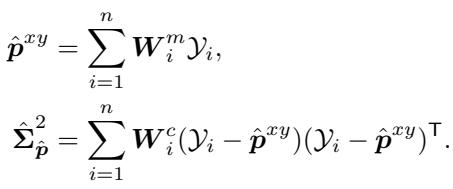
The UKF then compares:
- The position predicted by physics (IMU integration).
- The distance measured by UWB.
- The position derived from the Neural Network.
It merges these based on their respective uncertainties to produce the optimal estimated state. This cleaned-up state (better accelerations, better distances) is then fed back into the Neural Network for the next frame, completing the loop.
Tackling Real-World Noise
A major issue with UWB sensors is Line-of-Sight (LOS). If a body part blocks the signal path between two sensors, the distance measurement becomes unreliable.
The researchers analyzed the “visibility” of different sensor pairs. For example, the line of sight between the left lower leg and the right lower leg is almost always clear. However, the path between the head and the knee is frequently blocked.
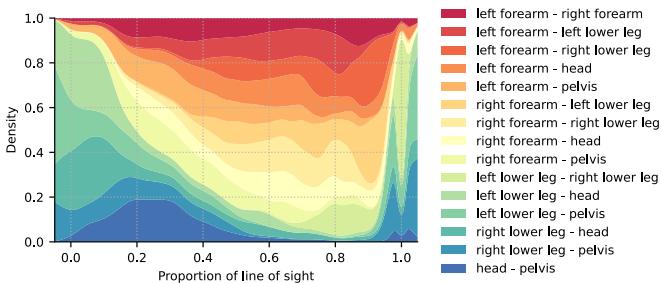
To handle this, UMotion implements a dynamic distance error model.
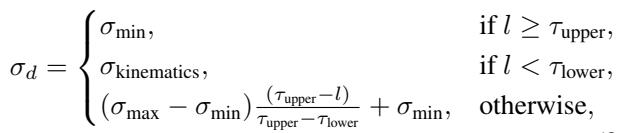
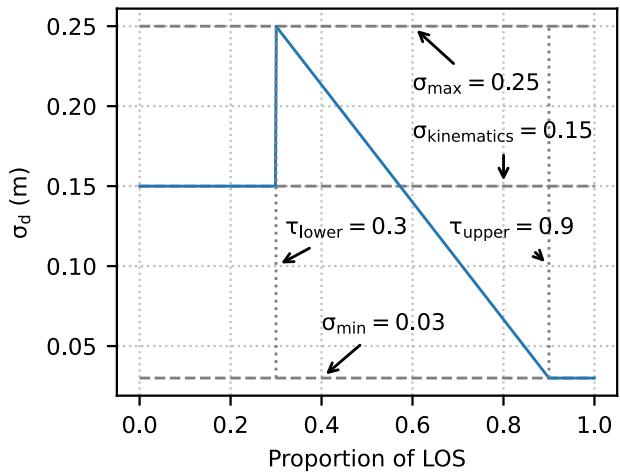
This model acts as a gatekeeper. If the system detects that the Line-of-Sight (LOS) probability is high, it trusts the UWB measurement (low \(\sigma_d\)). If the LOS is blocked (low probability), it artificially inflates the noise parameter (\(\sigma_{kinematics}\)), effectively telling the Kalman Filter: “Don’t trust this UWB reading; rely on the Physics prediction or the Neural Network instead.”
Experiments and Results
The researchers validated UMotion on standard datasets (AMASS, TotalCapture, DIP-IMU) and compared it against state-of-the-art methods.
Quantitative Performance
The results show a distinct improvement over IMU-only methods (like TransPose and PIP) and even previous hybrid methods (UIP).
Positional Error: This metric measures how far the estimated joints are from the real joints in 3D space. Lower is better.
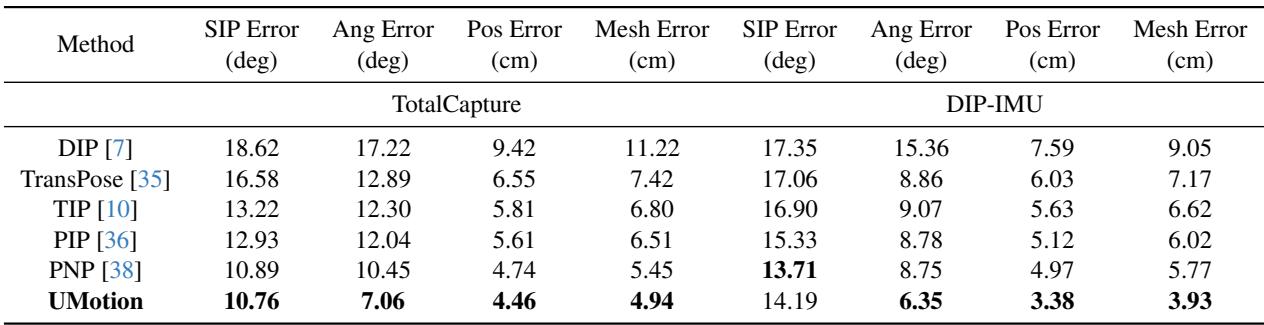
As seen in Table 1, UMotion achieves a Positional Error of 4.46 cm on the TotalCapture dataset, significantly beating the best IMU-only method (PNP), which sits at 4.74 cm.
When compared specifically against other methods that use distance information (Table 2), UMotion maintains the lead.
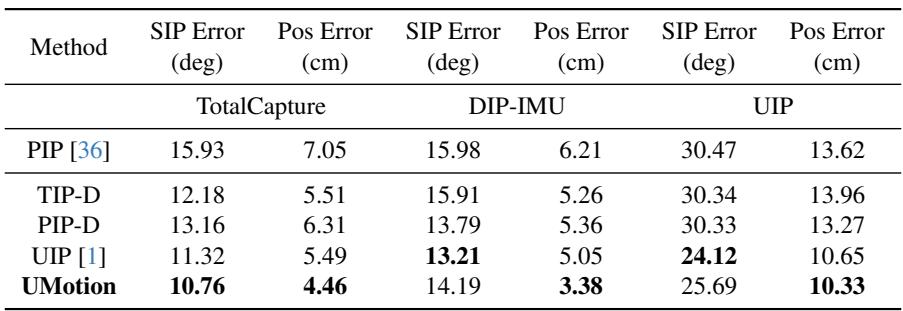
On the difficult UIP dataset, which features real-world sensor noise and complex motions, UMotion achieves the lowest positional error (10.33 cm vs. 10.65 cm for the previous best).
The Impact of Fusion
Does fusing all these sensors actually matter? The ablation study below visualizes the error distribution.
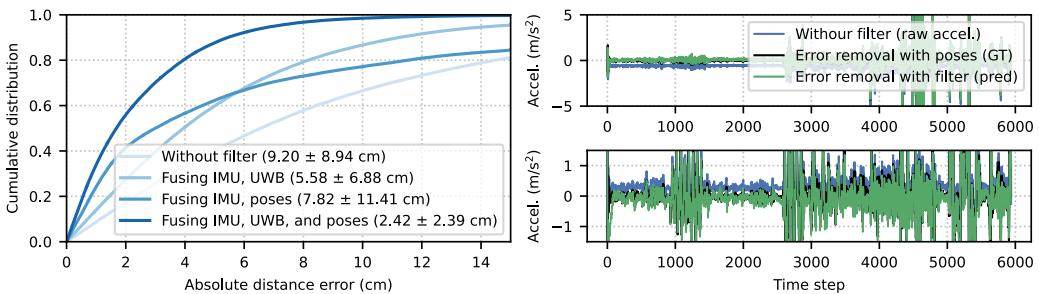
- Left Graph: The dark blue line (Fusing IMU, UWB, and Poses) is furthest to the left, indicating the lowest error. Fusing only IMU and UWB (light blue) is worse than fusing everything.
- Right Graph: Shows how the filter removes acceleration noise over time.
We can also look at the joint positional error over time steps:
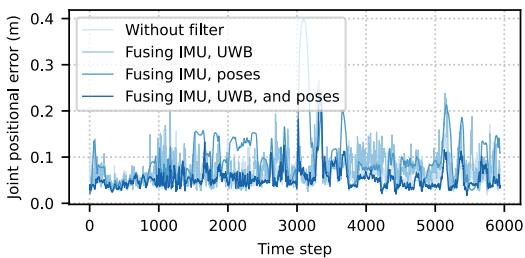
The “Without filter” line (grey) is erratic and high. The “Fusing IMU, UWB, and poses” line (dark blue) is not only the lowest but also the most stable, proving that the feedback loop stabilizes the system against drift.
Qualitative Visualization
Numbers are great, but visuals tell the story. In the comparison below, look at the legs and the general posture.

- Reference: The real motion (far right).
- TransPose/PIP: Often suffer from “floating” or unnatural leg bends.
- UMotion (Purple): Closely mimics the Reference, particularly in the complex lunging and crouching motions where occlusion would typically confuse the sensors.
Conclusion
UMotion represents a significant step forward in wearable motion capture. By acknowledging that sensors are imperfect, the framework turns a weakness into a strength. It doesn’t blindly trust the IMU, the UWB, or the Neural Network. Instead, it uses a probabilistic approach, constantly weighing the uncertainty of each component to find the mathematical “truth” in the middle.
Key takeaways from this work:
- Feedback Loops Matter: Using the output of the pose estimator to clean the input of the state estimator creates a virtuous cycle of accuracy.
- Uncertainty is Useful: Training Neural Networks to predict their own doubt (via GNLL loss) allows traditional filters (UKF) to make better decisions.
- Hybrid is the Future: Combining the high-frequency local data of IMUs with the drift-free spatial data of UWB solves the inherent limitations of both.
As wearable sensors become cheaper and smaller, frameworks like UMotion pave the way for high-fidelity motion capture in daily life—whether for rehabilitation monitoring, immersive VR gaming, or sports training—without a single camera in sight.