](https://deep-paper.org/en/paper/2505.09601/images/cover.png)
In the world of Artificial Intelligence, scale is everything. Large Language Models (LLMs) like GPT-4 and Vision-Language Models (VLMs) have achieved “generalist” capabilities primarily because they consumed massive, internet-scale datasets. Robotics, however, has been left behind in this data revolution. This is often referred to as the “Moravec’s paradox” or the data scarcity problem in robotics: while we have billions of text tokens, we do not have billions of examples of robots folding laundry or making coffee.
The traditional solution has been human teleoperation—where a human controls a robot to perform a task, recording the data. But this is slow, expensive, and requires physical access to the specific robot hardware. The alternative is simulation, but simulating the real world involves complex physics engines that often fail to model friction and contact accurately (the infamous “Sim2Real” gap).
A new paper titled “Real2Render2Real (R2R2R)” proposes a third way. What if we could generate thousands of high-quality robot training examples using just a smartphone scan and a single video of a human hand? And what if we could do it without a physics engine at all?
This post dives into how R2R2R works, why it discards physics simulation for “kinematic rendering,” and how it achieves results comparable to laborious human teleoperation.
The Problem: The High Cost of Robot Data
To train a robot to manipulate objects—like picking up a mug or turning a faucet—you generally need a policy that maps visual inputs (what the robot sees) to actions (how the robot moves). Deep learning models are data-hungry; they need thousands of diverse examples to generalize well.
Currently, we have two main sources for this data:
- Real-World Teleoperation: A human puts on a VR headset or uses a joystick to guide a robot arm. This produces high-quality data but is incredibly slow (about 1.7 demonstrations per minute) and unscalable.
- Physics-Based Simulation: Engineers build virtual worlds. However, creating these assets is labor-intensive. Furthermore, physics engines often struggle with “Lagrangian mechanics”—basic things like conservation of energy or complex friction during contact. To make a simulation work, engineers often spend weeks tuning parameters to stop objects from clipping through tables or flying off into space.
The researchers behind R2R2R asked a pivotal question: Can we computationally scale robot data without relying on dynamics simulation or teleoperation?
The Solution: Real2Render2Real (R2R2R)
The core idea of R2R2R is to treat data generation as a rendering problem rather than a simulation problem.
Instead of simulating forces, torques, and collisions (which is hard), the pipeline simply “plays back” valid geometries and motions extracted from the real world, rendering them into photorealistic images. It takes real-world “seeds” (a scan and a video) and grows a forest of synthetic training data.
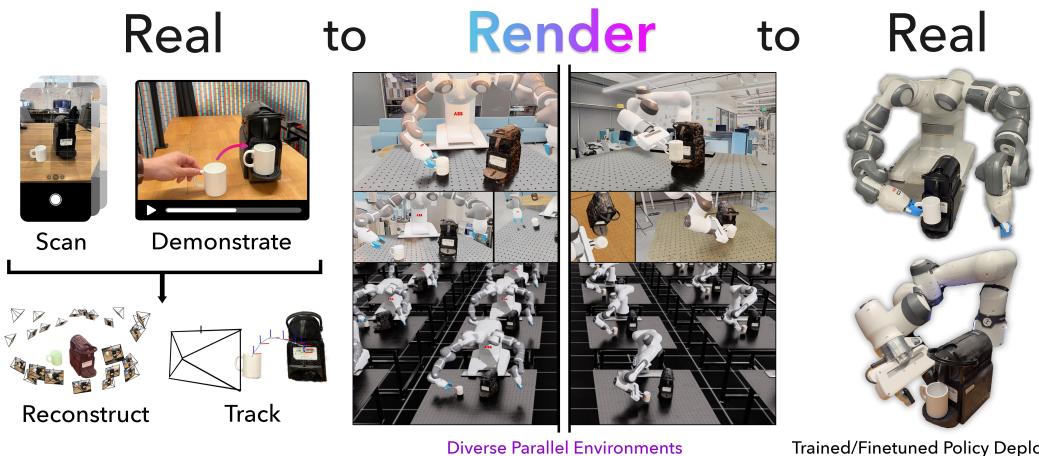
As shown in Figure 1, the pipeline consists of three main stages:
- Scan: Capturing the object’s geometry and appearance.
- Demonstrate: Tracking how the object moves during a human interaction.
- Render: Generating thousands of variations where a robot performs that same motion.
Let’s break down the technology stack that makes this possible.
1. Real-to-Sim Asset Extraction (3D Gaussian Splatting)
The first step is bringing the real world into the digital one. The user takes a smartphone scan of the objects involved (e.g., a mug and a coffee maker).
The researchers use 3D Gaussian Splatting (3DGS). Unlike traditional meshes which can look “gamey” or low-poly, 3DGS represents a scene as a cloud of 3D Gaussians (ellipsoids) that preserve the photorealistic shine and texture of the real objects.
However, a raw scan is just a static scene. To manipulate objects, the system needs to understand that a “mug” is separate from the “table.” The authors utilize GARField, a method that groups these Gaussians into semantically meaningful parts. This is crucial for articulated objects—like a drawer that slides or a faucet handle that rotates.
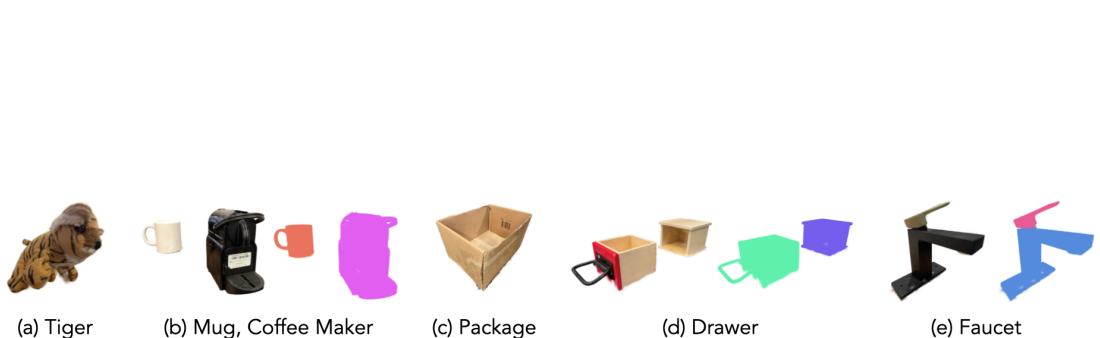
As seen in Figure 3, this segmentation allows the system to treat the mug or the drawer handle as independent rigid bodies that can be moved digitally.
2. Trajectory Extraction (Tracking the Human)
Next, the user records a single video of themselves performing the task (e.g., placing the mug on the machine). The system doesn’t care about the human’s hand per se; it cares about the object’s motion.
Using a technique called 4D Differentiable Part Modeling (4D-DPM), the system tracks the 6-Degrees-of-Freedom (6-DoF) pose of the object throughout the video. It effectively extracts the “ghost” of the motion—how the mug travels through space to land on the coffee maker.
3. Scaling Diversity: Interpolation and Randomization
If the system simply replayed that one trajectory, we would only have one data point. To train a robust robot, we need the robot to succeed even if the mug is slightly to the left, or if the lighting changes.
This is where R2R2R shines. It performs Trajectory Interpolation.
If the user wants to generate a new training example where the mug starts 10cm to the right, the system cannot just blindly replay the recorded motion (the mug would miss the target). Instead, R2R2R mathematically warps the trajectory using Spherical Linear Interpolation (Slerp). It calculates a smooth path from the new random start point to the original target destination.
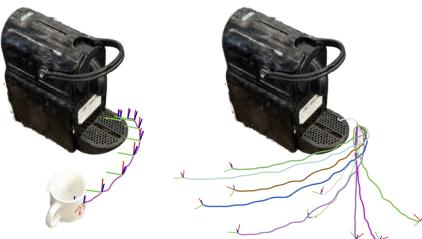
Figure 4 illustrates this adaptation. The system also introduces Grasp Pose Sampling. It analyzes the human video to find where the fingers were relative to the object, then calculates a valid grasp for the robot gripper at that location.
4. The “Physics-Free” Rendering Engine
This is the most radical design choice. Once the system has the assets and the calculated trajectories, it needs to create the final images for the robot to learn from.
Traditional approaches would load these assets into a physics simulator (like PyBullet or MuJoCo) and try to use a controller to push the objects. R2R2R skips this. It uses IsaacLab strictly as a renderer.
The system assumes the calculated trajectory is valid. It forces the robot arm (using Inverse Kinematics) and the object to follow the path frame-by-frame. It effectively creates a “stop-motion animation” of the robot doing the task.
- Pros: No exploding physics, no contact tuning, no friction parameters to guess.
- Cons: It cannot model dynamics like heavy objects slipping or deformable objects squishing (limitations the authors acknowledge).
Because it is purely kinematic rendering, it is computationally efficient. The system applies heavy Domain Randomization: changing lighting, camera angles, and background textures to force the robot to learn robust visual features.
Efficiency and Throughput
How does this compare to a human gathering data? The difference is staggering.
- Teleoperation: A human has to reset the scene, move the robot, and reset again. Speed: ~1.7 demos/minute.
- R2R2R: Once the 10-minute setup (scan + 1 video) is done, the server takes over. A single GPU can churn out 51 demos/minute.
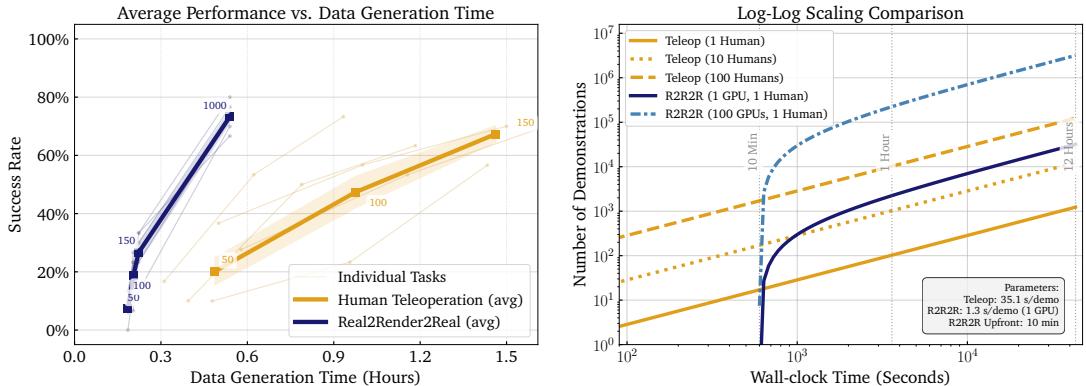
Figure 2 (Right) visualizes this scaling. R2R2R on a single GPU (Dark Blue line) outpaces even a hypothetical team of 10 human teleoperators working simultaneously.
Does the Data Actually Work?
Generating data is useless if it doesn’t train a good robot. The authors tested this by training two state-of-the-art imitation learning models: Diffusion Policy and \(\pi_0\)-FAST.
They evaluated the policies on a real ABB YuMi bimanual robot across five diverse tasks:
- Pick up a toy tiger.
- Put a mug on a coffee maker.
- Turn off a faucet (articulated object).
- Open a drawer (articulated object).
- Pick up a package with both hands (bimanual).
The Results
The researchers compared policies trained on 150 human teleoperated demos vs. those trained on R2R2R synthetic demos (up to 1000).
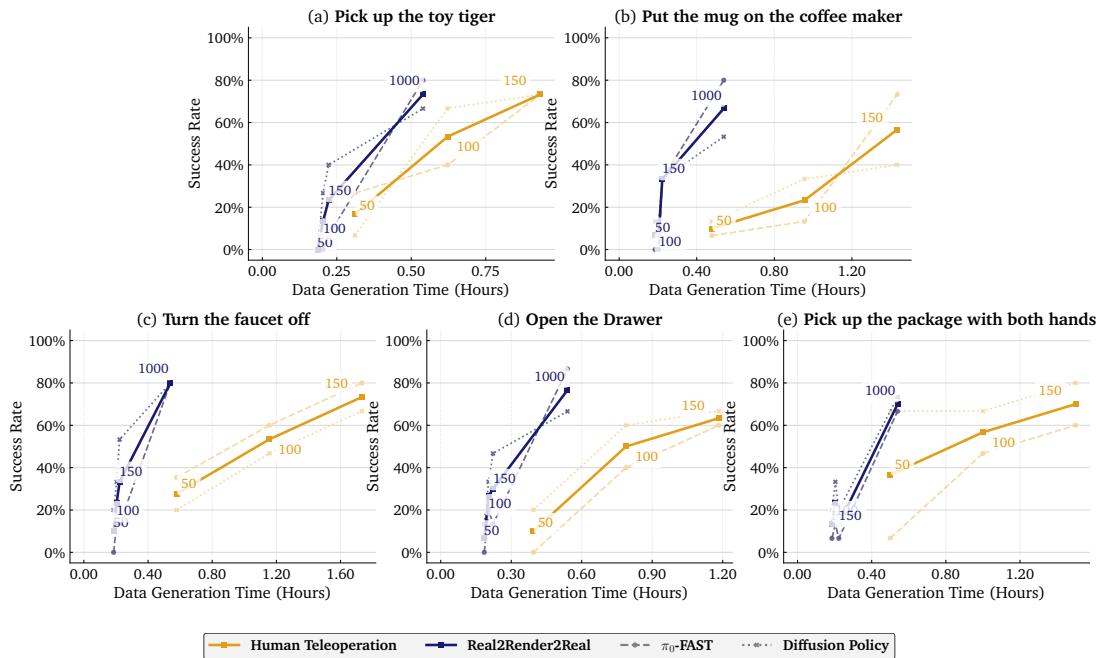
The results in Figure 5 are promising:
- Scaling Laws hold: As you add more synthetic data (from 50 to 1000 trajectories), the robot’s success rate consistently improves.
- Parity with Real Data: In many tasks, a policy trained on 1000 synthetic R2R2R trajectories (generated from just one human video) matched the performance of a policy trained on 150 real-world teleoperated demos.
- Complex Tasks: The system handled the “Put Mug on Coffee Maker” task exceptionally well. For example, the \(\pi_0\)-FAST model reached 80% success using R2R2R data, comparable to the best results with real data.
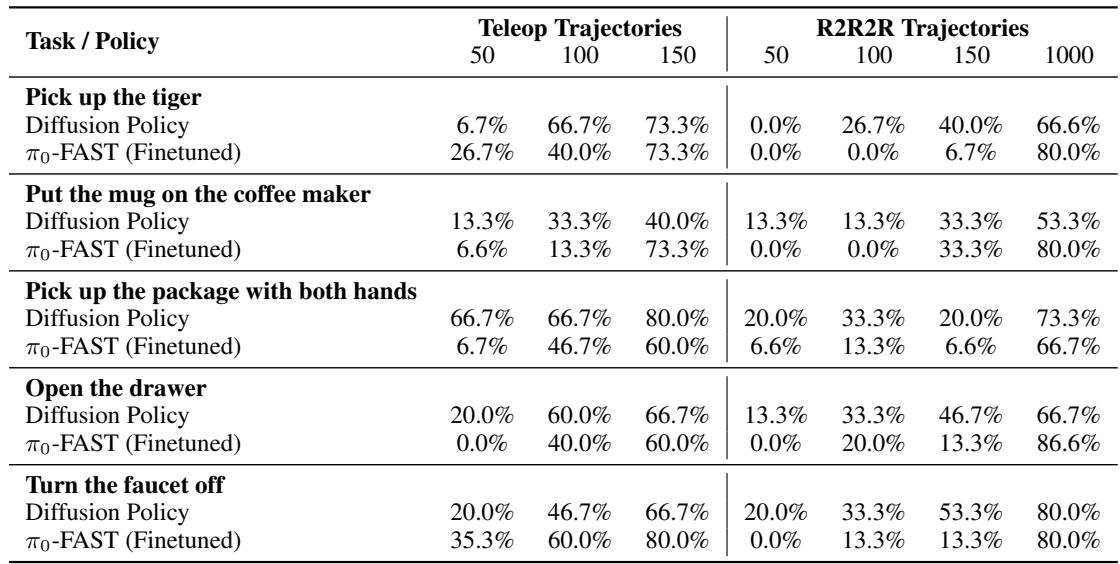
Table 2 provides the raw numbers. While real data is “more efficient” per sample (150 real samples are worth roughly 1000 synthetic ones), synthetic samples are essentially free to generate after the initial setup.
Ablation: Why Diversity Matters
The authors performed ablations to verify which parts of the pipeline were essential. One key finding was the importance of Trajectory Interpolation.

When they turned off the mathematical interpolation (simply replanting the same motion in different spots), the success rate on the coffee maker task dropped to nearly 0%. This proves that simply “augmenting” images isn’t enough; the robot needs to see diverse physical trajectories to learn a robust control policy.
Conclusion and the Future of Robot Learning
Real2Render2Real represents a shift in how we think about robot data. It challenges the assumption that we need expensive physics simulators or tedious human labor to teach robots.
By treating the world as a kinematic render, R2R2R allows anyone with a smartphone to become a data generator. You could scan your kitchen, record yourself loading the dishwasher once, and let your GPU generate a thousand training examples while you sleep.
Key Takeaways:
- No Hardware Needed: Data collection is decoupled from robot access.
- No Physics Engine: Kinematic rendering avoids the complexities of contact modeling.
- Visual Fidelity: 3D Gaussian Splatting bridges the visual gap between sim and real.
- Scale: It turns a single human action into a massive dataset.
While R2R2R has limitations—it cannot currently handle soft, deformable objects or dynamic tossing motions—it offers a practical path toward the “GPT moment” for robotics: a world where data is no longer the bottleneck, but a commodity we can generate at scale.