](https://deep-paper.org/en/paper/2505.11420/images/cover.png)
Introduction
Imagine trying to plug a charging cable into a socket behind a nightstand in pitch darkness. You can’t see the socket, yet you successfully maneuver the plug, feel the edges of the port, align it, and push it in. You rely entirely on your sense of touch.
For humans, touch is a seamless, high-bandwidth modality that covers our entire hand. For robots, however, replicating this capability has been a monumental challenge. While computer vision has seen explosive growth, robotic tactile sensing has lagged behind. Most robots today are essentially “numb,” relying heavily on vision to infer contact.
When roboticists do implement touch, they often face a dilemma. They can use vision-based tactile sensors (like GelSight), which provide high-resolution images of the contact patch but are bulky, slow, and restricted to fingertips. Alternatively, they can use magnetic skins, which are thin, fast, and can cover the entire hand, but output noisy, hard-to-interpret magnetic signals.
In a recent paper, researchers from FAIR at Meta and Carnegie Mellon University introduce Sparsh-skin, a breakthrough approach that bridges this gap. They propose a self-supervised learning framework that allows a multi-fingered robot hand covered in magnetic skin to “learn how to feel” by simply playing with objects.
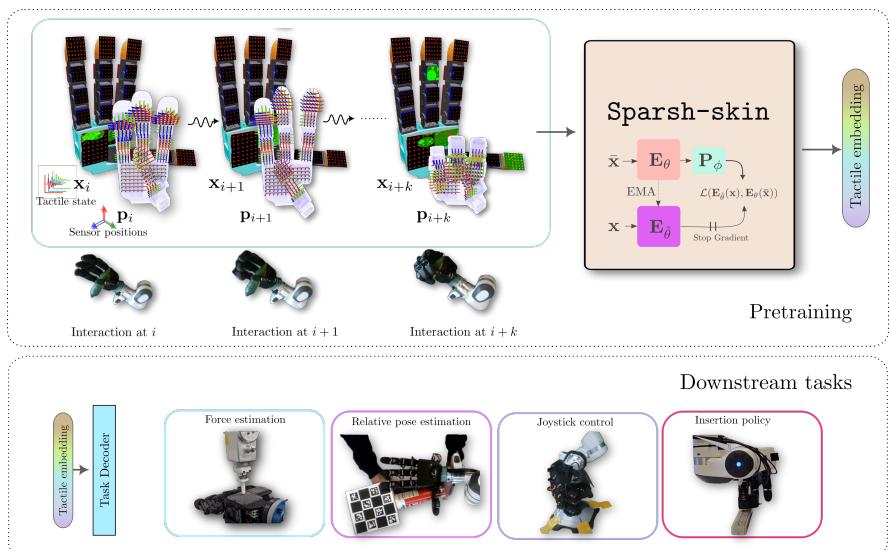
As shown in Figure 1, Sparsh-skin takes raw, noisy sensor data and converts it into a rich “tactile embedding”—a compressed, meaningful representation of touch that can be used for complex tasks like force estimation, joystick control, and object insertion.
The Problem with Robotic Skin
To understand why Sparsh-skin is necessary, we first need to look at the hardware. The researchers utilized an Allegro hand (a four-fingered robotic hand) covered with Xela uSkin sensors. These are magnetic tactile sensors.
Unlike a camera that takes a picture, these sensors work by detecting changes in magnetic fields. Inside the skin, there are tiny magnets suspended in a soft material. When the skin presses against an object, the material deforms, moving the magnets. A magnetometer underneath measures the change in magnetic flux (the magnetic field’s strength and direction).
This approach has massive advantages:
- Speed: They operate at ~100Hz (much faster than standard cameras).
- Form Factor: They are thin and flexible, allowing them to cover fingertips, phalanges (finger segments), and the palm.
However, they come with significant baggage. The signals are high-dimensional (hundreds of sensors on a single hand), noisy, and suffer from hysteresis (the sensor doesn’t immediately snap back to zero when pressure is released). Furthermore, calibrating these sensors to output exact forces (Newtons) is incredibly difficult and often requires expensive external equipment.
The Self-Supervision Solution
If we can’t easily program a mathematical formula to convert magnetic flux into contact information, we need machine learning. But training a model requires data. In the past, this meant “supervised learning”—collecting thousands of samples and manually labeling them (e.g., “This signal equals 2 Newtons of force”).
Collecting labeled tactile data for a whole hand is practically impossible. You cannot easily place a force sensor between a robot finger and an object during natural manipulation to get the “ground truth.”
The authors of Sparsh-skin tackled this by using Self-Supervised Learning (SSL). Instead of telling the robot what it is feeling, they let the robot play with objects for 4 hours and devised a mathematical game (an objective function) that forces the robot to understand the structure of the data itself.
Core Method: Inside Sparsh-skin
The core of the paper is the Sparsh-skin architecture, a system designed to distill messy magnetic signals into clean, useful representations.
1. Tokenizing Touch
The first challenge is formatting the data. A robot hand isn’t a static image; it’s a dynamic system.
- Temporal Context: A single snapshot of magnetic flux is ambiguous. To understand contact, you need to know what happened a split second ago. Sparsh-skin uses a 0.1-second history window.
- Proprioception: Feeling a touch on the fingertip means something different if the finger is bent versus straight. The model inputs both the tactile signal and the 3D position of the sensors (kinematics).
These inputs are chopped up and processed into “tokens”—vectors of numbers that represent small chunks of information, similar to how Large Language Models break words into tokens.
2. The Student-Teacher Architecture
The learning process uses a technique called Self-Distillation, specifically inspired by computer vision models like DINO.
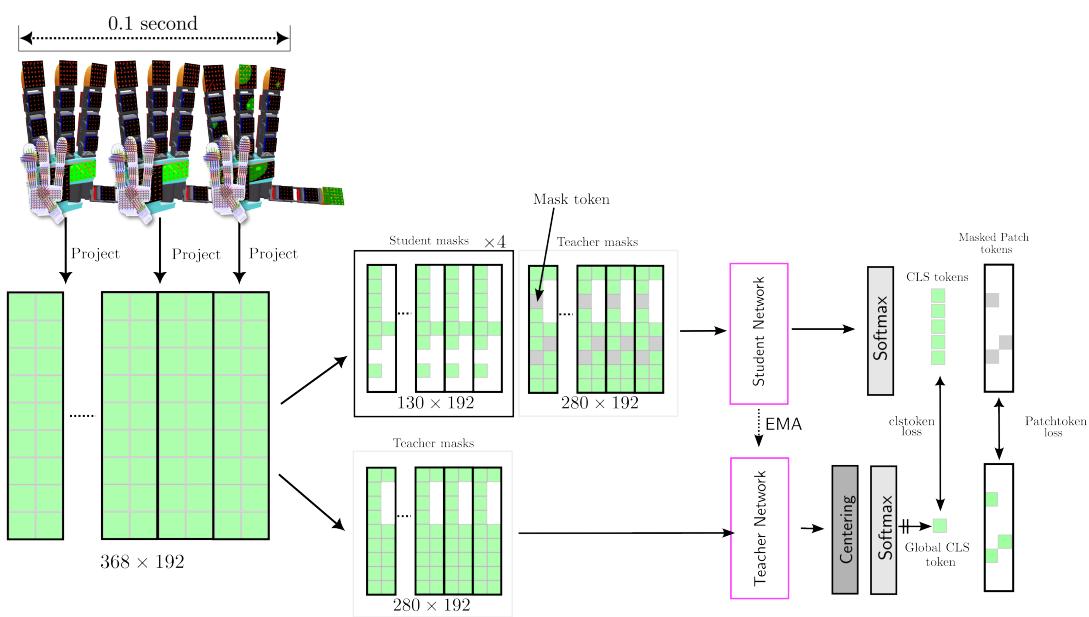
As illustrated in Figure 8, the architecture consists of two neural networks: a Student and a Teacher.
- The Student Network: Takes a “corrupted” version of the tactile data.
- The Teacher Network: Takes a clean (or less corrupted) view of the same data.
The goal is for the Student to look at the messy, incomplete data and predict the high-quality representation that the Teacher outputs.
Crucially, the Teacher is not trained via standard backpropagation. Instead, its weights are an Exponential Moving Average (EMA) of the Student’s weights. This creates a stable target for the Student to learn from, preventing the model from cheating or collapsing into a trivial solution.
3. Masking: The Learning Game
How do we “corrupt” the data to make the Student learn? The authors use Block Masking.
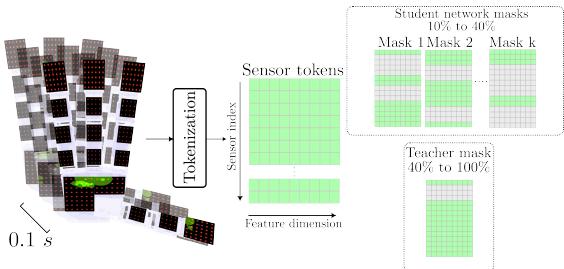
As shown in Figure 2, the system randomly hides (masks) large blocks of the sensor data from the Student. For example, it might blank out the data from the index finger or a patch on the palm.
The Student must look at the remaining visible sensors (e.g., the thumb and the palm) and use its understanding of physics and hand-object interaction to “hallucinate” or infer the features of the missing data. If the model can accurately predict the representation of the hidden parts, it proves it understands the underlying mechanics of touch.
4. Why Not Reconstruction?
A common SSL method is Masked Auto-Encoding (MAE), where the model tries to reconstruct the exact raw pixel or sensor values of the masked area.
The authors found that MAE works poorly for magnetic skins. Magnetic flux is incredibly noisy. If you force the model to reconstruct the exact noisy signal, it wastes capacity learning the noise rather than the signal.
By using Self-Distillation (predicting the Teacher’s representation rather than the raw data), Sparsh-skin learns the semantics of the touch—“I am pressing against a hard edge”—rather than the jittery raw values of the magnetometer.
Experiments and Results
The researchers evaluated Sparsh-skin by freezing the pre-trained model and adding small “decoders” on top for specific tasks. They compared it against models trained from scratch (End-to-End) and other pre-training methods (BYOL, MAE).
1. Force Estimation
Can the model predict the 3-axis force (Normal and Shear) applied to the skin? The team collected ground-truth data using a high-precision force probe indenting the skin.
The results were striking. As seen in Figure 10 (below), Sparsh-skin (especially the fine-tuned version) achieves near-perfect correlation with ground truth forces.
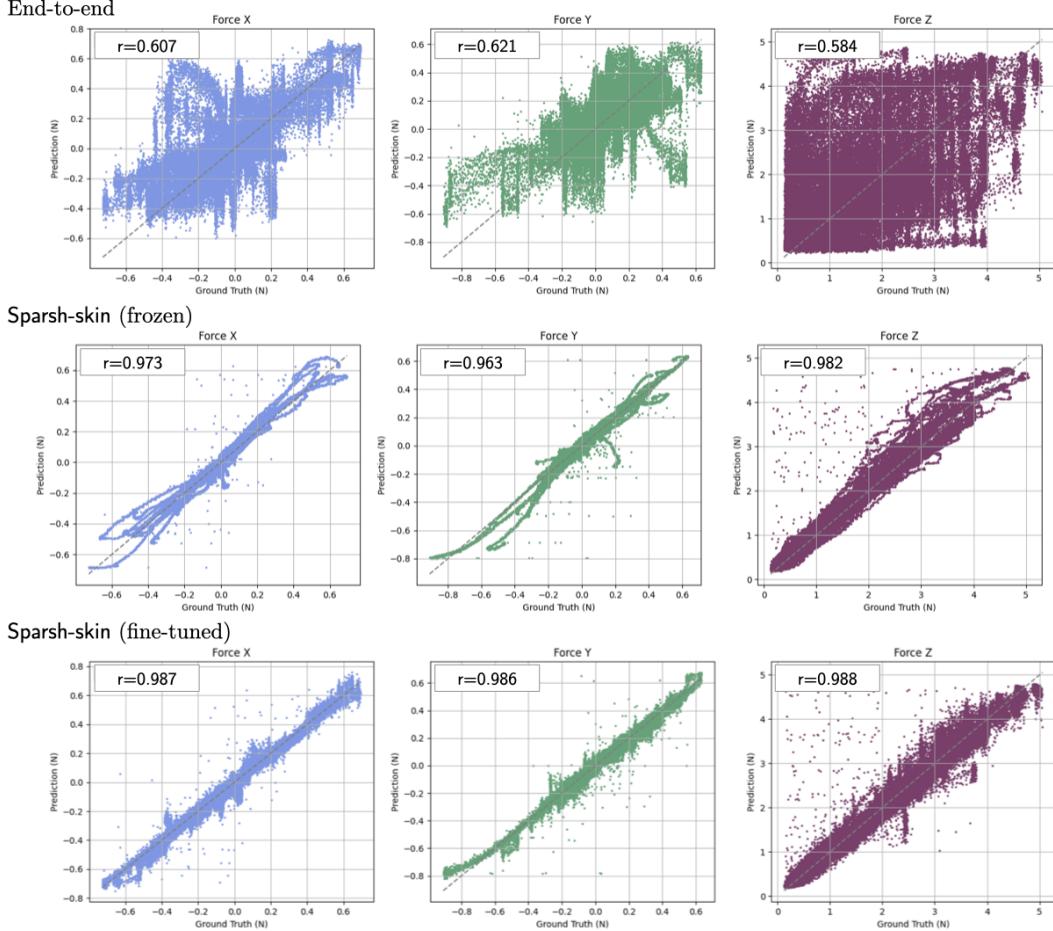
In contrast, the End-to-End model (trained only on the labeled force data) struggles significantly. This proves that the pre-training on random play data taught the model general principles of how the skin deforms, making it much better at estimating specific forces later.
2. Joystick State Estimation
This task involved manipulating a joystick and estimating its roll, pitch, and yaw based solely on tactile feedback from the hand.
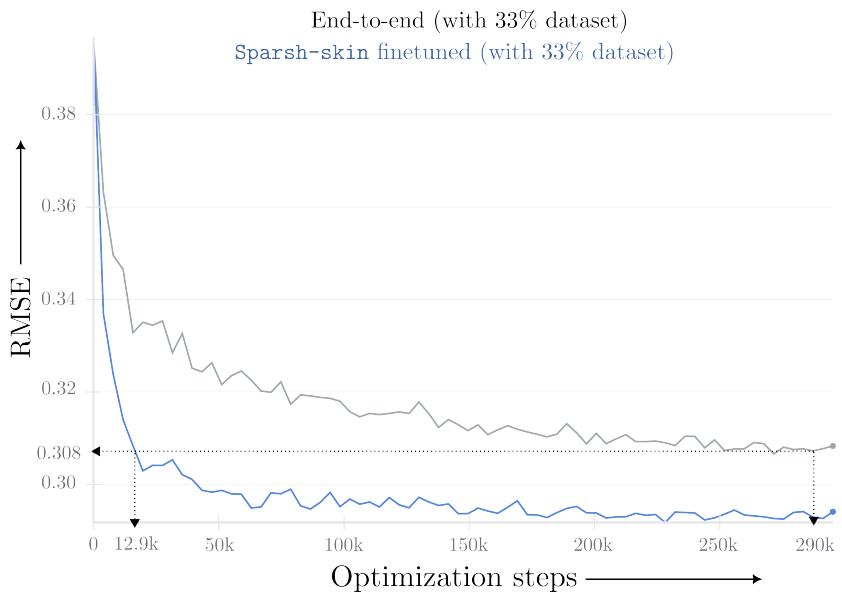
Figure 12 highlights the Sample Efficiency. The Sparsh-skin model (blue line) learns the task drastically faster than the End-to-End model (gray line). It requires fewer updates and less data to reach high performance. In robotics, where data collection is expensive and slow, this speed is a game-changer.
3. Object Pose Estimation
Here, the robot had to slide an object around in its hand and continuously track the object’s position (x, y) and rotation. This is a difficult temporal task because the object slips and rotates.
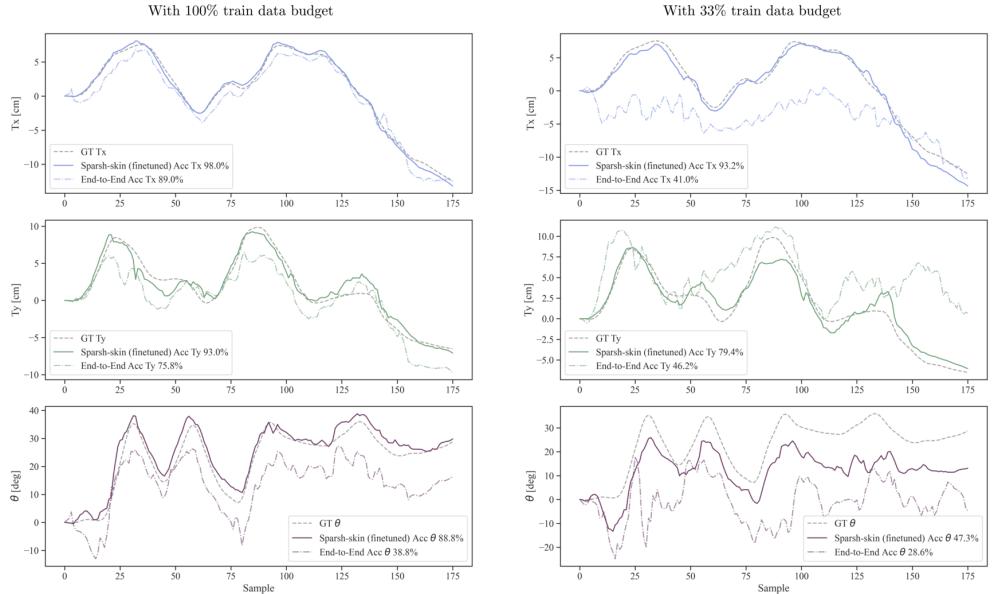
The graphs in Figure 13 show the trajectory tracking. Even when trained on only 33% of the available labeled data (Right column), Sparsh-skin tracks the object’s movement (Tx, Ty) with high accuracy (over 90%), whereas the End-to-End model fails catastrophically (dropping to ~40% accuracy).
4. Policy Learning: Plug Insertion
Finally, the authors tested the system on a dynamic control task: inserting a plug into a socket. This requires integrating vision (to find the socket) and touch (to align the plug).
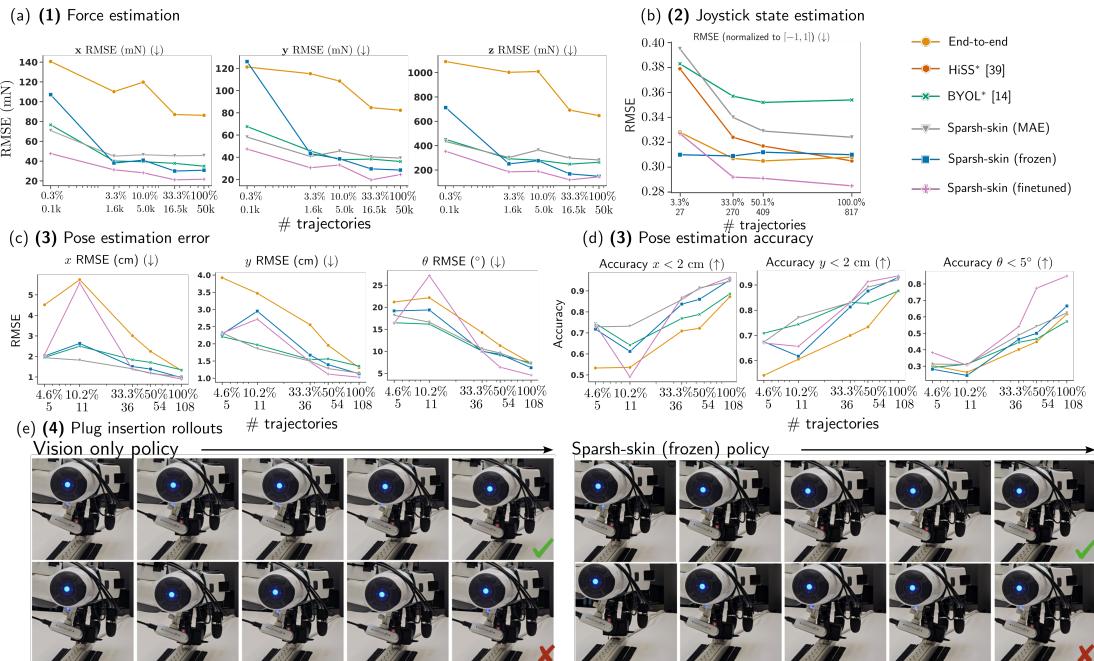
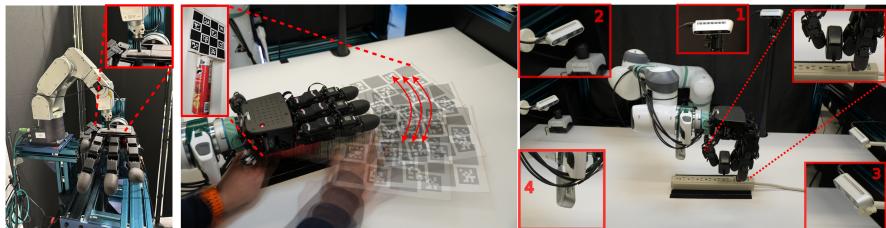
Panel (e) in Figure 7 visually demonstrates the difference.
- Vision Only: The robot gets close but often misses the hole or pushes against the faceplate indefinitely because it can’t “feel” that it’s hitting a wall.
- Sparsh-skin: The robot feels the contact, adjusts its grip, slides the plug, and successfully inserts it.
The Sparsh-skin policy achieved a 75% success rate, significantly outperforming vision-only methods (20%) and end-to-end tactile training (40%).
Conclusion and Implications
Sparsh-skin represents a significant step forward for dexterous manipulation. By applying self-supervised learning to magnetic skin sensors, the authors have turned a promising but difficult hardware technology into a practical tool for robotics.
The key takeaways are:
- Generalization: A model pre-trained on random “play” data learns representations that work across many different tasks (force, pose, control).
- Efficiency: You don’t need millions of labeled samples. A pre-trained skin model can learn a new task with very little data.
- Full-Hand Perception: Unlike fingertip-only sensors, Sparsh-skin enables whole-hand sensing, which is vital for manipulating large or complex objects.
This work suggests a future where robots have a “Foundation Model” for touch—a universal understanding of contact that allows them to pick up a violin, a sledgehammer, or a charging cable, and handle each with the appropriate dexterity solely through the sense of touch.