](https://deep-paper.org/en/paper/2505.12423/images/cover.png)
Introduction
Imagine trying to summarize a dense novel, but you can only hold ten pages in your memory at any given time. By the time you reach chapter three, chapter one is gone. This is the fundamental struggle of Large Language Models (LLMs) dealing with limited context windows. While models like GPT-4 and LLaMA-2 have revolutionized Natural Language Processing (NLP), their ability to process massive inputs—like entire books or legal repositories—is constrained by their “context window.”
The standard approach to solving this is not unlike trying to tune a radio. Researchers “stretch” the model’s internal positioning system (specifically, Rotary Position Embeddings, or RoPE) to accommodate longer sequences. Techniques like Position Interpolation (PI), YaRN, and LongRoPE have made great strides here. However, they all face a common problem: finding the exact frequency to tune the model to is incredibly difficult. It requires searching a massive parameter space. If the frequency is slightly off, the model’s understanding of position “drifts,” leading to a spike in perplexity (confusion) and hallucinations.
In this post, we are diving deep into a research paper titled “PSC: Extending Context Window of Large Language Models via Phase Shift Calibration.” The authors introduce a clever, lightweight module called Phase Shift Calibration (PSC). Instead of spending days searching for the perfect frequency, PSC accepts an imperfect guess and mathematically “calibrates” it on the fly.
We will unpack the mathematics of RoPE, visualize why current methods drift, and explain how PSC acts as a corrective lens, allowing models to read up to 64k tokens (and potentially beyond) with high precision.
Background: The Mechanics of Position
To understand why LLMs get confused by long documents, we first need to understand how they know where a word is located in a sentence. Unlike Recurrent Neural Networks (RNNs), Transformers process all words in parallel. They need a “timestamp” for each word.
Rotary Position Embedding (RoPE)
The industry standard for this “timestamping” is Rotary Position Embedding (RoPE). Rather than adding a static number to a word vector, RoPE rotates the vector in a high-dimensional space. The angle of rotation corresponds to the position of the word.
Let’s look at the math provided by the researchers. For a position \(m\) and an embedding vector \(\mathbf{x}_m\), RoPE transforms the Query (\(\mathbf{q}\)) and Key (\(\mathbf{k}\)) vectors using complex numbers.


Here, \(i\) is the imaginary unit and \(\theta\) is the base frequency. The crucial part is that the interaction between two words (the attention score) depends only on the relative distance between them. When the model calculates attention, it takes the dot product of the query and key.
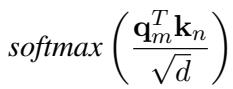
Because of the rotation property of complex numbers, this dot product results in a function that depends on \((m - n)\), the distance between the two words.
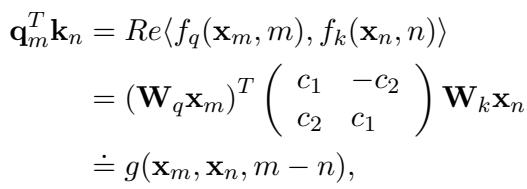
This mechanism is elegant and effective for the context lengths the model was trained on (e.g., 4096 tokens).
The Problem: Extrapolation and “The Stretch”
When we want to extend the context window (e.g., from 4k to 32k), we cannot simply rotate the vectors further—the model hasn’t seen those rotation angles during training. The popular solution, Position Interpolation (PI), involves “squishing” the longer sequence into the original rotation range. If you want to handle 4x the length, you rotate everything 4x slower.
Other methods like YaRN and LongRoPE use more sophisticated scaling factors to preserve high-frequency information. However, they all rely on predefining or searching for scaling factors.
Here is the catch: The search space for these factors is exponential. It is computationally impossible to find the perfect scaling factor. Consequently, researchers settle for “good enough” factors. But “good enough” results in a Phase Shift—a deviation where the encoded position slightly misses the optimal target.
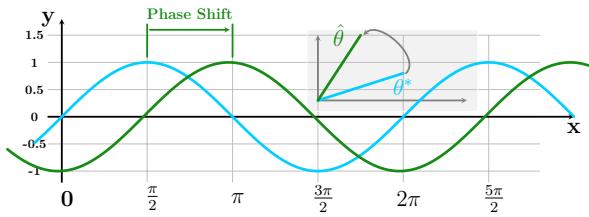
As shown in Figure 1 above, the blue line represents the optimal frequency (\(\theta^*\)), and the green line represents the actual frequency derived from our estimation methods. That horizontal gap is the phase shift. Over thousands of tokens, this small error compounds, confusing the model about where information is located.
Core Method: Phase Shift Calibration (PSC)
The authors of this paper propose a novel solution. Instead of trying to find the perfect frequency \(\theta^*\) (which is too expensive), let’s accept the imperfect frequency \(\hat{\theta}\) and add a small, learnable module to correct the error.
The Math of Calibration
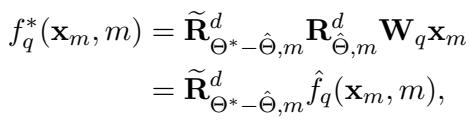
The researchers model the ideal query encoding \(f_q^*\) as a relationship between the optimal frequency and the estimated frequency.
If we assume there is an optimal frequency \(\theta^*\) that we missed, and we possess an estimated frequency \(\hat{\theta}\), the ideal encoding relates to our actual encoding by a rotation of the difference between them: \((\theta^* - \hat{\theta})\).
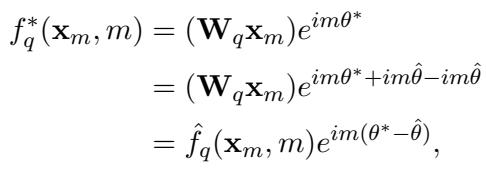
This equation reveals that the ideal embedding is just the actual embedding rotated by the error term \(e^{im(\theta^* - \hat{\theta})}\).
In matrix form, this correction looks like a block-diagonal rotation matrix. This matrix \(\tilde{\mathbf{R}}\) represents the “calibration” needed to snap the embeddings back into focus.
Why LoRA Isn’t Enough
A common technique for adapting LLMs is LoRA (Low-Rank Adaptation), which freezes the main model and trains small, low-rank matrices to adjust weights. You might ask: Can’t we just use LoRA to learn this correction?
The authors prove that LoRA is ill-suited for this specific task.
The correction matrix \(\tilde{\mathbf{R}}\) (the difference between the ideal and actual rotation) is a full-rank block diagonal matrix. If the estimated frequencies are even slightly off across all dimensions, the rank of the necessary correction matrix becomes very high (potentially equal to the number of attention heads). LoRA relies on the assumption that updates are low-rank. Therefore, LoRA struggles to approximate this high-rank rotary transformation efficiently.
The PSC Module Architecture
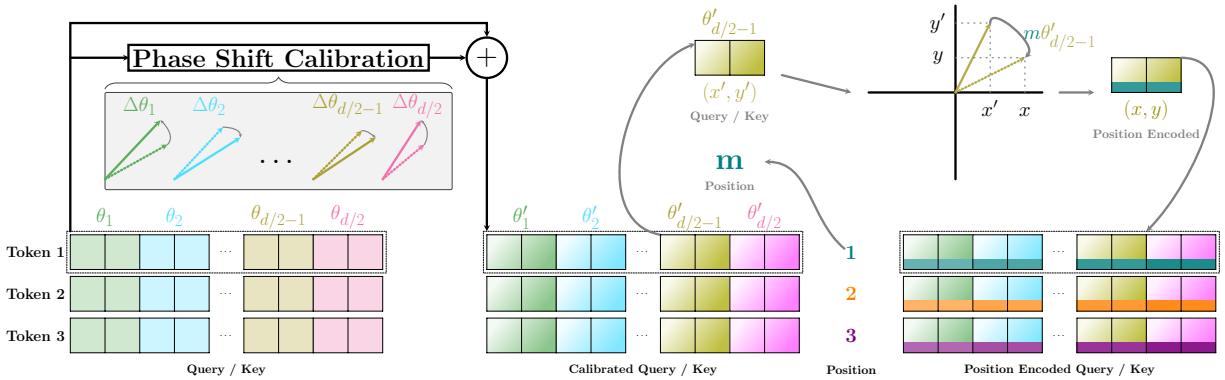
To solve this, the authors introduce the Phase Shift Calibration (PSC) module. It is designed specifically to learn this block-diagonal rotation.
The PSC module is a lightweight Multi-Layer Perceptron (MLP) injected into the attention mechanism. It operates on the embedding \(\mathbf{x}\).

Here, \(\mathbf{W}_1\) and \(\mathbf{W}_2\) are learnable block-diagonal matrices. This structure aligns perfectly with the block-wise nature of RoPE.
The architecture is visualized below in Figure 2. Notice how the PSC module sits parallel to the main path, calculating a shift that is added to the original embedding before (or after) the standard RoPE is applied.
Implementation
One of the strengths of PSC is its simplicity. It requires adding less than 1% additional parameters to the model. The algorithm calculates the calibration in the complex space (or block-diagonal equivalent) and adjusts the query and key vectors.
The authors found that Pre-calibration (applying PSC before the position encoding) works best. This is likely because position encoding introduces complex non-linear distortions; correcting the signal before it gets distorted is easier than fixing it afterward.
Experiments & Results
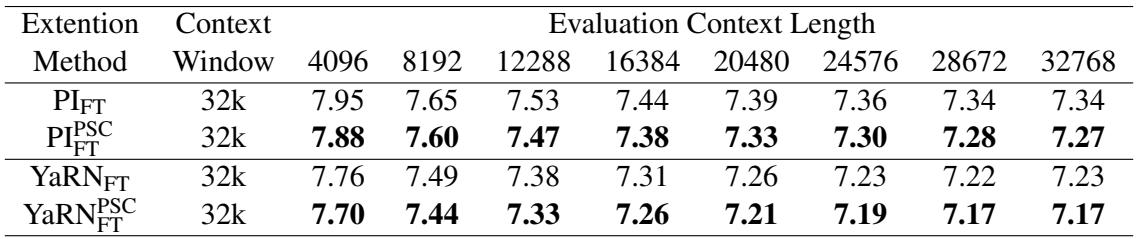
The researchers validated PSC on LLaMA-2 and Mistral models, testing context windows ranging from 16k to 64k tokens. They compared PSC against standard Position Interpolation (PI), YaRN, and LongRoPE.
1. Perplexity Improvement
Perplexity measures how surprised a model is by new text; lower is better.
In the table below (Table 1), look at the column for 16384 (16k) tokens.
- PIFT (Position Interpolation Fine-Tuned): 7.32
- LongRoPEFT: 7.26
- LongRoPE + PSC (LongRoPEPSCFT): 7.24
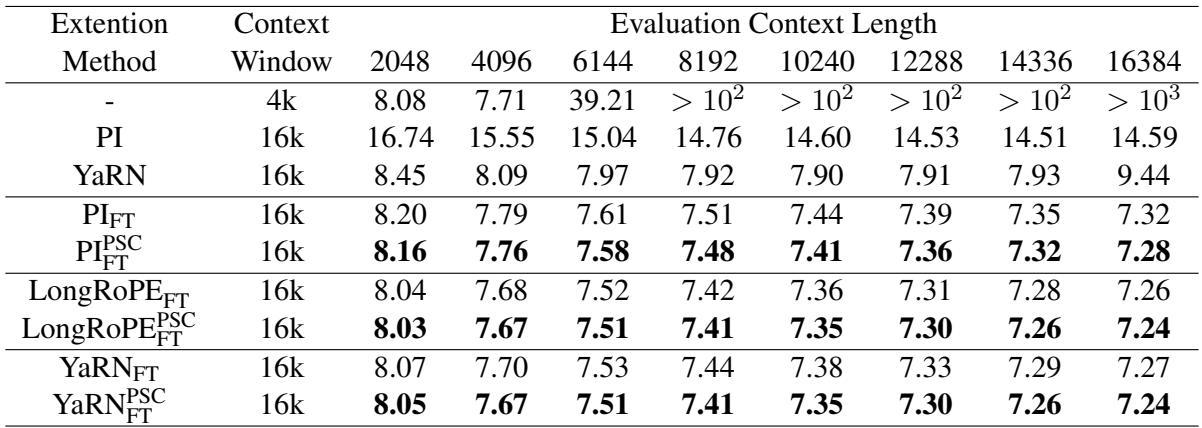
While the differences seem small numerically, in the world of LLMs, these marginal gains usually translate to significantly better stability. More importantly, notice that PSC improves every single method it touches. Whether you use PI, YaRN, or LongRoPE, adding PSC lowers the perplexity. It acts as a universal enhancer.
2. The Passkey Retrieval Test
This is the “needle in a haystack” test. The model is given a long text full of garbage data, with a random 5-digit passkey hidden somewhere inside. It is then asked, “What is the passkey?”
This test reveals if the model actually uses its context window or just gets confused by the length.
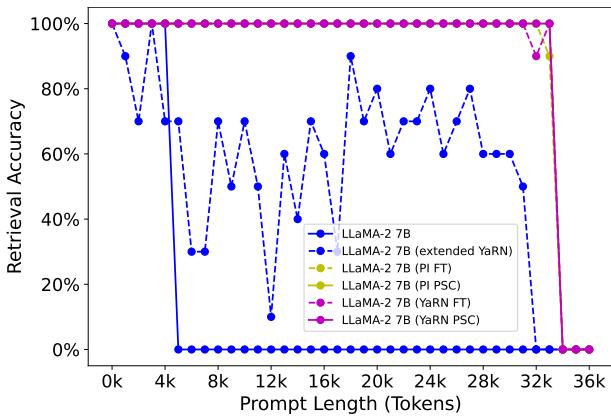
Figure 3 is the most compelling result in the paper.
- Blue line (Base LLaMA-2): Fails immediately after 4k tokens.
- Magenta line (YaRN FT): Performs well but crashes to 0% accuracy around 32k tokens.
- Pink line (YaRN + PSC): Maintains 100% accuracy all the way to 34k tokens.
The “Phase Shift” that usually causes models to degrade near the limit of their window is effectively neutralized by PSC, keeping the retrieval accuracy perfect for longer.
3. General Capabilities (Standard Benchmarks)
A common fear with context extension is “catastrophic forgetting”—that the model will get better at long texts but become stupid at short, standard tasks (like math or logic).
The authors tested PSC on the Hugging Face Open LLM Leaderboard (ARC, HellaSwag, MMLU, TruthfulQA).
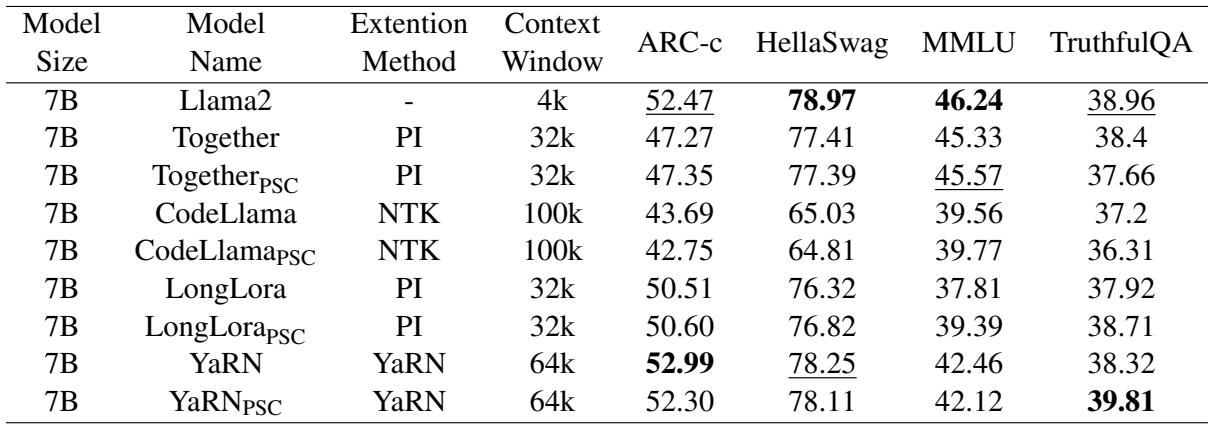
As shown in Table 5, models equipped with PSC (rows with subscript \(_{PSC}\)) perform comparably to, and sometimes better than, their non-PSC counterparts. For instance, YaRN\(_{PSC}\) achieves the highest score on TruthfulQA (39.81), beating the standard YaRN model. This confirms that calibrating the position frequencies does not hurt the model’s general reasoning abilities.
4. Efficiency
Does this new module bloat the model?
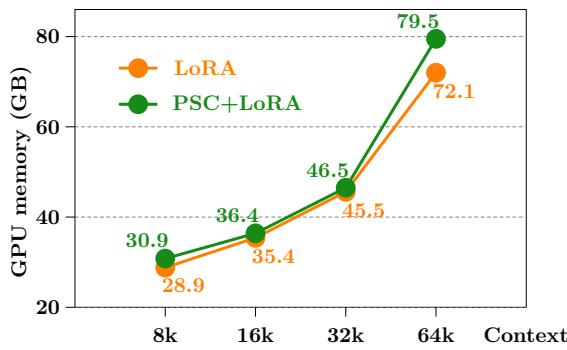
Figure 5 compares the GPU memory usage of standard LoRA (Orange) vs. PSC + LoRA (Green). The lines are nearly identical until the context becomes massive (64k), where PSC uses slightly more memory.
- Parameter Count: For LLaMA-2 7B, PSC adds only 64M parameters (0.095% of the total).
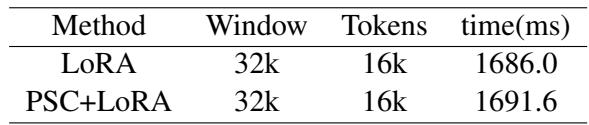
- Computational Overhead: The inference time increase is negligible (roughly 5ms difference on a 16k token input).
Conclusion & Implications
The paper “PSC: Extending Context Window of Large Language Models via Phase Shift Calibration” identifies a subtle but critical flaw in how we currently extend LLMs: the inaccuracy of frequency estimation.
By treating this inaccuracy as a “phase shift” and building a specific neural component to correct it, the authors offer a robust solution that:
- Enhances existing methods: It works on top of PI, YaRN, and LongRoPE.
- Solves the Rank Mismatch: It handles the full-rank rotary corrections that LoRA cannot efficienty learn.
- Is Parameter Efficient: It requires minimal compute and memory overhead.
For students and practitioners, this paper highlights an important lesson: sometimes, instead of searching for a perfect set of static hyperparameters (like frequency factors), it is more effective to build a system that can learn to correct itself. As we push towards infinite-context models, dynamic calibration mechanisms like PSC will likely become standard components in the Transformer architecture.