](https://deep-paper.org/en/paper/2505.12705/images/cover.png)
Introduction
In the field of robotics, data is the scarcest resource. While Large Language Models (LLMs) have consumed nearly the entire internet to learn how to write code and poetry, robots are stuck in a much slower loop: human teleoperation. To teach a robot to fold a shirt or pour coffee, a human operator usually has to manually guide the robot through the motion hundreds or thousands of times.
This reliance on manual data collection creates a massive bottleneck. If you train a robot to pick up a red apple in a lab, it often fails to pick up a green apple in a kitchen. To fix this, you traditionally need to collect more data in the kitchen. This lack of generalization is the “Sim2Real” and “Real2Real” gap that has plagued the field for decades.
But what if robots could learn from “dreams” instead of just physical practice?
A new research paper titled DREAMGEN proposes a pipeline that fundamentally shifts this paradigm. By leveraging state-of-the-art Video World Models—generative AI capable of creating realistic videos—researchers have found a way to generate synthetic training data that is high-quality, physically plausible, and diverse.
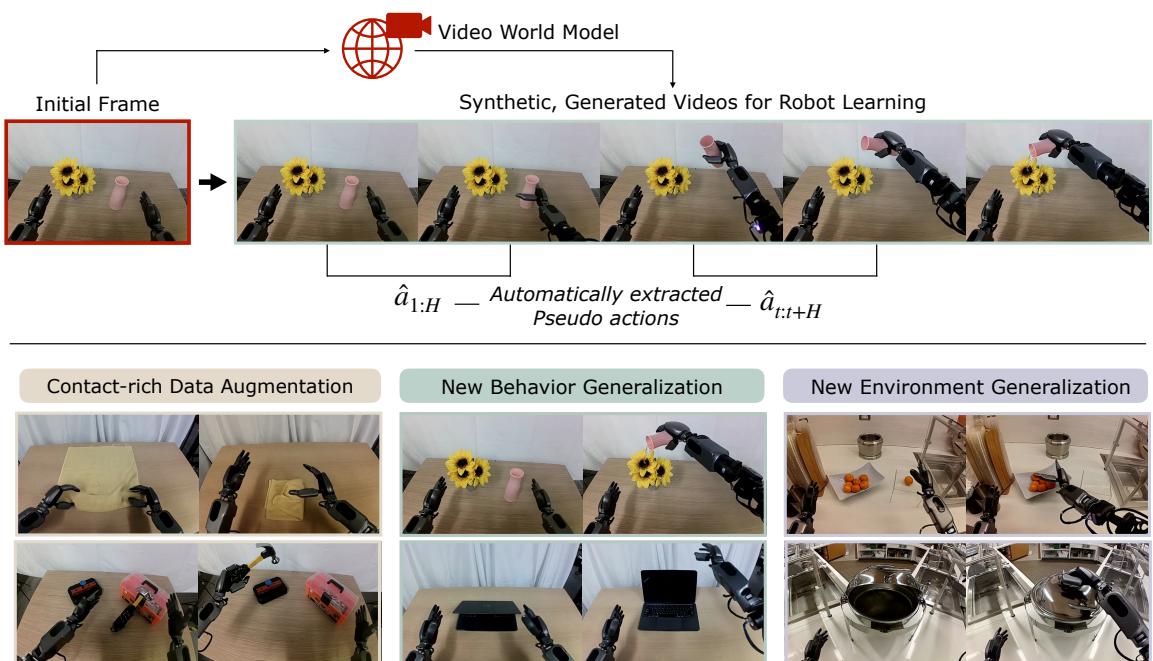
As illustrated in Figure 1 above, DREAMGEN allows a robot trained on a single boring task (pick-and-place) in a single room to suddenly perform complex, novel behaviors—like watering plants or arranging objects—in environments it has never seen before. This isn’t just a small incremental gain; it represents a zero-to-one capability in robot generalization.
In this deep dive, we will explore how DREAMGEN works, the architecture behind converting video “dreams” into physical actions, and the results that suggest we are entering a new era of scalable robot learning.
Background: The Data Bottleneck and World Models
To understand why DREAMGEN is significant, we first need to understand the current state of Robot Foundation Models. These are large neural networks trained on vast datasets of robot interactions (like the Open X-Embodiment dataset). While impressive, they are limited by the data they consume. If the dataset contains no examples of a robot opening a microwave, the model generally cannot figure out how to do it.
Parallel to robotics, the field of Computer Vision has seen an explosion in Video Generative Models (or Video World Models). Models like OpenAI’s Sora, or the open-source WAN and CogVideoX, have learned to generate incredibly realistic videos from text prompts. They understand lighting, texture, and, crucially, a fair amount of physics (e.g., if you drop a cup, it falls down).
The core insight of DREAMGEN is simple yet profound: Treat Video World Models not as planners, but as synthetic data generators. instead of using the video model to control the robot in real-time (which is slow and computationally expensive), we can use it offline to generate thousands of “dreamed” trajectories, label them, and teach the robot from this synthetic experience.
The DREAMGEN Pipeline
The DREAMGEN method is a 4-stage pipeline designed to bridge the gap between generative video and physical robot control. The researchers call the output of this pipeline “Neural Trajectories”—synthetic robot data generated by AI, for AI.
Let’s break down the four steps.
Step 1: Fine-tuning the Video World Model
Off-the-shelf video generators are trained on internet data (YouTube, movies, stock footage). They know what a human looks like, but they don’t necessarily understand the specific kinematics (movement constraints) of a specific robot, like the Fourier GR1 humanoid or a Franka Emika arm.
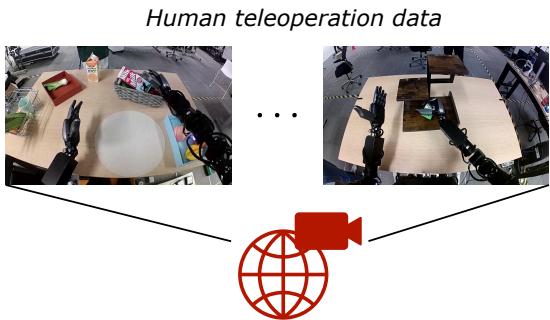
The first step is adaptation. The researchers take a pre-trained video world model (like WAN2.1) and fine-tune it using Low-Rank Adaptation (LoRA) on a dataset of the target robot. This teaches the model the “look and feel” of the robot—how its joints move and how it interacts with objects. Interestingly, they found that even with this fine-tuning, the model retains its “internet knowledge,” allowing it to imagine the robot in new environments it learned during pre-training.
Step 2: Rolling Out the World Model
Once the model understands the robot’s body, it’s time to generate data. This step acts as the “dreaming” phase.
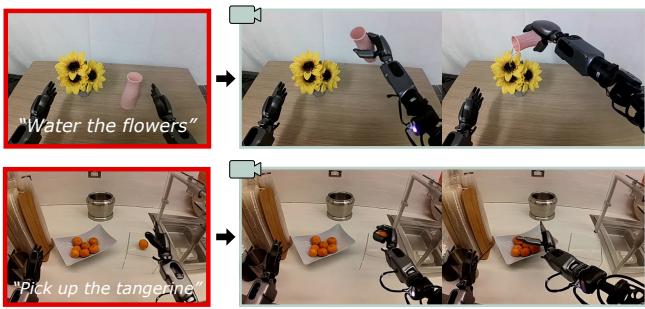
The system is provided with an initial image (the starting state of the world) and a text instruction (e.g., “Water the flowers” or “Pick up the tangerine”). The Video World Model then generates a video sequence—a “rollout”—depicting the robot performing that action.
This is where the magic of generalization happens. You can feed the model an initial frame of a kitchen it has never seen, or ask it to perform a verb (like “pour”) that wasn’t in the fine-tuning data. Because the underlying model has seen millions of pouring videos from the internet, it can synthesize a video of the robot pouring, even if the robot has never physically done it.
Step 3: Pseudo-Action Labeling
Here lies the hardest technical challenge. A video is just a sequence of pixels (\(H \times W \times T\)). A robot needs actions—specifically, joint angles, velocities, or end-effector positions (\(x, y, z, yaw, pitch, roll\)). Generative video models do not output motor commands.
To bridge this gap, DREAMGEN employs an Inverse Dynamics Model (IDM).
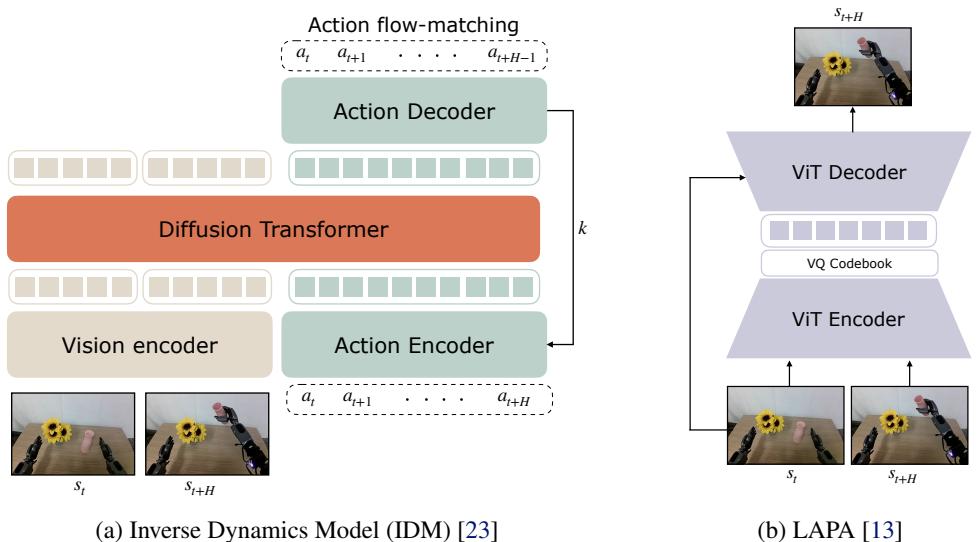
As shown in Figure 3(a) above, the IDM is a separate neural network. It takes two frames of video as input (current frame \(S_t\) and future frame \(S_{t+H}\)) and predicts the physical action \(a_t\) required to get from state \(A\) to state \(B\).
The researchers essentially “watch” the synthetic video generated in Step 2 and run the IDM over it to guess what motor commands the robot must have taken to produce that movement. This process labels the video with Pseudo-Actions.
Note: The authors also experimented with a Latent Action Model (LAPA), shown in Figure 3(b), which predicts actions in a compressed latent space rather than physical space, but the IDM approach was the primary driver for the physical experiments.

Step 4: Visuomotor Policy Training
Finally, we arrive at the standard robot learning phase. We now have a dataset of “Neural Trajectories”—pairs of video frames and the corresponding pseudo-actions derived in Step 3.
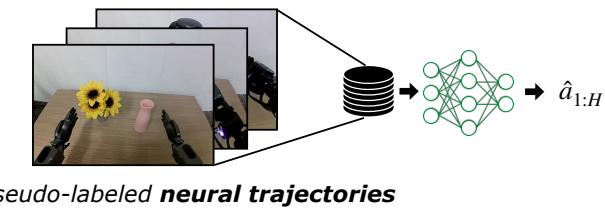
A Visuomotor Policy (the brain of the robot) is trained on this synthetic data. The policy learns to take an image from the robot’s camera and output the correct action. By training on thousands of these diverse, synthetic trajectories, the policy becomes robust and generalizable, capable of handling scenarios it never encountered in the real world.
Experiments and Key Results
The DREAMGEN pipeline was tested extensively in both simulation (RoboCasa) and on real-world hardware (GR1 Humanoid, Franka arm, SO-100). The results validate the hypothesis that synthetic video data can substitute for, and even surpass, manual data collection.
1. Data Augmentation and Scaling
In simulation, the researchers could rigorously test the “Scaling Laws” of neural trajectories. They compared training a robot on limited ground-truth data versus adding increasing amounts of synthetic data.
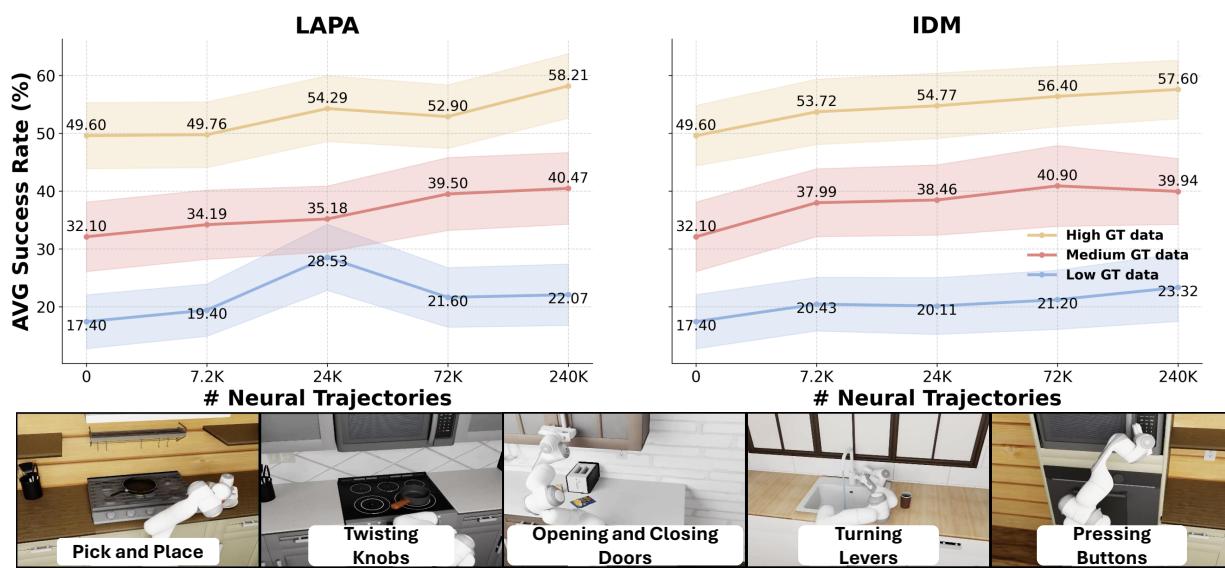
Figure 4 demonstrates a clear log-linear improvement. As the number of synthetic neural trajectories increases (x-axis), the success rate of the robot (y-axis) climbs steadily.
- Yellow Line (High Ground Truth): Even when you have plenty of real data, adding synthetic data boosts performance from ~50% to nearly 60%.
- Blue Line (Low Ground Truth): In data-scarce regimes, synthetic data provides critical support.
Most impressively, the researchers found that training solely on synthetic data (with zero real action labels in the policy training phase) achieved a 20.6% success rate, proving the high quality of the generated “dreams.”
2. Real-World Performance
Simulated results are promising, but real-world physics is unforgiving. The team tested the pipeline on tasks involving deformable objects (folding cloth), fluids (wiping tables), and precise tool use (hammering).
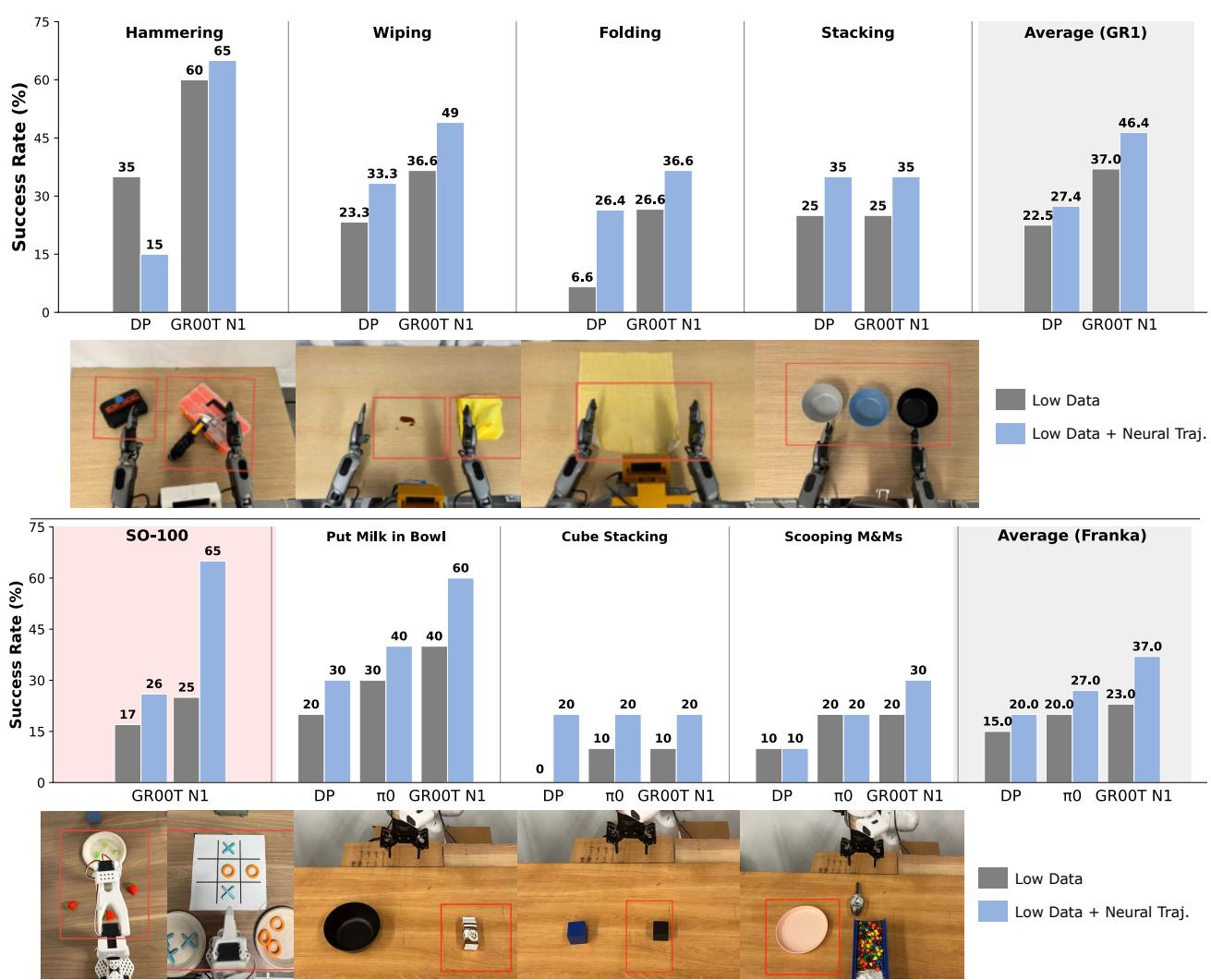
Figure 5 summarizes the real-world gains. The method was tested on three different robot embodiments:
- GR1 Humanoid: Tasks like hammering and folding saw success rates jump significantly. For example, on the “Folding” task, the baseline GR00T model achieved only 6.6% success. With DREAMGEN, it reached 36.6%.
- Franka Arm: Standard kitchen tasks saw similar improvements.
- SO-100: A low-cost arm performed complex tasks like “Tic-Tac-Toe,” jumping from 25% to 65% success.
These tasks are notoriously difficult to simulate using traditional physics engines (fluid dynamics and cloth are computationally heavy). Video World Models, however, handle these visuals naturally because they understand the visual dynamics of liquids and fabrics from their pre-training on internet videos.
3. The “Zero-to-One” Generalization
The most striking claim of the paper is the ability to generalize to completely new behaviors and environments.
Behavior Generalization: The researchers trained the video model on only pick-and-place data. They then prompted it with new text instructions like “Pour water” or “Open the laptop.”
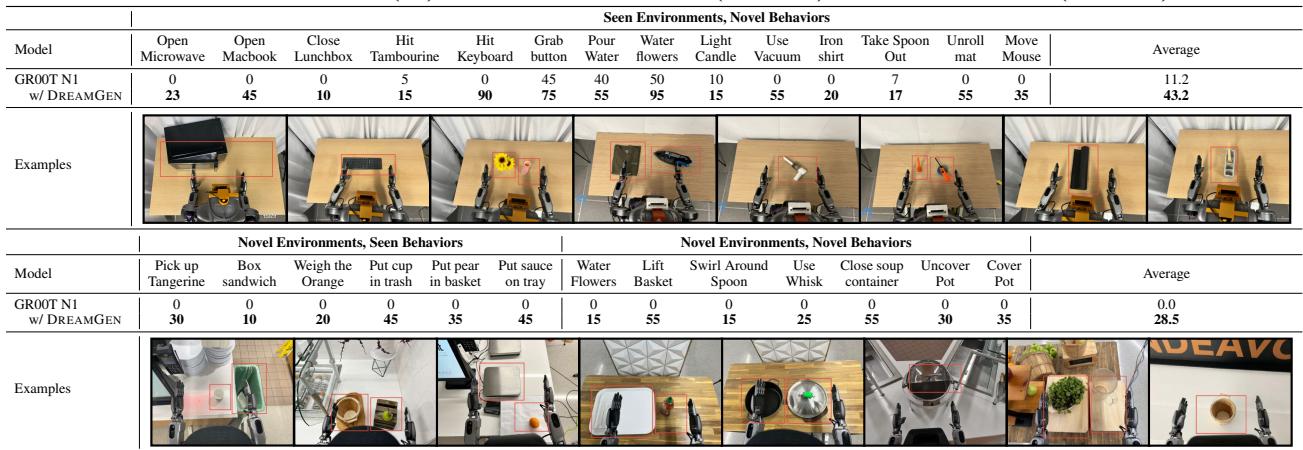
As Table 1 shows, the baseline model (trained only on pick-and-place) failed completely (0% success) on novel tasks like “Open Microwave” or “Uncover Pot.” However, the DREAMGEN-trained model achieved:
- 45% success on Opening a Macbook.
- 55% success on Using a Vacuum.
- 43.2% average success on novel behaviors.
This implies the Video World Model successfully transferred the concept of “opening” or “vacuuming” from human videos to the robot’s embodiment without explicit robot training data.
Environment Generalization: Similarly, by feeding the model a single photo of a new environment (Unseen Environment), the robot achieved a 28.5% success rate in completely new locations, compared to 0% for the baseline.
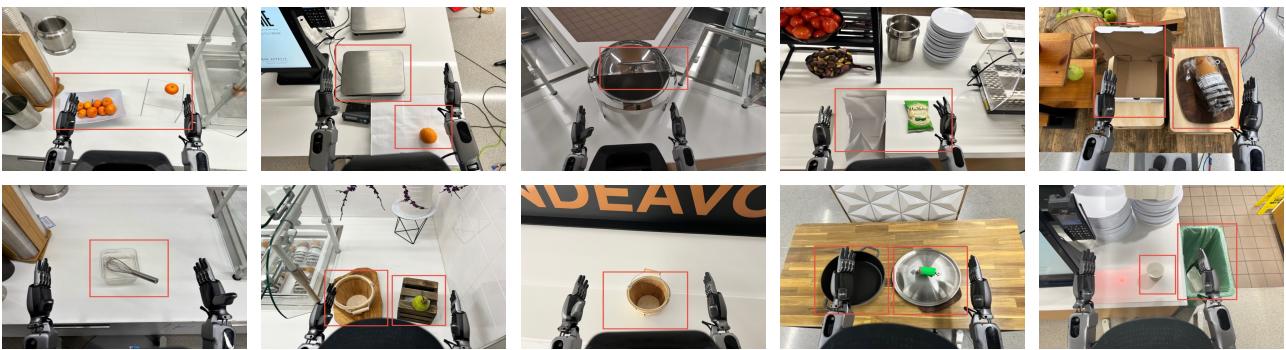
DREAMGEN BENCH: Benchmarking Video Models for Robotics
Recognizing that not all video models are created equal, the authors introduced DREAMGEN BENCH. This benchmark evaluates video models on two critical axes for robotics:
- Instruction Following (IF): Does the video actually show the robot doing what was asked?
- Physics Alignment (PA): Does the robot move in a physically possible way (no teleporting objects or passing hands through tables)?
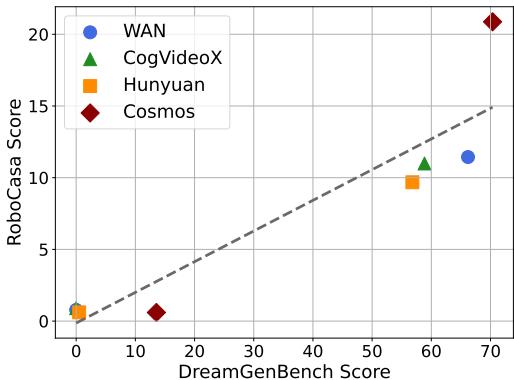
Figure 6 reveals a strong positive correlation between a video model’s score on this benchmark and the final success rate of the robot. This suggests that as the broader AI community builds better video generation models (like future versions of Sora or Cosmos), roboticists will get better robot policies “for free” simply by plugging in the better generator into the DREAMGEN pipeline.
Conclusion
DREAMGEN represents a pivotal shift in how we approach robot learning. Instead of asking “How do we collect more data?”, it asks “How do we synthesize better data?”.
By utilizing Video World Models as engines for synthetic experience, the researchers have demonstrated that robots can:
- Learn faster with less manual teleoperation.
- Master physics-rich tasks involving fluids and cloth.
- Generalize to completely new behaviors and environments that they have never physically encountered.
The implications are vast. If a robot can learn to “cook” by watching YouTube videos and dreaming about doing it itself, we are one step closer to general-purpose robots that can operate in the messy, unpredictable real world. The era of the “dreaming robot” has arrived, and it is powered by generative video.