](https://deep-paper.org/en/paper/2505.13441/images/cover.png)
Introduction
Imagine handing a kitchen knife to a friend. You instinctively grasp the blade or the spine carefully, offering the handle to them. Now, imagine you are about to chop carrots. You firmly grip the handle. Finally, imagine you are washing the knife; you might hold it by the very tip of the handle to reach the soapy sponge to the blade.
It is the same object—a knife—but the way you hold it changes drastically based on your intent.
In robotics, this is the core problem of Task-Oriented Grasping (TOG). For years, robotic grasping focused primarily on stability: finding a grip that ensures the object doesn’t slip or fall. While stability is a prerequisite, it isn’t enough for useful manipulation. If a robot grabs a mug by its opening, it can’t pour liquid into it. If it grabs a spray bottle by the nozzle, it can’t press the trigger.
While humans effortlessly map language instructions (“pour me some tea”) to physical affordances (grasping the handle), robots struggle with this semantic gap. Existing datasets are often too small, too simple, or rely on restrictive setups like pre-segmented point clouds.
Enter GraspMolmo, a new approach from researchers at the Allen Institute for AI (PRIOR) and collaborators. This paper introduces a pipeline that leverages the semantic reasoning of Large Vision-Language Models (VLMs) and grounds it in physical actions. Central to this work is the creation of PRISM, a massive synthetic dataset that teaches robots not just how to hold things, but why.

In this post, we will tear down the GraspMolmo paper, exploring how synthetic data can solve real-world semantic problems, how to bridge the gap between language and geometry, and how this model achieves state-of-the-art results in robotic manipulation.
The Background: Why Stability isn’t Enough
To understand the significance of GraspMolmo, we first need to look at the landscape of robotic grasping.
Object-Centric vs. Task-Oriented
Most grasping methods are object-centric. They look at a screwdriver and calculate a clamp point that aligns with the center of mass or a flat surface. This is great for “bin picking” (moving items from box A to box B), but it fails in messy, unstructured home environments where the robot is an assistant, not just a mover.
Task-Oriented Grasping (TOG) asks a follow-up question: “What are we doing with this object?” This requires understanding affordances—the functional properties of an object (e.g., a handle affords lifting, a button affords pressing).
The Data Bottleneck
The biggest hurdle in TOG has been data. Training a neural network requires thousands of examples. In previous works, datasets like TaskGrasp provided some benchmarks, but they suffered from:
- Simplicity: Instructions were often rigid templates like “grasp [noun] to [verb].”
- Lack of Realism: Scenes were simple, lacking the clutter and lighting variations of the real world.
- Sensor Dependency: Many models relied on fused point clouds (3D data), which are computationally heavy and prone to noise, rather than working directly from standard RGB-D camera images.
GraspMolmo addresses these issues by fundamentally changing how the data is generated and how the model learns.
The Core Method: PRISM and GraspMolmo
The researchers’ solution is a two-part system. First, they built a massive data engine called PRISM (Purpose-driven Robotic Interaction in Scene Manipulation). Second, they used this data to fine-tune a state-of-the-art Vision-Language Model called Molmo.
1. PRISM: Generating Synthetic Data at Scale
The key insight of this paper is that collecting human annotations for every possible combination of Object, Task, and Grasp is mathematically impossible. If you have thousands of objects and thousands of potential tasks, the combinations explode into the millions.
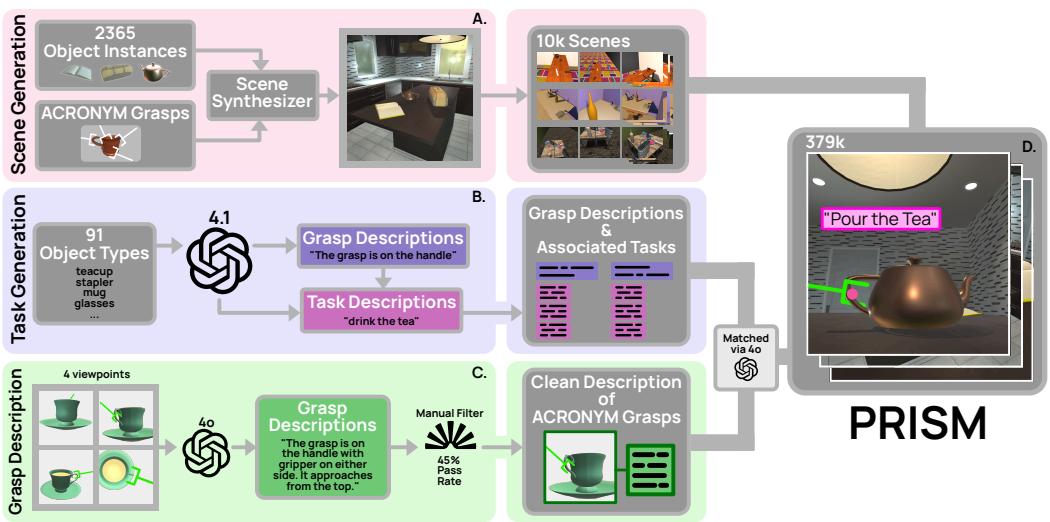
Instead of manual annotation, the authors devised a procedural pipeline to generate synthetic data. As shown in the figure below, the process moves from generating scenes to generating tasks, and finally matching them together.
Step A: The Scene Engine
The team started with 3D assets from ShapeNet-Sem, covering 91 object classes (like mugs, knives, pans, and tools). Using a tool called SceneSynthesizer, they procedurally generated 10,000 unique scenes.
Crucially, they didn’t just drop objects on a table. They randomized everything:
- Lighting: Intensity, color temperature, and shadows.
- Camera Angles: 10 distinct viewpoints per scene to simulate how a robot might approach a table from different heights or angles.
- Clutter: Objects are surrounded by “distractors”—items that aren’t part of the task but make the scene realistic and challenging.
Step B & C: The Semantic Bridge
This is the most innovative part of the methodology. How do you label hundreds of thousands of grasps with natural language tasks without hiring an army of annotators?
The authors used Grasp Descriptions as a bridge.
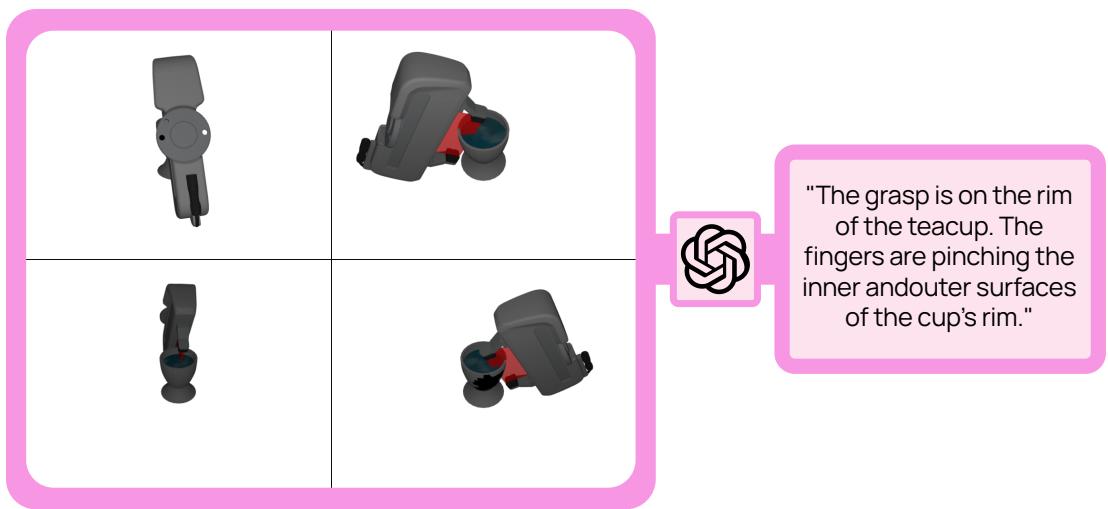
- From Objects to Descriptions: They used the ACRONYM dataset, which contains mathematically stable grasps for 3D meshes. They fed images of these grasps to GPT-4o and asked it to describe the grasp physically. For example: “The grasp is on the rim of the teacup. The fingers are pinching the inner and outer surfaces.” (See Figure below).
From Tasks to Descriptions: Separately, they asked an LLM (Large Language Model) to generate tasks for specific objects. For a mug, it might generate “pour coffee” or “hand it over.” The LLM was then asked: “How should the object be grasped for this task?” The LLM generates a description of the required grasp.
Matching: Finally, they used GPT-4o to match the Task Description to the Physical Grasp Description.
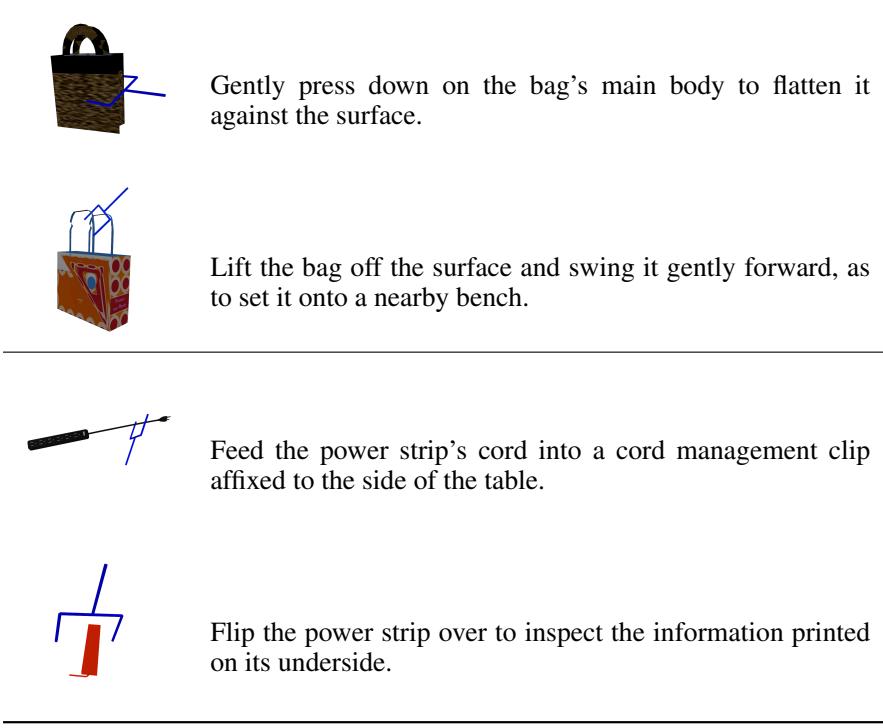
By decoupling the task from the geometry and using language as the connector, they reduced the complexity of the problem significantly. This process allowed them to generate 379,000 samples spanning diverse, natural language instructions like “mince some garlic” rather than just “grasp knife.”
Improving Diversity: Cross-Instance Sampling
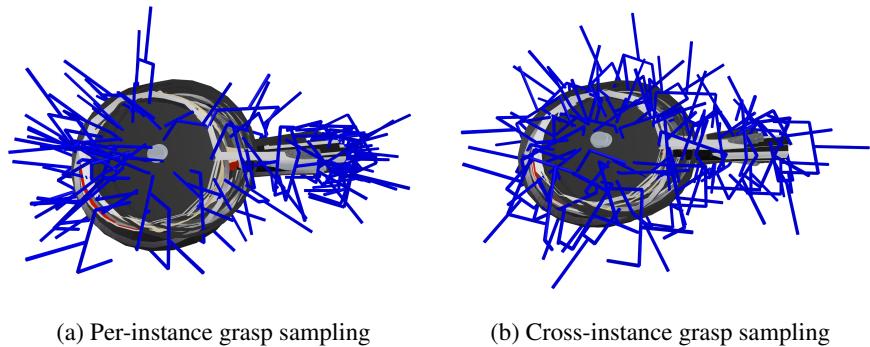
A subtle but important detail in their data generation is how they selected grasps. If you just pick the most stable grasps for a specific mug, they might all cluster around the handle. If you do this for every mug, your model overfits to specific handle shapes.
The authors introduced Cross-Instance Grasp Sampling. They aligned similar objects (e.g., all drills) and sampled grasps that covered the entire geometry of the class of objects, not just the specific instance. This ensures the dataset includes diverse grasps—some on the handle, some on the battery pack, some on the barrel—providing the variety needed for different tasks.
2. The Model: Fine-Tuning Molmo
With the PRISM dataset in hand, the researchers turned to the model architecture. They chose Molmo, an open-weight Vision-Language Model (VLM). VLMs are pre-trained on vast amounts of internet data, giving them a strong baseline understanding of objects (identifying a “mug” vs. a “bowl”).
However, standard VLMs don’t know how to grasp. The researchers fine-tuned Molmo on a mixture of:
- PRISM-Train: The synthetic dataset they created.
- TaskGrasp-Image: Real-world images from the older dataset, converted to RGB-D.
- General VLM Data: To prevent the model from forgetting general knowledge (catastrophic forgetting).
The Mechanism: Pointing to Affordances
GraspMolmo does not output a motor command directly. Instead, it treats grasping as a pointing problem.
- Input: An RGB image and a text instruction (e.g., “Take the flowers out of the vase”).
- Processing: The VLM processes the scene and the text.
- Output: The model predicts a specific 2D pixel coordinate on the image corresponding to the ideal grasp point.
From Pixels to 6-DoF Grasps
A 2D point on an image isn’t enough for a robot arm; the robot needs a 6-Degree-of-Freedom (6-DoF) pose (x, y, z position plus rotation).
To bridge this, the system uses a separate Grasp Proposal Network (a standard stable grasp generator).
- The generator proposes many stable grasps for the objects in the scene.
- These 3D grasps are projected onto the 2D image plane.
- The system selects the candidate grasp that is geometrically closest to the 2D point predicted by GraspMolmo.
This hybrid approach allows GraspMolmo to focus on the semantics (where should I grab?) while leveraging established methods for the geometry (is this grip stable?).
Experiments and Results
The evaluation of GraspMolmo was rigorous, testing the model in simulation, against existing benchmarks, and crucially, on real physical robots.
1. Simulation Benchmarks
The authors created a new evaluation set called PRISM-Test. This set includes objects and classes that were never seen during training. This tests true generalization—can the robot understand how to hold a “pitcher” even if it was only trained on “mugs”?
The results showed a massive gap in performance. On the challenging PRISM-Test, GraspMolmo achieved a 62.5% success rate, while the next best baseline (GraspGPT) only managed 40.0%.
2. Real-World Transfer
Simulation results are promising, but the “sim-to-real” gap is notorious in robotics. Synthetically rendered images rarely look exactly like real camera feeds.
The researchers deployed GraspMolmo on a Franka FR3 robot arm in a realistic home setting. They set up scenarios like a kitchen counter with a French press, a knife, and mugs.
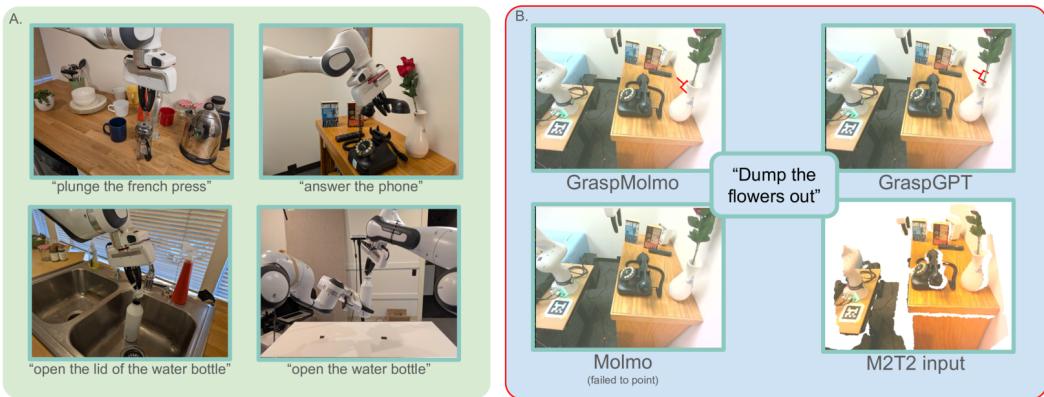
The quantitative results were striking:
- Prediction Success: 70.4% (GraspMolmo) vs. 35.2% (GraspGPT).
- Execution Success: 61.1% (GraspMolmo) vs. 24.1% (GraspGPT).
A specific qualitative example highlights the difference. In the task “Dump the flowers out,” the robot needs to grasp the vase by the bottom to flip it over.
- GraspMolmo: Correctly targeted the bottom of the vase.
- GraspGPT: Grasped the flowers themselves (semantically wrong).
- Molmo (Base): Failed to point to a coherent object.
3. The Correlation Discovery
One of the paper’s interesting scientific contributions is the analysis of benchmarks. The authors plotted the performance of models on the synthetic PRISM-Test against their performance in the real world.
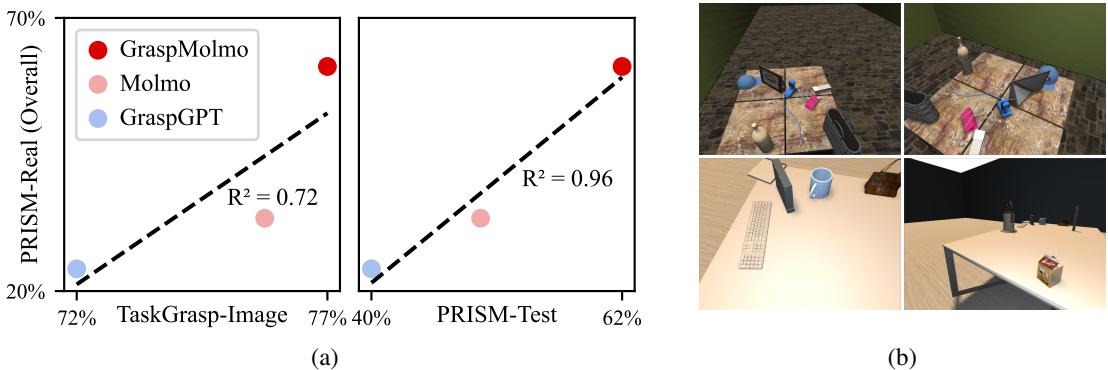
As shown in the graph above (right side), performance on PRISM-Test correlates almost perfectly (\(R^2=0.96\)) with real-world success. In contrast, the older TaskGrasp benchmark (left side) was a poor predictor of real-world utility. This validates PRISM not just as a training set, but as a reliable benchmark for future research.
4. Zero-Shot Bimanual Grasping
In a “one more thing” style reveal, the authors showed that GraspMolmo allows for zero-shot bimanual grasping. This means using two hands to perform a task, like unscrewing a bottle cap.
Although the model was trained on single-arm grasps, its semantic understanding allows it to answer prompts for the left and right arms separately. For example, given the instruction “open the bottle,” the system can identify that one hand should hold the bottle body (stability) and the other should twist the cap (manipulation). This capability emerged naturally from the model’s training without explicit bimanual data.
Conclusion and Implications
GraspMolmo represents a significant step forward in making robots useful partners in human environments. By moving away from purely geometric stability and embracing semantic understanding, robots can begin to interpret vague human commands like “make me a salad” or “clean this up.”
The success of this work relies heavily on PRISM. It proves that high-quality, large-scale synthetic data can bridge the gap to reality if the diversity is high enough. The “Sim-to-Real” transfer wasn’t achieved by making the simulation photorealistic pixel-perfect, but by making the semantics and variations rich enough that the real world just looked like another variation of the training data.
Key Takeaways:
- Context Matters: A stable grasp is not always a correct grasp.
- Synthetic Scale: Procedural generation + LLMs can create training data at a scale impossible for human annotators.
- VLM Grounding: Fine-tuning Vision-Language Models to output 2D points is an effective way to ground language in physical actions.
- Better Benchmarks: PRISM-Test provides a much more accurate forecast of real-world robot performance than previous standards.
As the authors release the PRISM dataset and the GraspMolmo code, we can expect a new wave of research that pushes robots further away from rigid, pre-programmed factories and closer to the messy, open-ended reality of our homes.